

 English
 Español
 Deutsch
 中文简体
中文简体

Product Consultation
Your email address will not be published. Required fields are marked *
Europe's Solar and Energy Storage Transition: Transforming the Power System Infrastructure for a Renewable Future
Jul 10,2026
Power Systems Are Becoming “Real-Time Systems”: Why Data Is More Critical Than Electricity
Jul 06,2026
New EPBD Regulations Drive HVAC Energy Transparency and Boost Demand for Smart Meters
Jul 07,2026Content
In modern electrical distribution, measurement equipment is expected to do more than display voltage and current. Facility managers, system integrators, panel builders, energy consultants, and industrial users increasingly need compact instruments that combine accurate power analysis, flexible current sensing, reliable communication, straightforward installation, and long-term stability. The 96x96 panel-mounted multi-function power analyzer with direct Rogowski coil input is designed for exactly this environment. It provides multi-parameter measurement for three-phase AC systems, supports 3P3W and 3P4W applications, communicates through RS485 Modbus RTU, and can measure high primary currents up to 5 kA when matched with suitable Rogowski coils.
This product is especially valuable where high-current measurement must be achieved without the weight, size, and installation complexity often associated with traditional current transformers. By accepting Rogowski coil input directly, the analyzer reduces the need for additional integrator modules, simplifies cabinet layout, and helps lower total system cost. Its 96x96 mm format makes it suitable for standard panel mounting, while its backlit LCD display, bar graph indication, pulse output, and broad electrical measurement range make it practical for industrial, commercial, and energy management applications.
The instrument is not only a measuring device but also part of a broader energy measurement solution. It reflects the technical direction of advanced smart metering: flexible sensing, digital communication, compact construction, and standards-based performance. For users who need a reliable panel instrument for load monitoring, sub-metering, power quality observation, energy efficiency projects, or system integration, this Rogowski coil power analyzer offers a strong balance of functionality, cost efficiency, and engineering convenience.
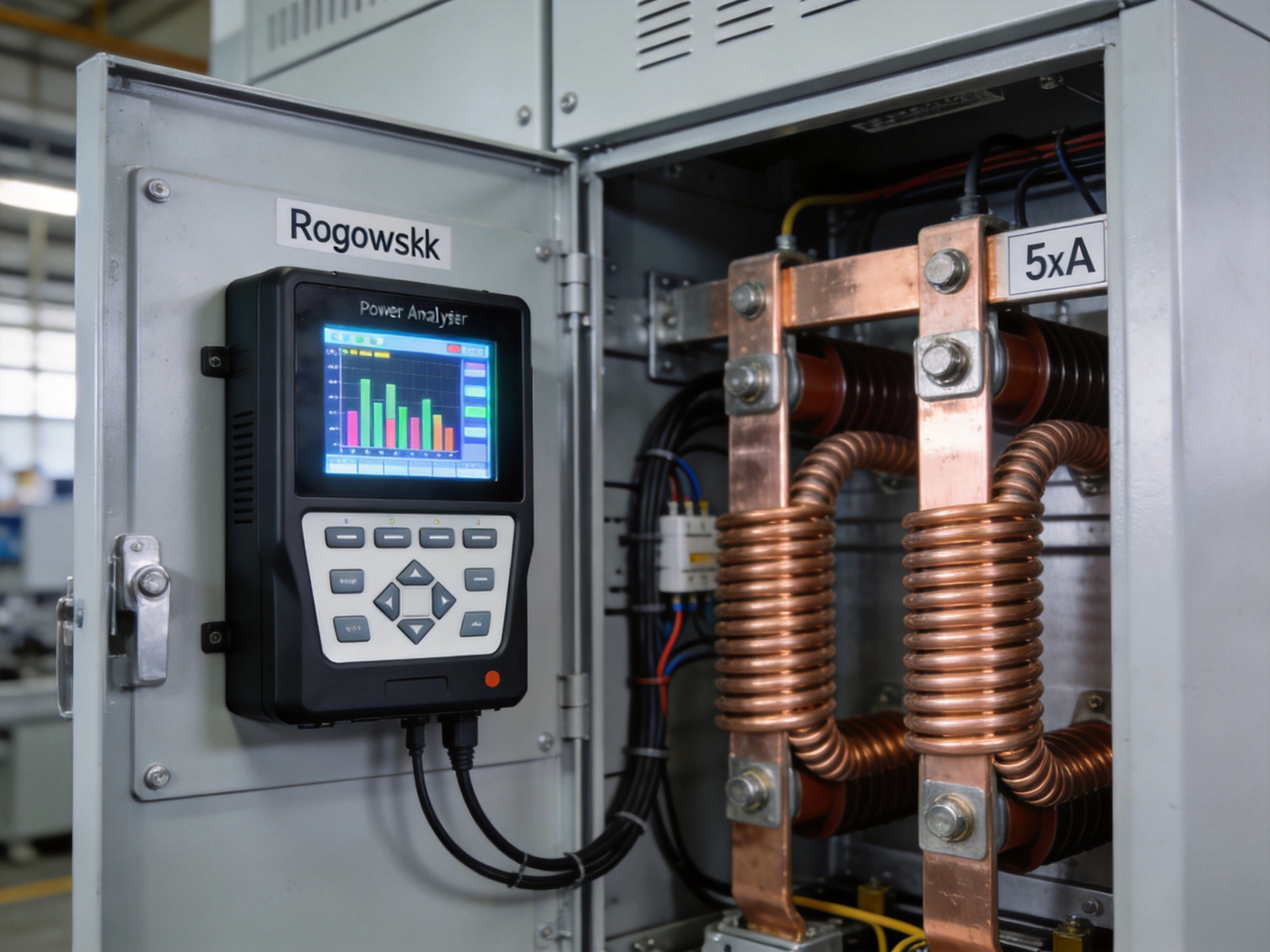
The product is a 96x96 panel-mounted multi-function power analyzer designed for three-phase AC measurement. It supports Rogowski coil current input and measures multiple parameters including voltage, current, frequency, active power, reactive power, apparent power, active energy, reactive energy, and power factor. It can display imported and exported energy, making it suitable for applications where bidirectional energy flow must be observed.
The analyzer supports both 3P3W and 3P4W electrical networks, which allows it to be used in a wide variety of distribution systems. The measured voltage range is 50 V to 600 V for 3P4W systems and 50 V to 480 V for 3P3W systems. Its auxiliary power supply supports 230 V L-N AC or 120 V to 380 V DC, providing flexibility in panel designs and control cabinets.
One of the product’s most important characteristics is its direct compatibility with Rogowski coils. The rated current input is specified as 85 mV/kA, and the maximum primary current can reach 1 kA or 5 kA depending on configuration. This makes the analyzer highly suitable for high-current distribution panels, busbar systems, main incomers, motor control centers, and industrial feeders where conventional current transformers may be difficult to install or costly to retrofit.
Communication is provided through an RS485 port using Modbus RTU. The communication type is two-wire half-duplex, with selectable baud rates of 2400, 4800, 9600, 19200, and 38400 bps. Device addresses can be set from 1 to 247, and parity can be configured as none, even, or odd. These settings allow the analyzer to be integrated into building management systems, energy monitoring platforms, PLC systems, SCADA networks, and data acquisition gateways.
The front display uses a backlit LCD designed for full viewing angles, helping operators read values clearly from different positions in front of the panel. A bar graph provides power indication at a glance, making it easier to identify load trends and system status without navigating complex menus. The product also supports pulse output, which is useful for energy counting, local monitoring, and integration with external control or logging devices.
The analyzer combines several features that are often separated across different devices. Instead of installing a meter, separate transducers, current integrators, and communication converters, users can install one compact panel instrument that performs multiple functions. This integrated approach is especially beneficial in space-constrained cabinets and retrofit projects.
Direct Rogowski coil connection is the central advantage. In many high-current installations, traditional current transformers require planned shutdowns, heavy cores, large mounting space, and careful selection of primary and secondary ratings. Rogowski coils, by contrast, are flexible, lightweight, and easy to install around existing conductors or busbars. Because this analyzer accepts Rogowski coil signals directly, the system does not require an additional external integrator in many cases. This reduces component count, wiring complexity, and potential points of failure.
The device measures a full range of electrical parameters, enabling users to observe not only current and voltage but also active power, reactive power, apparent power, frequency, energy, and power factor. This makes it suitable for energy audits, demand analysis, load balancing, power factor correction projects, and continuous monitoring of distribution circuits. In energy management, the ability to see multiple parameters from one device is essential because energy cost and power system health depend on more than kWh alone.
The RS485 Modbus RTU interface gives the product strong compatibility with industrial and commercial monitoring systems. Modbus RTU remains one of the most widely used protocols in electrical power monitoring because it is stable, easy to implement, and widely supported by gateways, PLCs, energy management software, and automation platforms. The analyzer’s adjustable baud rate, address range, parity, and stop bit configuration help it fit into existing networks with minimal engineering effort.
Installation is simplified by the 96x96 panel format, push-in installation, and plug-in connection concept. Panel builders can standardize cut-outs and wiring designs, while maintenance teams can replace or service instruments more efficiently. The self-extinguishing UL 94 V-0 meter case material contributes to safer panel construction, and the IP51 front display protection provides basic front-side protection suitable for many indoor panel environments.
Accuracy is also a major benefit. Active energy performance is specified according to IEC 62053-22 Class 0.5S and IEC 61557-12 Class 0.5S, while reactive energy performance is specified according to IEC 62053-23 Class 2 and IEC 61557-12 Class 2. Voltage and current measurement accuracy are listed as 0.5% of range maximum, and active, reactive, and apparent power accuracy are listed as 1.0% of range maximum. These specifications position the instrument as a capable analyzer for professional monitoring applications.
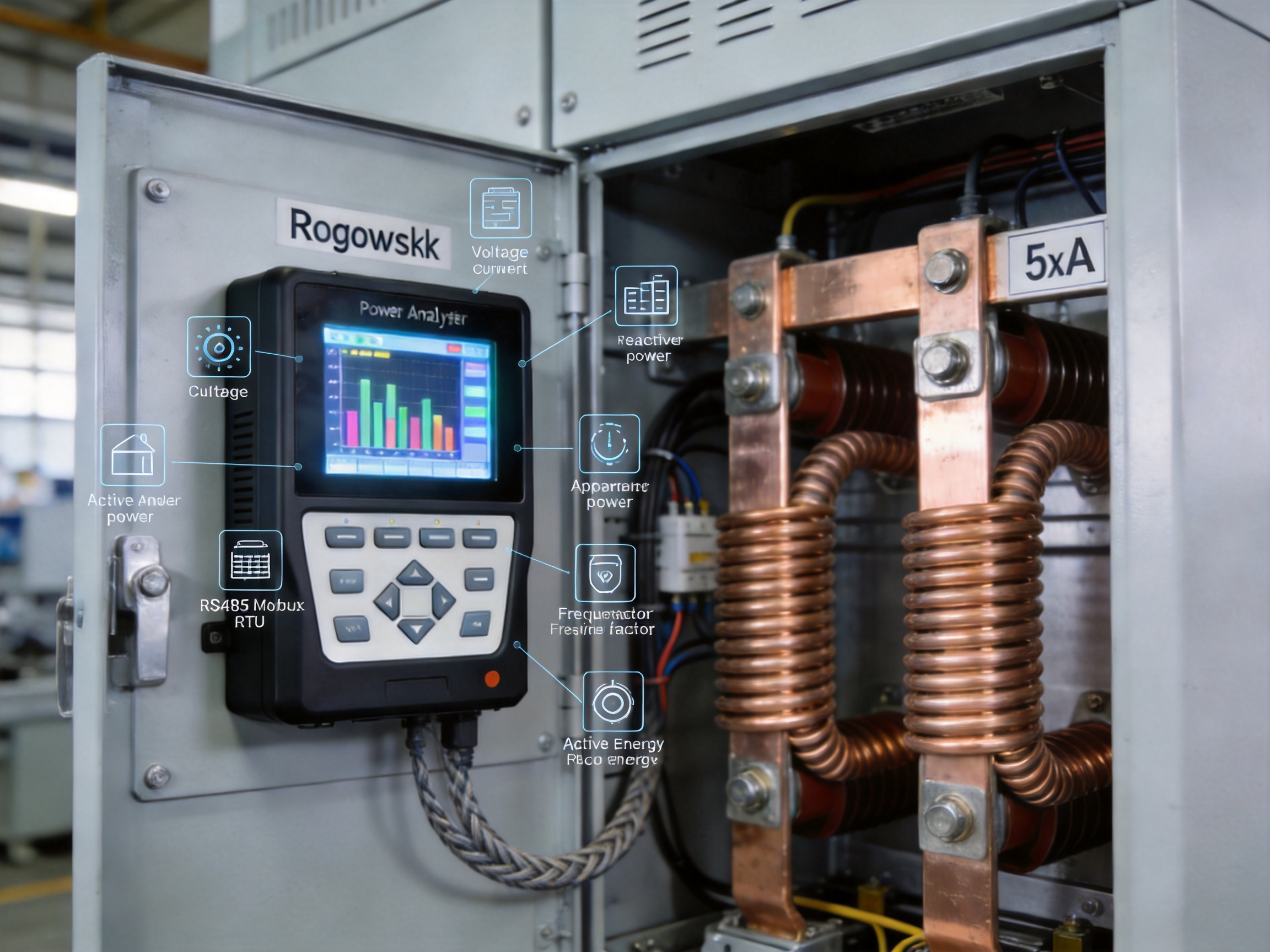
Rogowski coils have become increasingly important in modern electrical measurement because they solve practical problems found in conventional high-current sensing. A Rogowski coil is a flexible current sensor that produces a voltage proportional to the rate of change of current. Traditionally, this signal must be processed by an integrator before it can be used by a meter. Many competing systems therefore require three main components: the coil, the integrator, and the meter. Each additional component adds cost, panel space, wiring time, and troubleshooting requirements.
The direct Rogowski coil input design of this analyzer helps remove that extra layer of complexity. The meter is engineered to work with a wide range of Rogowski coils directly. This is particularly important for projects where cost control, installation speed, and cabinet space are critical. By reducing the need for separate integrators, the analyzer provides a simpler measurement chain and a cleaner panel design.
In retrofit projects, this advantage becomes even more obvious. Replacing or adding current transformers around existing busbars can be difficult, especially when the busbar arrangement is compact or the system cannot be easily dismantled. Flexible Rogowski coils can often be installed with less disruption. When the meter also accepts the coil signal directly, the retrofit process becomes faster and less invasive.
Compared with conventional current transformer solutions, Rogowski coils are generally lighter and less bulky. They are suitable for large conductors and busbars where rigid current transformers may be impractical. They also avoid some saturation limitations associated with iron-core current transformers, making them useful in applications with high dynamic range. For high-current monitoring up to 5 kA, this flexibility gives panel designers more freedom and allows energy monitoring to be extended to places where traditional metering would be expensive or physically difficult.
The product’s rated Rogowski input of 85 mV/kA and support for 1 kA or 5 kA maximum current enable it to serve a wide range of electrical distribution requirements. In commercial buildings, it can monitor main incoming supplies or large feeder circuits. In industrial plants, it can measure high-current loads, production lines, motor systems, and distribution boards. In energy management systems, it can provide accurate data for performance benchmarking and consumption analysis.
Many power analyzers on the market are designed primarily for conventional 1 A or 5 A current transformer inputs. While these products are familiar to engineers, they can be less convenient in high-current applications. A current transformer-based system may require careful CT selection, correct secondary wiring, shorting blocks, and adequate cabinet space. Installation mistakes can lead to measurement errors or safety risks, particularly if CT secondary circuits are opened under load.
By contrast, this Rogowski coil analyzer provides a safer and more flexible current measurement approach for many applications. Flexible coils are easier to route around conductors, and the absence of heavy magnetic cores reduces handling difficulty. The ability to connect coils directly to the meter reduces the number of accessories and creates a simpler bill of materials.
Another competitor limitation is display usability. Some compact meters provide only basic numerical screens or limited visibility under cabinet lighting conditions. This analyzer uses a backlit LCD display designed for full viewing angles, improving readability during commissioning and routine operation. The bar graph power indication adds a fast visual reference, allowing users to understand loading conditions immediately.
Communication flexibility is another competitive advantage. RS485 Modbus RTU is a practical standard for distributed metering. Some lower-cost meters may offer pulse output only, while some advanced meters may require more expensive communication modules. This analyzer provides Modbus RTU as a built-in function and also supports pulse output, giving users both digital network integration and simple energy pulse signaling.
The instrument also offers strong mechanical practicality. Its 96x96 mm size is familiar to panel builders, and its 70 mm depth helps fit into common panel layouts. The plug-in connection and push-in installation approach support efficient assembly and maintenance. Compared with systems that require separate signal conditioners or integrator boxes, this analyzer helps keep wiring organized and reduces panel clutter.
From a life-cycle perspective, fewer components can mean fewer installation errors, less maintenance, and easier troubleshooting. When a conventional Rogowski solution uses separate integrators, a technician must verify coil wiring, integrator power, integrator scaling, output wiring, and meter configuration. A direct-input analyzer simplifies this process. That simplicity is especially valuable in large metering projects where many points must be installed, commissioned, and maintained over time.
The following table summarizes major technical characteristics of the analyzer. These values are based on the provided product information and show why the device is suitable for professional energy measurement and power monitoring applications.
Category |
Specification |
Value or Description |
System Type |
Measurement Network |
Three-phase AC system, 3P3W and 3P4W |
Current Input |
Sensor Type |
Direct Rogowski coil input |
Current Input |
Rated Signal |
85 mV/kA |
Current Input |
Maximum Primary Current |
1 kA or 5 kA |
Voltage Input |
Measured Voltage for 3P4W |
50 V to 600 V |
Voltage Input |
Measured Voltage for 3P3W |
50 V to 480 V |
Power Supply |
Auxiliary Supply |
230 V L-N AC or 120 V to 380 V DC |
Communication |
Protocol |
RS485 Modbus RTU |
Communication |
Baud Rate |
2400, 4800, 9600, 19200, or 38400 bps |
Accuracy |
Active Energy |
IEC 62053-22 Class 0.5S and IEC 61557-12 Class 0.5S |
Accuracy |
Reactive Energy |
IEC 62053-23 Class 2 and IEC 61557-12 Class 2 |
Mechanical |
Dimensions |
96 x 96 x 70 mm |
Mechanical |
Weight |
420 g |
Environmental |
Operating Temperature |
-25°C to 55°C |
Environmental |
Storage Temperature |
-40°C to 70°C |
Good energy management depends on reliable measurement. The analyzer measures RMS values on three-phase AC systems and presents essential electrical parameters in a form that can be used locally or transmitted to supervisory systems. By measuring voltage, current, frequency, active power, reactive power, apparent power, power factor, active energy, and reactive energy, the device provides a broad picture of electrical performance.
Voltage and current measurements help operators confirm that feeders are operating within expected limits. Frequency monitoring supports basic supply condition observation. Active power shows the real power consumed by loads, while reactive power reveals the effect of inductive or capacitive loads on the electrical system. Apparent power helps users understand total capacity demand on transformers, switchgear, and cables. Power factor measurement supports power factor correction decisions and helps identify inefficient load behavior.
Active energy and reactive energy measurements are especially important for long-term analysis. Active energy data supports cost allocation, sub-metering, tenant billing support, production energy intensity studies, and energy-saving verification. Reactive energy data can help identify equipment that causes poor power factor and may contribute to utility penalties or system inefficiency.
The instrument’s Class 0.5S active energy performance according to IEC 62053-22 and IEC 61557-12 is valuable in professional monitoring applications. Class 0.5S is often preferred for sub-metering and energy management because it supports reliable energy data across a useful operating range. Although the product is not described here as a billing meter, its accuracy class supports serious measurement work in industrial and commercial environments.
Reactive energy measurement according to Class 2 standards also supports power factor and reactive load analysis. In many facilities, reactive power can be overlooked until it creates penalties, transformer loading issues, voltage drops, or unnecessary losses. By placing analyzers at important feeders, engineers can identify where corrective equipment or load adjustments may be needed.
A power analyzer must be useful both to digital systems and to people standing in front of the panel. The product’s backlit LCD display improves visibility in electrical rooms, distribution panels, and industrial cabinets. Full viewing angle design helps maintenance personnel read the screen without needing to stand directly in front of it, which can be important in crowded switchgear rooms.
The bar graph for power indication provides quick visual feedback. Numerical data is precise, but a bar graph helps operators understand load level immediately. During commissioning, load testing, or troubleshooting, this visual indication can reduce the time needed to determine whether a circuit is lightly loaded, approaching capacity, or behaving unexpectedly.
The compact 96x96 format is another operator-friendly feature. Many electrical panels are already designed around standard panel meter sizes, and 96x96 instruments are familiar to engineers worldwide. This makes the analyzer easy to specify in new designs and convenient to install as an upgrade in existing panel layouts.
Pulse output adds another layer of monitoring flexibility. Pulse signals can be used by energy counters, building systems, data loggers, or PLC inputs. In simple installations, pulse output may be enough for basic energy accumulation. In more advanced installations, pulse output can operate alongside Modbus communication, giving users both local pulse-based energy counting and detailed digital parameter access.

Modern power analyzers must communicate. Local display is useful, but the greatest value comes when measurement data is collected, stored, analyzed, and compared across time. The analyzer’s RS485 Modbus RTU communication makes it suitable for integration into many energy management and automation systems.
RS485 is well known for multi-drop communication, allowing multiple devices to share one communication bus when properly wired and addressed. Modbus RTU is simple, robust, and widely supported. This means the analyzer can be connected to gateways, PLCs, industrial computers, building management systems, and cloud-connected energy platforms through appropriate communication architecture.
The selectable baud rates from 2400 to 38400 bps allow the device to match the requirements of existing networks. Lower baud rates may be preferred for long cable runs or electrically noisy environments, while higher baud rates can improve data collection speed where network conditions permit. Address settings from 1 to 247 provide enough range for large metering networks. Configurable parity and stop bits help the analyzer fit into different communication standards already used on site.
In a practical energy monitoring system, multiple analyzers may be installed at main incomers, distribution boards, production line feeders, HVAC equipment, pumps, compressors, lighting panels, and renewable energy interfaces. Data can then be collected centrally to identify peak demand, abnormal consumption, phase imbalance, poor power factor, and changes in operating behavior. Because the analyzer provides both real-time power data and accumulated energy data, it supports both operational monitoring and management reporting.
For system integrators, Modbus RTU also reduces software complexity. Many SCADA and energy management platforms already include Modbus drivers. This makes mapping registers, collecting values, and creating dashboards more straightforward than using proprietary communication methods. As a result, integration time can be reduced, and long-term maintenance becomes easier.
Installation efficiency is one of the most important real-world advantages of this analyzer. Electrical panel projects often involve tight schedules, limited space, and the need for neat, reliable wiring. The combination of a 96x96 mm panel format, direct Rogowski coil input, push-in installation, and plug-in connection supports efficient panel assembly and commissioning.
The product dimensions are 96 x 96 x 70 mm, and its weight is approximately 420 g. This compact and manageable size helps it fit into panel doors or instrument sections without requiring excessive depth. The front display has an IP51 degree of protection, suitable for many protected indoor panel environments. The meter case material is self-extinguishing UL 94 V-0, supporting safer construction in electrical equipment.
When compared with systems using separate Rogowski integrators, the installation benefit is clear. A separate integrator needs mounting space, auxiliary power or signal arrangement, input wiring from coils, output wiring to the meter, scaling checks, and sometimes additional labeling. Removing this device from the system can reduce cabinet congestion and installation labor. In large projects with dozens or hundreds of metering points, this difference can become significant.
Direct Rogowski coil compatibility also supports easier field installation. Flexible coils can be routed around large busbars and conductors where solid current transformers may not fit. This is useful in retrofit energy monitoring, where existing switchgear may not have been designed with future metering in mind. Instead of rebuilding the cabinet around rigid sensors, engineers can add flexible coil measurement with less mechanical disruption.
The product’s measured voltage range also supports broad installation use. With 50 V to 600 V measurement in 3P4W systems and 50 V to 480 V measurement in 3P3W systems, the analyzer can be applied across many low-voltage distribution environments. The auxiliary supply options further support flexible cabinet power design.
Electrical meters and analyzers must remain reliable under real operating conditions. The analyzer is designed for an operating temperature range from -25°C to 55°C and a storage temperature range from -40°C to 70°C. This allows use in many industrial and commercial environments where temperature conditions may vary between seasons or cabinet locations.
The humidity rating is less than 95% relative humidity at 50°C, non-condensing. This supports use in environments where humidity can be elevated, provided condensation is avoided. The pollution degree is specified as 2, and altitude capability is listed at 3000 m. These values are relevant for engineers who must confirm suitability for installation conditions.
The front display protection of IP51 helps protect the panel-facing side against limited dust ingress and vertically falling water drops under defined conditions. While it is not a substitute for an enclosure suitable for harsh outdoor exposure, it provides appropriate protection for many panel-mounted indoor applications.
The use of self-extinguishing UL 94 V-0 material for the meter case is important because electrical panels must be designed with fire safety in mind. Components inside panels should not contribute unnecessarily to flame propagation. The specified material characteristic supports safer equipment design and reflects attention to mechanical and safety requirements.
The analyzer can be used in a wide range of applications where accurate three-phase monitoring and high-current measurement are required. In commercial buildings, it can monitor main distribution boards, tenant supplies, HVAC systems, elevators, lighting panels, and backup power circuits. Energy managers can use the data to understand consumption patterns, allocate costs, and identify opportunities for efficiency improvement.
In industrial facilities, the product can monitor production lines, large motors, compressors, pumps, furnaces, process equipment, and power distribution feeders. High-current capability up to 5 kA makes it suitable for large electrical loads and main incomers. With Modbus RTU communication, measurement data can be integrated into plant monitoring systems and used for maintenance, production efficiency analysis, or energy performance indicators.
In data centers and communication facilities, three-phase power monitoring is essential for capacity planning and reliability. The analyzer’s multi-parameter measurement can help operators track load levels, balance phases, and observe energy consumption. The compact format and flexible coil input can be useful in retrofit monitoring where existing panels are densely populated.
In renewable energy and distributed energy systems, bidirectional energy observation may be useful. The ability to display imported and exported energy supports monitoring where power flow direction can change. While system design must always consider the specific electrical architecture and regulatory requirements, the analyzer provides useful measurement functions for such applications.
Panel builders and system integrators can also benefit from standardizing on this type of instrument. Because it combines measurement, display, pulse output, and Modbus communication, it can serve many project requirements with one product family. This reduces engineering variation, simplifies documentation, and can improve installation consistency.
The value of a power analyzer depends not only on its design but also on the strength of the manufacturer behind it. Eastron Electronic Co., Ltd. is headquartered in Jiaxing, China, near Shanghai, Hangzhou, and Jiangsu. The company develops and produces electricity meters, power analyzers, current sensors, communication modules, and energy management systems. Its product range covers multiple areas of energy measurement, including electronic kWh meters, multi-function energy meters, MID energy meters, ETL energy meters, DC energy meters, current transformers, relays and switches, gateways, and system solutions.
One of the company’s strengths is its continuous investment in research and development. Its development teams in China and the United Kingdom contribute to new product design, embedded software, hardware engineering, and metering technology improvement. Cooperation with universities and technical institutions helps bring advanced technologies into product development. This R&D foundation is important for a product such as the Rogowski coil power analyzer because direct current sensor integration requires careful signal processing, accuracy control, and practical field usability.
The company has established a professional laboratory capable of performing EMC, LVD, accuracy, and environmental tests according to IEC, EN, GB, and UL standards. This testing capability helps ensure that products are evaluated for electromagnetic compatibility, low-voltage safety, measurement accuracy, and environmental durability. For electrical measurement instruments, such testing is essential because meters must operate reliably in panels where electrical noise, temperature variation, and installation differences can affect performance.
The manufacturer also follows the ISO 9001 quality management system, and its production is approved by SGS according to MID standards. These quality and production controls help create consistency from design to manufacturing. For customers, this means the product is supported by structured processes rather than informal assembly alone. In professional energy measurement, consistency is crucial because meters may be deployed across many sites and must perform predictably.
Patented technologies in software, embedded software, and hardware further strengthen the manufacturer’s position. Multi-function power analyzers depend heavily on embedded firmware, measurement algorithms, communication stability, display logic, and calibration processes. Strong intellectual property and engineering experience help improve product reliability and differentiation.
The company’s international service experience is also relevant. Its products and services have been supplied to more than 50 countries across Europe, Asia-Pacific, America, the Middle East, and Africa. Global deployment experience helps manufacturers understand different installation practices, electrical standards, user expectations, and environmental conditions. This experience contributes to product refinement and support capability.
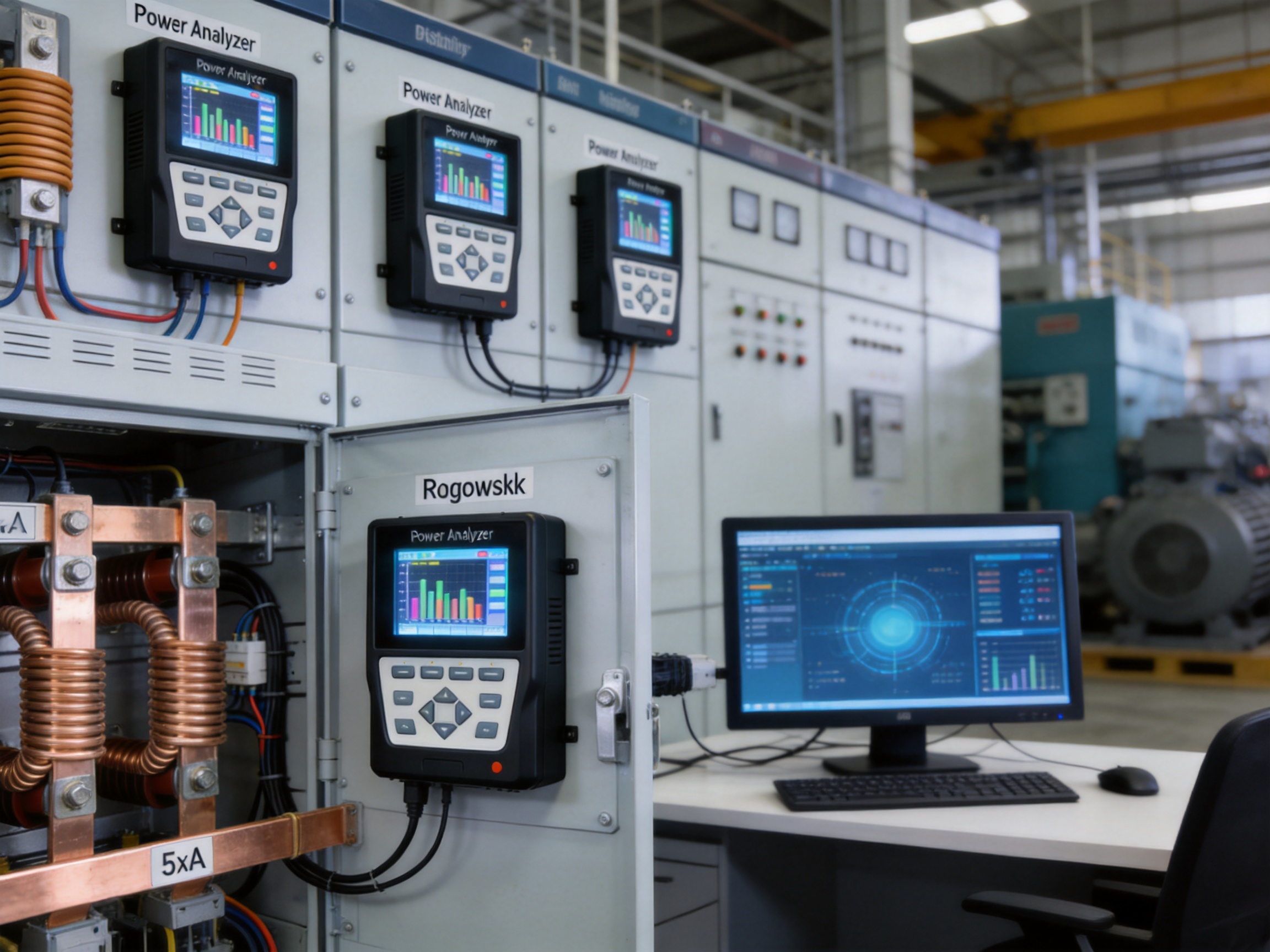
High-quality energy measurement products require disciplined manufacturing. The production of a multi-function analyzer involves electronic component selection, PCB assembly, firmware programming, calibration, functional testing, communication verification, enclosure assembly, and final inspection. Each stage affects the final performance of the instrument.
In advanced manufacturing, accuracy control begins with design and continues through calibration. Measurement circuits must be stable, low-noise, and suitable for the input signals they process. For a Rogowski coil analyzer, current signal processing is particularly important because the sensor output must be interpreted correctly over the expected operating range. Proper calibration ensures that voltage, current, power, and energy values meet specified accuracy requirements.
EMC testing is another essential process. Electrical panels can include contactors, drives, motors, switching power supplies, communication cables, and high-current busbars. These can create electromagnetic disturbance. A power analyzer must remain stable and accurate in such environments. Testing according to recognized standards helps verify that the product can resist interference and avoid creating unacceptable interference for other devices.
LVD-related safety testing supports safe operation under low-voltage electrical conditions. Insulation, creepage, clearance, enclosure material, terminal design, and power supply performance all contribute to safety. The use of shrouded screw-clamp terminals and self-extinguishing case material reflects attention to panel safety and practical installation.
Environmental testing helps confirm that instruments can operate across specified temperature and humidity conditions. Components expand, contract, and age differently under environmental stress. Testing supports confidence that the analyzer can maintain performance during real service life.
The company’s professional laboratory and standards-based testing capability provide an advantage over suppliers that rely only on external spot checks or limited in-house verification. For customers, this means faster product improvement, better control of quality feedback, and stronger technical support. For system integrators, it reduces risk when selecting devices for long-term deployment.
When evaluating a power analyzer, the purchase price of the meter is only one part of the total cost. Users must also consider current sensors, accessories, installation labor, wiring, panel space, commissioning time, communication setup, maintenance, and future troubleshooting. The direct Rogowski coil design provides cost advantages in several of these areas.
First, eliminating separate integrators can reduce hardware cost. In a traditional Rogowski measurement system, each metering point may require external integrator modules. If many circuits are monitored, these modules can represent a substantial cost. A direct-input analyzer helps simplify procurement and reduce accessory requirements.
Second, panel space has economic value. Electrical enclosures are expensive, and crowded panels are harder to build and maintain. Removing additional modules makes layouts cleaner and may reduce the need for larger enclosures. This benefit is especially important in retrofit work where panel space is already fixed.
Third, installation labor is reduced. Fewer devices mean fewer mounting operations, fewer wires, fewer labels, and fewer points to check during commissioning. In projects with multiple meters, labor savings can be significant. Clearer wiring also reduces the chance of mistakes.
Fourth, maintenance becomes easier. When measurement data appears incorrect, technicians must identify whether the issue is caused by the sensor, wiring, integrator, meter settings, communication, or load conditions. By simplifying the signal chain, the analyzer reduces diagnostic complexity.
Finally, the product’s multi-parameter measurement increases value because one device supports many monitoring objectives. Users can start with basic energy data and later use the same instrument for power factor studies, load analysis, or system integration. This future-ready functionality improves return on investment.
To apply the analyzer correctly, engineers should confirm the electrical system type, voltage range, current range, Rogowski coil compatibility, communication requirements, and installation environment. The product supports 3P3W and 3P4W systems, but the correct wiring configuration must be selected during installation and commissioning.
The Rogowski coil selection should match the expected current range and physical installation conditions. Since the analyzer supports rated current input of 85 mV/kA and maximum primary currents of 1 kA or 5 kA, the selected coils should be suitable for the system current and meter configuration. Coil placement around conductors must be correct to ensure accurate measurement.
Voltage connections must remain within the specified measurement range. For 3P4W systems, the measured voltage range is 50 V to 600 V; for 3P3W systems, it is 50 V to 480 V. Auxiliary power supply availability should also be checked. The analyzer supports 230 V L-N AC or 120 V to 380 V DC auxiliary supply.
For communication, network planning should include RS485 cable routing, termination strategy, device addresses, baud rate, parity, stop bits, and master system compatibility. Good RS485 wiring practice is essential for stable communication, particularly in electrically noisy environments or long cable runs.
Environmental conditions should be reviewed before installation. The analyzer is specified for operation from -25°C to 55°C and humidity below 95% RH at 50°C without condensation. If the installation environment is outdoors, dusty, wet, or corrosive, the surrounding enclosure must provide appropriate protection.
The main advantage is its direct Rogowski coil input. It can work with a wide range of Rogowski coils without requiring separate integrator modules in many applications. This reduces cost, saves panel space, simplifies wiring, and improves installation efficiency.
The analyzer supports three-phase AC systems, including 3P3W and 3P4W configurations. It is suitable for many low-voltage distribution applications in commercial and industrial environments.
It can measure voltage, current, frequency, active power, reactive power, apparent power, active energy, reactive energy, imported and exported energy, and power factor. These parameters support comprehensive energy monitoring and power analysis.
The analyzer supports primary current configurations up to 1 kA or 5 kA when used with suitable Rogowski coils. This makes it practical for high-current distribution panels and main feeder monitoring.
Yes. It includes RS485 Modbus RTU communication. It supports selectable baud rates, address settings from 1 to 247, parity configuration, and one or two stop bits, making it suitable for integration with many monitoring systems.
Active energy accuracy is specified according to IEC 62053-22 Class 0.5S and IEC 61557-12 Class 0.5S. Reactive energy is specified according to IEC 62053-23 Class 2 and IEC 61557-12 Class 2.
A Rogowski coil is flexible, lightweight, and easier to install around large conductors or busbars. It is especially useful in retrofit applications and high-current systems where rigid current transformers may be difficult to install.
Yes. Its direct Rogowski coil input and compact 96x96 panel-mounted design make it well suited for retrofit energy monitoring, especially where existing panels have limited space or large conductors.
The manufacturer has strong R&D capabilities, professional testing laboratories, ISO 9001 quality management, SGS-approved production according to MID standards, experience with IEC, EN, GB, and UL-related testing, and products supplied to more than 50 countries.
Yes. It is designed for operating temperatures from -25°C to 55°C, supports high-current measurement, offers Modbus communication, and provides multi-parameter monitoring needed in industrial power distribution and energy management.
The 96x96 panel-mounted multi-function power analyzer with direct Rogowski coil input is a practical and advanced solution for modern energy measurement. It combines high-current measurement capability, multi-parameter analysis, Modbus RTU communication, pulse output, a readable backlit LCD, and compact panel installation. Its ability to connect directly to Rogowski coils is a major competitive advantage because it reduces the need for external integrators, lowers installation complexity, saves space, and improves total system value.
For commercial buildings, industrial plants, data centers, panel builders, system integrators, and energy management projects, the analyzer offers a strong balance of performance and practicality. It supports 3P3W and 3P4W systems, measures active and reactive energy with recognized accuracy classes, and integrates easily into digital monitoring networks.
Behind the product is a manufacturer with broad experience in electricity metering, power analysis, current sensing, communication modules, and energy measurement systems. Strong R&D teams, professional laboratories, standards-based testing, patented technologies, ISO 9001 quality management, and international market experience all contribute to product reliability and competitiveness.
As electrical systems become more data-driven, compact and flexible analyzers like this one will play an increasingly important role. They help users understand where energy is consumed, how loads behave, and where efficiency improvements can be made. With direct Rogowski coil compatibility and comprehensive measurement capability, this product is well positioned for the next generation of smart energy monitoring.
International Electrotechnical Commission. IEC 62053-22: Electricity Metering Equipment, Particular Requirements for Static Meters for Active Energy, Classes 0.2S and 0.5S.
International Electrotechnical Commission. IEC 62053-23: Electricity Metering Equipment, Particular Requirements for Static Meters for Reactive Energy.
International Electrotechnical Commission. IEC 61557-12: Electrical Safety in Low Voltage Distribution Systems up to 1000 V AC and 1500 V DC, Performance Measuring and Monitoring Devices.
International Electrotechnical Commission. IEC 60529: Degrees of Protection Provided by Enclosures.
Underwriters Laboratories. UL 94: Tests for Flammability of Plastic Materials for Parts in Devices and Appliances.
ISO. ISO 9001: Quality Management Systems Requirements.
Modbus Organization. Modbus Application Protocol Specification.
Your email address will not be published. Required fields are marked *

We develop and produce high performance electricity meters, power analyzers, current sensors, communication modules and management systems. China Custom Smart Meters Manufacturers and Factory
Address:NO 52, Dongjin Road, Nanhu, Jiaxing, Zhejiang, China
Copyright @ Eastron Electronic Co., Ltd. All rights reserved Electricity Meters Manufacturers
