

 English
 Español
 Deutsch
 中文简体
中文简体

Product Consultation
Your email address will not be published. Required fields are marked *
Europe's Solar and Energy Storage Transition: Transforming the Power System Infrastructure for a Renewable Future
Jul 10,2026
Power Systems Are Becoming “Real-Time Systems”: Why Data Is More Critical Than Electricity
Jul 06,2026
New EPBD Regulations Drive HVAC Energy Transparency and Boost Demand for Smart Meters
Jul 07,2026Content
Modern electrical installations demand more than basic kWh readings. Facility managers, panel builders, energy consultants, OEM equipment manufacturers, and industrial maintenance teams increasingly need detailed visibility into voltage, current, power, power factor, energy flow, demand, harmonic distortion, and communication data. A panel-mounted multifunction power analyzer with RS485 Modbus RTU, pulse outputs, RJ12 current transformer connection, and advanced harmonic measurement provides a practical answer to these needs. The RJ CT Type RS485 Modbus Panel Mounted Multi-function Power Analyzer, model Smart X96-1A, is designed to combine installation efficiency, measurement depth, communication flexibility, and long-term operational reliability in one compact 96 mm panel instrument.
This article presents a detailed technical and application-focused overview of the analyzer, explaining why it is suitable for three-phase monitoring, distribution panels, energy efficiency projects, industrial control systems, building management, and system integration. It also discusses the manufacturing strengths behind the product, including laboratory testing capabilities, quality management, research and development resources, and production experience in electricity metering and energy measurement solutions.
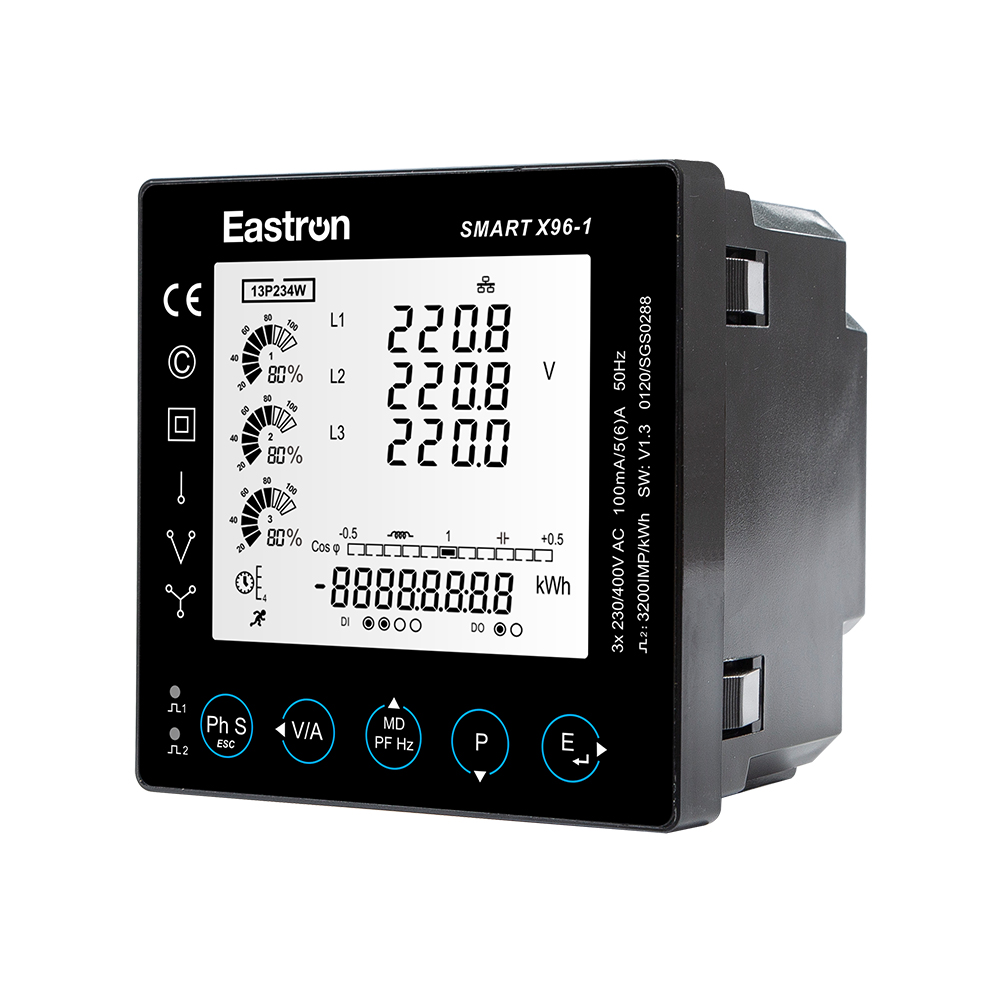
RJ CT Type RS485 Modbus Panel Mounted Multi-function Power Analyzer
The Smart X96-1A is a panel-mounted multifunction power analyzer for AC power systems. It supports three-phase three-wire and three-phase four-wire systems, and it is also suitable for single-phase two-wire measurement applications where required by the installation design. Its current input is based on a 100 mA CT connection, using RJ12 type current transformer wiring to simplify installation and improve wiring consistency.
The analyzer measures RMS values including harmonics on three-phase AC systems. It provides readings for voltage, current, frequency, active power, reactive power, apparent power, power factor, active energy, reactive energy, imported energy, exported energy, harmonic distortion, and maximum demand-related data. This makes it much more than a simple panel meter. It is a diagnostic instrument, an energy monitoring device, and a communication endpoint for energy management systems.
One of the defining characteristics of the product is its combination of high measurement capability and installation convenience. The analyzer is equipped with RS485 Modbus RTU communication for remote monitoring, while pulse outputs allow integration with traditional counting systems, PLC inputs, or data acquisition devices. The backlit LCD display provides clear on-site visibility, and the bar graph power indication gives operators a quick visual understanding of load levels.
The analyzer is designed for panel installation with a 96 mm by 96 mm front format and a depth of approximately 92 mm. This common panel meter size makes it suitable for electrical switchboards, distribution cabinets, control panels, generator panels, and energy monitoring enclosures. Push-in installation and plug-in connection features support faster assembly, reduced installation time, and more reliable field wiring.
Electrical systems are becoming more complex. Variable frequency drives, LED lighting systems, switched-mode power supplies, EV charging equipment, renewable energy inverters, and automated machinery can introduce harmonic distortion and rapidly changing load profiles. Measuring energy alone is often not enough to identify inefficiency, abnormal loading, phase imbalance, or power quality concerns.
A multifunction power analyzer gives users a broader view of electrical behavior. Voltage measurement helps detect under-voltage and over-voltage conditions. Current measurement helps identify overloads and imbalance. Active power and active energy show real consumption. Reactive power and power factor help users assess compensation needs and identify inefficient loads. Apparent power indicates the total burden placed on electrical infrastructure. Harmonic data helps diagnose waveform distortion that may cause heating, nuisance tripping, transformer stress, or equipment failure.
By measuring up to the 63rd harmonic, the analyzer provides deeper insight than many basic power meters that either do not measure harmonics or only provide limited total harmonic distortion data. This capability is particularly useful in modern industrial and commercial sites where nonlinear loads are common. Harmonic visibility can support maintenance planning, filter selection, power quality assessment, and compliance efforts.
The Smart X96-1A offers several technical advantages that make it stand out in the competitive field of panel-mounted power analyzers. These advantages are not limited to one feature; rather, they arise from the combination of measurement accuracy, harmonic capability, communication options, installation simplicity, and display usability.
The RJ12 type CT connection is a major advantage for panel builders and installers. Traditional CT wiring often requires individual secondary terminals, manual identification of polarity, and careful routing of wires. Errors in current transformer wiring can lead to incorrect readings, reversed power direction, unstable measurements, or commissioning delays.
With RJ12 connection, the current sensor wiring becomes faster and more standardized. The 100 mA CT input helps reduce installation complexity and improves safety compared with higher secondary current CT systems. The product is especially suitable for applications where pre-cut wiring looms and current sensors are used together to create a repeatable and efficient installation process.
The analyzer supports a 3-in-1 current sensor solution. This is beneficial for three-phase installations because it reduces loose wiring, simplifies CT alignment, and shortens the time needed to connect the meter and current sensors. For OEM panel manufacturers, this means better production consistency. For field installers, it means fewer wiring mistakes and faster commissioning.
The analyzer supports self-powered operation from any of the three phases. This can simplify the panel design because a separate auxiliary power supply may not be required in many applications. Self-powering is particularly valuable in distribution boards and retrofit energy monitoring projects where additional auxiliary wiring can be inconvenient or costly.
Compared with devices that require a separate dedicated supply, self-powered operation can reduce installation material, reduce wiring labor, and decrease panel complexity. It also helps create a cleaner electrical layout, which can be important in compact panels where space is limited.
Measurement accuracy is central to energy monitoring. The analyzer provides active energy accuracy according to IEC 62053-22 Class 0.5S and IEC 62053-21 Class 1.0. Class 0.5S performance is important for users who require dependable energy data for allocation, analysis, efficiency management, or internal cost distribution.
While many basic power meters provide lower accuracy or limited power measurement, this analyzer is designed for professional energy measurement applications. Its voltage and current accuracy of 0.5% of range maximum and power accuracy of 1.0% of range maximum support reliable system analysis. Frequency accuracy of 0.2% of mid-frequency and power factor accuracy of 1% of unity further enhance its usefulness for electrical diagnostics.
Harmonic measurement is one of the product’s most important capabilities. The analyzer measures total harmonic distortion and individual harmonic distortion up to the 63rd harmonic. This level of harmonic depth can help reveal conditions that simpler meters cannot show.
For example, a site may appear to have acceptable current levels but still suffer from excessive harmonic distortion. Harmonics can cause neutral conductor overheating, transformer losses, capacitor bank stress, motor vibration, and protection device issues. A meter with 63rd harmonic visibility enables users to investigate these problems and make informed decisions about mitigation.
Compared with competitor products that only show basic THD or omit individual harmonic analysis, this analyzer gives engineers and facility managers richer information. That information can be valuable for troubleshooting, energy audits, preventive maintenance, and system optimization.
The analyzer includes an RS485 port with Modbus RTU communication. Modbus RTU remains one of the most widely used communication protocols in industrial automation, building management, energy monitoring, and supervisory control systems. Its broad compatibility makes the analyzer easy to integrate with data loggers, gateways, PLCs, HMIs, SCADA platforms, and energy management software.
The communication interface is a two-wire half-duplex RS485 port. It supports multiple baud rates, including 2400, 4800, 9600, 19200, and 38400 bps. Device addresses from 1 to 247 allow multiple meters to be connected on the same communication bus. Parity settings include none, even, and odd, with one or two stop bits. This flexibility simplifies integration into existing networks and makes the product suitable for retrofit applications.
In addition to Modbus RTU communication, the analyzer provides pulse outputs. Pulse outputs remain useful in many energy monitoring and automation environments because they can be connected to counters, PLC digital inputs, remote terminal units, and building automation interfaces.
The contact rating voltage is 5 to 27 V DC, with contact rating current of 2 to 27 mA at 27 V DC. Pulse width can be configured to 60, 100, or 200 ms. One pulse output supports configurable constants such as 0.01, 0.1, 1, 10, or 100 kWh/kVArh, while another output provides 3200 impulses per kWh as a non-configurable option. This dual-output structure provides versatility for different monitoring strategies.
A power analyzer must be easy to read in real-world conditions. Electrical rooms, cabinets, machine panels, and utility spaces may have poor lighting or awkward viewing angles. The analyzer uses a backlit LCD display designed for full viewing angles, helping users read values clearly during inspection and commissioning.
The device also includes a bar graph for power indication. This allows operators to quickly understand load level without navigating through many numerical screens. New sector-style icons show the percentage of the power load on three phases, helping users identify high load conditions and phase imbalance more intuitively.
Specification Area |
Key Data |
Operational Value |
System Type |
1P2W, 3P3W, 3P4W AC systems |
Suitable for common single-phase and three-phase distribution applications |
Current Input |
100 mA rated current, RJ12 CT connection |
Fast wiring, simplified CT connection, reduced installation errors |
Maximum Current Display Range |
Up to 9999 A |
Applicable to a wide range of monitored circuits through CT scaling |
Active Energy Accuracy |
IEC 62053-22 Class 0.5S, IEC 62053-21 Class 1.0 |
Reliable data for energy monitoring and cost allocation |
Voltage and Current Accuracy |
0.5% of range maximum |
Supports dependable electrical parameter analysis |
Power Accuracy |
Active, reactive, and apparent power: 1.0% of range maximum |
Practical for load analysis and power management |
Harmonic Measurement |
THD and IHD up to 63rd harmonic |
Supports power quality investigation and nonlinear load assessment |
Communication |
RS485 Modbus RTU, two-wire half duplex |
Easy integration with BMS, EMS, SCADA, PLC, and gateways |
Pulse Output |
Configurable pulse width and pulse constants |
Flexible connection to counters, PLCs, and data acquisition systems |
Display |
Backlit LCD with bar graph power indication |
Clear local reading and quick load status recognition |
Dimensions |
96 x 96 x 92 mm |
Standard panel format for switchboards and control cabinets |
Protection |
IP51 front display |
Suitable for protected panel environments |
Operating Temperature |
-25°C to 55°C |
Applicable to many commercial and industrial environments |
Case Material |
Self-extinguishing UL 94 V-0 |
Supports safety and durability expectations in electrical panels |
The analyzer is designed to measure the parameters that matter most in daily electrical operation. Its RMS measurement includes harmonics, which is important because distorted waveforms can make simple average-based or limited measurement instruments inaccurate. True RMS measurement provides a more realistic view of electrical values in modern installations.
Voltage monitoring helps detect unstable supply conditions, phase loss, over-voltage, and under-voltage. In industrial environments, voltage quality can affect motor performance, drive operation, automation stability, and equipment lifetime. By monitoring voltage on a panel-mounted display and through Modbus communication, users can identify whether electrical problems are caused by the supply side or load side.
Current measurement is essential for load management. The analyzer helps users observe current on each phase and identify imbalance. Phase imbalance can create overheating, inefficient transformer loading, and motor stress. Because the device supports CT scaling up to a maximum current of 9999 A, it can be applied from smaller distribution boards to larger feeder circuits.
Active power shows the real working power consumed by equipment. Reactive power shows the non-working component associated with inductive or capacitive loads. Apparent power shows the total electrical capacity required. By displaying active, reactive, and apparent power, the analyzer gives users a complete view of load behavior.
Active energy and reactive energy measurement support energy efficiency programs, tenant sub-monitoring, internal departmental allocation, machine-level monitoring, and sustainability reporting. Imported and exported energy measurement is useful where power can flow in both directions, such as systems involving distributed generation, battery storage, or regenerative equipment.
Power factor is a key indicator of electrical efficiency. Poor power factor can increase apparent power demand and may lead to utility penalties or inefficient use of electrical infrastructure. By monitoring power factor, users can evaluate the need for capacitor banks, active power factor correction, or operational changes.
The analyzer’s harmonic measurement up to the 63rd order makes it especially relevant for sites with nonlinear loads. Harmonic distortion is common in buildings and factories using drives, rectifiers, LED lighting, UPS systems, computer power supplies, welding equipment, and inverter-based systems. THD provides an overall distortion indicator, while individual harmonic data helps identify the harmonic profile and potential source.
For example, a high 5th harmonic may point toward specific types of nonlinear three-phase loads. High triplen harmonics can affect neutral conductors. With detailed harmonic visibility, users can take targeted action rather than relying on guesswork.
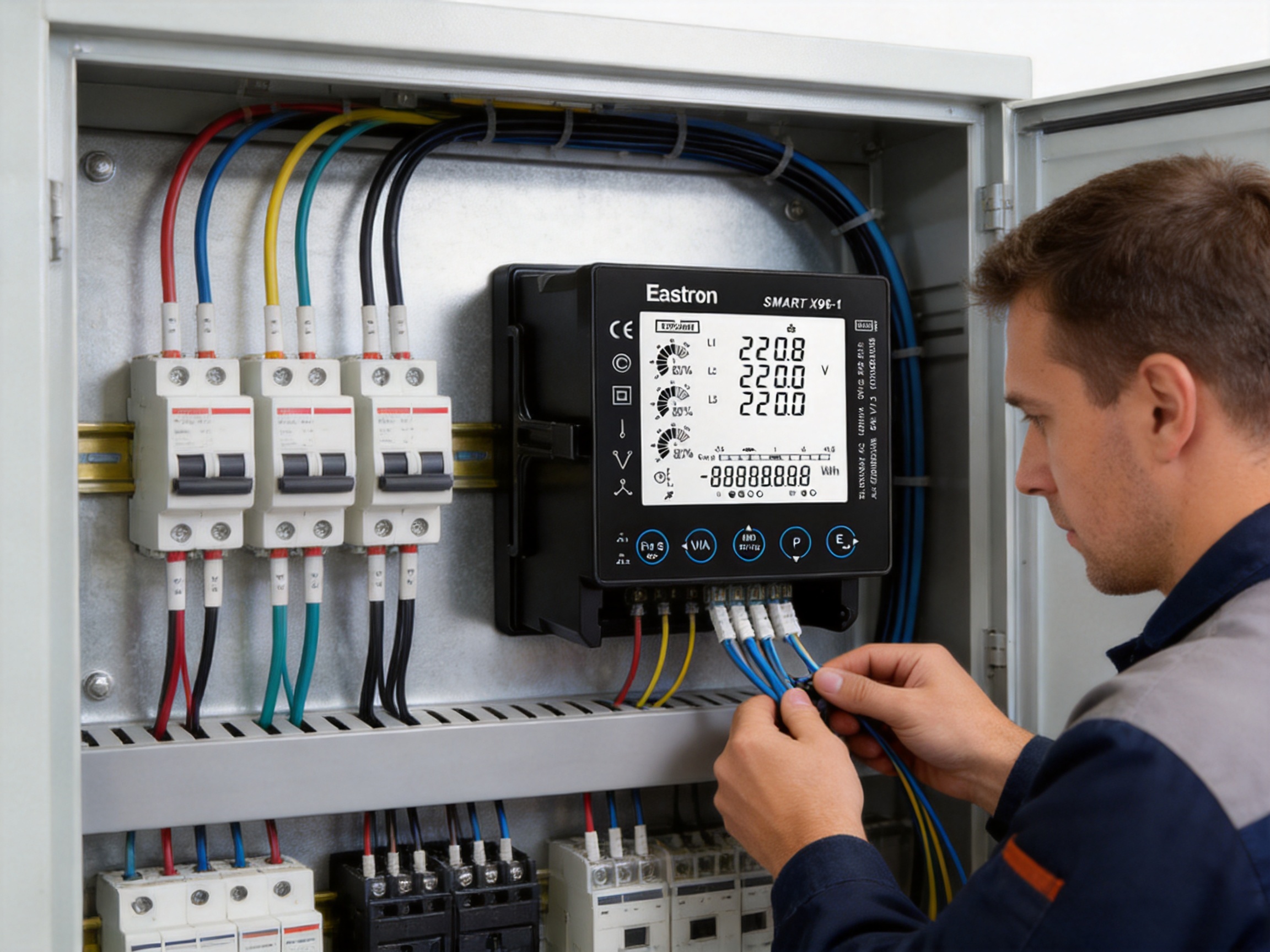
Installation time is a major cost factor in electrical projects. A meter that performs well but requires complicated wiring can slow down panel assembly and increase the likelihood of errors. The Smart X96-1A addresses this challenge through push-in installation, plug-in connection, RJ12 current input, and compatibility with pre-cut wiring looms.
The 96 mm by 96 mm size is familiar to panel builders and electricians. It fits common panel cut-out designs and supports standardized layout planning. The voltage terminals use shrouded screw-clamp construction, while the current input uses RJ12 terminals. This combination provides secure voltage wiring and simplified CT wiring.
For OEM panel manufacturers, repeatability is extremely important. When multiple cabinets must be built to the same specification, standardized current sensor connections reduce variability between panels. The 3-in-1 current sensor solution helps installers connect the three current inputs quickly and correctly. This advantage becomes more valuable when producing large numbers of distribution boards or control cabinets.
For retrofit projects, simplified CT connection can reduce downtime. Existing panels may have limited space, and technicians often need to complete installation within a short maintenance window. A plug-in CT system helps reduce installation complexity and minimizes the chance of extended power interruption.
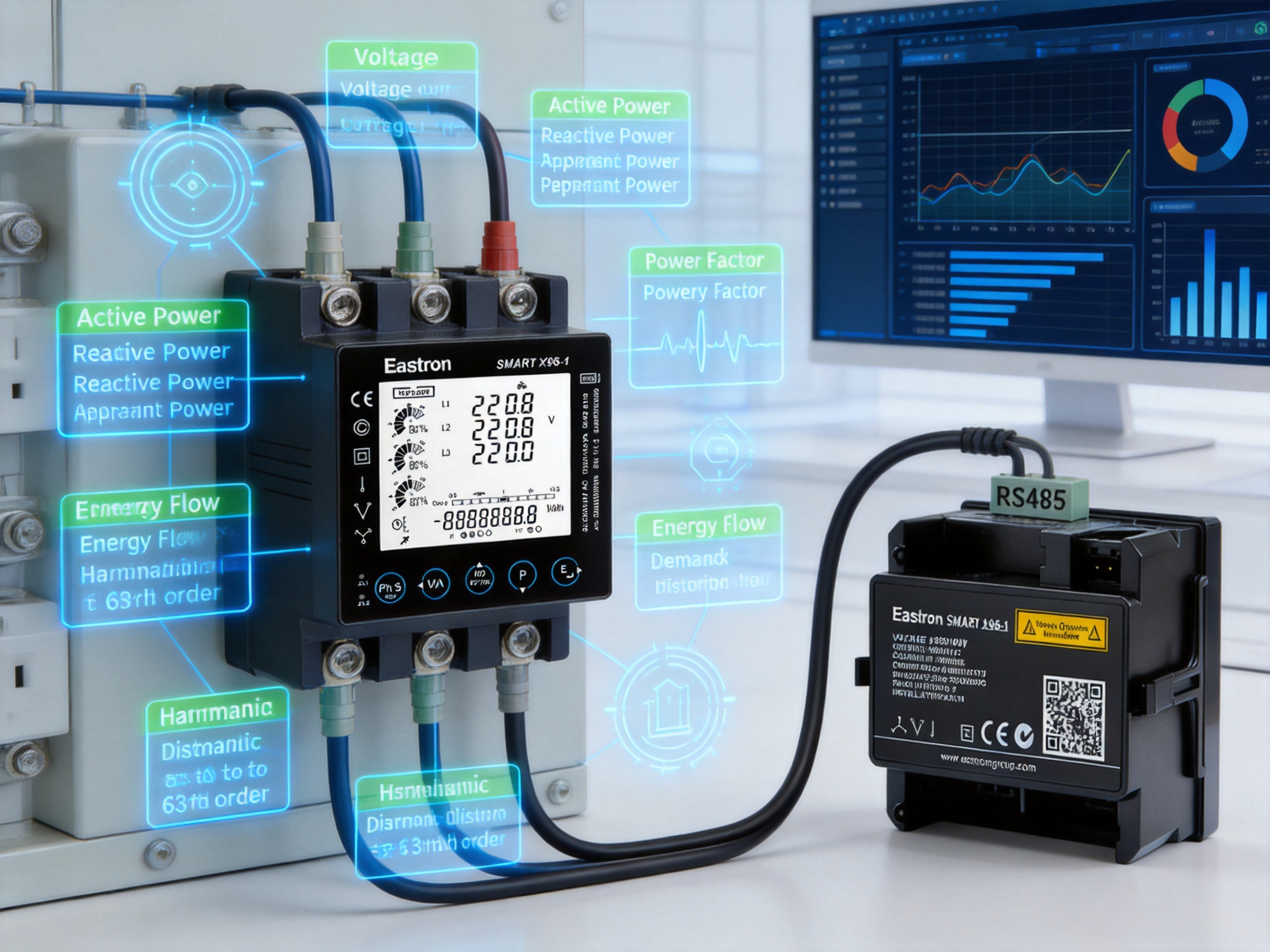
Energy data becomes more valuable when it can be collected, stored, analyzed, and compared. The RS485 Modbus RTU interface allows the analyzer to become part of a larger monitoring system. It can be connected to a gateway, which then transmits data to an energy management platform, building automation system, industrial SCADA network, or cloud-based dashboard.
Modbus RTU is widely used because it is stable, simple, and supported by many devices. This makes the analyzer easy to integrate in both new and existing projects. System integrators can configure the communication address, baud rate, parity, and stop bit settings to match network requirements.
Pulse outputs provide another layer of compatibility. Some legacy systems do not read Modbus registers but can count pulses. Other applications may use pulse outputs for independent verification, simple energy counting, or integration into PLC logic. The combination of digital communication and pulse output makes the analyzer more versatile than devices that offer only one communication method.
Many panel meters in the market can display voltage, current, and energy. However, the Smart X96-1A is positioned as a multifunction power analyzer, not merely a basic meter. Its advantages become clear when comparing it with typical alternatives.
Conventional CT meters often require separate current transformer secondary wiring for each phase. This can be time-consuming and prone to wiring mistakes. RJ12 type 100 mA CT connection and the 3-in-1 current sensor solution provide a cleaner installation method. This is especially valuable for panel manufacturers, installers, and maintenance teams working under time pressure.
Basic energy meters may provide kWh readings and perhaps voltage and current. The Smart X96-1A provides a much broader set of measurements, including active power, reactive power, apparent power, power factor, frequency, imported and exported energy, maximum demand-related information, THD, and individual harmonic distortion up to the 63rd harmonic.
Harmonic measurement up to the 63rd order gives the product an important competitive edge. Many lower-cost meters provide no harmonic data or only limited THD values. For users who need to understand power quality, this deeper measurement capability is highly valuable.
Some competitor devices provide only a local display, while others may provide communication but no practical pulse output. This analyzer provides both RS485 Modbus RTU and pulse outputs. That dual integration capability supports modern digital systems and traditional counting systems.
The ability to self-power from any of the three phases helps simplify wiring and panel design. In many applications, this is an advantage over meters requiring a separate auxiliary supply. Fewer wires and fewer components can mean faster installation and lower total project cost.
The backlit LCD, full viewing angle design, and bar graph power indication improve field usability. In real electrical rooms, quick readability is not a minor feature. It affects commissioning speed, maintenance efficiency, and operator confidence.
In factories, the analyzer can be installed in main distribution boards, sub-distribution panels, motor control centers, and machine panels. It helps maintenance teams observe load patterns, detect imbalance, measure energy consumption, and diagnose harmonic distortion caused by drives and industrial equipment.
In shopping centers, office buildings, hotels, hospitals, schools, and public facilities, the analyzer can support energy management and cost allocation. Its Modbus communication allows connection to building management systems, while pulse outputs can connect to existing metering infrastructure.
Energy consultants and auditors need reliable data before and after efficiency upgrades. The analyzer helps track power consumption, demand behavior, power factor, and harmonic conditions. This data can support lighting upgrades, HVAC optimization, motor efficiency projects, and power factor correction initiatives.
Where electrical systems include solar inverters, storage systems, or export-capable equipment, imported and exported energy data can be useful. The analyzer provides visibility into energy direction and system behavior, helping users understand how power flows through the installation.
Manufacturers of electrical equipment, generator panels, compressor systems, pumps, and industrial machines can integrate the analyzer as a value-added monitoring component. The standardized panel format, RJ12 CT connection, and Modbus interface make it suitable for repeatable OEM designs.
Critical facilities need continuous awareness of electrical loading and power quality. The analyzer can support monitoring of feeder circuits, UPS outputs, distribution panels, and mechanical plant loads. Harmonic measurement is especially relevant in environments with UPS systems, power electronics, and high-density IT loads.
The quality of a power analyzer depends not only on its design but also on the company’s manufacturing process, testing capability, and engineering culture. Eastron Electronic Co., Ltd. is headquartered in Jiaxing, China, near Shanghai, Hangzhou, and Jiangsu. The company is a high-tech manufacturer and supplier of electricity products and energy measurement solutions, with a product range that includes electricity meters, power analyzers, current sensors, communication modules, gateways, and management systems.
The company’s strength comes from its long-term focus on electricity metering and energy measurement. Rather than treating power analyzers as isolated products, it develops them as part of a wider ecosystem of meters, current transformers, relays, switches, gateways, and system solutions. This product ecosystem helps ensure compatibility across different monitoring applications and gives customers access to broader energy measurement support.
Advanced metering products require expertise in electronics, embedded software, signal processing, communication protocols, calibration, and electrical safety. Eastron maintains development teams in China and the United Kingdom, supporting continuous product improvement and new technology development. Cooperation with universities and institutions helps bring advanced technologies into product design.
For the Smart X96-1A, R&D capability is reflected in the combination of high-accuracy measurement, harmonic analysis, display design, communication functionality, and simplified installation structure. The analyzer is not merely a collection of components; it is a practical solution shaped by field requirements and engineering experience.
Eastron has established a professional laboratory capable of performing EMC, LVD, accuracy, and environmental tests according to IEC, EN, GB, and UL standards. This is a significant manufacturing advantage because electrical measurement devices must remain stable and safe under real operating conditions.
EMC testing helps ensure that the product can withstand electromagnetic interference and does not create unacceptable interference for other equipment. LVD-related testing supports electrical safety. Accuracy testing verifies measurement performance. Environmental testing assesses how products behave under temperature, humidity, and other operating conditions.
By maintaining in-house testing capability, the company can shorten development cycles, verify design changes more efficiently, and maintain tighter control over product quality. This is especially important for products installed in electrical panels where long-term reliability is expected.
The company follows the ISO 9001 quality management system, and its production has been approved by SGS according to MID standards. These quality and production controls demonstrate a structured approach to manufacturing. For customers, this means that products are produced under defined processes rather than inconsistent assembly practices.
Quality management affects many aspects of the final product: component selection, PCB assembly, firmware programming, calibration, final inspection, packaging, traceability, and after-sales support. In energy measurement, consistency is essential because even small errors can affect confidence in data. A disciplined production system helps ensure that each unit meets expected performance standards.
Eastron holds patented technologies in software, embedded software, and hardware. It has been recognized as a High-tech Enterprise and High-tech R&D Centre of Electricity Application. These recognitions reflect ongoing investment in product innovation and engineering capability.
For customers, innovation is valuable when it results in practical benefits: easier installation, more accurate data, better communication, wider application range, and improved user experience. The Smart X96-1A demonstrates this practical innovation through features such as RJ12 CT connection, 63rd harmonic analysis, Modbus communication, self-powered operation, and high-visibility display.
The analyzer weighs approximately 420 g and uses a self-extinguishing UL 94 V-0 meter case material. The front display has an IP51 degree of protection according to IEC 60529. These characteristics support use in protected panel environments where durability and safety are important.
The operating temperature range is -25°C to 55°C, while the storage temperature range is -40°C to 70°C. The humidity rating is less than 95% RH at 50°C, non-condensing. The pollution degree is 2, and the altitude rating is 2000 m. These environmental characteristics make the analyzer suitable for many commercial, industrial, and infrastructure installations.
Mechanical reliability also depends on practical installation details. Shrouded screw-clamp voltage terminals help protect wiring points, while RJ12 current terminals simplify current input connection. The compact 96 x 96 x 92 mm dimension helps the device fit into standard panels without excessive space requirements.
Energy management is most effective when accurate field data is available. The analyzer can serve as a measurement node in a larger energy management architecture. Multiple analyzers can be installed across feeders, floors, departments, production lines, machines, or tenant areas. Their Modbus data can then be collected by gateways or controllers for analysis.
With this structure, users can identify where energy is consumed, when peak demand occurs, which loads create poor power factor, and whether harmonic distortion is increasing. Over time, the data supports better decisions about equipment scheduling, maintenance, capacity planning, and efficiency investment.
In building management systems, the analyzer can provide electrical data alongside HVAC, lighting, occupancy, and environmental data. In industrial SCADA systems, it can provide power information for production equipment and utilities. In cloud-based energy platforms, it can contribute to dashboards, reports, alarms, and benchmarking.
Panel builders benefit from a standardized product format, simplified CT wiring, plug-in connection, and a professional front display. These characteristics support faster assembly, cleaner wiring, and a more advanced final panel offering.
Contractors benefit from reduced installation complexity and flexible integration. The self-powered design, RJ12 CT connection, and Modbus communication help shorten commissioning time. Clear local display readings also help verify wiring and system operation during installation.
Facility managers gain access to reliable electrical data for energy control, maintenance planning, and operational decision-making. The analyzer helps them see not only how much energy is used, but also how loads behave.
System integrators benefit from RS485 Modbus RTU compatibility, configurable communication settings, and pulse outputs. These features allow the analyzer to fit into a wide range of system architectures.
Maintenance teams can use the analyzer to detect abnormal current, voltage variation, imbalance, poor power factor, and harmonic distortion. This supports preventive maintenance and faster troubleshooting.
Electrical panels are not laboratory environments. They may contain contactors, drives, relays, switching power supplies, transformers, and long cable runs. These conditions create electrical noise, temperature variation, and mechanical constraints. A reliable power analyzer must be designed for this reality.
The Smart X96-1A is supported by a manufacturer with EMC, LVD, accuracy, and environmental testing capability. Its case material, front protection, terminal design, and operating temperature range all contribute to real-world reliability. The product’s communication flexibility also supports stable system integration in diverse installations.
Reliability also means consistent measurement. When a facility uses multiple analyzers across its distribution system, the data must be comparable. Manufacturing quality control, calibration, and compliance with recognized standards help provide that consistency.
The analyzer reflects a practical design philosophy: provide advanced data without making installation or operation unnecessarily complicated. Some power quality instruments offer deep analysis but are costly, complex, and difficult to integrate. Some basic meters are easy to install but provide limited information. The Smart X96-1A occupies an important middle ground by combining multifunction measurement, harmonic analysis, communication, pulse output, and installation efficiency.
This balance is important for real projects. A building owner may not need a laboratory-grade portable power quality analyzer permanently installed in every distribution panel, but they still need more than simple kWh readings. An industrial plant may need harmonic visibility and Modbus integration without installing a complex analyzer at every feeder. The product provides a practical and scalable solution.

The analyzer can be used for single-phase two-wire, three-phase three-wire, and three-phase four-wire AC systems. This makes it suitable for a wide variety of distribution and panel monitoring applications.
The rated current input is 100 mA. The product uses an RJ12 type current transformer connection, which simplifies installation and supports fast, standardized wiring.
RJ12 CT connection reduces wiring complexity compared with traditional individual CT secondary wiring. It can help minimize installation errors, improve panel assembly efficiency, and support cleaner wiring layouts.
The analyzer supports self-powered operation from any of the three phases. In many installations, this can reduce wiring requirements and simplify panel design.
The analyzer includes RS485 Modbus RTU communication. It supports common communication settings such as multiple baud rates, device addresses from 1 to 247, parity options, and one or two stop bits.
Yes. Its Modbus RTU communication and pulse outputs allow integration with building management systems, energy management platforms, PLCs, SCADA systems, data loggers, and gateways.
The analyzer measures total harmonic distortion and individual harmonic distortion up to the 63rd harmonic. This helps users evaluate power quality and identify distortion from nonlinear loads.
Active energy accuracy complies with IEC 62053-22 Class 0.5S and IEC 62053-21 Class 1.0. Voltage and current accuracy are 0.5% of range maximum, while active, reactive, and apparent power accuracy are 1.0% of range maximum.
The analyzer uses a backlit LCD display designed for full viewing angles. It also includes a bar graph for power indication, helping users quickly understand load conditions.
It is commonly installed in switchboards, distribution panels, control cabinets, industrial panels, commercial building electrical rooms, OEM equipment panels, and energy monitoring enclosures.
A basic kWh meter mainly records energy consumption. This analyzer measures multiple electrical parameters, supports harmonic analysis, communicates through Modbus RTU, provides pulse outputs, and offers local display features for power monitoring and diagnostics.
Power analyzers must provide accurate and reliable data over long operating periods. Manufacturer capabilities such as professional testing laboratories, quality management systems, R&D expertise, and production control help ensure product reliability and consistency.
The RJ CT Type RS485 Modbus Panel Mounted Multi-function Power Analyzer, Smart X96-1A, is a strong solution for modern energy monitoring and electrical analysis. It combines the practicality of a standard 96 mm panel instrument with advanced multifunction measurement, Class 0.5S active energy accuracy, harmonic analysis up to the 63rd order, Modbus RTU communication, pulse outputs, self-powered operation, and easy RJ12 CT connection.
Its advantages are especially clear in applications where installation speed, wiring reliability, data depth, and system integration matter. Compared with many conventional panel meters, it provides richer diagnostic information and a more installer-friendly current transformer connection. Compared with basic energy meters, it gives users a fuller understanding of electrical performance, power quality, and load behavior.
The product is also supported by the manufacturing and engineering strengths of Eastron Electronic Co., Ltd., including research and development teams, professional testing laboratories, ISO 9001 quality management, SGS-approved MID production, patented technologies, and broad experience in electricity metering and energy measurement solutions. These strengths help ensure that the analyzer is not only technically capable but also reliable, practical, and suitable for real-world electrical environments.
For panel builders, contractors, facility managers, energy consultants, and system integrators, this analyzer offers a well-balanced combination of performance and usability. It helps transform electrical panels from simple distribution points into intelligent sources of actionable energy data.
IEC 62053-22, Electricity Metering Equipment: Static Meters for Active Energy, Classes 0.2S and 0.5S.
IEC 62053-21, Electricity Metering Equipment: Static Meters for Active Energy, Classes 1 and 2.
IEC 62053-24, Electricity Metering Equipment: Static Meters for Reactive Energy.
IEC 60529, Degrees of Protection Provided by Enclosures.
ISO 9001, Quality Management Systems Requirements.
UL 94, Standard for Tests for Flammability of Plastic Materials for Parts in Devices and Appliances.
Modbus Organization, Modbus Application Protocol Specification.
General engineering literature on power quality, harmonic distortion, and electrical energy management systems.
Your email address will not be published. Required fields are marked *

We develop and produce high performance electricity meters, power analyzers, current sensors, communication modules and management systems. China Custom Smart Meters Manufacturers and Factory
Address:NO 52, Dongjin Road, Nanhu, Jiaxing, Zhejiang, China
Copyright @ Eastron Electronic Co., Ltd. All rights reserved Electricity Meters Manufacturers
