

 English
 Español
 Deutsch
 中文简体
中文简体

Product Consultation
Your email address will not be published. Required fields are marked *
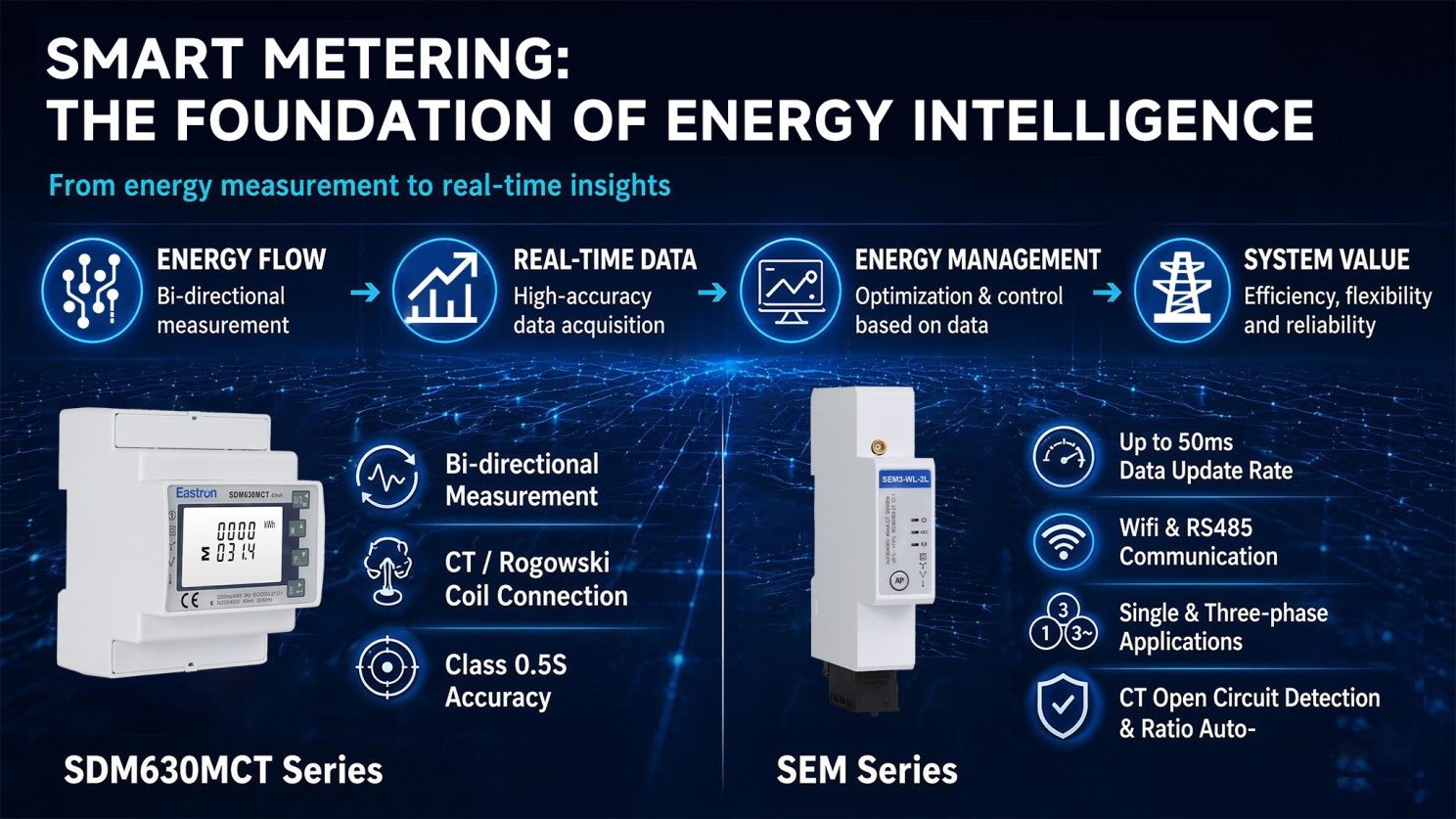
Europe's Solar and Energy Storage Transition: Transforming the Power System Infrastructure for a Renewable Future
Jul 10,2026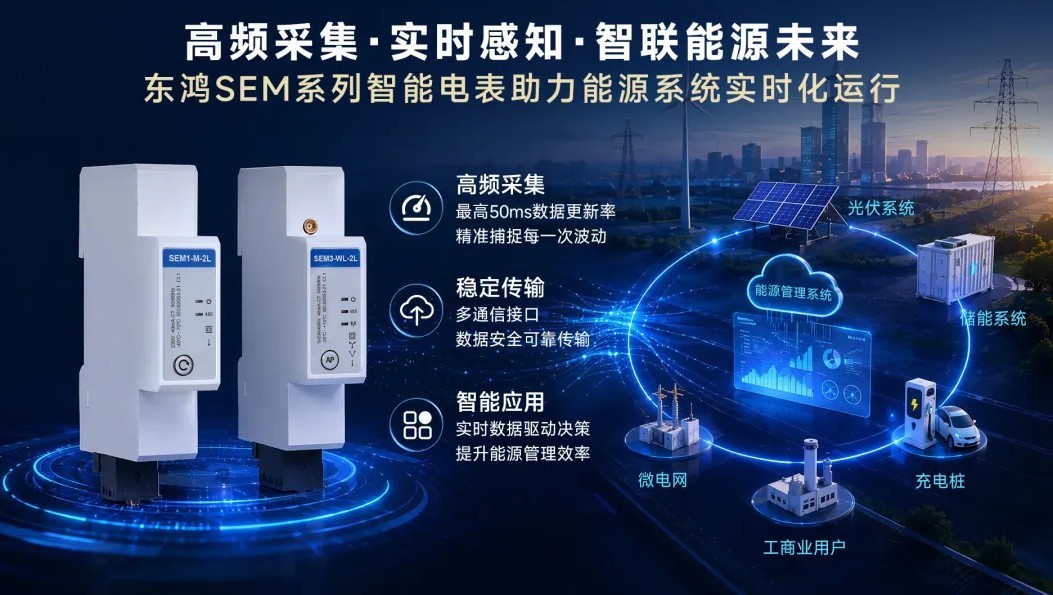
Power Systems Are Becoming “Real-Time Systems”: Why Data Is More Critical Than Electricity
Jul 06,2026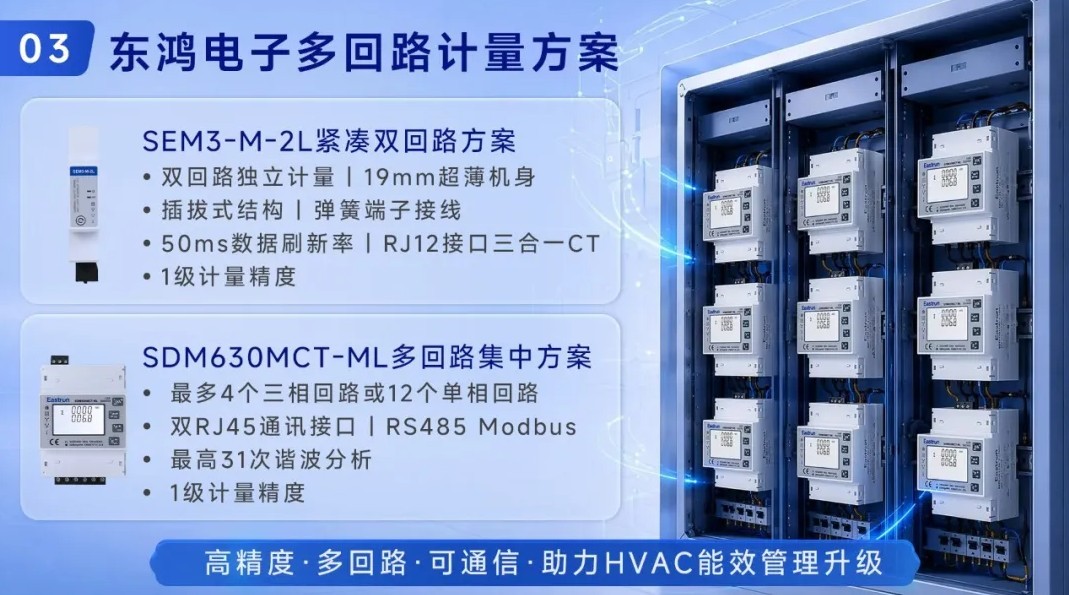
New EPBD Regulations Drive HVAC Energy Transparency and Boost Demand for Smart Meters
Jul 07,2026Content
In modern electrical systems, accurate energy measurement is no longer a secondary requirement. It is a foundation for cost control, load analysis, sustainability reporting, preventive maintenance, and intelligent energy management. The RS485 100A DIN rail three-phase multifunction energy meter, identified as SDM630-Modbus V2, is designed to serve these needs in commercial buildings, industrial distribution boards, renewable energy monitoring systems, residential power management projects, and smart energy platforms.
This meter combines direct-load measurement up to 100A, three-phase compatibility, multifunction electrical parameter monitoring, bi-directional energy measurement, pulse outputs, and RS485 Modbus RTU communication in a compact 4-module DIN rail housing. For installers, system integrators, panel builders, facility managers, and energy service providers, this combination creates a highly practical balance between installation convenience, measurement performance, communication capability, and long-term operating value.
Unlike many conventional three-phase meters that require external current transformers for higher-load applications, this meter can directly connect to loads up to 100A. This reduces installation complexity, saves panel space, lowers accessory cost, and helps minimize wiring errors. At the same time, it provides a broad range of measurements, including active energy, reactive energy, power, reactive power, apparent power, power factor, frequency, demand, voltage, and current. The meter supports 3P4W, 3P3W, and 1P2W systems, making it adaptable to different electrical distribution architectures.
Behind the product is Eastron Electronic Co., Ltd., a specialist manufacturer of electricity metering products and energy measurement solutions. Headquartered in Jiaxing, China, near Shanghai, Hangzhou, and Jiangsu, the company develops and produces electricity meters, power analyzers, current sensors, communication modules, and management systems. Its strength is not limited to product assembly; it is supported by research and development teams, patented technologies, professional testing capabilities, quality management practices, and production experience serving markets across more than 50 countries.
RS485 100A Din Rail Three Phase Multi-function Energy Meter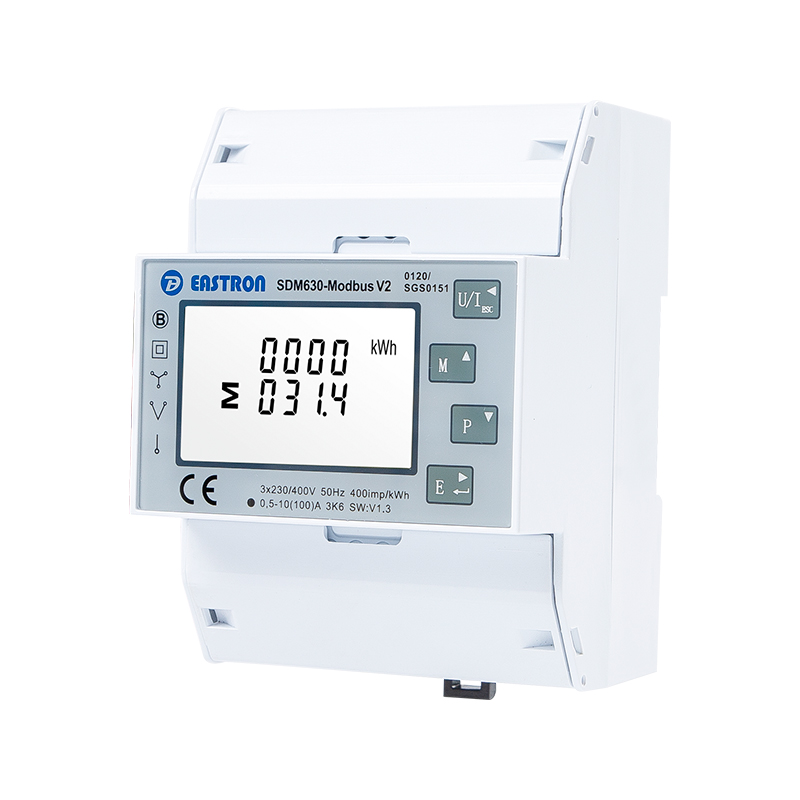
The SDM630-Modbus V2 is a DIN rail-mounted three-phase multifunction energy meter with RS485 communication. It is designed for direct connection up to 100A and can operate in 3P4W, 3P3W, and 1P2W electrical supply systems. The unit measures RMS values, including harmonics, on three-phase AC systems. It is suitable for applications where both electrical energy data and real-time power quality-related parameters are needed.
The product’s front-panel display and button configuration allow users to check values and set parameters locally. Configuration is password protected, which helps prevent accidental or unauthorized changes. For remote monitoring, the built-in RS485 interface supports Modbus RTU communication. This is a widely used protocol in energy management systems, building automation, industrial monitoring, and supervisory platforms. The meter also provides two pulse outputs for imported and exported energy, allowing integration with data loggers, counters, controllers, or legacy monitoring equipment.
Its compact 4-module, 72mm-wide housing is an important practical advantage. Electrical panels often have limited space, especially in retrofit projects where extra metering points must be added without redesigning the entire cabinet. By integrating direct-load measurement, display, energy accumulation, power monitoring, pulse output, and Modbus communication into one compact unit, the meter helps simplify panel design and installation planning.
The product is particularly suitable for energy monitoring in office buildings, shopping centers, apartment complexes, factories, workshops, data cabinets, charging infrastructure support systems, photovoltaic and storage monitoring panels, HVAC power distribution, machine-level energy tracking, and sub-metering projects. It is also valuable in applications requiring import and export energy measurement, such as sites with distributed generation or bidirectional power flow.
One of the most important advantages of this meter is its maximum 100A direct-load capability. In many three-phase metering installations, current transformers are necessary when the current exceeds the direct input range of basic meters. Current transformers add cost, take up space, require additional wiring, and introduce ratio configuration requirements. If the CT ratio is set incorrectly, the energy data can be wrong. By supporting direct connection up to 100A, this meter eliminates many of those risks in suitable applications.
Another significant advantage is its compatibility with multiple wiring systems. The meter can work with 3P4W, 3P3W, and 1P2W supplies. This gives engineers more flexibility because the same model can be used across different panel types and regional wiring practices. For distributors and project managers, this reduces model selection complexity and inventory pressure.
The meter also provides multi-measurement capability. It is not simply an energy counter. It measures kWh, kVarh, W, Var, VA, power factor, frequency, demand, voltage, current, and related electrical values. This makes it suitable not only for billing-related sub-metering and cost allocation, but also for operational analysis. Facility managers can identify load peaks, observe power factor problems, compare consumption between different circuits, and support energy-saving programs with measurable data.
Bi-directional measurement is another important feature. In modern energy systems, power does not always flow in one direction. Solar photovoltaic installations, battery storage systems, generator-backed circuits, and certain industrial processes may involve both imported and exported energy. A meter that can distinguish import and export energy is more useful in these environments than a basic one-way meter.
The inclusion of two pulse outputs and RS485 Modbus RTU communication provides integration flexibility. Pulse outputs are simple, reliable, and widely understood. RS485 Modbus enables richer digital data communication, allowing centralized monitoring software or gateways to read many parameters from multiple meters. The RS485 transmission distance can reach up to 1000m under appropriate installation conditions, making it practical for medium and large facilities.
Item |
Specification |
Practical Value |
Product Type |
Three-phase multifunction energy meter |
Suitable for advanced sub-metering and energy monitoring |
Maximum Current |
100A direct load |
Reduces or removes the need for external current transformers in many applications |
Rated Current |
10A |
Designed for common distribution circuit monitoring |
Starting Current |
40mA |
Supports sensitive detection of low-load energy usage |
Supported Wiring |
3P4W, 3P3W, 1P2W |
Flexible installation in different electrical systems |
Rated Voltage |
230V L-N / 120V L-N |
Applicable to multiple regional power environments |
Operational Voltage |
80% to 120% of Un |
Stable operation across normal voltage variations |
Active Energy Accuracy |
IEC 62053-21 Class 1.0, EN50470-1/3 Class B |
Reliable energy measurement for professional monitoring |
Reactive Energy Accuracy |
IEC 62053-23 Class 2 |
Supports reactive energy analysis and power factor review |
Communication |
RS485 Modbus RTU |
Easy integration with energy management systems |
Communication Address |
1 to 247 |
Supports multi-device networks |
Transmission Speed |
1200bps to 38400bps |
Adaptable to different communication network requirements |
Transmission Distance |
Up to 1000m |
Useful for larger sites and distributed panels |
Mounting Width |
4 modules, 72mm |
Saves DIN rail space in electrical cabinets |
Direct connection is one of the strongest competitive advantages of this energy meter. In a traditional CT-operated metering system, the installer must select the correct transformer ratio, mount the current transformers, wire secondary circuits, confirm polarity, verify phase matching, and configure the meter ratio. Each step creates possible cost and error points. For small and medium distribution circuits up to 100A, direct measurement can be more efficient and less complicated.
By accepting up to 100A directly, the SDM630-Modbus V2 helps panel builders produce cleaner and more compact assemblies. Fewer components mean fewer terminal connections, fewer labels, fewer commissioning checks, and reduced material cost. In projects with many sub-metering points, these savings can multiply quickly. A building with dozens of tenant distribution circuits, for example, may benefit substantially from a meter that avoids external CTs for each monitored point.
Direct-load measurement is also useful for retrofit installations. Existing panels may not have enough physical space to add CTs around conductors, particularly if cable routing is dense or busbar access is limited. A compact DIN rail meter with direct current terminals can simplify the upgrade path, provided that the circuit rating and installation requirements are appropriate.
From a data quality perspective, removing CT ratio configuration reduces the chance of scaled readings being reported incorrectly. In many energy management projects, errors are discovered only after data appears inconsistent over days or weeks. A direct meter can help commissioning teams complete verification faster and with greater confidence.
An effective modern meter should provide more than accumulated kWh. The SDM630-Modbus V2 measures active energy, reactive energy, power, reactive power, apparent power, power factor, frequency, voltage, current, and demand. These parameters allow users to move from simple consumption tracking to deeper electrical insight.
Active energy, expressed in kWh, is the most familiar measurement. It tells how much usable electrical energy has been consumed or exported. Reactive energy, expressed in kVarh, is important in systems with inductive or capacitive loads. Monitoring reactive energy and power factor can help identify inefficient load behavior and guide corrective actions such as capacitor bank adjustment or equipment review.
Real-time power values, including W, Var, and VA, help users understand what is happening at a specific moment. This is useful for diagnosing unexpected load increases, checking operating cycles, comparing machinery, or identifying circuits that remain energized outside working hours. Current and voltage readings support electrical balance checks across phases, helping maintenance teams detect uneven load distribution or supply irregularities.
Frequency measurement provides another layer of system awareness. While frequency is usually stable in grid-connected systems, monitoring it can still be useful in generator-backed applications or isolated systems. Demand measurement is especially valuable where utility charges include peak demand components. By observing maximum demand over preset periods up to 60 minutes, facility managers can identify peak load behavior and develop load-shifting strategies.
Because the meter supports bi-directional measurement, it is suitable for installations where energy can be imported from the grid and exported back to it. This function is increasingly important as photovoltaic systems, battery storage, and distributed energy resources become more common. A one-way meter may not provide sufficient clarity in such installations, while a bi-directional meter gives a more complete energy picture.
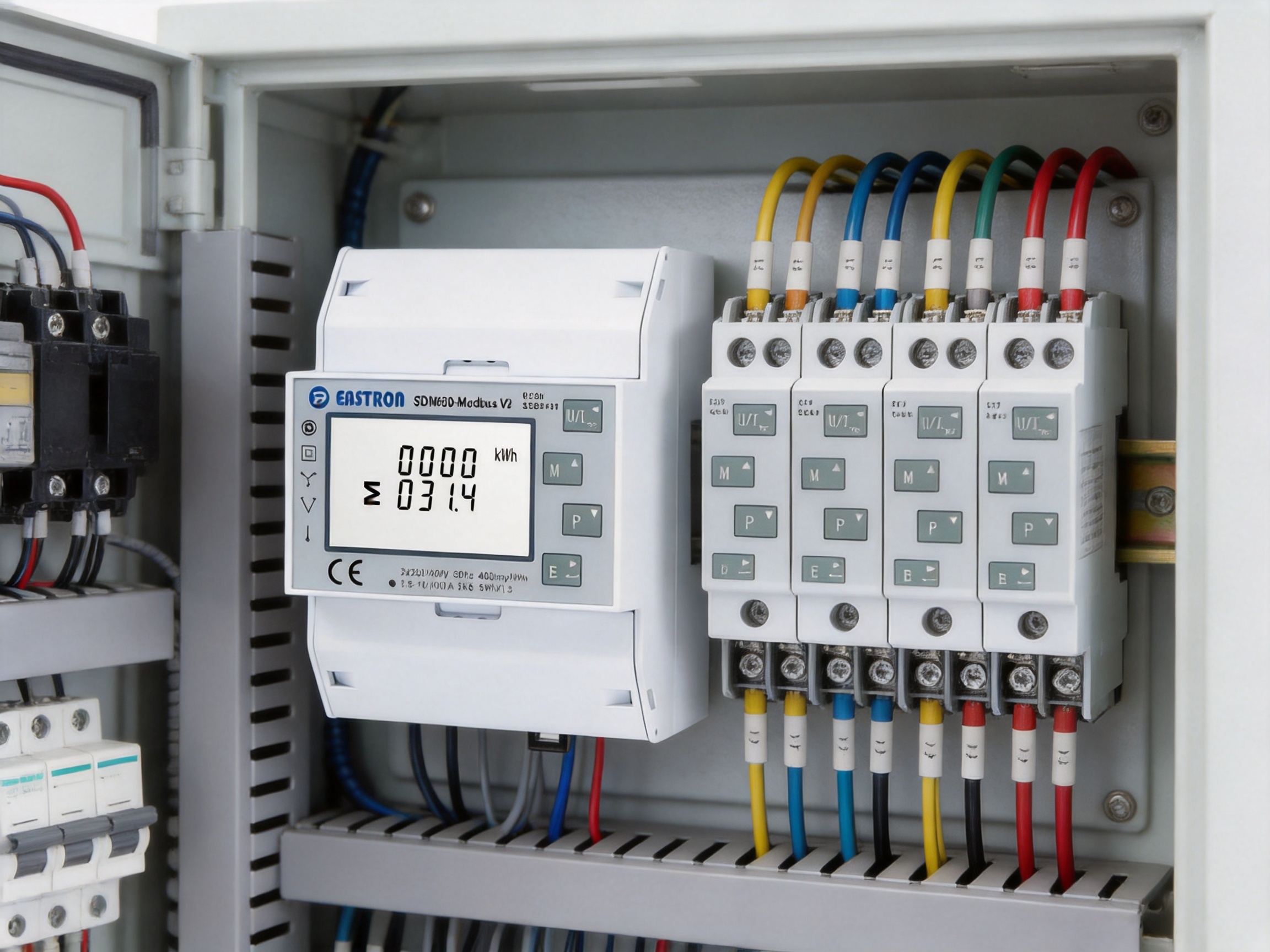
The RS485 Modbus RTU interface is a key feature that makes the meter valuable in connected energy systems. Modbus RTU is widely used because it is stable, simple, and supported by many controllers, gateways, data loggers, PLCs, building management systems, and energy monitoring platforms. With an address range from 1 to 247, multiple meters can be connected on the same RS485 network, allowing scalable data collection across a building or facility.
The communication speed range of 1200bps to 38400bps provides flexibility for different network conditions. The default parity can be none, with odd and even parity options also available. Stop bits can be set to 1 or 2, and the response time is less than 100ms. These details are important for engineers who must integrate meters into existing communication networks with specific protocol settings.
The maximum RS485 transmission distance of 1000m makes the meter suitable for distributed installations. In a shopping mall, factory, or campus-style facility, meters may be installed in multiple electrical rooms. RS485 enables a centralized data collection architecture when properly designed with suitable cable, termination, shielding, grounding, and communication topology.
The two pulse outputs provide an alternative or additional integration method. Pulse outputs are often used when systems require simple energy counting without reading a complete Modbus register map. They are also helpful for compatibility with older monitoring systems, pulse counters, or automation devices. The combination of pulse output and Modbus communication makes the meter more versatile than products that offer only one interface type.
For broader product families, related versions may include M-Bus EN13757 communication, dual tariff functions, digital input, or Ethernet Modbus TCP. This demonstrates that the platform can address various application requirements. However, the RS485 Modbus version remains especially attractive because of the balance between cost, compatibility, and data richness.
Accuracy is fundamental to any energy meter. The SDM630-Modbus V2 offers active energy accuracy according to IEC 62053-21 Class 1.0 and EN50470-1/3 Class B, while reactive energy follows IEC 62053-23 Class 2. Power accuracy is stated as 0.5% of range maximum, with current and voltage also at 0.5% of range maximum. Frequency accuracy is 0.2% of mid-frequency, and power factor accuracy is 1% of unity, equivalent to 0.01.
These accuracy characteristics support professional monitoring in applications where dependable energy data is needed. In tenant sub-metering, inaccurate data can create disputes. In energy-saving projects, inaccurate baseline and post-improvement measurements can distort return-on-investment calculations. In industrial monitoring, inaccurate current or power values may affect equipment performance analysis. A meter designed to recognized standards provides greater confidence for engineers and users.
The meter measures RMS values including harmonics on three-phase AC systems. This is important because modern electrical loads are often non-linear. Variable frequency drives, LED lighting drivers, power supplies, charging equipment, and electronic devices can introduce harmonic content. RMS measurement that includes harmonics gives a more realistic representation of electrical conditions than simplified measurement approaches.
The starting current of 40mA helps detect low-load operation. This can be valuable in circuits where standby consumption matters. Many facilities underestimate the energy impact of small continuous loads such as control systems, network equipment, displays, chargers, and auxiliary devices. A meter with low starting current can help reveal this consumption more effectively.
The 4-module, 72mm-wide DIN rail form factor is practical for modern distribution boards. DIN rail mounting is common in industrial and commercial electrical panels because it is standardized, secure, and easy to service. A compact meter allows more devices to fit in a panel, including circuit protection, terminals, communication gateways, relays, and control modules.
Compared with larger multifunction meters or CT-based systems, this product helps optimize panel layout. Reducing external components can improve airflow, simplify cable routing, and make maintenance access easier. For panel builders, a compact meter can help reduce assembly time and improve the visual organization of the cabinet.
Installation simplicity also contributes to long-term reliability. Every additional wiring connection is a potential point of failure. By reducing auxiliary CT wiring and supporting direct connection, the meter helps reduce installation variables. This does not eliminate the need for qualified electrical installation, correct conductor sizing, proper torque, and compliance with local electrical regulations, but it provides a cleaner and more efficient design approach.
The local button setting function allows configuration without requiring specialized software for every basic adjustment. Password protection helps ensure that settings are not changed casually. In facilities with multiple maintenance personnel, this is useful for preserving configuration integrity.
When compared with basic three-phase kWh meters, the SDM630-Modbus V2 offers substantially more measurement depth. A basic meter may show only total active energy, while this multifunction unit supports voltage, current, power, reactive power, apparent power, power factor, frequency, demand, active energy, and reactive energy. This turns the meter from a passive counter into an active diagnostic tool.
When compared with CT-operated meters in the same current range, the direct 100A design can reduce total installed cost. The purchase price of the meter alone does not tell the full story. The total cost includes CTs, wiring, terminal blocks, installation labor, commissioning, documentation, and possible troubleshooting. For circuits within the direct current limit, a direct meter can provide a more economical and less error-prone solution.
When compared with meters that provide pulse output only, the RS485 Modbus version provides richer data and better integration with digital platforms. Pulse counting can tell how much energy has accumulated, but Modbus can provide real-time electrical parameters and detailed monitoring. This is important for energy analytics, alarms, dashboards, reporting, and remote troubleshooting.
When compared with meters that support only a single wiring mode, this product’s compatibility with 3P4W, 3P3W, and 1P2W systems improves project flexibility. Contractors and distributors can use one model in more scenarios, reducing the risk of selecting the wrong meter type.
When compared with larger panel meters, the DIN rail 4-module size gives a practical space advantage. Panel space is valuable. A compact solution can make the difference between a straightforward retrofit and an expensive panel redesign.
Commercial buildings are one of the strongest application areas for this meter. Office towers, retail centers, hotels, schools, hospitals, and mixed-use buildings often need to monitor energy consumption by floor, tenant, zone, or equipment group. The meter’s direct 100A input, DIN rail mounting, and RS485 communication make it well suited for these sub-metering networks.
In tenant metering, accurate data supports fair cost allocation. Instead of dividing electricity costs by floor area or estimated usage, property managers can collect actual consumption data from each distribution circuit. This improves transparency and can encourage tenants to adopt energy-saving behavior.
In building operations, real-time power and demand data can help identify inefficient schedules. For example, lighting, HVAC support equipment, or plug loads may remain active after business hours. By monitoring circuit-level consumption, facility managers can locate unnecessary energy use and take corrective action.
Commercial buildings also benefit from Modbus integration. Meters can connect to building management systems, energy dashboards, or cloud gateways. This enables automatic reporting, trend analysis, alarms, and performance benchmarking across multiple sites.
Industrial facilities often require more detailed electrical monitoring than ordinary buildings. Production lines, motors, compressors, pumps, ovens, packaging equipment, and auxiliary systems all contribute to energy consumption. Understanding where energy is used is the first step toward improving efficiency.
The SDM630-Modbus V2 can be installed in distribution panels feeding machines or process areas. With real-time current, voltage, power, and demand readings, maintenance teams can observe load patterns and detect abnormal operation. A sudden increase in current may indicate mechanical resistance, failing bearings, clogged filters, or process changes. Irregular power factor may suggest motor loading issues or compensation problems.
Energy data can also support production cost analysis. By comparing kWh consumption to output volume, manufacturers can calculate energy intensity and identify opportunities for optimization. In factories with multiple production lines, sub-metering helps reveal which lines or processes consume the most energy.
RS485 Modbus communication is familiar in industrial environments, making integration with PLCs, SCADA systems, and industrial gateways more straightforward. The meter’s compact form factor also fits well in machine panels and local distribution boards.
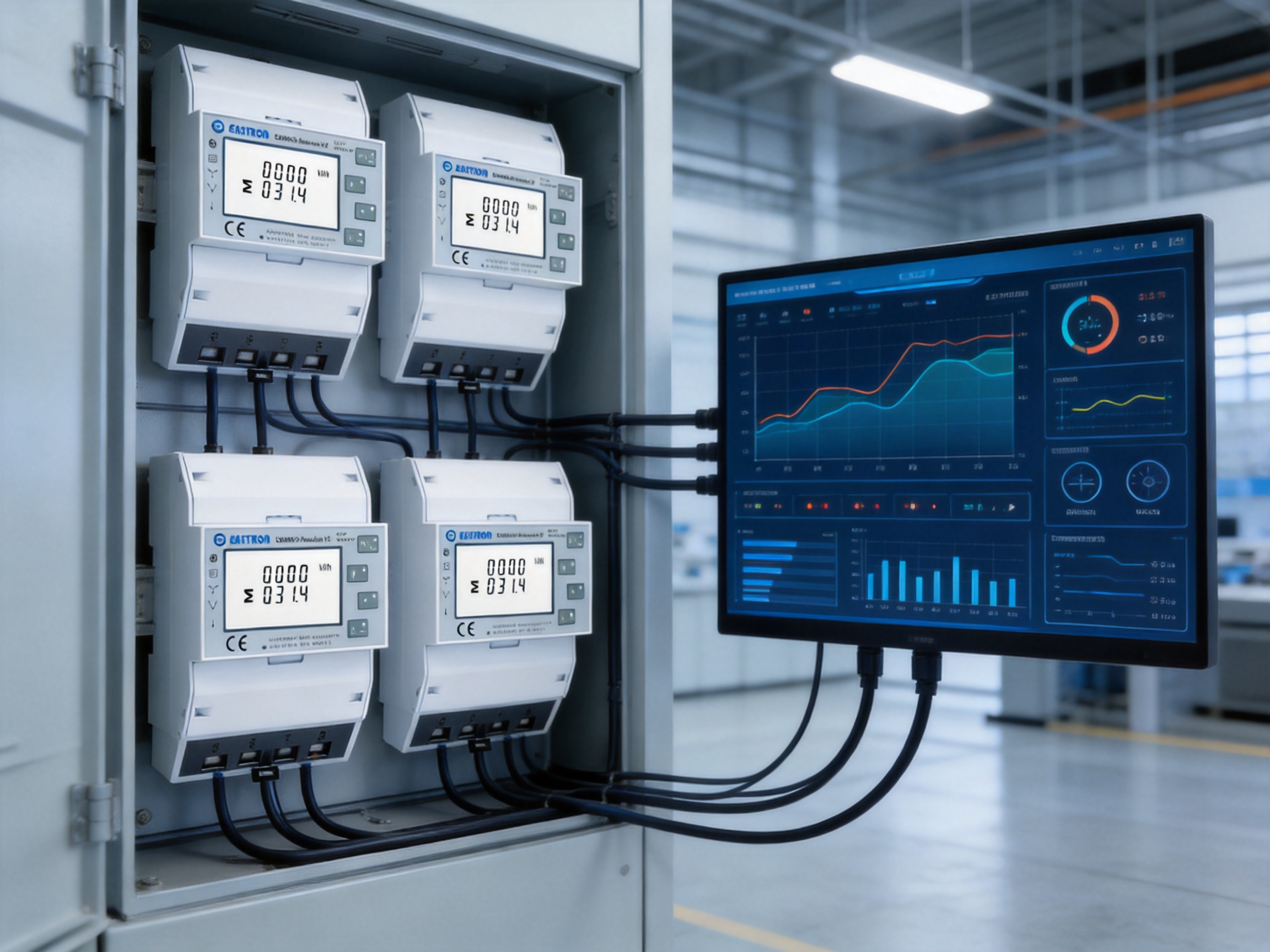
The rise of distributed energy resources has changed the role of electrical metering. In sites with solar photovoltaic systems, battery storage, or generator backup, energy may flow both into and out of a circuit. Bi-directional measurement is essential for understanding these flows.
The SDM630-Modbus V2 can measure imported and exported active and reactive energy. This helps system owners understand how much energy is drawn from the grid and how much is exported or returned. In energy storage systems, it can support monitoring of charging and discharging paths. In photovoltaic installations, it can help compare generation, self-consumption, and export behavior when placed at appropriate points in the electrical system.
Pulse outputs for import and export energy provide simple hardware-level signaling, while Modbus communication allows more detailed digital data acquisition. This dual capability makes the meter useful in hybrid energy monitoring systems where both legacy controllers and modern digital platforms are present.
A strong product depends on a strong manufacturing organization. Eastron Electronic Co., Ltd. is a high-tech manufacturer and supplier focused on electricity products and energy measurement solutions. The company develops and produces high-performance electricity meters, power analyzers, current sensors, communication modules, and management systems. This broad product scope gives the company a deep understanding of electrical measurement, communication integration, and practical field requirements.
The company’s location in Jiaxing, China, near Shanghai, Hangzhou, and Jiangsu, provides access to a developed industrial ecosystem, transportation networks, technical talent, and supply chain resources. This helps support efficient production, logistics, and product development.
Research and development is a major strength. The company maintains energetic and innovative development teams in China and the United Kingdom. This international R&D structure supports product improvement, technology updates, and adaptation to different market requirements. Cooperation with leading universities and institutions further strengthens the company’s ability to introduce advanced technologies into its products.
Manufacturing quality is supported by professional laboratory capabilities. The company has established its own laboratory for EMC, LVD, accuracy, and environmental tests according to IEC, EN, GB, and UL standards. This is highly important for energy meters because they must operate reliably in electrically noisy environments, withstand voltage-related stresses, maintain accuracy, and perform across expected environmental conditions.
The company follows the ISO 9001 quality management system. Its production is approved by SGS according to MID standards. It also holds many patented technologies in software, embedded software, and hardware, and has been recognized as a High-tech Enterprise and High-tech R&D Centre of Electricity Application. These strengths indicate an organization that invests in technology, testing, and quality control rather than relying only on basic assembly.
Advanced manufacturing for energy meters requires precision, consistency, and traceability. A meter is both an electronic device and a measuring instrument, so its production process must control component quality, circuit performance, calibration accuracy, software reliability, enclosure consistency, and final testing.
In a professional manufacturing environment, incoming components must be inspected and controlled to ensure they meet design requirements. For an energy meter, critical components may include measurement chips, resistors, voltage dividers, current sensing elements, communication interfaces, display modules, terminals, memory devices, and protective components. Stable component quality helps ensure measurement consistency across production batches.
Printed circuit board assembly requires controlled processes to maintain soldering quality and electrical reliability. Good manufacturing practice includes process monitoring, visual inspection, automated testing where applicable, and functional verification. For a meter with RS485 communication, pulse outputs, display, measurement inputs, and local buttons, each functional subsystem must be checked.
Calibration is especially important. Energy meters must measure accurately across defined current and voltage conditions. A professional calibration process verifies the meter against reference standards and adjusts or confirms measurement performance. The stated accuracy classes require disciplined production testing and quality assurance.
Environmental and compliance-related testing provides additional confidence. EMC testing helps verify that the meter can tolerate electromagnetic disturbances and does not create unacceptable interference. LVD-related evaluation supports electrical safety. Accuracy testing confirms measurement performance. Environmental testing helps assess reliability under temperature and humidity conditions. These capabilities are essential for products used in global markets.
Embedded software is another important part of the manufacturing and product-quality equation. The meter must correctly calculate energy, store values, display parameters, manage communication, protect configuration settings, and respond reliably to Modbus requests. Eastron’s patented technologies in software and embedded software support the product’s competitive position.
Reliability is not only about accuracy on the day of installation. It is about stable operation over time in real electrical environments. Distribution panels may experience voltage variation, temperature changes, switching transients, electromagnetic interference, dust, vibration, and human interaction. A well-designed meter must remain dependable through these conditions.
The SDM630-Modbus V2 is designed for professional use in electrical distribution systems. Its DIN rail housing provides secure mounting. Its password-protected configuration reduces accidental changes. Its RS485 communication settings allow adaptation to different site networks. Its direct 100A measurement capability reduces dependency on external sensing accessories in suitable applications.
The product’s measurement range also supports practical reliability. With operational voltage from 80% to 120% of rated voltage, it can operate across typical supply variations. With a starting current of 40mA and maximum current of 100A, it can track both low-level and substantial load conditions. Its RMS measurement approach, including harmonics, makes it suitable for modern electrical loads.
System integrators need products that are easy to specify, install, communicate with, and support. The SDM630-Modbus V2 addresses these needs with a combination of standard DIN rail mounting, direct current input, Modbus RTU communication, and broad measurement capability.
Because Modbus RTU is widely supported, integrators can connect the meter to many types of gateways, PLCs, data concentrators, and energy management platforms. The communication address range supports networks with many meters. Adjustable baud rate, parity, and stop bits make it easier to match existing communication settings.
The meter’s multifunction data can improve the value of the final monitoring system. Instead of showing only energy totals, dashboards can display real-time power, phase values, demand, and power factor. This enables better analytics and more useful customer reports.
For integrators working across multiple project types, the support for 3P4W, 3P3W, and 1P2W systems is valuable. It allows a consistent product approach while still accommodating different electrical configurations.
Distributors benefit from products that cover many applications and reduce inventory complexity. A three-phase multifunction meter with direct 100A input, compact size, RS485 communication, pulse outputs, and multi-system wiring compatibility can meet a wide range of customer needs.
Panel builders benefit from reduced installation complexity. Eliminating external CTs in suitable circuits saves space and assembly time. The 72mm width helps keep panel layouts compact. The product’s communication and pulse output capabilities allow panel builders to offer both basic and advanced monitoring options without redesigning the core metering arrangement.
The product also supports professional-looking panel construction. Fewer external accessories and simpler wiring can improve cabinet organization and reduce troubleshooting time during factory acceptance testing or site commissioning.
End users want energy data that is accurate, accessible, and actionable. The SDM630-Modbus V2 helps them understand where electricity is used, when demand peaks occur, whether loads are balanced, and how power factor behaves. This information can support energy-saving measures, maintenance planning, tenant billing support, and operational decision-making.
For businesses facing increasing energy costs, sub-metering is a practical step toward control. Without measurement, energy waste often remains invisible. By placing meters on important circuits, users can identify high-consumption areas and verify the impact of improvements.
For facilities with sustainability goals, reliable metering data supports carbon reporting and energy performance tracking. Even when the meter is not the only data source, circuit-level measurement improves transparency and accountability.
The SDM630 platform includes several output and communication options. The pulse version provides two pulse outputs for imported and exported energy. The Modbus version provides two pulse outputs plus RS485 Modbus. Other variants may include M-Bus EN13757, two-tariff functions, digital input, or Ethernet Modbus TCP. This variety allows customers to choose a model that matches their specific monitoring architecture.
For projects standardized on RS485 networks, the Modbus version is often the logical choice. For projects in markets or systems where M-Bus is preferred, an M-Bus version may be appropriate. For applications requiring Ethernet communication, a TCP version may reduce gateway requirements. The existence of these options shows a product strategy built around real project diversity.
Its main purpose is to measure and monitor electrical energy and related power parameters in three-phase and single-phase systems. It supports active energy, reactive energy, power, voltage, current, frequency, power factor, demand, and bi-directional energy measurement.
The biggest installation advantage is its ability to connect directly to loads up to 100A. This can eliminate the need for external current transformers in many applications, reducing cost, space usage, wiring work, and commissioning complexity.
The meter supports 3P4W, 3P3W, and 1P2W systems. This makes it flexible for different electrical distribution arrangements.
Yes. The SDM630-Modbus V2 supports RS485 Modbus RTU communication. It also includes two pulse outputs for imported and exported energy.
The RS485 transmission distance can reach up to 1000m under suitable installation conditions, using appropriate cabling and communication practices.
Yes. Because it supports bi-directional energy measurement, it can be useful in systems where energy may be imported and exported, such as photovoltaic, battery storage, and distributed generation applications.
A basic kWh meter usually records only energy consumption. This multifunction meter provides a much broader electrical profile, including power, reactive power, apparent power, voltage, current, frequency, power factor, demand, active energy, and reactive energy.
Modbus RTU is widely used in building automation, industrial monitoring, and energy management systems. It allows multiple meters to communicate with centralized software, gateways, PLCs, or data loggers.
Eastron Electronic Co., Ltd. supports product quality through R&D teams in China and the United Kingdom, cooperation with universities and institutions, patented software and hardware technologies, ISO 9001 quality management, SGS-approved MID production, and an in-house laboratory for EMC, LVD, accuracy, and environmental testing.
Panel builders, electrical contractors, system integrators, facility managers, energy service companies, industrial users, commercial building operators, and renewable energy monitoring projects can all benefit from the meter’s compact design, direct 100A input, multifunction measurement, and communication capability.
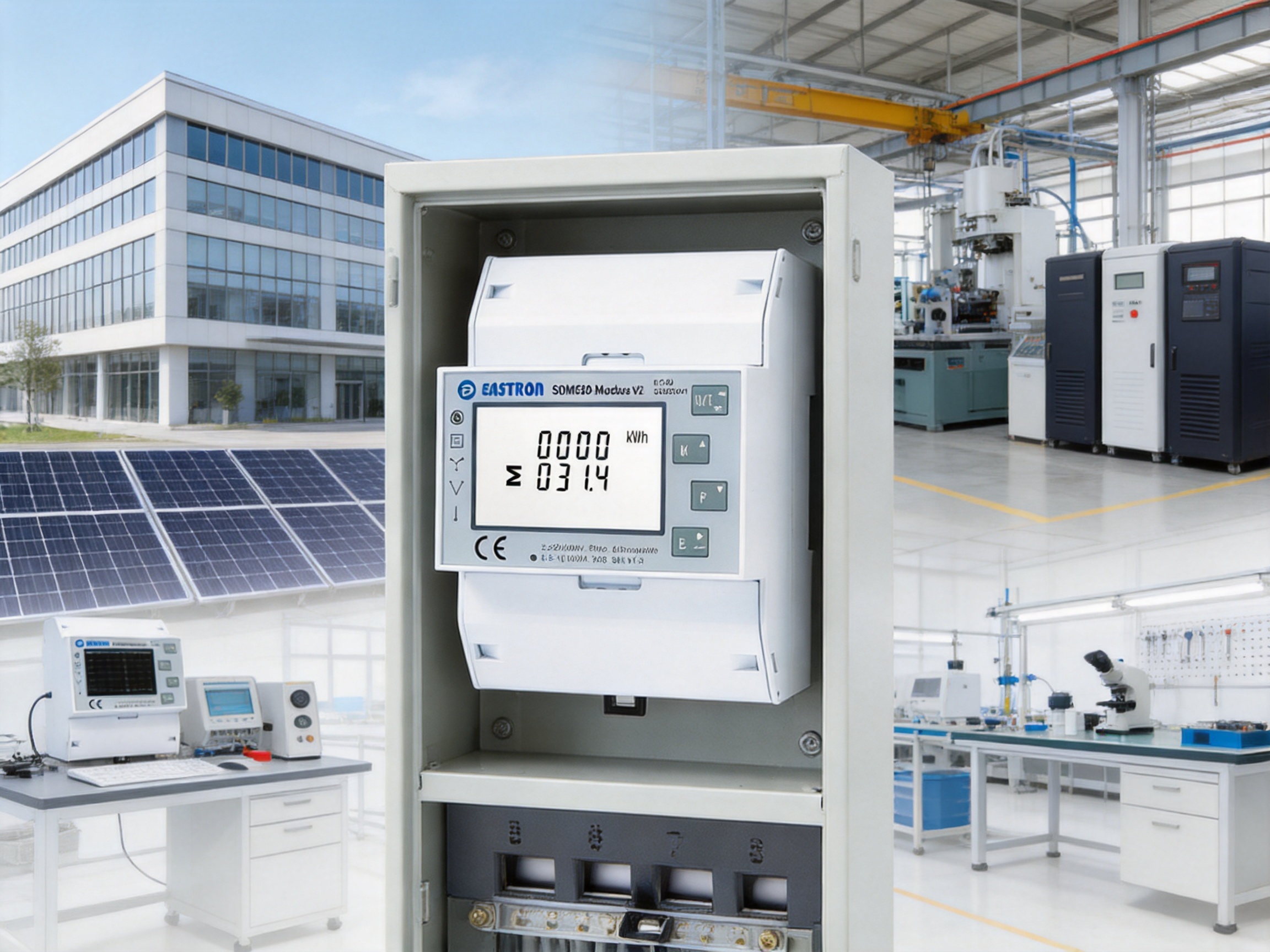
The RS485 100A DIN rail three-phase multifunction energy meter is a practical and advanced solution for modern power monitoring. Its direct 100A load capability, compact 4-module DIN rail design, support for 3P4W, 3P3W, and 1P2W systems, bi-directional measurement, pulse outputs, and RS485 Modbus RTU communication create a strong combination for commercial, industrial, and smart energy applications.
Its competitive advantage is not based on one feature alone. It comes from the way multiple practical benefits work together: simplified installation, reduced external accessory cost, broad measurement capability, flexible communication, reliable accuracy, and integration readiness. Compared with conventional basic meters, it provides deeper intelligence. Compared with CT-based solutions in suitable current ranges, it can reduce complexity and total installed cost. Compared with pulse-only meters, it enables richer digital monitoring.
The manufacturing and technical foundation behind the product further strengthens its value. Eastron Electronic Co., Ltd. brings experience in electricity meters, power analyzers, current sensors, communication modules, and management systems. Its R&D investment, in-house testing laboratory, patented technologies, ISO 9001 quality management, and SGS-approved MID production support reliable product development and manufacturing. For customers seeking a compact, capable, and integration-friendly three-phase energy meter, the SDM630-Modbus V2 offers a strong answer to modern energy measurement requirements.
International Electrotechnical Commission. IEC 62053-21: Electricity Metering Equipment, Particular Requirements for Static Meters for Active Energy.
International Electrotechnical Commission. IEC 62053-23: Electricity Metering Equipment, Particular Requirements for Static Meters for Reactive Energy.
European Committee for Standardization. EN 50470-1: Electricity Metering Equipment, General Requirements, Tests and Test Conditions.
European Committee for Standardization. EN 50470-3: Electricity Metering Equipment, Particular Requirements for Static Meters for Active Energy.
Modbus Organization. Modbus Application Protocol Specification.
International Organization for Standardization. ISO 9001: Quality Management Systems Requirements.
Product technical materials for SDM630-Modbus V2 three-phase multifunction energy meter.
Your email address will not be published. Required fields are marked *

We develop and produce high performance electricity meters, power analyzers, current sensors, communication modules and management systems. China Custom Smart Meters Manufacturers and Factory
Address:NO 52, Dongjin Road, Nanhu, Jiaxing, Zhejiang, China
Copyright @ Eastron Electronic Co., Ltd. All rights reserved Electricity Meters Manufacturers
