

 English
 Español
 Deutsch
 中文简体
中文简体

Product Consultation
Your email address will not be published. Required fields are marked *
Europe's Solar and Energy Storage Transition: Transforming the Power System Infrastructure for a Renewable Future
Jul 10,2026
Power Systems Are Becoming “Real-Time Systems”: Why Data Is More Critical Than Electricity
Jul 06,2026
New EPBD Regulations Drive HVAC Energy Transparency and Boost Demand for Smart Meters
Jul 07,2026Content
Modern electrical systems are becoming more distributed, more data-driven, and more demanding. Solar photovoltaic installations, smart buildings, industrial equipment, commercial distribution boards, electric heating systems, and multi-tenant facilities all require reliable measurement of voltage, current, power, frequency, power factor, and energy flow. A conventional energy meter can record consumption, but many applications now require much more: fast data updates, remote access, bi-directional energy measurement, flexible current transformer connection, and compatibility with automation platforms.
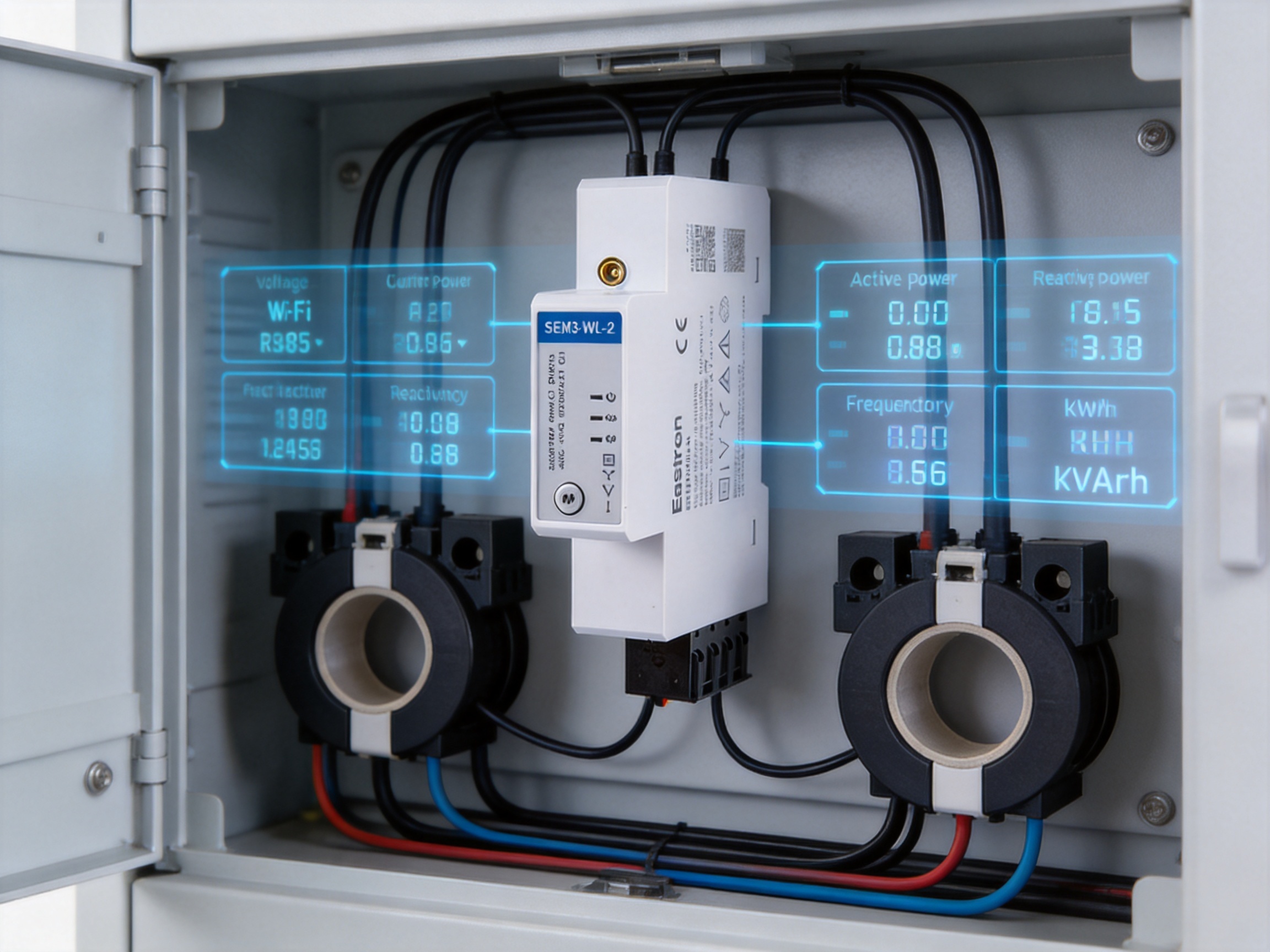
The Din Rail Three Phase Multi-function Wi-Fi Energy Meter with 3 in 1 CT, model SEM3-WL-2, is designed for this new generation of energy monitoring. It combines compact din rail installation, external CT connection, Wi-Fi communication, RS485 Modbus communication, multi-parameter measurement, import and export energy monitoring, and flexible use as either one three-phase meter or three independent single-phase meters. This makes it suitable for a wide range of power measurement scenarios where easy installation, accurate data, and communication flexibility are important.
Unlike simple kWh meters that focus only on accumulated energy, this meter is built as a multi-function monitoring device. It measures characteristics of 1P2W, 3P4W, and 3P3W supplies, including voltage, current, frequency, active power, reactive power, active energy, reactive energy, power factor, imported energy, and exported energy. Energy is recorded in kWh and kVArh, allowing users to understand both real energy consumption and reactive power behavior.
For installers and system integrators, one of the strongest advantages of the SEM3-WL-2 is its “easy connection solution” supported by a 3 in 1 CT approach. CT-based metering reduces the need for direct high-current wiring through the meter body, which is especially useful in retrofit projects, distribution boards, and applications where space and installation time matter. The meter’s ability to support 1 x three-phase measurement or 3 x single-phase load measurements adds another level of flexibility that many competing meters do not provide in the same compact format.
For building owners, energy managers, and equipment operators, the Wi-Fi and RS485 Modbus design is especially valuable. Wi-Fi communication supports Modbus TCP and enables convenient integration where wireless networking is preferred. RS485 supports Modbus RTU and remains the industry standard for robust wired communication over long distances, with a maximum transmission distance of up to 1000 m under appropriate conditions. With both communication options, the device can serve traditional automation systems and modern smart energy platforms at the same time.
Din Rail Three Phase Multi-function Wifi Energy Meter with 3 in 1 CT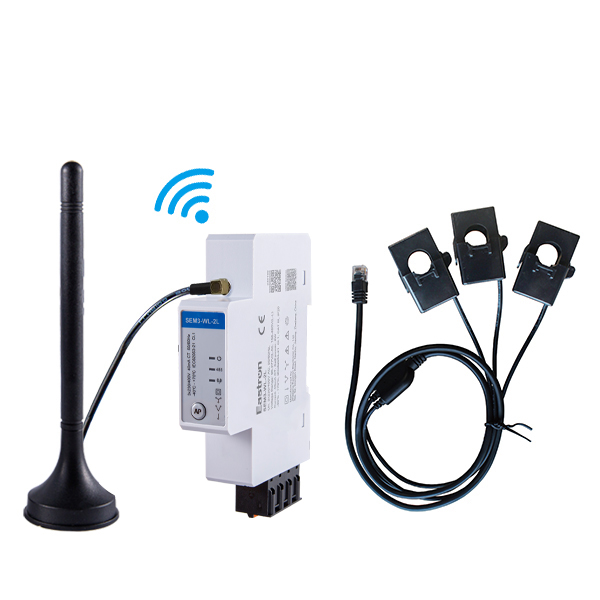
The SEM3-WL-2 belongs to the category of three-phase multi-function energy meters. It is not merely a billing-style kWh counter; it is a data collection device for energy monitoring and electrical performance analysis. Its compact din rail design makes it suitable for installation inside electrical panels, control cabinets, smart distribution boxes, renewable energy systems, and industrial equipment enclosures.
The meter is suitable for solar PV systems because it supports bi-directional measurement. In solar applications, power can flow from the grid to the load or from the PV system back toward the grid or local distribution network. A meter that can measure both imported and exported energy provides clearer insight into energy balance, self-consumption, and exported generation. This is a major advantage compared with one-way meters that only record consumption.
In smart buildings, the meter can monitor whole-building electrical supply, floor-level distribution, mechanical equipment, lighting panels, or tenant circuits. The ability to use the device as three independent single-phase meters is particularly useful in buildings where several separate single-phase loads must be measured but panel space is limited. In single-phase mode, three external CTs can be configured with different CT ratios, making the meter adaptable to loads of different sizes.
In industrial applications, the meter provides data for equipment energy monitoring, preventive maintenance, load balancing, and power quality awareness. Parameters such as current, voltage, frequency, power factor, active power, and reactive energy help operators identify overload conditions, inefficient equipment operation, abnormal phase imbalance, or unexpected energy use. The fast active power update rate, 50 ms through RS485 and 100 ms through Wi-Fi, supports responsive monitoring for applications where near-real-time power data is valuable.
For system integrators, the use of Modbus RTU and Modbus TCP is a practical advantage. Many building management systems, programmable logic controllers, industrial gateways, energy management platforms, and data acquisition systems already support Modbus. Because the meter communicates using established protocols, integration can be more straightforward than with proprietary communication systems that require special drivers or closed software ecosystems.
The first major advantage is communication versatility. Many competing meters offer either RS485 or Wi-Fi, but not always both in one compact meter. The SEM3-WL-2 provides RS485 Modbus RTU for stable wired communication and Wi-Fi Modbus TCP for convenient network integration. This dual communication approach gives engineers more freedom when designing a monitoring architecture. A wired RS485 bus may be used in industrial environments, while Wi-Fi may be used in buildings where cable routing is difficult or expensive.
The second advantage is flexible metering architecture. The meter can work as one three-phase meter or as three independent single-phase meters. In three-phase mode, it is suitable for 3P4W and 3P3W electrical systems. In single-phase mode, it can measure three separate 1P2W loads. This reduces the number of devices required in certain applications and may lower installation cost, wiring complexity, and panel space requirements.
The third advantage is the external CT connection solution. CT metering enables current measurement without routing the full load current directly through the meter. This can simplify installation, especially where existing cables are already in place. The 3 in 1 CT design improves connection convenience and helps reduce wiring clutter. In real projects, cleaner CT installation can reduce commissioning errors and improve long-term maintainability.
The fourth advantage is bi-directional measurement. Import and export active and reactive energy measurement is increasingly important as more sites adopt solar PV, battery storage, electric vehicle charging, and distributed generation. A meter that only measures one direction may fail to provide the complete energy picture. With bi-directional capability, the SEM3-WL-2 can help users understand both consumption and generation flow.
The fifth advantage is phase sequence automatic detection and alarm. Incorrect phase sequence can cause operational problems in three-phase systems, especially with motors and industrial machinery. The meter can detect reversed phase sequence and issue an alarm. The phase sequence can also be adjusted through communication, which can help commissioning teams resolve configuration issues efficiently.
The sixth advantage is broad parameter measurement. The meter measures RMS values including harmonics on three-phase AC systems. It provides power, voltage, current, frequency, power factor, active energy, and reactive energy. Multi-parameter visibility helps users move from simple energy recording to deeper electrical system understanding.
The seventh advantage is compact din rail mounting. Electrical panels are often crowded, and every module width matters. A compact din rail meter is easier to integrate into new designs and retrofit into existing cabinets. The combination of compact size, CT connection, and communication options makes the product practical for installers who need capability without excessive panel space consumption.
The SEM3-WL-2 is designed for three-phase AC systems including 3P and 3P+N configurations. It supports measurement of 1P2W, 3P4W, and 3P3W supplies. The rated input voltage is 3 x 230 V line-to-neutral and 400 V line-to-line. The working voltage range is 90 to 277 V AC line-to-neutral and 156 to 480 V AC line-to-line. The frequency range is 50/60 Hz.
For active energy, the meter provides Class 1 accuracy according to IEC 62053-21. Power accuracy is ±1%, reactive energy accuracy is ±2%, frequency accuracy is ±0.2%, voltage accuracy is ±0.5%, and power factor accuracy is ±0.1. Current measurement accuracy varies across the current range: ±0.5% from 4 A to 120 A, ±1% from 1 A to 4 A, and ±3% from 0.06 A to 1 A. These specifications provide a practical balance of accuracy and wide application coverage.
The RS485 interface uses Modbus RTU. It supports communication addresses from 1 to 247, half-duplex transmission, floating point data, a maximum transmission distance of 1000 m, baud rates from 2400 bps to 115200 bps, parity options of none, odd, or even, and one or two stop bits. The response time is less than 50 ms. These characteristics make it suitable for industrial control systems and energy management networks.
The Wi-Fi interface uses Modbus TCP. It operates in the 2.4 GHz to 2.5 GHz RF band, supports 802.11 b/g/n, and provides a Wi-Fi range of up to 30 m indoors and 50 m outdoors depending on local conditions. The maximum RF power is less than 20 dBm. Wi-Fi communication allows easier access in locations where wired communication may be difficult, while Modbus TCP keeps the data structure familiar to system integrators.
Feature |
SEM3-WL-2 Capability |
Practical Benefit |
Installation Type |
Din rail mounted, compact design |
Fits easily into distribution boards and control panels |
Current Measurement |
External CT connection with 3 in 1 CT solution |
Simplifies wiring and supports retrofit installation |
Operating Modes |
1 x three-phase meter or 3 x single-phase meters |
Reduces device count and improves application flexibility |
Communication |
Wi-Fi Modbus TCP and RS485 Modbus RTU |
Supports both wireless and wired integration |
Energy Flow |
Bi-directional import and export measurement |
Suitable for solar PV, distributed generation, and storage systems |
Accuracy |
Class 1 active energy according to IEC 62053-21 |
Provides dependable energy monitoring data |
Data Update |
Active power update of 50 ms by RS485 and 100 ms by Wi-Fi |
Enables responsive monitoring and system analysis |
Phase Sequence |
Automatic detection and alarm |
Helps identify wiring errors during commissioning |
Communication is one of the most important differences between a basic meter and a smart energy monitoring device. The SEM3-WL-2 includes both Wi-Fi and RS485, giving users two practical pathways for data transmission. This is an important advantage over meters that provide only pulse output, only wired communication, or only wireless connectivity.
RS485 remains widely used because it is robust, cost-effective, and suitable for long-distance communication. In electrical rooms, industrial plants, and building automation networks, RS485 can connect multiple meters on the same bus and transmit data over long cable runs. With support for addresses from 1 to 247 and baud rates up to 115200 bps, the meter can be adapted to many network requirements. The half-duplex Modbus RTU structure is familiar to engineers, technicians, and software developers.
Wi-Fi adds another layer of convenience. Many retrofit projects face obstacles such as finished walls, long cable routes, limited conduits, or installation restrictions. Wireless communication can reduce the need for additional communication cabling. Because the meter supports Modbus TCP, data can be accessed using a widely recognized protocol rather than a limited proprietary format. This can reduce integration time and provide greater freedom when connecting to gateways, local monitoring systems, or cloud-connected platforms.
The combination of Wi-Fi and RS485 also supports redundancy and project flexibility. A system integrator may use RS485 for primary data collection and Wi-Fi for setup, diagnostics, or local access. Alternatively, a small building may use Wi-Fi from the beginning, while a larger facility may use RS485 for centralized acquisition. This flexibility helps the same meter fit multiple project types, reducing inventory complexity for distributors and contractors.
Compared with competitors that require separate communication modules or gateway accessories, an integrated communication design can simplify procurement and reduce installation complexity. Fewer accessories can mean fewer compatibility questions, fewer wiring points, and a cleaner panel layout. For customers managing multiple projects, this can translate into smoother deployment and easier standardization.
One of the most distinctive features of the SEM3-WL-2 is its ability to operate as either one three-phase meter or three independent single-phase meters. This feature increases the value of the device in applications where load arrangements may vary.
In a standard three-phase application, the meter can monitor a 3P4W or 3P3W supply. It can record the overall energy use of a three-phase load or distribution feeder and provide phase-level data. This is suitable for machinery, HVAC systems, commercial distribution, industrial panels, and building main feeds.
In single-phase mode, the meter can measure three independent 1P2W loads. Each external CT can be set with a different CT ratio, allowing three loads with different current capacities to be monitored from one meter. This feature is useful in multi-circuit monitoring, apartment service panels, equipment groups, and commercial tenant circuits.
Many conventional meters force the user to choose between a three-phase meter or several single-phase meters. If three separate single-phase loads must be monitored, three devices may be required. That approach consumes more panel space, increases wiring time, and adds communication addresses. The SEM3-WL-2 can reduce this complexity by combining the capability into a single compact unit.
This flexibility also improves future-proofing. A panel may initially require three single-phase measurements but later be reconfigured for one three-phase load. Or a three-phase monitoring point may be repurposed for separate branch circuits. A flexible meter can adapt to changes more easily than a fixed-purpose device.
Energy systems are no longer defined only by one-way power flow from the utility grid to the load. Solar PV systems generate power locally. Battery storage may charge and discharge at different times. Electric vehicle chargers can create new load profiles. Smart buildings may use energy management systems to shift consumption based on tariffs, demand limits, or on-site generation.
In this environment, bi-directional energy measurement is essential. The SEM3-WL-2 measures imported and exported active and reactive energy. This means it can record energy consumed from the grid as well as energy exported from a local generation source. For solar PV monitoring, this helps users understand how much energy is used locally and how much is sent outward. For facility management, it helps separate consumption from generation and provides better data for energy optimization.
Reactive energy measurement is also important. Reactive power does not perform useful work in the same way as active power, but it affects current flow, system capacity, and power factor. Monitoring reactive energy in kVArh can help identify loads that may require power factor correction or operational review. In industrial and commercial environments, this can be relevant for efficiency and utility tariff management.
Compared with meters that only measure active imported kWh, the SEM3-WL-2 provides a more complete picture of electrical behavior. This is especially useful for consultants, energy auditors, and automation engineers who need more than a monthly energy total. Detailed multi-parameter data supports better decisions.
Phase sequence is a practical issue in three-phase electrical systems. If phase order is incorrect, certain equipment, especially motors, can rotate in the wrong direction or operate improperly. During installation and commissioning, identifying phase sequence problems quickly can prevent equipment damage, downtime, and troubleshooting delays.
The SEM3-WL-2 includes phase sequence automatic detection and alarm capability. If the phase sequence is reversed, the meter can issue an alarm. The phase sequence can also be adjusted through communication. This feature helps installers verify wiring and improves commissioning efficiency.
In competitive terms, phase sequence detection is a meaningful differentiator. Basic meters may require installers to use separate phase rotation testers or rely on manual checks. A meter with built-in detection can reduce the risk of overlooked wiring errors. In complex panels with multiple circuits, this can be especially valuable.
The ability to adjust phase sequence through communication also supports remote configuration and system management. In a connected monitoring environment, not every correction requires physical interaction with the meter. This aligns with the broader goal of smart energy systems: better information, fewer manual steps, and faster response.
Energy data is only useful if it is reliable. The SEM3-WL-2 provides Class 1 active energy accuracy according to IEC 62053-21. This level of accuracy is suitable for many monitoring, allocation, efficiency analysis, and equipment energy management applications. The meter also provides defined accuracy for power, reactive energy, voltage, current, frequency, and power factor.
The current accuracy specification is particularly practical because it identifies different accuracy levels across different current ranges. From 4 A to 120 A, current accuracy is ±0.5%. From 1 A to 4 A, it is ±1%. From 0.06 A to 1 A, it is ±3%. This transparent specification helps engineers evaluate suitability for their expected load profile. Many real systems operate across changing current levels, so understanding measurement performance at low and high current is important.
RMS measurement including harmonics is also important. Electrical systems frequently include non-linear loads such as variable frequency drives, LED lighting drivers, switch-mode power supplies, inverters, and electronic equipment. These loads can create harmonic distortion. RMS measurement including harmonics provides a more realistic view of electrical conditions than simple sinusoidal assumptions.
Fast active power update rates further support monitoring reliability. With 50 ms updates via RS485 and 100 ms updates via Wi-Fi, the meter can provide responsive power data. This is valuable for equipment behavior analysis, demand tracking, control optimization, and event observation. While energy totals are important, fast power data gives users insight into dynamic changes.
Current transformer connection is a major practical advantage in many installations. Direct-connected meters require load current to pass through the meter terminals. This can be appropriate for lower-current circuits, but it may be less convenient for higher-current feeders, retrofit installations, or panels where conductor routing is difficult. CT connection allows the meter to measure current indirectly through external current transformers.
The SEM3-WL-2 uses CT connection and promotes an easy connection solution with a 3 in 1 CT approach. For installers, this can reduce installation time and improve panel organization. Instead of routing large conductors into the meter, CTs can be installed around existing conductors where appropriate. This is especially useful when upgrading an existing electrical system to include monitoring.
A cleaner CT solution can also reduce wiring errors. In multi-phase systems, incorrect CT orientation, phase mismatch, or reversed polarity can create incorrect readings. The product’s focus on easy connection, combined with phase sequence detection, helps address real-world installation challenges. The result is a more installer-friendly metering solution.
Compared with competitors that require separate CTs with complex terminal wiring, a simplified CT approach can offer a significant advantage. Electrical contractors value products that are clear, compact, and easy to commission. Reduced labor time can be as important as hardware cost, especially in commercial or industrial projects with many monitoring points.
Solar PV systems require accurate measurement of power flow. A site may consume power from the grid, generate power from solar panels, export surplus energy, or operate in combination with storage. The SEM3-WL-2 supports bi-directional measurement, making it suitable for monitoring import and export energy in such systems.
In a solar installation, the meter can help identify whether generated energy is being consumed on site or exported. This information supports energy optimization strategies such as shifting loads to daylight hours, adjusting battery operation, or evaluating return on investment. If connected through Modbus, the data can be used by an energy management platform or local gateway.
Wi-Fi communication can be useful in smaller solar installations where running RS485 cable is inconvenient. RS485 remains valuable in larger sites where many devices are connected to a central controller. The availability of both communication methods gives solar integrators more freedom.
Because solar systems often involve inverters and other electronic equipment, RMS measurement including harmonics and multi-parameter visibility can provide useful system insight. Voltage, frequency, current, and power factor data can help diagnose abnormal operating conditions or verify system performance.
Smart buildings depend on data. Energy monitoring allows building managers to understand where electricity is used, when peak demand occurs, and how operational changes affect consumption. The SEM3-WL-2 fits smart building applications because it combines compact installation, multi-load flexibility, and communication options.
In a commercial building, the meter can monitor main distribution, sub-panels, HVAC systems, lighting circuits, elevators, pumps, or tenant loads. When used as three independent single-phase meters, it can measure multiple branch loads with one device. This reduces panel space and simplifies communication addressing.
Data from the meter can support building management systems through Modbus RTU or Modbus TCP. Facility managers can use the information to identify abnormal consumption, compare equipment performance, allocate energy costs, or verify savings after efficiency upgrades. For example, if a ventilation system consumes more energy than expected outside operating hours, meter data can help identify scheduling problems.
Wi-Fi communication is particularly attractive for retrofit smart building projects. Existing buildings may not have spare communication conduits. Wireless access can reduce disruption and installation cost. At the same time, RS485 remains available for new construction or large integrated systems.
Industrial equipment often requires detailed power monitoring. Motors, drives, compressors, heaters, pumps, and production machinery can have changing load profiles. Monitoring voltage, current, active power, reactive power, frequency, and power factor helps operators understand equipment operation and detect abnormal conditions.
The SEM3-WL-2 can be installed in control panels to monitor individual machines or groups of equipment. The compact din rail design is suitable for cabinet installation, while CT connection helps avoid routing heavy load conductors through the meter. Fast power updates can support process monitoring and energy performance analysis.
In industrial automation, Modbus RTU over RS485 is a widely accepted communication standard. The meter’s address range, baud rate options, parity settings, and floating point data format make it adaptable to many control networks. For industrial users who already collect data from PLCs or gateways, adding the meter can be relatively straightforward.
Phase sequence detection is also valuable in industrial environments. Reversed phase sequence can affect motor direction and machine behavior. Built-in alarm capability helps commissioning teams identify issues quickly. This can reduce downtime and avoid costly mistakes.
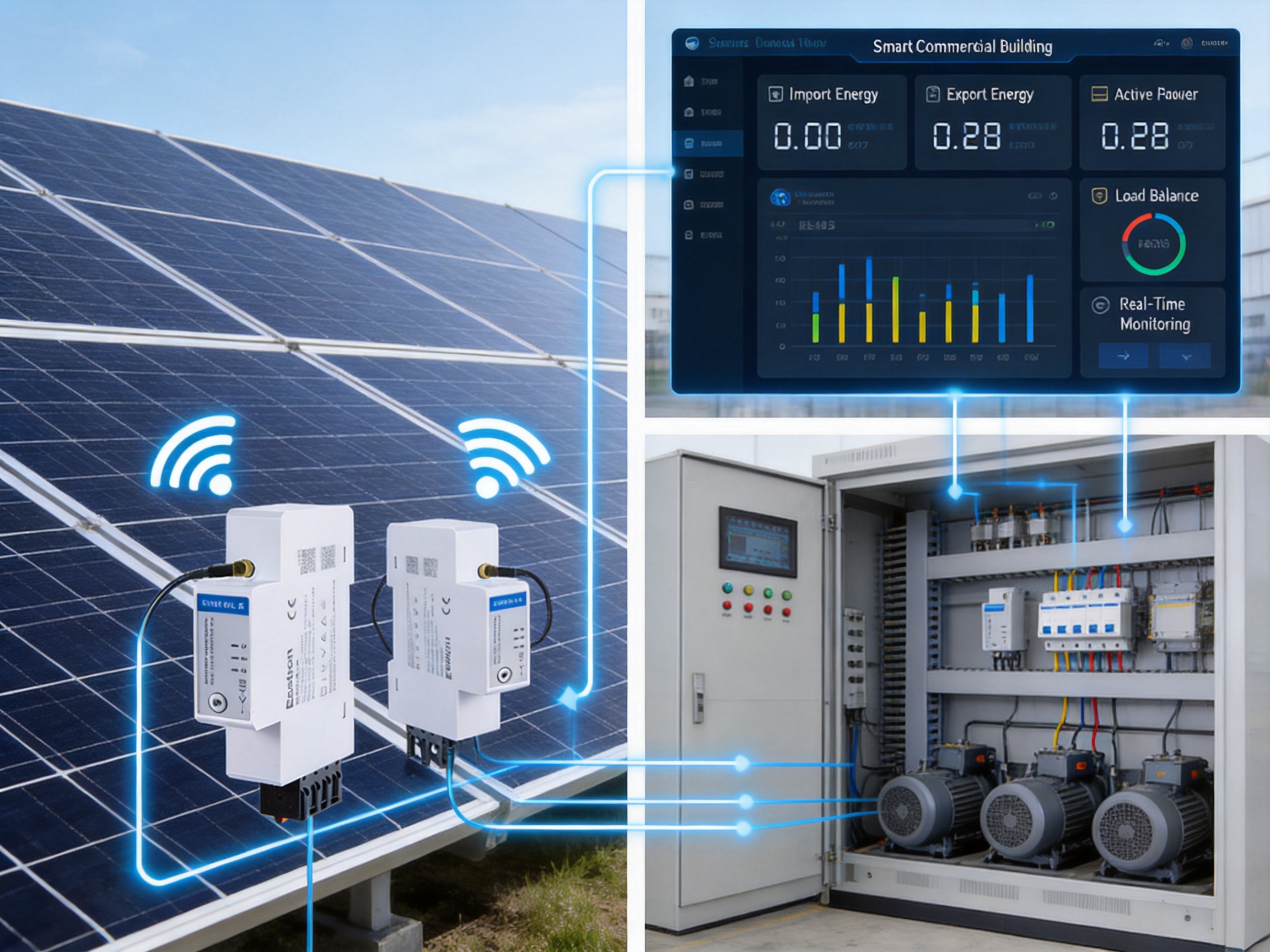
When comparing the SEM3-WL-2 with competing energy meters, several practical advantages stand out. The first is the combination of Wi-Fi and RS485 in one meter. Some meters require users to choose between wireless convenience and wired reliability. Others require separate external gateways or communication modules. By integrating both Modbus TCP and Modbus RTU communication, the SEM3-WL-2 reduces compromise.
The second advantage is operating mode flexibility. A conventional three-phase meter usually cannot be used as three independent single-phase meters. A conventional single-phase meter cannot monitor a three-phase supply. The SEM3-WL-2 can serve both use cases. For distributors, this means one model can cover more application scenarios. For installers, it means more options during commissioning. For end users, it means better adaptability if the electrical layout changes.
The third advantage is the 3 in 1 CT easy connection solution. Many meters with external CTs still require time-consuming wiring and careful terminal management. A product designed around easier CT connection can reduce installation effort and improve consistency. In projects with multiple meters, this installation advantage can become significant.
The fourth advantage is bi-directional measurement. As renewable energy and distributed generation become more common, one-way meters are increasingly limited. A meter that measures both import and export is more suitable for modern energy systems. It can support solar PV monitoring, storage integration, and load-generation balancing.
The fifth advantage is phase sequence automatic detection. This is a practical commissioning feature that many basic meters do not include. It provides extra confidence during installation and can help avoid operational problems in three-phase systems.
The sixth advantage is strong protocol compatibility. Modbus is widely used across automation, metering, and energy management. A meter using Modbus RTU and Modbus TCP can communicate with many existing systems. This reduces the risk of vendor lock-in and supports long-term system maintainability.
The seventh advantage is transparent technical performance. Specifications such as voltage range, frequency range, communication speed, response time, RF band, Wi-Fi protocol, and measurement accuracy are clearly defined. Engineers need this information to design reliable systems. Clear specifications are a sign of a product intended for professional applications.
A high-quality energy meter depends not only on design but also on manufacturing capability, test systems, quality management, and long-term technical expertise. Eastron Electronic Co., Ltd. is headquartered in Jiaxing, China, near Shanghai, Hangzhou, and Jiangsu. The company develops and produces electricity meters, power analyzers, current sensors, communication modules, and energy management systems.
The company has built a broad product portfolio across electronic kWh meters, multi-function energy meters, MID energy meters, ETL energy meters, DC energy meters, power analyzers, systems and solutions, current transformers, relays and switches, PTB and Eichrecht energy meters, UL and ETL energy meters, and gateways. This broad experience is important because modern energy meters combine measurement electronics, communication technology, embedded software, current sensing, enclosure design, and compliance engineering.
Research and development is a central strength. The company continues to invest in new technologies and new products for electricity metering. Development teams in China and the United Kingdom contribute to product innovation and competitiveness. Cooperation with universities and professional institutions helps bring advanced technologies into the product line. For a device such as the SEM3-WL-2, this R&D foundation supports the integration of metering accuracy, communication protocols, embedded software, and practical installation design.
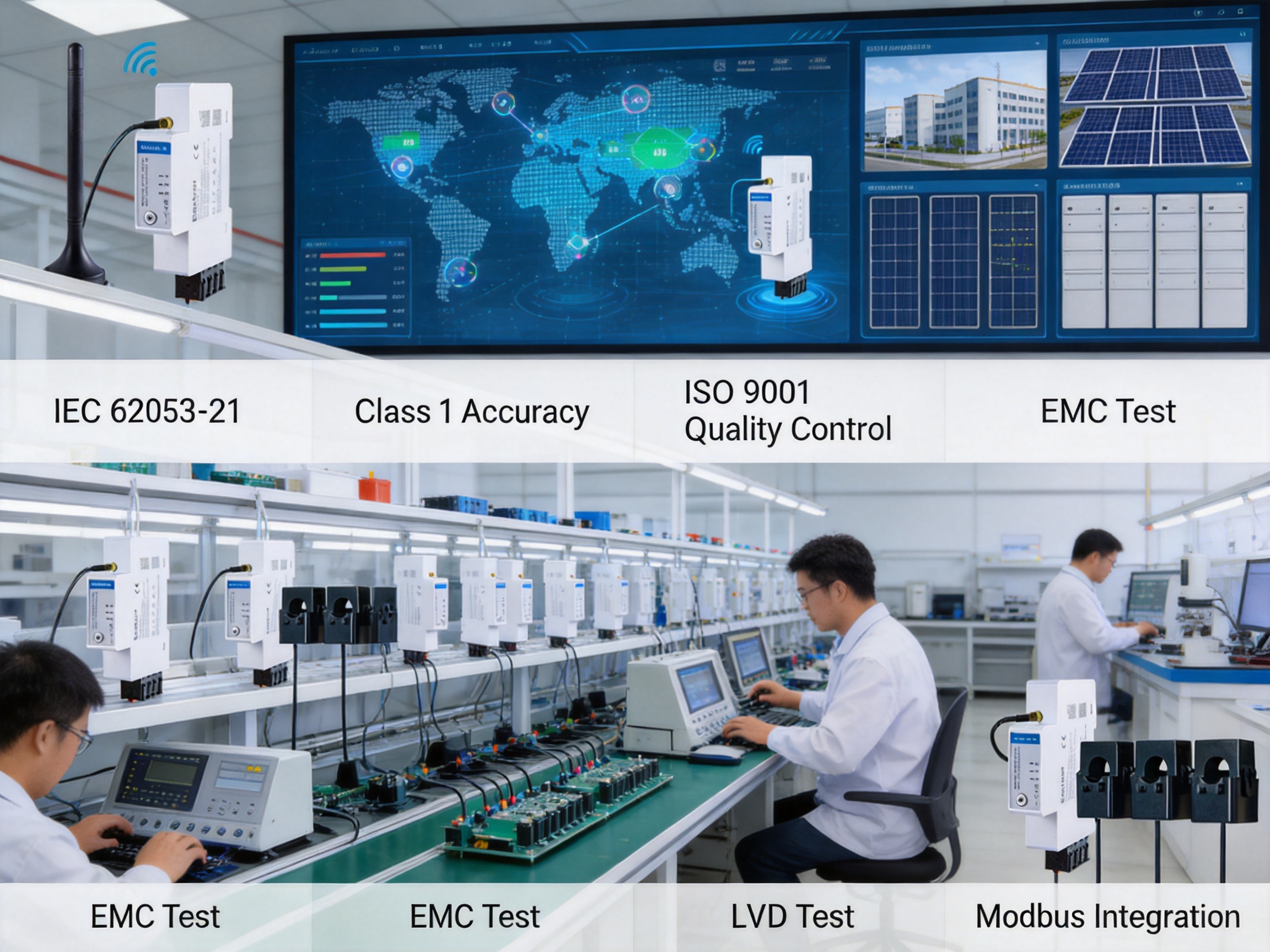
Testing capability is another major advantage. The company has established a professional laboratory capable of performing EMC, LVD, accuracy, and environmental tests according to IEC, EN, GB, and UL standards. This matters because energy meters operate in electrically noisy environments, must maintain measurement stability, and must withstand real installation conditions. EMC testing helps verify resistance to electromagnetic disturbance. LVD-related testing supports electrical safety. Accuracy testing verifies measurement performance. Environmental testing helps evaluate behavior under temperature and humidity conditions.
Quality management provides another layer of reliability. The company follows the ISO 9001 quality management system, and its production has been approved by SGS according to MID standards. While individual product certification requirements vary by model and market, this manufacturing background reflects an organized approach to quality control, process management, and compliance readiness.
The company also holds patented technologies in software, embedded software, and hardware. This is relevant because smart meters are not simple electromechanical devices. They rely on measurement algorithms, communication firmware, data registers, calibration processes, user configuration, and electrical design. Patented technology and embedded software expertise help support product differentiation and long-term development.
Reliable energy meters require consistent manufacturing. Components must be selected carefully, circuit boards must be assembled accurately, firmware must be loaded and verified, measurement channels must be calibrated, communication interfaces must be checked, and final products must pass inspection before shipment. A manufacturer with mature production processes can deliver more consistent product quality than suppliers focused only on low-cost assembly.
For a multi-function meter such as the SEM3-WL-2, production quality is especially important because the device combines several functional systems. The voltage measurement circuit must be stable. The current input and CT interface must be correctly calibrated. The RS485 interface must communicate reliably. The Wi-Fi module must perform within RF specifications. The embedded software must correctly calculate and store data. The enclosure and terminals must fit panel installation requirements. Any weakness in one area can affect the user experience.
Professional laboratory testing supports this process. Accuracy testing ensures that the meter meets specified performance. EMC testing helps verify that communication and measurement remain reliable in the presence of electrical interference. Environmental testing helps ensure that the product can operate under expected field conditions. Safety-related testing supports user protection and regulatory compliance.
Process control also matters during calibration. Energy meters must translate electrical signals into reliable data. Calibration procedures help align measurement results with reference standards. A strong manufacturing organization uses defined procedures, trained staff, controlled equipment, and traceable test methods. This improves consistency from one production batch to another.
The company’s international experience is also relevant. Products and services have been supplied to more than 50 countries across Europe, Asia-Pacific, America, the Middle East, and Africa. Different markets have different expectations for documentation, compliance, communication practices, and technical support. Experience across many regions helps the company understand practical customer requirements and develop products that are easier to deploy globally.
The SEM3-WL-2 becomes most powerful when connected to a larger energy management or automation system. Through Modbus RTU or Modbus TCP, measured parameters can be collected by gateways, PLCs, building management systems, supervisory software, or cloud-connected platforms. The data can then be visualized, analyzed, stored, or used for control decisions.
Common uses include energy dashboards, alarm systems, peak demand analysis, load profiling, solar self-consumption monitoring, equipment efficiency tracking, tenant energy allocation, and maintenance diagnostics. Because the meter provides multiple electrical parameters, users can correlate energy consumption with voltage, current, power factor, and reactive power. This gives more insight than a simple pulse output meter.
The floating point data type helps simplify interpretation in software systems. Instead of requiring complicated scaling conversions in every case, floating point values can be easier for integrators to process. This reduces development time and improves readability in monitoring applications.
RS485 communication supports long cable distances and multi-device networks, making it suitable for larger installations. Wi-Fi communication supports easier deployment where wireless infrastructure is available. The ability to use both communication forms allows a system designer to choose the best architecture for each project.
For example, a commercial building may use RS485 meters in the main electrical room and Wi-Fi meters in remote tenant panels where cable installation is difficult. A solar installer may use Wi-Fi for a small site and RS485 for a larger installation with multiple measurement points. An industrial equipment manufacturer may use RS485 inside a machine cabinet and Wi-Fi for service access during testing.
Energy measurement is the first step toward energy management. Without reliable data, it is difficult to identify waste, verify savings, or optimize operation. The SEM3-WL-2 helps users collect detailed energy data at the circuit or equipment level.
For facility managers, the meter can reveal when energy is consumed outside normal operating hours. It can show whether loads are balanced across phases. It can help identify equipment that consumes more power than expected. It can support internal cost allocation and sustainability reporting.
For industrial users, the meter can support production energy intensity analysis. By comparing energy consumption with production output, operators can evaluate efficiency. Changes in current or power factor may indicate equipment wear, process changes, or maintenance needs. Reactive energy data can support power factor improvement projects.
For renewable energy users, import and export data can support self-consumption optimization. If exported energy is high while grid import remains high at other times, storage or load shifting may be beneficial. If power flow patterns change unexpectedly, the data can help identify inverter, load, or configuration issues.
For system integrators, the meter provides a standardized data source that can be used across many applications. Its combination of Modbus RTU and Modbus TCP makes it easier to connect to existing software and hardware ecosystems. This reduces integration risk and supports scalable project design.
Good product design is not only about specifications. It is also about how easily the product can be installed, configured, diagnosed, and maintained. The SEM3-WL-2 is designed with practical installation needs in mind.
The compact din rail form allows the meter to be installed in standard electrical panels. CT connection reduces the need to route full load current through the meter. The easy connection solution helps reduce wiring complexity. Phase sequence automatic detection helps identify wiring issues. Communication options allow local and remote access to data. These features help contractors complete projects more efficiently.
Maintenance teams also benefit from multi-parameter visibility. If a load is behaving abnormally, technicians can review voltage, current, power, power factor, and energy data. If communication problems occur, the availability of both RS485 and Wi-Fi may provide alternative diagnostic pathways. If system configuration changes, the ability to operate as three-phase or multiple single-phase measurement provides flexibility.
Compared with low-cost meters that provide limited data and limited communication, a multi-function meter can reduce the need for additional diagnostic instruments. While handheld instruments remain important for troubleshooting, permanently installed monitoring provides continuous visibility and historical context.
When selecting an energy meter, engineers should consider the electrical system type, voltage range, current measurement method, required accuracy, communication protocol, installation space, environmental conditions, and data requirements. The SEM3-WL-2 is especially suitable when a project needs three-phase or multi-circuit single-phase measurement, CT connection, compact din rail mounting, Wi-Fi and RS485 communication, bi-directional measurement, and multi-parameter data.
For applications requiring legal metrology billing certification, users should confirm the required certification for the specific market and use case. The SEM3-WL-2 provides Class 1 active energy accuracy according to IEC 62053-21, but billing and revenue-grade requirements can vary by country and regulation. For monitoring, control, energy analysis, and internal allocation, the product’s feature set offers strong practical value.
Users should also consider Wi-Fi environment quality. The specified Wi-Fi range is up to 30 m indoors and 50 m outdoors depending on local conditions. Actual range may be affected by walls, metal enclosures, interference, router placement, and site layout. In electrically harsh or long-distance installations, RS485 may be the preferred primary communication method.
CT selection and configuration should be performed carefully. Correct CT ratio, orientation, and phase matching are essential for accurate readings. The meter’s easy connection solution helps simplify installation, but good electrical practice remains important. Installers should follow wiring instructions, safety standards, and commissioning procedures.
The SEM3-WL-2 stands out because it addresses several real-world needs at the same time. It is compact, but multi-functional. It supports three-phase systems, but can also monitor three single-phase loads. It provides Wi-Fi, but does not abandon RS485. It measures imported energy, but also exported energy. It offers fast data updates, but remains compatible with standard Modbus protocols. It simplifies CT connection, but still provides a professional level of measurement detail.
This combination makes the meter useful for a broad range of customers. Electrical contractors can reduce installation complexity. System integrators can connect data through standard protocols. Facility managers can gain detailed energy insight. Solar installers can monitor import and export. Industrial users can track equipment performance. Distributors can offer one flexible product for many applications.
The product is also supported by a manufacturer with broad experience in electricity metering and energy measurement solutions. Eastron’s product range, R&D capability, professional laboratory, ISO 9001 quality management, SGS MID production approval, patented technologies, and international market experience all contribute to the credibility behind the meter. In a market where reliability and long-term support matter, manufacturing strength is a key advantage.
Competitor products may offer some of the same features individually, but the value of the SEM3-WL-2 lies in how many practical requirements it integrates into one device. A meter that reduces installation effort, supports modern communication, adapts to different load types, and provides detailed measurement can deliver a lower total cost of ownership even when the purchase decision is based on more than the unit price.
It is a din rail mounted three-phase multi-function Wi-Fi energy meter with CT connection. It is designed for energy monitoring, multi-parameter electrical measurement, and integration with smart energy systems.
Yes. It can be used as one three-phase energy meter or as three individual single-phase energy meters. In single-phase mode, three external CTs can be set with different CT ratios for three independent loads.
It supports RS485 Modbus RTU and Wi-Fi Modbus TCP. RS485 is suitable for stable wired communication, while Wi-Fi is useful for wireless network integration.
Bi-directional measurement allows the meter to record both imported and exported energy. This is important for solar PV systems, distributed generation, battery storage applications, and any site where power may flow in more than one direction.
It measures voltage, current, frequency, active power, reactive power, active energy, reactive energy, power factor, imported energy, and exported energy. Energy is measured in kWh and kVArh.
The meter provides Class 1 active energy accuracy according to IEC 62053-21. It also provides specified accuracy for power, voltage, current, frequency, reactive energy, and power factor.
The 3 in 1 CT solution helps simplify installation and reduce wiring complexity. CT connection is useful in retrofit projects and higher-current circuits because the load current does not need to pass directly through the meter body.
Yes. It includes phase sequence automatic detection and alarm. If the phase sequence is reversed, the meter can issue an alarm, helping installers identify problems during commissioning.
Yes. It is suitable for smart buildings because it provides compact din rail installation, multiple measurement parameters, flexible three-phase or single-phase operation, and Modbus communication for integration with building management systems.
Yes. It can monitor voltage, current, power, frequency, power factor, and energy use in industrial equipment and control panels. RS485 Modbus RTU is especially useful in industrial automation environments.
Basic kWh meters often measure only accumulated energy. This meter provides multi-parameter measurement, Wi-Fi and RS485 communication, CT connection, bi-directional energy measurement, fast power updates, and flexible operating modes.
The product is supported by a manufacturer with extensive experience in electricity meters and energy measurement solutions, R&D teams in China and the United Kingdom, a professional laboratory for EMC, LVD, accuracy, and environmental testing, ISO 9001 quality management, SGS MID production approval, patented technologies, and international market experience.
The Din Rail Three Phase Multi-function Wi-Fi Energy Meter with 3 in 1 CT is a practical and advanced solution for modern energy monitoring. It combines the features that today’s electrical systems increasingly require: compact installation, CT-based easy connection, three-phase and single-phase flexibility, bi-directional measurement, multi-parameter data, Wi-Fi Modbus TCP, RS485 Modbus RTU, fast data updates, and phase sequence detection.
Its advantages are especially clear in solar PV systems, smart buildings, industrial equipment monitoring, commercial distribution boards, and retrofit energy management projects. By allowing one device to serve multiple measurement roles, the SEM3-WL-2 can reduce panel space, simplify installation, and improve system design flexibility. By supporting both wired and wireless Modbus communication, it can connect to a wide range of automation and energy management platforms.
Beyond the product itself, the manufacturing foundation behind it adds important value. Eastron Electronic Co., Ltd. brings broad metering experience, advanced R&D capability, professional testing infrastructure, quality management systems, and international market knowledge. These strengths support product reliability and long-term usability.
For users seeking more than a basic energy counter, this meter offers a strong balance of measurement performance, installation convenience, communication flexibility, and application adaptability. It is well aligned with the future of electrical energy management, where accurate data, easy integration, and intelligent monitoring are essential.
IEC 62053-21, Electricity Metering Equipment: Static Meters for Active Energy, Classes 1 and 2.
IEC Standards for Electrical Measurement, Safety, and Electromagnetic Compatibility in Low-Voltage Equipment.
Modbus Organization, Modbus Application Protocol Specification.
International Energy Agency, Energy Efficiency and Digitalization Reports.
Building Energy Management Systems: Principles, Practices, and Integration Methods.
Power Measurement Handbook for Industrial and Commercial Electrical Systems.
Smart Metering and Energy Monitoring Technologies for Distributed Energy Resources.
Your email address will not be published. Required fields are marked *

We develop and produce high performance electricity meters, power analyzers, current sensors, communication modules and management systems. China Custom Smart Meters Manufacturers and Factory
Address:NO 52, Dongjin Road, Nanhu, Jiaxing, Zhejiang, China
Copyright @ Eastron Electronic Co., Ltd. All rights reserved Electricity Meters Manufacturers
