

 English
 Español
 Deutsch
 中文简体
中文简体

Product Consultation
Your email address will not be published. Required fields are marked *
Europe's Solar and Energy Storage Transition: Transforming the Power System Infrastructure for a Renewable Future
Jul 10,2026
Power Systems Are Becoming “Real-Time Systems”: Why Data Is More Critical Than Electricity
Jul 06,2026
New EPBD Regulations Drive HVAC Energy Transparency and Boost Demand for Smart Meters
Jul 07,2026Content
In modern residential, utility, commercial, and light industrial electrical installations, energy measurement is no longer limited to reading kilowatt-hours at the end of a billing cycle. Facility owners, solar photovoltaic operators, property managers, energy service companies, and equipment manufacturers increasingly require meters that can measure multiple electrical parameters, communicate data efficiently, support bidirectional energy flow, and comply with recognized accuracy and regulatory standards. The WiFi communication single-phase DIN rail MID energy meter described in this article is designed for exactly this environment: compact installation, dependable measurement, certified metering performance, and convenient wireless data access.
The product is a single-phase DIN rail energy meter with WiFi communication, 100A direct load capability, two pulse outputs, LCD display with backlight, and MID approval. It supports measurement of active energy, voltage, current, active power, reactive power, apparent power, power factor, frequency, demand, and related electrical parameters. Its bidirectional measurement function makes it suitable for both consumption and generation monitoring, especially in solar PV metering applications where energy may flow from the grid to the load or from the generation system back toward the grid.
Unlike basic single-function electricity meters, this meter combines regulatory compliance, communication convenience, space-saving design, and multi-parameter monitoring in one device. Its 2-module, 36 mm DIN rail width is valuable where panel space is limited, while its 100A direct connection reduces the need for external current transformers in many common single-phase applications. For installers and system integrators, this can mean simpler wiring, fewer components, lower installation time, and a neater distribution board layout.
Beyond the product itself, the value of this energy meter is strengthened by the manufacturer’s experience in electricity metering, power analyzers, current sensors, communication modules, and energy management systems. The company maintains advanced research and development teams, testing capability for EMC, LVD, accuracy, environmental performance, and compliance with IEC, EN, GB, and UL-related standards. This background helps ensure that the product is not just a measurement device, but part of a mature and reliable energy measurement solution.
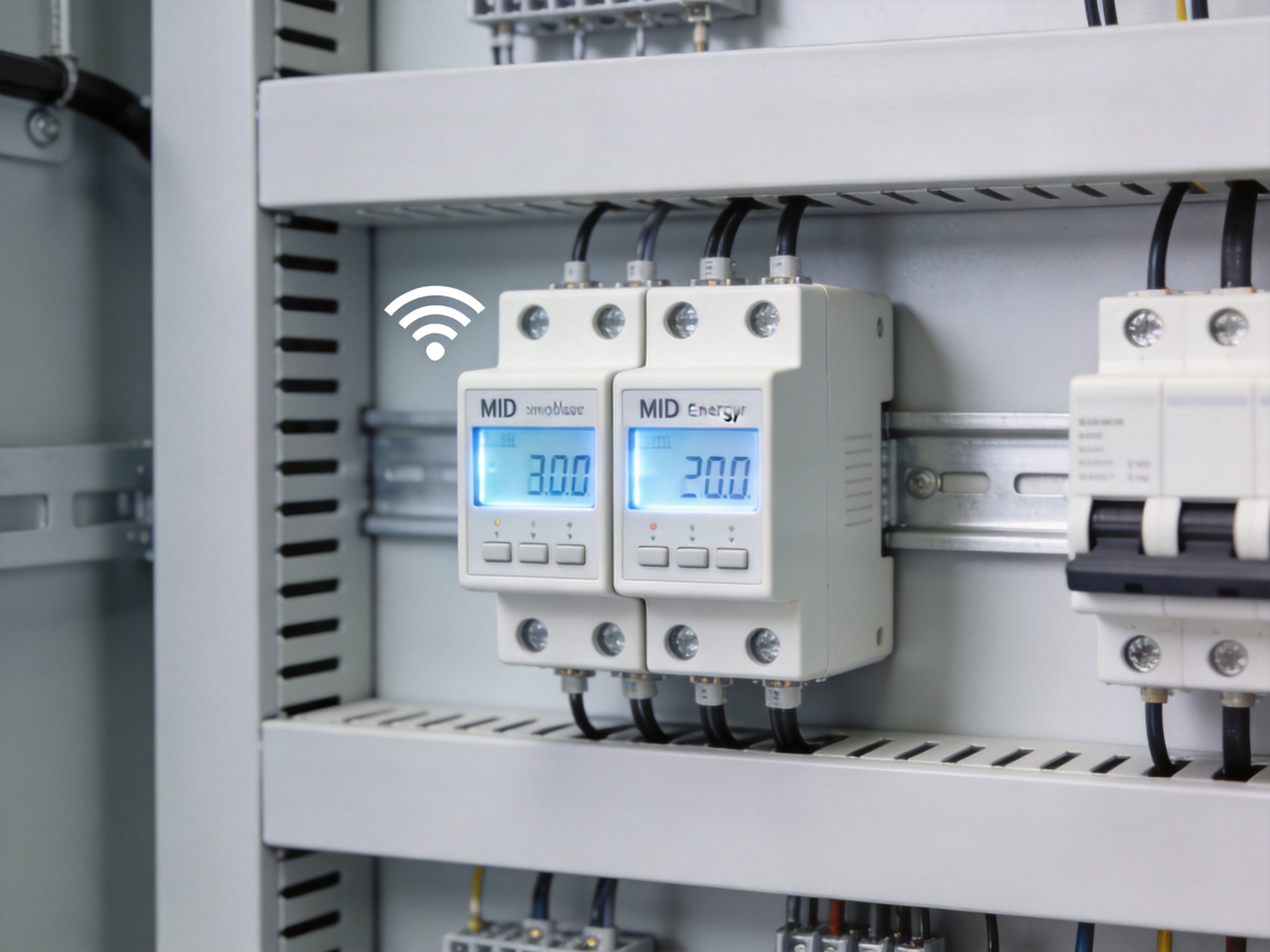
The WiFi communication single-phase DIN rail MID energy meter is designed for 1P2W single-phase AC systems, typically operating at a rated voltage of 230V. It performs RMS measurement on single-phase AC circuits and provides a broad set of electrical parameters through an LCD display with backlight and communication outputs. The meter is suitable for residential metering, utility sub-metering, industrial branch circuit monitoring, solar PV energy measurement, rental property cost allocation, and energy-saving projects.
One of its most practical features is direct load measurement up to 100A. Many single-phase meters require an external current transformer for higher load applications, which can increase wiring complexity and create opportunities for installation errors. A 100A direct-connected design allows many domestic and commercial loads to be monitored without CTs, improving installation simplicity and measurement integrity.
The meter includes two pulse outputs plus WiFi communication. Pulse outputs are widely used for integration with data loggers, building management systems, and legacy metering equipment. WiFi communication adds flexibility for digital monitoring without requiring additional serial communication wiring. In retrofit projects, wireless communication can significantly reduce installation disruption because there may be no need to pull RS485 cables through existing structures.
The meter is MID approved to meet the requirements of EU Directive 2014/32/EU. MID approval is especially important in applications where measured energy data may be used for billing, cost allocation, tenant charging, or regulated metering environments. Compared with non-certified meters, an MID-approved meter offers stronger confidence in accuracy, traceability, and compliance.
The product’s feature set is broad for a compact single-phase DIN rail device. It is engineered to provide essential measurement, communication, installation, and compliance functions in one enclosure.
Key features include multi-measurement capability for kWh, W, V, A, PF, Hz, demand, and related values. These measurements allow users to understand not only how much energy has been consumed, but also how electricity is being used in real time. Voltage and current values reveal supply conditions and load levels. Power factor helps identify inefficient inductive or capacitive loads. Frequency monitoring supports basic power quality observation. Demand values can help users identify peak usage periods.
The LCD display with backlight improves usability in distribution boards, cabinets, plant rooms, and utility areas where lighting conditions may be poor. Clear local display remains important even when communication is available, because technicians may need to verify readings directly during commissioning, maintenance, or troubleshooting.
The meter supports bidirectional energy measurement. This is a crucial advantage for modern energy systems. Traditional meters are usually designed only to measure imported energy. In installations with solar PV, battery storage, or distributed generation, power may flow in both directions. Bidirectional measurement enables the device to register energy imported from the grid and exported back to the grid, helping users better evaluate system performance and energy balance.
Its two pulse outputs plus WiFi communication give the product both traditional and modern connectivity. Pulse outputs provide a simple, robust method for energy data acquisition. WiFi communication supports easier connection to digital monitoring platforms. This dual-output concept makes the meter adaptable across new installations and retrofit environments.
The compact 2-module, 36 mm width is another competitive advantage. Electrical distribution boards often have limited DIN rail space, particularly after protective devices, surge protection, contactors, and control modules have been installed. A compact meter preserves valuable cabinet space and can reduce the need for larger enclosures.
Item |
Specification |
Practical Benefit |
System Type |
Single-phase AC, 1P2W, 1P+N |
Suitable for residential, utility, and light industrial single-phase circuits |
Rated Voltage |
230V |
Compatible with common European and international single-phase supply systems |
Operational Voltage Range |
80% to 120% of rated voltage |
Maintains operation across normal supply variation |
Rated Current |
10A |
Designed for accurate measurement around standard reference load conditions |
Maximum Current |
100A |
Direct load measurement without external CTs in many applications |
Minimum Current |
0.15A |
Supports measurement at low load levels |
Active Energy Accuracy |
Class 0.5 IEC 62053-22; Class C EN 50470-3:2022 |
High accuracy for metering and energy management |
Reactive Energy Accuracy |
Class 2 IEC 62053-23 |
Useful for monitoring reactive energy behavior |
Communication |
WiFi plus two pulse outputs |
Flexible integration with wireless and pulse-based systems |
Installation Width |
2 modules, 36 mm |
Space-saving DIN rail installation |
Certification |
MID approved |
Supports regulated metering and billing-related applications |
Many conventional single-phase meters are designed mainly to record active energy. While such devices may be acceptable for basic consumption reading, they are often inadequate for modern energy management. A property owner or energy manager may need to know voltage stability, load current, instantaneous power, power factor, frequency, and demand trends. By offering multi-measurement functionality, this WiFi-enabled meter provides a more complete electrical picture.
Another advantage is its communication design. Traditional meters may have only a mechanical register, an optical port, or a pulse output. While pulse outputs are dependable, they provide limited data compared with digital communication. WiFi connectivity allows energy information to be accessed more conveniently, especially where wired communication infrastructure is unavailable or expensive to install. This is highly useful in residential retrofit projects, apartment buildings, small commercial facilities, shops, workshops, and distributed equipment locations.
The compact form factor is also superior to many older metering designs. Some meters occupy 4 modules or more on a DIN rail, which can be a problem in crowded panels. A 2-module, 36 mm meter offers more installation flexibility while still supporting direct 100A measurement. This combination of small size and high current capacity is particularly attractive for installers who want efficient panel layouts.
For solar PV applications, bidirectional measurement is a clear competitive advantage. A conventional import-only energy meter may fail to represent exported energy correctly, or it may not separate import and export data in a useful way. Bidirectional energy measurement enables more accurate analysis of renewable generation behavior, self-consumption ratio, and grid interaction.
MID approval further differentiates the product from low-cost, non-certified meters. In energy cost allocation, tenant billing, commercial sub-metering, or regulated measurement environments, certification matters. Users need confidence that the meter has been evaluated according to recognized standards. Choosing an MID-approved device reduces compliance risk and supports transparent energy accounting.
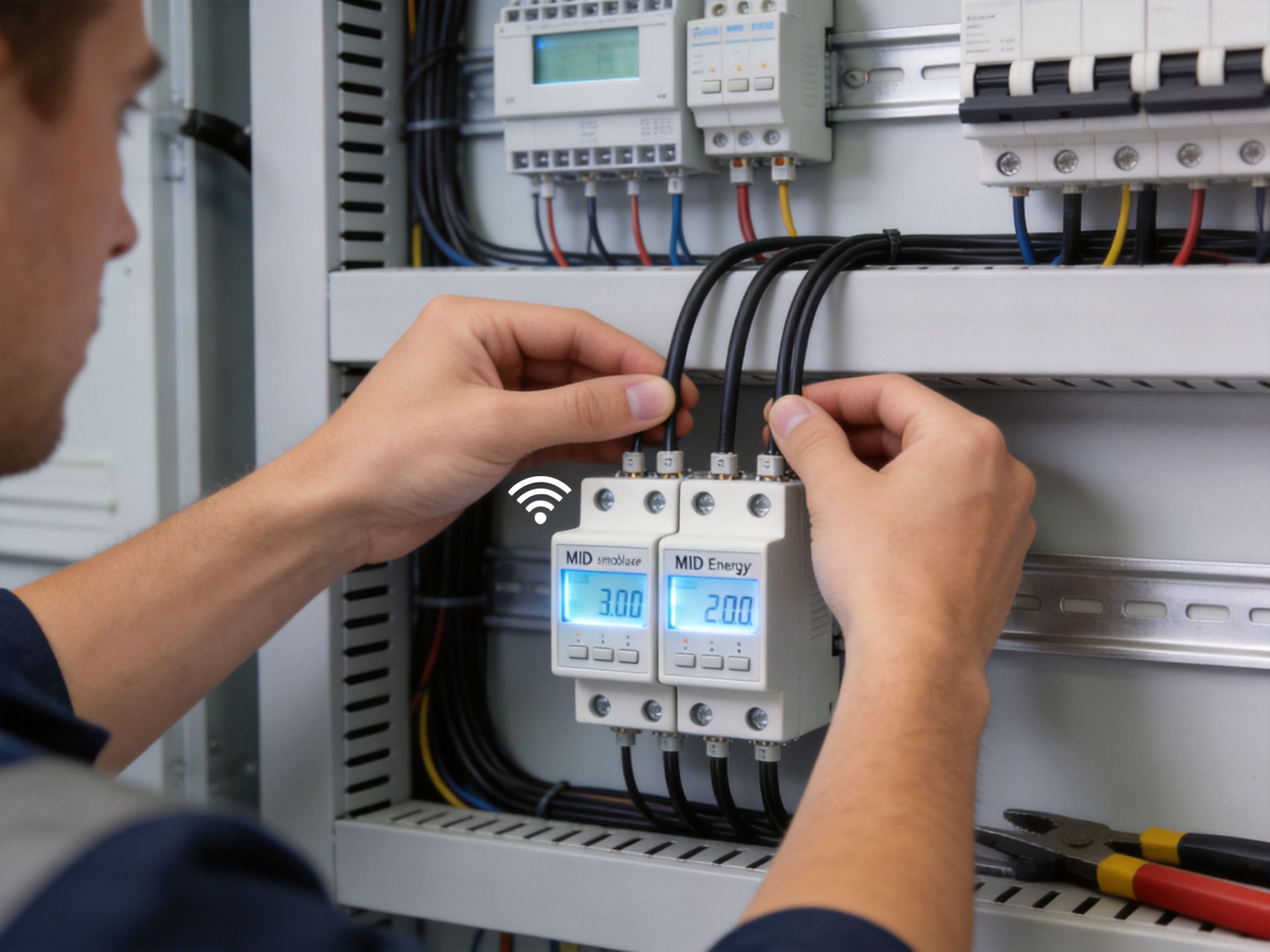
The Measuring Instruments Directive, commonly referred to as MID, establishes essential requirements for measuring instruments used in specific regulated applications within the European market. For electricity meters, MID approval indicates that the product has been assessed for performance, accuracy, reliability, and conformity according to relevant requirements. This is important when measurements are used for commercial transactions or billing-related purposes.
In practical terms, MID approval helps build trust among building owners, tenants, utilities, facility managers, and system integrators. If a meter is used to allocate energy costs in an apartment building, shopping center, office park, marina, camping site, or industrial estate, all parties need assurance that the readings are dependable. A non-approved device may be acceptable for informal monitoring, but it may not be suitable where energy charges are calculated from readings.
The meter’s active energy accuracy of Class 0.5 according to IEC 62053-22 and Class C according to EN 50470-3:2022 demonstrates a strong accuracy profile for single-phase metering. In competitive comparison, some low-cost products may only meet lower accuracy classes or provide insufficient documentation. This product’s certification and accuracy claims support its use in more demanding applications.
MID approval also reflects manufacturing discipline. Certified products require consistent production quality, controlled processes, calibration reliability, and conformity management. The manufacturer’s ISO 9001 quality management system and production approval under MID-related supervision reinforce confidence that the delivered meters will maintain consistent performance from batch to batch.
Energy data becomes more valuable when it is easy to collect, analyze, and act upon. WiFi communication gives this meter a practical advantage in many real-world installations. In existing buildings, adding wired communication can involve drilling, cable trays, conduits, labor cost, and disruption. A WiFi-enabled meter can reduce this complexity by using available wireless network infrastructure.
For residential users, WiFi communication can support convenient monitoring of household energy behavior. Users can identify high-consumption appliances, evaluate time-of-day usage, and compare energy use before and after efficiency upgrades. For landlords and property managers, connected metering can simplify data collection across multiple units or service areas.
For small commercial facilities, WiFi communication enables energy visibility without requiring a full industrial automation network. Shops, restaurants, offices, and workshops may not have RS485 cabling or dedicated energy management infrastructure, but they often have WiFi. A meter with wireless communication can make energy monitoring more accessible to these users.
For system integrators, WiFi capability can reduce installation time and improve flexibility. It can also help in temporary monitoring applications where meters are installed to evaluate equipment consumption, troubleshoot energy issues, or verify savings after an upgrade. In such scenarios, wireless communication reduces the need for permanent cabling.
The product also retains two pulse outputs, which is important because not every installation relies on WiFi. Pulse outputs are simple, robust, and widely compatible. By combining pulse outputs and WiFi, the meter avoids forcing users into a single communication method. This balanced design is a strength when compared with meters that offer only wireless communication or only pulse output.
Direct load measurement up to 100A is one of the most important installation benefits of this meter. In many single-phase applications, 100A covers the main supply or a significant sub-circuit. A direct-connected meter eliminates the need for external current transformers, CT ratio settings, CT orientation checks, and additional secondary wiring.
External CT installations can be effective, especially at higher currents, but they introduce potential errors. A CT may be installed in the wrong direction, connected to the wrong phase, mismatched with meter settings, or selected with unsuitable accuracy. In direct-connected metering, the load conductor passes through the meter terminals according to the wiring diagram, simplifying commissioning and reducing the probability of configuration mistakes.
Direct measurement also reduces component count. Fewer components can mean fewer procurement items, fewer installation steps, fewer panel accessories, and lower maintenance burden. For contractors, this can improve project efficiency. For end users, it can reduce lifetime system complexity.
The product’s 0.15A minimum current also supports measurement at low load levels. This matters in residential and small commercial facilities where standby loads, lighting circuits, electronic equipment, and low-power devices may contribute to total energy consumption over time. Accurate low-load measurement helps users understand baseline consumption and identify hidden energy waste.
Solar photovoltaic systems have changed the way energy flows through buildings. In a conventional building, energy typically flows from the grid to the load. With PV generation, energy may be consumed locally, exported to the grid, or combined with battery storage operation. This makes bidirectional measurement essential.
The meter’s bidirectional measurement capability allows it to support import and export monitoring. For solar PV users, this enables clearer understanding of system performance. Users can compare generation, consumption, export, and self-consumption to evaluate how effectively solar energy is being used. This information can inform decisions about load shifting, battery storage, tariff selection, and system expansion.
In commercial or industrial sites with distributed generation, bidirectional energy data can support internal energy accounting and sustainability reporting. Facilities may need to document how much renewable energy is consumed on site and how much is exported. A meter that can measure bidirectional flow provides a foundation for this analysis.
Compared with non-bidirectional meters, this product is better aligned with future energy trends. Distributed energy resources, electric vehicle charging, battery storage, demand response, and smart buildings all require more dynamic measurement. A meter installed today should remain useful as energy systems evolve, and bidirectional capability supports that future-readiness.
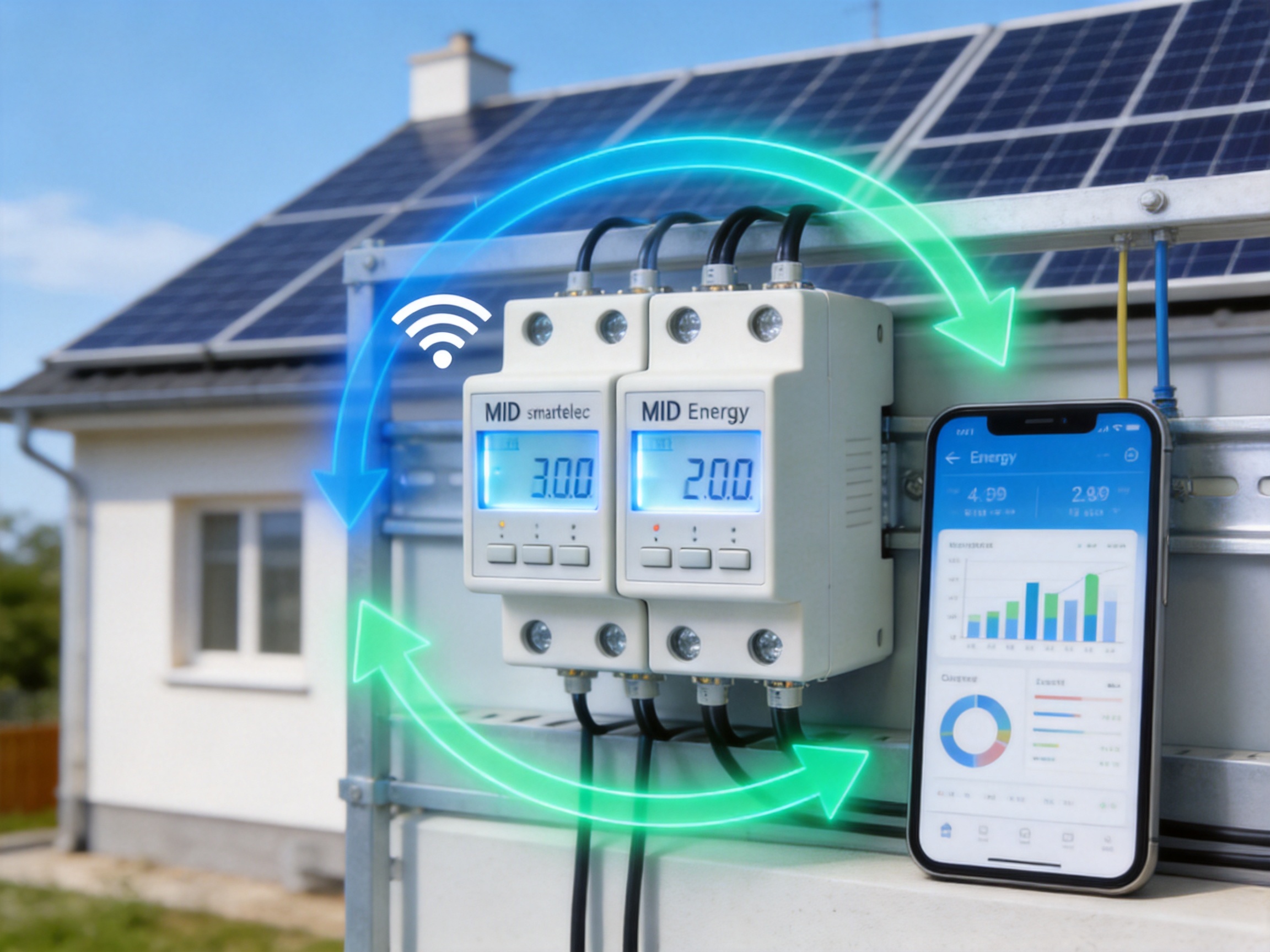
Energy management is most effective when users can see more than the total kWh figure. The meter provides measurements including active energy, voltage, current, power, power factor, frequency, demand, reactive power, and apparent power. Each of these parameters contributes to a more complete understanding of electrical behavior.
Voltage measurement helps users detect supply variation. Low voltage may cause equipment performance issues, while high voltage may increase stress on electrical devices. Current measurement indicates load intensity and can help identify overload risks. Active power shows real-time consumption, while demand values help reveal peak usage patterns.
Power factor measurement is important because poor power factor can increase losses and may lead to penalties in certain commercial or industrial tariff structures. Although small residential users may not be directly billed for power factor, monitoring it still helps identify inefficient loads or unusual operating conditions.
Reactive power and apparent power measurements are valuable for technical analysis. They help differentiate between real energy used to perform work and energy associated with magnetic or electric fields in equipment. For facilities with motors, pumps, compressors, HVAC systems, and other inductive loads, these parameters can support better electrical management.
Frequency measurement gives users a basic indication of supply stability. While frequency is usually tightly controlled in grid-connected systems, monitoring it can be relevant in generator-backed systems, microgrids, or unstable supply areas.
While communication features are increasingly important, local display remains essential. The meter’s LCD with backlight provides direct access to measurement information at the installation point. This is useful during installation, inspection, verification, and maintenance.
In a distribution board, lighting may be poor. A backlit LCD makes readings easier to see, reducing technician frustration and improving commissioning efficiency. Clear local reading also provides a backup method when communication networks are temporarily unavailable.
Local display can be especially valuable in tenant environments. A tenant, manager, or technician may want to verify the meter reading without accessing a software platform. The ability to see key values directly on the device improves transparency.
Compared with meters that rely entirely on external gateways or software interfaces, a built-in display offers practical resilience. It ensures that the meter remains useful even in simple installations where no advanced monitoring platform is present.
The meter’s 2-module, 36 mm width makes it suitable for compact distribution boards. DIN rail equipment is often installed alongside circuit breakers, residual current devices, surge protective devices, isolators, contactors, timers, relays, gateways, and other control equipment. Every module of space matters.
A compact energy meter can help panel builders and electricians maintain clean layouts. It may allow metering to be added without replacing an enclosure. In retrofit installations, this can be the difference between a straightforward upgrade and a costly panel modification.
Small size should not come at the expense of performance, and this is where the product’s combination of compactness, 100A direct measurement, MID approval, multi-parameter measurement, and WiFi communication becomes compelling. Many competing products may offer one or two of these features, but fewer combine all of them in a compact format.
In residential buildings, the meter can be used for whole-home monitoring, apartment sub-metering, solar PV import and export measurement, landlord energy allocation, heat pump monitoring, EV charger monitoring, and high-consumption appliance tracking. Homeowners are increasingly interested in understanding their energy use, especially as electricity prices fluctuate and electrification increases.
For a home with solar panels, the meter can help show whether energy is being consumed locally or exported. This can guide behavioral changes, such as running appliances during sunny periods. For homes with heat pumps or electric vehicle chargers, the meter can help isolate the energy use of major loads.
In multi-tenant residential buildings, MID approval is valuable when readings are used for cost allocation. Tenants are more likely to trust meter readings when the device is certified and designed for accurate measurement. Property owners benefit from more transparent accounting and fewer disputes.
Small commercial facilities often have multiple energy-consuming zones, such as lighting, HVAC, refrigeration, kitchen equipment, office equipment, and production machinery. Installing a compact single-phase meter on selected circuits can reveal where energy is being used and where savings may be possible.
Restaurants and retail shops can monitor specific loads to understand operating costs. Offices can track lighting and plug loads. Workshops can monitor machinery or compressed air systems. Small manufacturing facilities can use the meter for sub-metering auxiliary systems.
In light industrial environments, multi-parameter measurement provides practical technical value. Monitoring current, power factor, voltage, and demand can help identify abnormal load behavior or inefficient operation. When combined with WiFi communication, the data can be accessed more conveniently and used for energy reporting.
Utilities, energy service providers, and sub-metering operators require meters that are accurate, reliable, and easy to deploy. The product’s MID approval, compact design, and communication flexibility make it appropriate for a wide range of metering projects.
Sub-metering is commonly used in apartment complexes, office buildings, mixed-use properties, industrial parks, marinas, campsites, data rooms, and shared facilities. In these environments, space constraints and installation cost are important considerations. A compact DIN rail meter with direct 100A capacity can simplify deployment.
Pulse outputs can connect to established data acquisition systems, while WiFi communication can support modern remote monitoring. This flexibility helps installers meet different project requirements without changing the basic meter platform.
The quality of an energy meter depends not only on its design specification but also on the manufacturing system behind it. The manufacturer is a high-tech enterprise specializing in electricity products and energy measurement solutions. Its product range includes electricity meters, power analyzers, current sensors, communication modules, management systems, relays, switches, gateways, DC energy meters, ETL and UL/ETL-related energy meters, MID energy meters, and PTB/Eichrecht-related metering solutions.
This broad technical foundation gives the company a strong understanding of electrical measurement, communication integration, standards compliance, and application requirements. A manufacturer focused only on basic meters may lack the cross-disciplinary experience needed for connected energy systems. By contrast, experience in meters, analyzers, gateways, sensors, and systems supports better product integration and long-term development.
The company invests in research and development of new technologies and products for electricity metering. Its development teams in China and the United Kingdom contribute to product innovation, embedded software design, hardware architecture, communication functions, and measurement algorithms. Cooperation with universities and technical institutions further strengthens the technology base.
Advanced manufacturing processes include controlled component selection, precision assembly, firmware programming, calibration, accuracy verification, safety inspection, communication testing, and final quality control. For an MID-approved meter, production consistency is particularly important because each unit must conform to certified performance expectations.

Reliable energy meters must perform accurately under varied electrical and environmental conditions. The manufacturer has established a professional laboratory capable of conducting EMC, LVD, accuracy, and environmental tests according to IEC, EN, GB, and UL-related standards. This internal testing capability is a major strength because it allows engineers to evaluate designs thoroughly before and during production.
EMC testing helps ensure that the meter can operate properly in electromagnetic environments and does not generate unacceptable interference. This is important in electrical panels where switching devices, inverters, contactors, variable speed drives, and communication equipment may be present.
LVD-related testing addresses electrical safety considerations, including insulation, dielectric strength, creepage, clearance, temperature rise, and protection against electrical hazards. Since the meter is connected directly to mains voltage and up to 100A load current, safety design and verification are essential.
Accuracy testing verifies measurement performance across load conditions, voltage variations, power factors, and other relevant scenarios. This is central to the credibility of any energy meter, especially one intended for certified metering applications.
Environmental testing can evaluate performance under temperature, humidity, vibration, and other stresses. Meters may be installed in distribution boards, cabinets, utility rooms, industrial spaces, or outdoor enclosures, so environmental robustness contributes to long service life.
The manufacturer follows an ISO 9001 quality management system and its production is approved according to MID-related standards by a recognized inspection organization. This is important because metering products require consistent accuracy and safety across high-volume production.
A strong quality management system supports controlled processes from incoming materials to final inspection. Components must meet specifications. Assembly procedures must be repeatable. Calibration equipment must be maintained and traceable. Nonconforming products must be identified and controlled. Continuous improvement must be part of the production culture.
For customers, this means greater confidence in long-term supply consistency. When a project requires hundreds or thousands of meters, every unit should perform according to the same standard. A manufacturer with professional testing facilities and a structured quality system is better positioned to deliver that consistency than a supplier relying only on outsourced testing or informal inspection.
Modern energy meters rely on both hardware and embedded software. Hardware must measure voltage and current accurately, withstand electrical stress, maintain isolation, support communication, and fit into compact enclosures. Embedded software must calculate energy and power parameters, manage display functions, handle communication, store data, and support metrological integrity.
The manufacturer holds patented technologies in software, embedded software, and hardware. This indicates a commitment to original engineering rather than simple product imitation. In a competitive market, this matters because the best energy meters require careful integration of measurement circuits, digital processing, user interface, communication stability, and compliance controls.
The product’s ability to combine multi-parameter measurement, bidirectional metering, WiFi communication, pulse outputs, LCD display, and MID approval in a compact 36 mm width reflects this engineering integration. Competitors may provide WiFi but lack MID approval, or provide MID approval but require more panel space, or provide direct 100A measurement but limited parameter display. The balanced combination is the core product advantage.
Energy efficiency begins with visibility. Without measurement, users rely on utility bills that provide delayed and aggregated information. A connected multi-function meter gives more immediate insight. Users can identify high-load periods, evaluate equipment behavior, measure the impact of changes, and track energy-saving results.
For example, a building manager may install the meter on an HVAC circuit and discover that demand peaks occur outside working hours. A homeowner may identify high standby consumption. A solar PV owner may adjust appliance use to increase self-consumption. A workshop may monitor equipment energy use before and after maintenance.
Demand measurement is particularly useful for identifying peaks. Even if total monthly consumption is moderate, short high-demand periods may indicate operational inefficiency or load scheduling problems. By providing demand-related data, the meter supports more intelligent energy decisions.
Power factor data can also contribute to efficiency improvement. Poor power factor may indicate motors, transformers, or other loads operating inefficiently. Monitoring power factor helps users identify whether correction or equipment review is necessary.
When evaluating energy meters, buyers often compare price first. However, the lowest purchase price may not deliver the lowest total cost of ownership. A meter without certification, communication flexibility, direct load capability, or reliable manufacturing support may create hidden costs in installation, compliance, maintenance, and data collection.
Compared with a basic kWh-only meter, this product offers multi-parameter measurement, WiFi communication, pulse outputs, backlit LCD, bidirectional measurement, and MID approval. This makes it suitable for applications that require more than simple energy accumulation.
Compared with a CT-operated meter, this direct-connected 100A design can reduce installation complexity in many single-phase systems. It eliminates CT selection and wiring in suitable applications, reducing potential errors and saving panel space.
Compared with a non-certified smart meter, MID approval provides stronger regulatory confidence. This is particularly important when readings are used for billing, cost sharing, or contractual energy allocation.
Compared with a wired-only communication meter, WiFi communication improves deployment flexibility in retrofit environments. At the same time, compared with wireless-only devices, the inclusion of two pulse outputs preserves compatibility with conventional monitoring infrastructure.
Proper installation is essential for accurate and safe metering. The meter is designed for DIN rail mounting in suitable electrical enclosures. Installers should follow the wiring diagram, observe local electrical codes, confirm supply voltage compatibility, and ensure that current does not exceed the rated maximum.
Because the meter is direct-connected up to 100A, terminal tightening and conductor sizing are important. Poor connections can cause heating, voltage drop, or measurement issues. Qualified electricians should perform installation and commissioning.
During commissioning, the installer should verify voltage readings, current direction, power values, energy accumulation, display operation, pulse output behavior, and WiFi communication status. In bidirectional applications, import and export behavior should be checked to ensure the meter is installed in the intended orientation and configured correctly for the monitoring purpose.
The backlit LCD supports quick local verification. WiFi communication should be tested under actual site conditions, considering signal strength, cabinet material, distance from access points, and network configuration. In some installations, a nearby access point or signal improvement measure may be beneficial.
The product is not an isolated device; it fits into a broader ecosystem of energy measurement solutions. The manufacturer’s portfolio includes electricity meters, power analyzers, current transformers, relays and switches, gateways, communication modules, DC energy meters, MID meters, ETL meters, and management systems. This broader capability is valuable for customers who need integrated solutions rather than standalone components.
A residential project may need compact single-phase meters. A commercial project may need three-phase meters, gateways, current transformers, and software integration. A renewable energy project may need bidirectional AC metering and DC energy monitoring. A more complex facility may need power analyzers and data management systems. Working with a manufacturer that offers a wide product family can simplify procurement and technical support.
Technical support and after-sales service are also important strengths. Energy metering projects often require guidance on product selection, wiring, communication, certification, and integration. A professional support team helps customers deploy products correctly and solve problems efficiently.
The manufacturer supplies products and services to more than 50 countries across Europe, Asia-Pacific, America, the Middle East, and Africa. This international experience is significant because metering requirements vary by region. Different markets may require different standards, communication expectations, installation practices, and documentation.
Global supply experience helps the company understand practical customer needs across residential, commercial, utility, and industrial sectors. It also encourages continuous improvement in product reliability, packaging, documentation, compliance, and support.
For buyers, a supplier with global experience can provide greater confidence in export quality, technical documentation, and long-term cooperation. This is especially important for distributors, OEM customers, system integrators, and project contractors who need stable supply and reliable technical communication.
The company’s stated mission is to create value for customers and grow together with partners. This customer-oriented approach is visible in the product’s balance of features: certified measurement for confidence, WiFi for convenience, pulse outputs for compatibility, compact size for installation efficiency, 100A direct measurement for practicality, and bidirectional capability for renewable energy applications.
Its values of integrity, pragmatism, refinement, and innovation align well with the metering industry. Integrity matters because energy measurement must be trusted. Pragmatism matters because products must be easy to install and useful in real applications. Refinement matters because accuracy, safety, and reliability depend on detail. Innovation matters because energy systems are changing rapidly.
When selecting a single-phase energy meter, buyers should consider accuracy class, certification, current rating, communication method, installation size, measured parameters, display quality, bidirectional capability, manufacturer support, and long-term product availability. This meter performs strongly across these categories.
For billing-related or cost allocation applications, MID approval should be a priority. For retrofit monitoring, WiFi communication can reduce installation difficulty. For compact panels, 36 mm width is valuable. For solar PV, bidirectional measurement is essential. For practical single-phase circuits, 100A direct measurement is often enough to avoid external CTs.
Buyers should also consider whether they need integration with broader systems. The availability of pulse outputs and wireless communication provides flexible options. Where future expansion is expected, choosing a manufacturer with gateways, analyzers, and management systems can simplify long-term planning.
The meter is designed for single-phase AC systems, specifically 1P2W or 1P+N applications. It is suitable for residential, utility, commercial, and light industrial single-phase circuits.
The meter supports direct load measurement up to 100A. This allows it to be used in many single-phase applications without external current transformers.
WiFi communication makes it easier to collect energy data without installing dedicated communication wiring. It is especially useful in retrofit projects, residential buildings, small commercial facilities, and distributed monitoring applications.
Yes. The meter supports bidirectional energy measurement, making it suitable for solar PV import and export metering. It can help users understand grid import, export, and self-consumption behavior.
MID approval indicates that the meter meets relevant European requirements for measuring instruments. It is important when readings may be used for billing, cost allocation, tenant charging, or regulated metering purposes.
The meter can measure active energy, voltage, current, active power, reactive power, apparent power, power factor, frequency, demand, and other related values. This provides more complete energy insight than a basic kWh-only meter.
Pulse outputs provide compatibility with traditional data loggers, building management systems, and metering equipment. Including both pulse outputs and WiFi gives users more integration flexibility.
The meter has a compact 2-module width of 36 mm, making it suitable for crowded DIN rail distribution boards.
Its combination of MID approval, WiFi communication, two pulse outputs, 100A direct measurement, bidirectional metering, multi-parameter measurement, backlit LCD, and compact DIN rail design gives it a strong advantage over many basic or single-function meters.
The manufacturer has professional R&D teams, patented technologies in software and hardware, an ISO 9001 quality system, MID-related production approval, and laboratory capability for EMC, LVD, accuracy, and environmental testing according to recognized standards.
The WiFi communication single-phase DIN rail MID energy meter is a modern metering solution for users who require accuracy, connectivity, compact installation, and future-ready energy measurement. It goes beyond basic kWh recording by providing multi-parameter monitoring, bidirectional measurement, wireless communication, pulse outputs, and certified metering performance.
Its 100A direct load capability simplifies installation in many single-phase applications, while its 36 mm DIN rail width preserves valuable panel space. WiFi communication reduces the need for additional wiring, and two pulse outputs maintain compatibility with traditional monitoring systems. MID approval strengthens confidence for regulated and billing-related applications.
The product is particularly well suited for residential energy monitoring, solar PV metering, apartment sub-metering, commercial load tracking, utility sub-metering, and light industrial energy management. Backed by a manufacturer with advanced R&D capability, professional laboratory testing, quality management systems, international market experience, and a broad energy measurement product portfolio, it represents a reliable choice for modern energy measurement projects.
As electricity systems become more distributed, digital, and efficiency-focused, meters must do more than record consumption. They must communicate, analyze, support renewable energy flows, and comply with recognized standards. This meter meets those demands in a compact and practical form, making it a strong solution for today’s energy management needs and tomorrow’s smarter electrical infrastructure.
International Electrotechnical Commission. IEC 62053-22: Electricity Metering Equipment, Particular Requirements for Static Meters for Active Energy.
International Electrotechnical Commission. IEC 62053-23: Electricity Metering Equipment, Particular Requirements for Static Meters for Reactive Energy.
European Committee for Electrotechnical Standardization. EN 50470-3:2022: Electricity Metering Equipment, Particular Requirements for Static Meters for Active Energy.
European Union. Directive 2014/32/EU on Measuring Instruments.
International Organization for Standardization. ISO 9001: Quality Management Systems Requirements.
General technical literature on DIN rail electricity metering, bidirectional energy measurement, and smart energy monitoring systems.
Your email address will not be published. Required fields are marked *

We develop and produce high performance electricity meters, power analyzers, current sensors, communication modules and management systems. China Custom Smart Meters Manufacturers and Factory
Address:NO 52, Dongjin Road, Nanhu, Jiaxing, Zhejiang, China
Copyright @ Eastron Electronic Co., Ltd. All rights reserved Electricity Meters Manufacturers
