

 English
 Español
 Deutsch
 中文简体
中文简体

Product Consultation
Your email address will not be published. Required fields are marked *
Europe's Solar and Energy Storage Transition: Transforming the Power System Infrastructure for a Renewable Future
Jul 10,2026
Power Systems Are Becoming “Real-Time Systems”: Why Data Is More Critical Than Electricity
Jul 06,2026
New EPBD Regulations Drive HVAC Energy Transparency and Boost Demand for Smart Meters
Jul 07,2026Content
In modern electrical control systems, accurate timing is more than a convenience; it is a core requirement for safety, efficiency, energy saving, and process stability. The Pulse Program Single Channel Digital Weekly Time Switch is designed for applications where electrical loads must be switched automatically according to a planned schedule, with the added flexibility of pulse operation, weekly programming, holiday mode, manual override, and long-term clock retention during power interruptions.
This digital time switch is built for users who need a compact DIN-rail device that can perform dependable time-based control in commercial buildings, industrial panels, public facilities, lighting systems, ventilation systems, pumps, signage, and other automation circuits. With a single channel output, LCD display, 52 program capacity, wide supply voltage range, automatic weekday transfer, automatic summer and winter time switchover, and a 10-year power reserve, it combines practical field usability with robust electrical performance.
The product is especially suitable for control cabinet builders, electrical contractors, automation engineers, energy management specialists, and facility maintenance teams who require a dependable weekly time switch that is easy to install, easy to configure, and capable of operating in demanding environments. Its pulse program function gives it an important advantage over many conventional weekly timers, because it can generate short switching actions for equipment that does not need continuous ON/OFF operation but requires a momentary command at a precise time.
Behind the product is Eastron Electronic Co., Ltd., a manufacturer with deep experience in electricity products, smart meters, power analyzers, current sensors, communication modules, and energy measurement solutions. The company’s engineering resources, quality management systems, in-house testing capabilities, and long-term focus on electrical control and measurement technologies contribute to the reliability of this time switch. Rather than being a simple timer assembled as a commodity component, the device reflects a manufacturing approach that emphasizes stable electronics, accurate timing, safe switching, practical installation, and consistent quality control.
Pulse Program Single Channel Digital Weekly Time Switch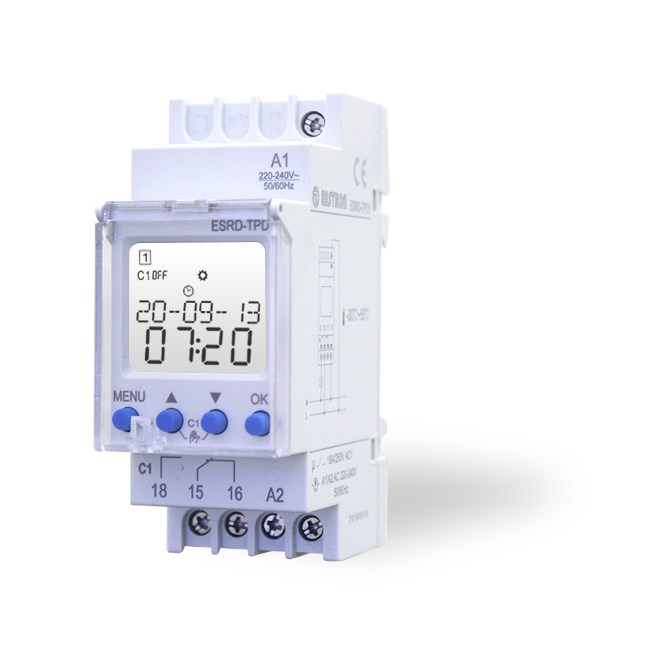
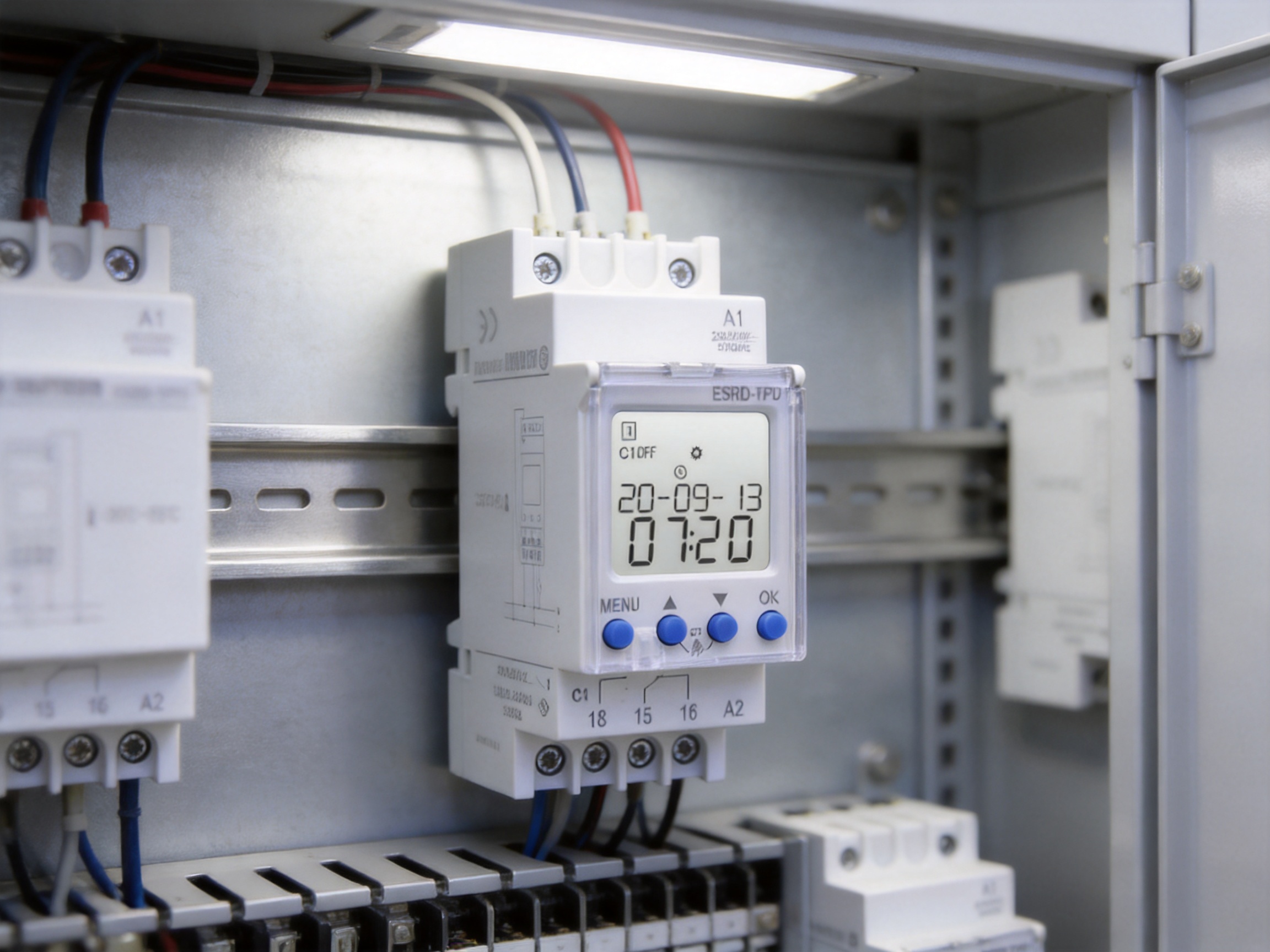
The Pulse Program Single Channel Digital Weekly Time Switch, model ESRD-TPD1, is a DIN-rail mounted digital time control device used to realize timing functions in control systems and automation circuits. It operates according to a schedule set by the user and can switch electrical loads through its output contact at selected times during the day or week. The internal real-time clock maintains timing accuracy, while the lithium battery power reserve protects clock data and user settings when the main power supply is disconnected.
The product belongs to the time switch category and is designed as a single-channel unit. A single channel is often the best choice for applications where one independent circuit needs reliable scheduled control. Compared with multi-channel controllers, a single-channel time switch offers simpler operation, reduced wiring complexity, easier maintenance, and lower risk of programming confusion. For many installations, one precisely controlled output is more valuable than unnecessary additional channels.
The LCD display provides clear visual feedback for programming and operation. Users can set schedules using four front-panel keys, protected by a sealable cover. This design helps prevent accidental changes after commissioning and supports safer operation in shared electrical rooms, public facilities, and industrial environments. Manual control is available through key combinations, allowing maintenance personnel to override the schedule when testing, servicing, or responding to exceptional operating conditions.
The weekly program structure allows recurring operation across weekdays. Automatic transfer of weekdays simplifies schedule setup, especially when the same switching behavior is required on multiple days. In many practical applications, users do not want to enter identical schedules repeatedly. The automatic weekday transfer function saves time and reduces programming errors, which is a meaningful advantage in real-world installation work.
The pulse program function is one of the most significant capabilities of this product. In addition to standard daily and weekly switching programs, pulse operation enables short-duration commands. This is useful for bells, warning indicators, relay triggering, door or gate control interfaces, energy-saving ventilation bursts, irrigation commands, reset signals, and other systems where a brief output activation is required at a defined time. Many basic digital timers support only continuous ON and OFF commands; pulse programming adds a higher level of flexibility.
A strong time switch must combine accuracy, programming capacity, electrical compatibility, mechanical durability, and user-friendly installation. This product provides a balanced feature set that supports those requirements in one compact device. Its advantages can be understood from both the user’s daily experience and the engineer’s long-term reliability perspective.
The device supports AC/DC 24–264 V rated voltage, with 50/60 Hz frequency compatibility. This wide supply voltage range gives the product a major practical advantage over timers that are limited to one specific voltage. In control cabinets, voltage availability can vary according to system design. Some circuits use 24 V control power, while others use 110 V, 220 V, or 240 V AC supplies. A wide-range input device reduces inventory complexity and makes the same model suitable for many regions and applications.
For panel builders and distributors, wide voltage compatibility lowers the need to stock multiple voltage variants. For maintenance teams, it reduces the chance of replacing a timer with the wrong voltage type. For global projects, it makes system design more consistent across different electrical standards. This flexibility is particularly important for equipment exported internationally or installed in facilities where control voltage standards differ from one area to another.
The product supports 52 programs, allowing users to create detailed weekly and daily timing schedules. This program capacity gives it an advantage over simple timers that may allow only a small number of switching events. In real applications, operating schedules are often more complex than a single ON/OFF event per day. Lighting may need different schedules for weekdays and weekends. Ventilation may need intermittent operation. Pumps may need scheduled starts at specific intervals. Public equipment may require holiday exceptions.
With 52 programs, the time switch provides enough capacity for most commercial and industrial time-control tasks without requiring a more expensive programmable controller. Users can create schedules that reflect actual operating needs rather than forcing the facility to adapt to the limitations of a basic timer. The result is better energy use, better comfort, and more precise automation.
Pulse programming is a decisive advantage for users who need momentary output commands. In many control systems, the purpose of a timer is not to keep a load powered for hours, but to send a signal at a precise moment. A pulse can be used to trigger another relay, initiate a process, send a start command, reset a counter, operate an audible signal, or activate a control input on another device.
Traditional ON/OFF timer programming may require additional relay logic to create a short pulse. By integrating pulse programming directly into the time switch, the ESRD-TPD1 reduces external components, simplifies wiring, and improves control cabinet efficiency. Fewer external components also mean fewer possible failure points. This helps reduce installation time, panel space usage, and maintenance complexity.
The time switch includes a lithium battery power reserve, with the product information specifying a 10-year reserve. This is highly important because power outages should not erase user schedules or disturb the real-time clock. If a timer loses its clock setting after every interruption, maintenance personnel must repeatedly reset it, and controlled loads may operate at the wrong time. A long power reserve protects schedule integrity and supports reliable automation even in areas where power interruptions occur.
The long reserve also benefits equipment that may be stored, transported, or installed before final commissioning. When the electrical supply is absent, the internal clock and settings remain protected. This improves user confidence and reduces the risk of schedule loss during maintenance shutdowns.
Automatic summer/winter time switchover is a valuable feature for regions that observe daylight saving time. Without automatic correction, timed loads may shift by one hour when seasonal time changes occur. This can lead to lighting turning on too early or too late, ventilation schedules being offset, or automated systems operating outside intended periods.
By supporting automatic changes, the time switch helps maintain schedule accuracy across the year. Users can also set summer/winter time to off when the installation location does not use seasonal time changes. This flexibility makes the device suitable for both domestic and international markets.
Holiday mode allows temporary changes to normal operation during vacation periods, public holidays, maintenance shutdowns, or special facility schedules. This is particularly useful in offices, schools, public buildings, commercial spaces, and factories where normal weekday routines may not apply during holidays.
Instead of deleting or rewriting standard weekly programs, users can activate holiday mode to modify operation for a defined period. After the holiday period, normal scheduling can resume. This saves programming time and reduces the risk of forgetting to restore regular settings after an exception period.
The time tolerance is specified as less than one second per day at 25°C. Accurate timing is essential in systems where scheduled operation affects energy use, process coordination, safety signals, or user comfort. While a small drift may seem insignificant, accumulated timing errors can become noticeable over weeks or months if a clock is not accurate. The specified accuracy supports long-term dependable operation.
The output is rated for 16 A at 250 VAC, with switching capacity of 4000 VA/AC1 and 384 W/DC. These values allow the device to control many common electrical loads through its relay contact. In practice, engineers must always consider the load type, inrush current, duty cycle, and protective devices, but the available switching capacity gives the timer strong application coverage for lighting, contactor coils, small motors through proper control interfaces, heating control circuits, and automation relays.
Compared with low-capacity timers, a 16 A contact gives designers more flexibility. It may allow direct control of suitable loads or reliable triggering of intermediate relays and contactors. The mechanical life of 106 operations also supports long service expectations when the device is properly applied.
The following table summarizes the core technical data of the Pulse Program Single Channel Digital Weekly Time Switch. These specifications help engineers, panel builders, and purchasing teams compare the device with project requirements.
Item |
Specification |
Product type |
Digital weekly time switch with pulse program |
Model |
ESRD-TPD1 |
Supply terminals |
A1-A2 |
Rated voltage |
AC/DC 24-264 V |
Rated frequency |
50/60 Hz |
Power consumption |
1 W |
Number of channels |
1 |
Number of programs |
52 |
Program types |
Weekly, daily, pulse |
Operating modes |
Manual, automatic, holiday |
Summer/winter time |
Off or automatic changes |
Time tolerance |
<1 s/day at 25°C |
Power reserve |
10 years |
Output contact rating |
16 A / 250 VAC |
Switching capacity |
4000 VA/AC1, 384 W/DC |
Mechanical life |
106 operations |
Rated insulation voltage |
250 V |
Protection degree |
IP20 |
Pollution degree |
3 |
Ambient temperature |
-20°C to 55°C |
Storage temperature |
-30°C to 70°C |
Wire size |
1 mm² to 4 mm² |
Installation |
2-module DIN-rail mounting |
Applicable standards |
IEC/EN 60730-1 and IEC/EN 60730-2-7 |
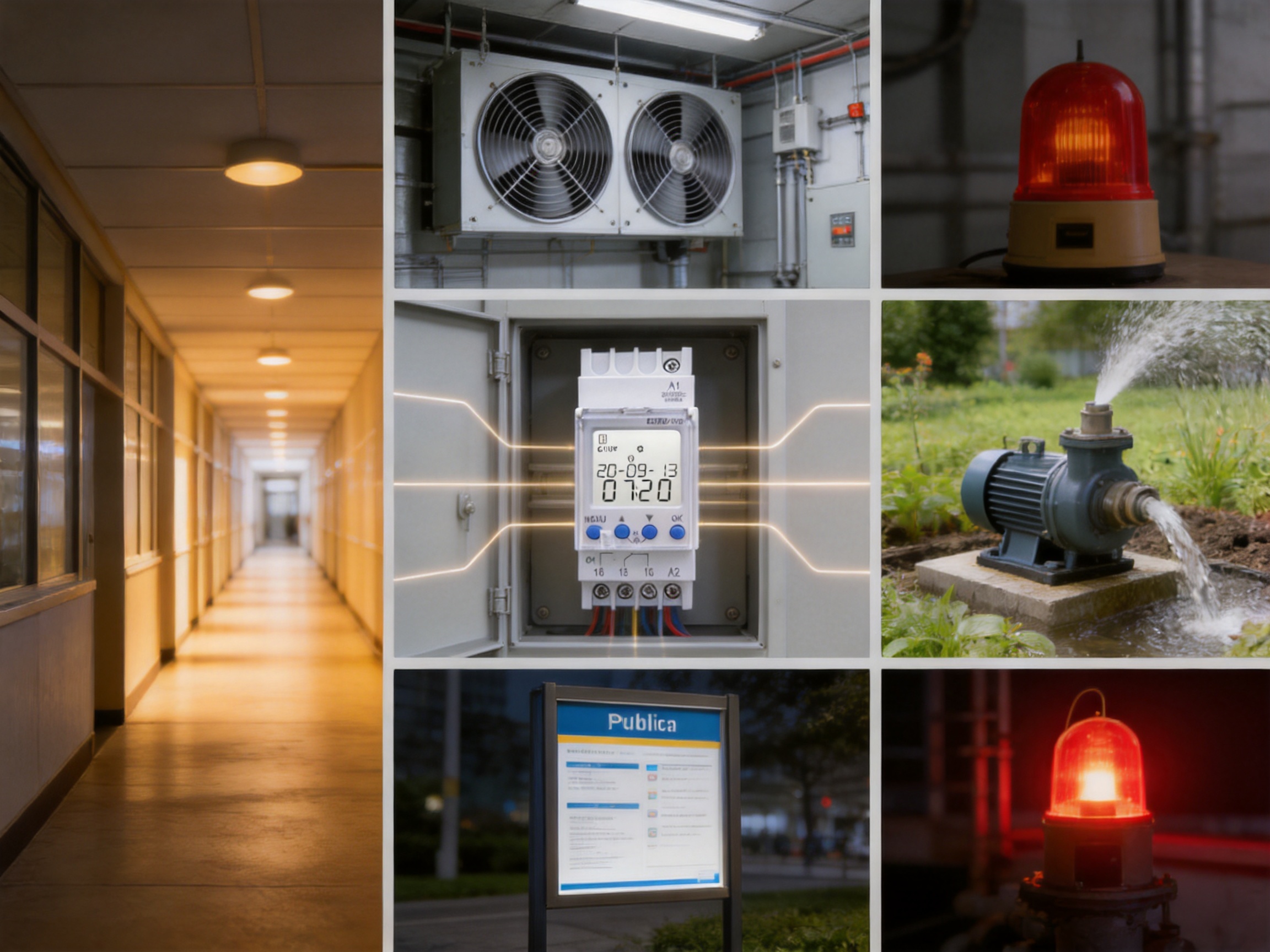
The digital weekly time switch can be used wherever a load or control signal needs to operate according to a planned time schedule. Because it supports weekly, daily, and pulse programming, it can serve both simple and moderately complex automation requirements without the cost and programming burden of a full programmable logic controller.
Lighting is one of the most common applications for weekly time switches. In offices, corridors, parking areas, warehouses, schools, shops, public buildings, and outdoor spaces, lighting often needs to follow predictable schedules. The time switch can turn lighting circuits on before occupancy begins and off after people leave. It can also create different schedules for weekdays, weekends, and holidays.
In energy-saving projects, automatic lighting control is an effective way to reduce unnecessary electricity consumption. Manual switching depends on human discipline, and lights are often left on after hours. A programmable time switch provides consistent control, reducing waste while maintaining convenience and safety.
Ventilation systems may require scheduled operation to maintain air quality, remove moisture, or comply with facility routines. In some cases, continuous operation is unnecessary and wasteful. Pulse or intermittent programs can activate fans for defined periods or send timed commands to ventilation control relays. The device’s weekly programming allows different ventilation strategies for working days and non-working days.
Pumps and irrigation systems frequently require scheduled starts. A weekly time switch can support applications such as garden irrigation, water circulation, tank management through auxiliary control circuits, or scheduled pump cycling. Pulse output may be used where the timer triggers a separate pump controller rather than directly powering the pump.
For motor applications, appropriate contactors, overload protection, and safety devices should be used according to the system design. The time switch can then serve as the timing command source, allowing the motor control circuit to handle the high-power switching duty.
Illuminated signs, display boards, advertising panels, and public information systems can benefit from automatic schedule control. The time switch can energize signage during business hours or after sunset and turn it off when visibility or operation is no longer required. Holiday mode is useful for changing schedules during special events or seasonal closures.
In industrial environments, a time switch may be used to initiate auxiliary operations, control sirens, start support equipment, activate lighting zones, reset devices, or command relay logic. The pulse program is particularly useful in such applications because many industrial controls respond to momentary signals rather than continuous switching.
Commercial buildings require predictable operation of many electrical systems. A weekly timer can contribute to energy management by scheduling lighting, exhaust fans, signs, small heating control circuits, and auxiliary equipment. The sealable front cover helps prevent unauthorized schedule changes, which is important in shared service areas.
Many time switches on the market provide basic ON/OFF scheduling, but not all devices offer the combination of features needed for flexible, long-term, and international use. The Pulse Program Single Channel Digital Weekly Time Switch stands out through its broad operating voltage, pulse program capability, large program memory, long power reserve, automatic time change function, holiday mode, and practical DIN-rail format.
Mechanical timers are simple, but they often lack precision, advanced schedules, weekday differentiation, holiday settings, and pulse functions. They may be suitable for basic daily switching, but they become limiting when a facility requires multiple events, different weekday schedules, or seasonal adjustments. The digital weekly time switch provides more accurate timing and richer programming while remaining compact and easy to use.
Some applications use programmable controllers for simple time-based switching, but this can increase cost, wiring complexity, commissioning time, and maintenance requirements. A PLC may be unnecessary when the main task is scheduled operation of one circuit. The digital time switch offers a focused solution: it is easier to install, easier to program, and more economical for timing tasks that do not require full logic control.
Competitor timers with narrow supply voltage ranges require separate models for different control voltages. This increases stocking complexity and can delay installation if the wrong model is selected. The AC/DC 24–264 V input range gives this product a practical advantage for distributors, OEMs, and project contractors. One device can cover a broad range of applications, simplifying procurement and reducing the risk of mismatch.
A timer with weak or short-term backup can lose timekeeping reliability after outages. The 10-year power reserve protects the real-time clock and stored settings, helping maintain schedule continuity. This is especially important in facilities where maintenance staff may not immediately notice that a timer has reset. With long-term reserve capability, the device supports dependable unattended operation.
Pulse programming gives the time switch a functional advantage over many standard weekly timers. Instead of using extra relays, delay modules, or external pulse generators, users can configure pulse actions directly. This simplifies panels and improves design efficiency. For contractors and panel builders, this can translate into faster assembly, lower component count, and cleaner wiring layouts.
The front panel is designed for easy setting by four keys and includes a sealable cover. This combination supports convenient commissioning and better protection after setup. Some low-cost devices may be easy to access but also easy to tamper with. Others may be secure but difficult to program. This product balances both needs by providing straightforward operation with physical protection for the interface.
The device is designed for 2-module DIN-rail mounting, making it suitable for standard electrical distribution boards and control cabinets. DIN-rail mounting is widely used because it supports fast installation, organized layouts, and easy replacement. The compact two-module width helps save cabinet space, an important consideration in modern panels where many devices must fit within limited enclosure dimensions.
The wire size range of 1 mm² to 4 mm² supports common control wiring practices. Proper wire preparation, tightening torque, protective devices, and separation from high-interference circuits should be considered during installation. As with all control equipment, wiring must follow applicable standards, local electrical codes, and the system designer’s instructions.
The supply terminals are identified as A1-A2. The output contact should be wired according to the control circuit requirements and the load’s electrical characteristics. Where loads exceed the direct switching capacity or produce high inrush current, the time switch should control a contactor or relay rather than the load directly. This approach extends service life and improves safety.
The IP20 protection degree indicates suitability for installation inside an enclosure or panel where protection from direct contact, dust, moisture, and mechanical impact is provided by the cabinet. The pollution degree 3 rating supports use in many industrial and electrical environments when installed correctly.
The time switch supports manual, automatic, and holiday operating modes. Automatic mode is the normal operating state, where the device follows the programmed schedule. Manual mode allows users to intervene when needed, such as during testing, maintenance, or special circumstances. Holiday mode supports temporary schedule exceptions.
The LCD display improves user confidence by showing relevant timing and status information. In field maintenance, visible status feedback is important because technicians need to confirm whether a device is operating correctly. Clear display and intuitive key operation reduce training requirements and help prevent configuration errors.
Automatic transfer of weekdays is another important usability feature. For example, if a schedule must apply from Monday to Friday, the user can set the program more efficiently rather than creating separate entries for each day. This saves time and reduces mistakes. In facilities with several timers, simplified programming can significantly reduce commissioning effort.
The sealable cover is useful in environments where many people can access electrical panels. After the schedule has been approved and set, the cover can be sealed to discourage unauthorized changes. This helps maintain operational discipline and can be valuable for energy management programs, where unauthorized manual changes may compromise savings.
A reliable digital time switch depends not only on its circuit design but also on the manufacturer’s process discipline, testing capability, component selection, and long-term expertise in electrical products. Eastron Electronic Co., Ltd. is headquartered in Jiaxing, China, near Shanghai, Hangzhou, and Jiangsu. This location provides access to a strong industrial supply chain, skilled technical talent, logistics advantages, and established manufacturing infrastructure.
The company develops and produces high-performance electricity meters, power analyzers, current sensors, communication modules, management systems, and related electrical products. This broad technical background is important because time switches share many quality requirements with metering and control devices: stable electronics, precise timing, electrical safety, electromagnetic compatibility, environmental durability, and repeatable production quality.
Eastron continues to invest in research and development for electricity metering and control technologies. The company has energetic and innovative development teams in China and the United Kingdom, supporting product design, firmware development, hardware engineering, and application improvement. Cooperation with leading universities and institutions also helps introduce advanced technologies into product development.
For a digital time switch, R&D capability matters in areas such as clock accuracy, low power consumption, button interface logic, relay control design, display readability, battery backup management, EMC resistance, and safe operation across a wide voltage range. A manufacturer with strong electronics design experience can better address these details than a supplier focused only on low-cost assembly.
The company has established its own professional laboratory capable of performing EMC, LVD, accuracy, and environmental tests according to IEC, EN, GB, and UL standards. This in-house testing capability is a significant competitive strength. It allows engineers to verify product performance earlier in development, identify weaknesses, improve design robustness, and maintain quality consistency during production.
EMC testing is particularly important for digital control devices installed in electrical panels. Such panels may contain contactors, switching power supplies, motors, relays, and communication equipment that generate electrical noise. A reliable time switch must maintain correct operation in these environments. LVD testing supports electrical safety, while environmental testing helps verify operation under temperature and storage conditions.
Eastron follows the ISO 9001 quality management system, and its production has been approved by SGS according to MID standards in relation to its metering product capabilities. While a time switch is not an energy meter, the company’s experience with regulated metering products supports a culture of documentation, process control, inspection, traceability, and continuous improvement.
Consistent production quality is essential for devices installed in control systems. A time switch may be small, but if it fails, it can disrupt lighting, ventilation, process signals, or energy-saving systems. Manufacturing discipline helps ensure that each unit meets expected electrical and mechanical performance. This includes incoming component inspection, soldering quality, relay verification, display testing, button function testing, battery reserve checks, and final inspection before shipment.
The company holds many patented technologies in software, embedded software, and hardware. This indicates long-term engineering investment rather than simple product trading. Embedded software knowledge is especially relevant for digital time switches because schedule handling, clock control, user interface logic, holiday mode, and pulse operation all depend on reliable firmware behavior.
A good digital time switch must behave predictably. It must store settings correctly, maintain time accurately, respond properly to user input, and switch outputs according to programmed rules. Embedded software quality is therefore central to the user experience. A company experienced in software and hardware integration can provide more dependable products than competitors relying on generic designs without strong development control.
Eastron’s products and services have been supplied to more than 50 countries across Europe, Asia-Pacific, America, the Middle East, and Africa. Global market experience gives the company insight into different electrical standards, installation practices, customer expectations, environmental conditions, and certification requirements. This experience supports product designs that are practical for international use.
The time switch’s wide voltage input, DIN-rail mounting, IEC/EN standard reference, and automatic summer/winter time function are all aligned with global application needs. Customers working on export projects or international installations benefit from a supplier familiar with diverse market requirements.
Reliability in a time switch comes from many small design choices. The device must combine timing electronics, a user interface, non-volatile memory or protected setting storage, relay output, power supply circuitry, battery backup, terminals, and an enclosure. Each element must work under real installation conditions.
The wide input supply requires a robust power stage that can tolerate different AC and DC sources within the rated range. Low power consumption of 1 W helps reduce heat inside the panel and contributes to energy efficiency. Lower internal heating can also support longer component life, especially in enclosed cabinets where temperature rise is a concern.
The relay contact must handle switching demands within its rating. The specified mechanical life of 106 operations indicates durable mechanical performance. In applications with frequent pulse commands, mechanical life is particularly relevant. Users should still design circuits properly, especially for inductive loads, by using contactors, suppression components, or interface relays where needed.
The ambient operating temperature range of -20°C to 55°C supports use in many indoor control panels, plant rooms, and distribution boards. The storage range of -30°C to 70°C supports transportation and warehousing conditions. These ranges help distributors and installers handle the product across different climates.
Although a time switch is not an energy meter, it can play a direct role in energy saving. Many electrical loads consume power simply because they remain on longer than needed. Scheduled control ensures that equipment operates only during required periods. This reduces unnecessary consumption, lowers operating costs, and supports sustainability goals.
For lighting systems, even small schedule improvements can produce significant savings over time. For ventilation, intermittent operation can maintain necessary air movement without excessive runtime. For signage, automatic shutdown after business hours reduces waste. For auxiliary systems, pulse and weekly programs can prevent unnecessary continuous operation.
The product’s own power consumption is only 1 W, which is low for a control device. This means the energy used by the timer itself is minimal compared with the energy it can help save by controlling larger loads. In energy management projects, such devices are often simple but effective tools for improving operational discipline.
The product references IEC/EN 60730-1 and IEC/EN 60730-2-7 standards. These standards relate to automatic electrical controls and timers, supporting safe and reliable operation in intended applications. Standards compliance is important because time switches are installed in electrical systems where insulation, temperature performance, switching behavior, and mechanical construction must meet established requirements.
The rated insulation voltage of 250 V, IP20 protection degree, and pollution degree 3 rating provide important guidance for installation. Users should install the device in a suitable enclosure and ensure that it is protected according to the environment. Proper installation includes appropriate upstream protection, correct conductor size, secure terminal connection, and separation from circuits that may create excessive interference or heat.
Safety also depends on using the timer within its electrical rating. The 16 A contact rating and switching capacity should not be exceeded. For high inrush loads, motors, capacitive lighting drivers, and inductive devices, interface components may be required. Good engineering practice ensures that the time switch performs as a reliable control component within a complete safe system.
An office building needs corridor lighting from 7:00 a.m. to 8:00 p.m. Monday through Friday, reduced operation on Saturday, and no normal operation on Sunday. The time switch can be programmed with weekday schedules and weekend exceptions. Holiday mode can be used during public holidays. This prevents lights from remaining on throughout the night and reduces electricity cost.
A factory uses an audible indicator to signal shift start, break times, and shift end. The pulse program can activate the signal for a short duration at precise times. Instead of leaving the output energized, the timer sends momentary commands. This is exactly the type of application where pulse programming is more suitable than ordinary ON/OFF operation.
A retail store wants its illuminated sign to operate from late afternoon to closing time on weekdays and longer on weekends. The weekly program allows different schedules for different days. Automatic summer/winter time adjustment helps maintain correct local timing through seasonal changes.
A utility room requires periodic ventilation for moisture control. Rather than running continuously, a pulse or scheduled program can activate a fan control relay at selected intervals. This reduces energy use and equipment wear while maintaining environmental conditions.
An agricultural installation may require scheduled irrigation commands or auxiliary equipment starts. The time switch can provide timing control to a relay or pump controller. The long power reserve protects timing data if power is interrupted, which is valuable in remote or seasonal installations.
Professional users value equipment that reduces uncertainty. They need devices that are easy to specify, easy to wire, easy to program, and dependable after installation. The Pulse Program Single Channel Digital Weekly Time Switch meets these needs through a combination of practical features and robust engineering.
For electrical contractors, the device offers quick DIN-rail installation, wide voltage compatibility, and straightforward front-panel programming. For control panel manufacturers, it offers compact size, reduced inventory variation, and reliable output capability. For facility managers, it offers energy-saving scheduling, holiday mode, and protection against power-loss schedule errors. For automation engineers, it offers pulse command capability without requiring additional timing modules.
Compared with many competitor products, the overall value is not based on one specification alone. Its advantage comes from the integration of multiple useful features: 52 programs, pulse mode, weekly and daily scheduling, automatic weekday transfer, automatic seasonal time adjustment, 10-year power reserve, 16 A output, wide AC/DC supply, LCD display, sealable cover, and IEC/EN standard alignment. This makes it a complete time-control solution rather than a basic timer.

Eastron Electronic Co., Ltd. has built a rich product range in electricity metering, smart meters, energy measurement solutions, power analyzers, current transformers, relays and switches, gateways, and related systems. This broad portfolio allows the company to understand electrical systems from measurement to control. Customers who source a time switch from such a manufacturer gain access to a supplier familiar with the wider electrical ecosystem.
The company’s mission is to create value for customers and grow together with partners. This is reflected in its focus on quality products, technical support, and after-sales service. For industrial and commercial electrical products, support matters because customers may need help with specification, wiring interpretation, application selection, and troubleshooting. A responsive supplier helps reduce project risk.
The company’s professional teams for technical support and after-sales service provide additional confidence for buyers who require long-term cooperation rather than one-time transactions. Its presence in more than 50 countries also suggests practical experience with export packaging, documentation, compliance expectations, and international customer communication.
To maintain reliable performance, the time switch should be installed in a clean, dry, appropriately rated electrical enclosure. Although the device has IP20 protection, the surrounding cabinet should provide the level of environmental protection required by the installation site. Avoid exposure to dripping water, conductive dust, corrosive gases, excessive vibration, or temperatures outside the specified operating range.
During commissioning, users should verify the supply voltage, confirm terminal wiring, set the correct time and date, configure summer/winter time behavior, enter programs carefully, and test the output operation. For pulse applications, the pulse duration and receiving device requirements should be checked to ensure the command is recognized correctly.
For loads with high inrush current or inductive characteristics, use an appropriate relay, contactor, or suppression device. This protects the time switch contact and improves system durability. Periodic inspection may include checking terminal tightness, confirming the displayed time, verifying schedule operation, and ensuring the front cover seal remains intact if unauthorized access is a concern.
A1: Its main purpose is to automatically switch an electrical circuit or send a control signal according to user-defined daily, weekly, or pulse schedules. It is used in control systems, automation panels, lighting control, ventilation, signage, pumps, alarms, and other time-based applications.
A2: The pulse program allows the output to activate briefly at a scheduled time. This is useful for momentary commands such as bells, signals, relay triggering, reset inputs, or control pulses. It reduces the need for extra timing relays or external pulse modules.
A3: The device supports 52 programs. This allows users to create detailed schedules for weekdays, weekends, holidays, and special operating requirements.
A4: It supports a wide rated voltage range of AC/DC 24–264 V. This makes it suitable for many control systems and reduces the need to stock multiple voltage-specific models.
A5: The internal lithium battery power reserve protects the real-time clock and user settings. The product specification indicates a 10-year power reserve, helping maintain schedule accuracy and configuration during power interruptions.
A6: Yes. It supports automatic summer/winter time switchover, and this function can also be turned off when not required.
A7: The output contact is rated at 16 A / 250 VAC, with switching capacity of 4000 VA/AC1 and 384 W/DC. It may directly switch suitable loads within rating, but high inrush, motor, capacitive, or inductive loads should be controlled through appropriate contactors or relays.
A8: It is designed for 2-module DIN-rail mounting inside an electrical enclosure or control cabinet. Because it has IP20 protection, it should be protected from moisture, dust, accidental contact, and mechanical damage by the surrounding enclosure.
A9: The specified ambient operating temperature is -20°C to 55°C. The storage temperature range is -30°C to 70°C.
A10: The manufacturer has extensive experience in electricity meters, power analyzers, current sensors, communication modules, and energy measurement solutions. Its R&D teams, in-house laboratory, quality management system, and global market experience support reliable product design and consistent production quality.
The Pulse Program Single Channel Digital Weekly Time Switch is a compact but capable control device for users who require reliable scheduled switching. Its combination of weekly, daily, and pulse programming makes it more flexible than basic mechanical or digital timers. Its 52-program capacity, LCD display, holiday mode, automatic weekday transfer, automatic summer/winter time adjustment, and manual override functions give users practical control over a wide range of electrical applications.
From an engineering perspective, the device’s wide AC/DC 24–264 V supply range, 1 W power consumption, 16 A output contact, 10-year power reserve, DIN-rail mounting, and IEC/EN standard alignment make it suitable for professional use in control cabinets and distribution boards. It helps reduce inventory complexity, simplify panel design, protect schedules during power loss, and improve energy efficiency through accurate automatic control.
The product is also strengthened by the manufacturer’s broader capabilities in electrical measurement and control technologies. Eastron Electronic Co., Ltd. supports its product development with R&D teams, professional laboratory testing, ISO 9001 quality management, patented technologies, and global market experience. These strengths help distinguish the time switch from ordinary commodity timers and make it a dependable choice for contractors, panel builders, facility managers, and automation professionals.
For applications that require a single-channel digital weekly timer with pulse output, long backup time, broad voltage compatibility, and user-friendly operation, this product offers a well-balanced solution. It delivers practical functionality, reliable construction, and professional manufacturing support in one compact device.
IEC 60730-1, Automatic Electrical Controls for Household and Similar Use, General Requirements.
IEC 60730-2-7, Automatic Electrical Controls for Household and Similar Use, Particular Requirements for Timers and Time Switches.
EN 60730 Series, Safety Requirements for Automatic Electrical Controls.
ISO 9001 Quality Management Systems, Requirements and Implementation Guidance.
Electrical Control Panel Design Practices for DIN-Rail Mounted Control Devices.
Industrial Automation Timing and Relay Control Application Guidelines.
Energy Management Principles for Scheduled Lighting, Ventilation, and Auxiliary Electrical Loads.
Your email address will not be published. Required fields are marked *

We develop and produce high performance electricity meters, power analyzers, current sensors, communication modules and management systems. China Custom Smart Meters Manufacturers and Factory
Address:NO 52, Dongjin Road, Nanhu, Jiaxing, Zhejiang, China
Copyright @ Eastron Electronic Co., Ltd. All rights reserved Electricity Meters Manufacturers
