

 English
 Español
 Deutsch
 中文简体
中文简体

Product Consultation
Your email address will not be published. Required fields are marked *
Europe's Solar and Energy Storage Transition: Transforming the Power System Infrastructure for a Renewable Future
Jul 10,2026
Power Systems Are Becoming “Real-Time Systems”: Why Data Is More Critical Than Electricity
Jul 06,2026
New EPBD Regulations Drive HVAC Energy Transparency and Boost Demand for Smart Meters
Jul 07,2026Content
The rapid growth of electric vehicle charging infrastructure has created a strong demand for accurate, compact, certified, and communication-ready energy meters. In residential, commercial, and semi-public charging installations, metering is no longer a simple accessory; it is a critical part of billing, load management, monitoring, safety verification, and energy transparency. A modern EV charging meter must do more than count kilowatt-hours. It must measure multiple electrical parameters, communicate reliably with a charger controller or energy management system, fit into limited enclosure space, and meet strict regulatory expectations for accuracy and certification.
The SDM220-Modbus is designed for this exact environment. It is a MID approved single phase 100A DIN rail multi-function energy meter developed for AC EV charging metering, especially 7kW single phase charging piles. With direct load capability up to 100A, RS485 Modbus RTU communication, pulse outputs, bi-directional measurement, and a compact 2-module 36mm DIN rail housing, it offers a powerful combination of certified energy measurement and practical installation convenience.
For EV charging manufacturers, system integrators, electrical contractors, facility operators, and energy service providers, this meter provides a practical route to accurate energy measurement in a compact format. It supports active energy, reactive energy, current, voltage, power, power factor, frequency, demand, and other key parameters. These features make it suitable not only for basic metering but also for advanced monitoring and integration into smart charging platforms.
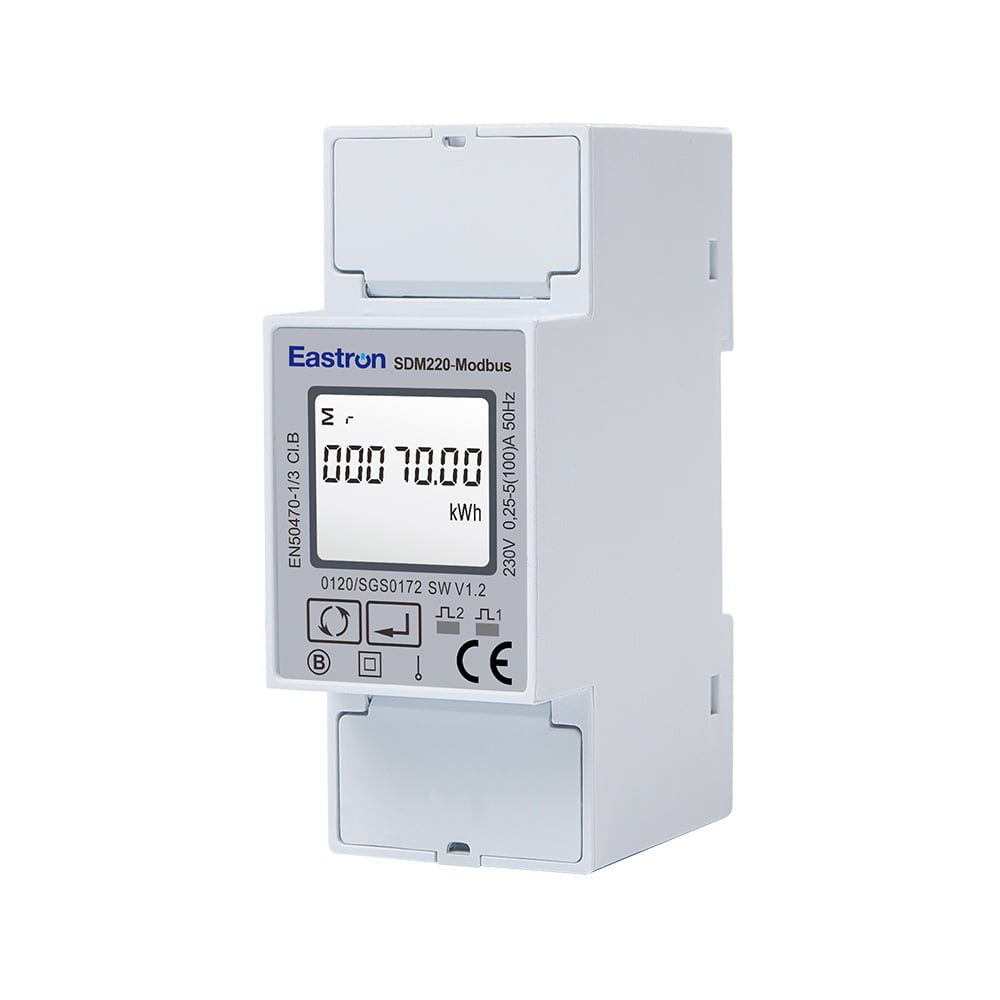
MID Approved Single Phase 100A Din Rail Multi-function Meter for EV Charging Metering
The SDM220-Modbus is a single phase multi-function energy meter for 1P2W AC systems. It is built for direct connection up to 100A, meaning that in many 7kW AC EV charging applications, no external current transformer is needed. This simplifies the wiring structure, reduces installation cost, saves panel space, and improves the reliability of the measurement chain.
The meter is designed around RMS measurement on a single phase AC system, typically 1P+N. Its rated voltage is 230V, with operational voltage from 80% to 120% of nominal voltage. The rated current is 5A, maximum current is 100A, minimum current is 0.25A, and starting current is 20mA. These characteristics allow the meter to capture both small standby consumption and full charging load with dependable measurement performance.
The product supports active energy accuracy according to IEC 62053-21 Class 1.0 and EN 50470-1/3 Class B, while reactive energy is measured according to IEC 62053-23 Class 2 and IEC 61557-12 Class 2. These standards are highly relevant in professional electrical metering and help support the product’s use in regulated or accountability-focused environments.
The SDM220 Series has been assessed and certified as meeting the requirements of EU Directive 2014/32/EU, commonly known as the Measuring Instruments Directive or MID. The EU Type Examination Certificate Number is 0120/SGS0172. For EV charging metering, MID approval is an important differentiator because it supports trustworthy energy measurement for applications where metered values may be used for invoicing, reimbursement, tenant allocation, or energy records.
EV charging presents different metering challenges compared with ordinary household or commercial loads. A single phase AC charger may operate for long periods at high current, often close to the rated load of the circuit. Charging sessions can last several hours, and the energy value recorded by the meter may be used for billing, reporting, or carbon accounting. This means the meter must combine electrical robustness with stable accuracy.
In many EV charging stations, space is limited. The meter may need to be installed inside a charger housing, a small distribution board, or a dedicated control cabinet. A bulky meter can increase enclosure size and manufacturing cost. The SDM220-Modbus addresses this with a 2-module design and 36mm width, allowing it to fit into compact DIN rail spaces without sacrificing direct 100A measurement capability.
Communication is another essential requirement. EV charging systems often include a main controller, display unit, network gateway, payment system, or cloud platform. A meter that only provides visual readings may not be sufficient for smart charging. The SDM220-Modbus provides RS485 Modbus RTU communication, enabling easy data collection by charger controllers and energy management devices. It also provides pulse outputs for traditional energy accumulation or local system integration.
Another factor is bi-directional measurement. As EV charging infrastructure evolves, more systems may interact with local generation, battery storage, and future vehicle-to-grid or vehicle-to-home concepts. Even when a charger is not used for reverse power flow today, bi-directional measurement provides flexibility for system design and future upgrades.
One of the strongest advantages of the SDM220-Modbus is its maximum 100A direct load capability. Many meters designed for compact DIN rail installation require current transformers when current levels become high. Current transformer systems are useful in many industrial applications, but they add additional components, wiring, space requirements, and potential sources of error.
For a 7kW single phase AC EV charger, a direct-connected 100A meter offers a simpler and more compact solution. It reduces the number of parts in the charger assembly and helps manufacturers improve production efficiency. Installers also benefit because the wiring process is more straightforward, reducing the risk of incorrect CT orientation, ratio mismatch, loose secondary wiring, or commissioning errors.
Compared with lower-current meters, a 100A direct meter provides greater headroom. This is important because EV charging loads are continuous and demanding. A meter operating close to its upper limit must maintain thermal stability, mechanical reliability, and measurement accuracy. The 100A design offers confidence in applications where charging current may be high for extended periods.
This direct load capability is especially valuable for charger manufacturers looking for a standardized metering solution. Instead of using several different meter models for different single phase charger ratings, a 100A meter can cover a broad range of applications. This simplifies procurement, inventory, product certification, and after-sales service.
The product is not limited to active energy measurement. It measures kWh, W, V, A, power factor, frequency, demand, reactive energy, and other electrical parameters. This multi-function capability transforms the meter from a passive counter into an active data source for the charging system.
Active energy measurement is the foundation of charging billing and consumption records. Power measurement helps the system understand real-time charging behavior. Voltage and current readings support electrical diagnostics and allow the charger controller to monitor supply conditions. Power factor and reactive energy can be useful for analyzing load quality, especially in installations with multiple chargers or mixed electrical equipment. Frequency measurement helps verify grid condition and system stability.
Demand measurement is also useful for EV charging environments. Facilities with multiple loads may need to manage peak demand to avoid high tariffs or overload conditions. When connected through Modbus, the meter can provide useful data for load balancing strategies. A charging system can use meter readings to reduce output current, delay charging, or coordinate multiple chargers based on available capacity.
Compared with simple pulse-only meters, the SDM220-Modbus provides much richer data. This makes it suitable for modern EV charging systems where operators expect real-time information, remote monitoring, session reports, and integration with software platforms. The meter can serve as a reliable measurement point in a larger smart energy architecture.
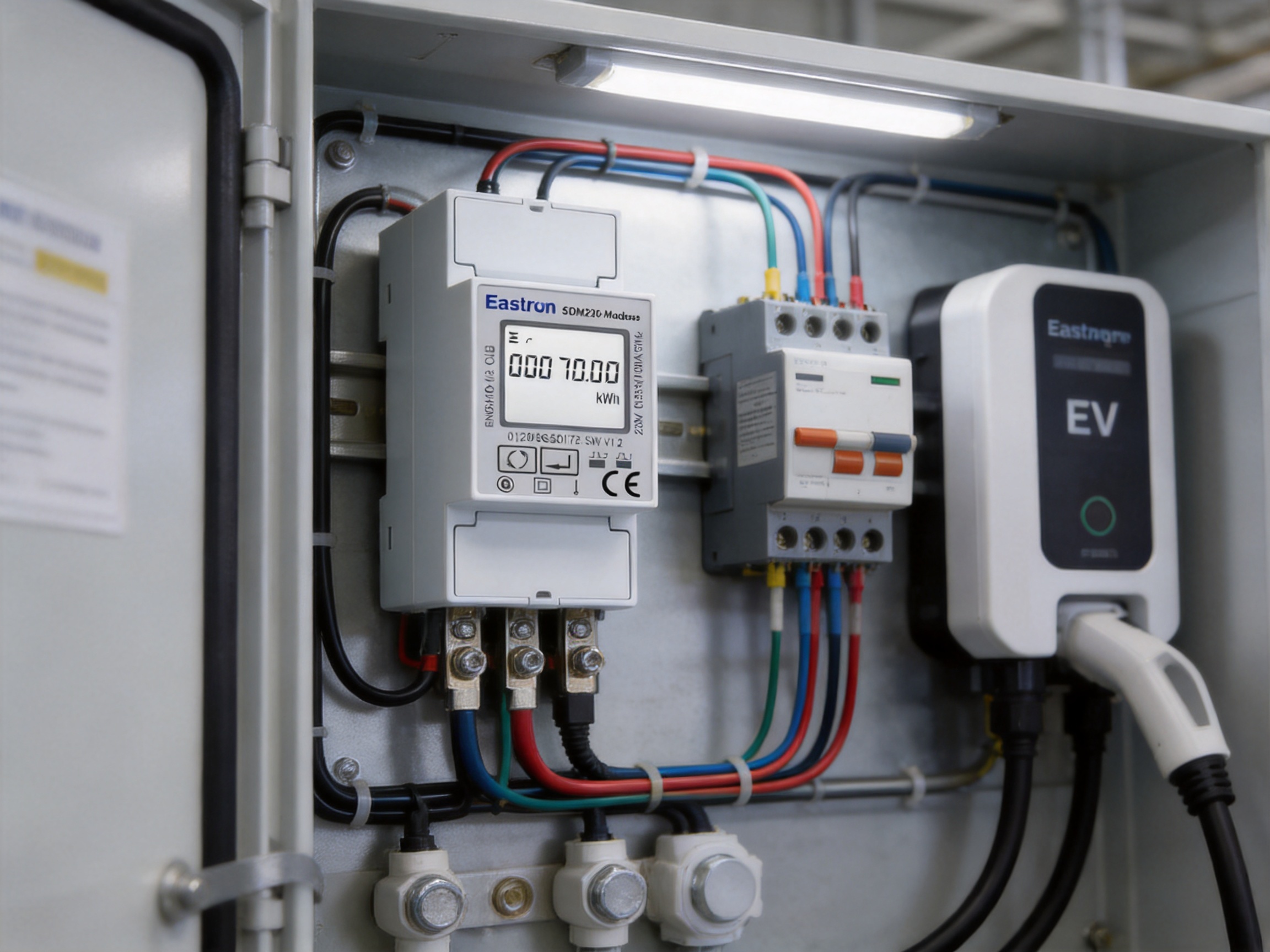
The SDM220-Modbus includes RS485 communication using the Modbus RTU protocol. RS485 remains one of the most widely used communication interfaces in industrial and energy applications because it is robust, economical, and suitable for long-distance transmission. The meter supports communication addresses from 1 to 247, which allows multiple devices to be connected on a network when properly designed.
The transmission distance can reach up to 1000 meters under suitable installation conditions. Supported baud rates range from 1200bps to 9600bps. Parity can be set to none, odd, or even, and stop bits can be configured as 1 or 2. These communication settings give integrators flexibility when connecting the meter to different controllers, gateways, or energy management systems.
For charger manufacturers, Modbus RTU is a practical choice because it is familiar, open, and supported by many embedded control systems. It allows the charger to read key values such as voltage, current, power, active energy, and other parameters. This data can then be shown on a screen, sent to a backend platform, used in charging session calculations, or stored for maintenance records.
In addition to RS485 Modbus, the product provides two pulse outputs. Pulse outputs are useful for systems that require a simple energy counting signal, redundancy, or compatibility with traditional monitoring devices. The combination of Modbus and pulse outputs increases system design flexibility. A charger may use Modbus for detailed monitoring while also using pulse output for local verification or an auxiliary counting function.
This dual-output design is a competitive advantage over meters that provide only a basic interface. It allows the product to support both conventional and intelligent systems, reducing the need to redesign metering hardware when a charger platform evolves.
In energy measurement, certification matters. Accuracy claims are important, but third-party assessment and compliance with recognized standards provide stronger confidence to customers, installers, and regulatory stakeholders. The SDM220 Series has been assessed and certified according to EU Directive 2014/32/EU. Its EU Type Examination Certificate Number is 0120/SGS0172.
MID approval is particularly significant in Europe and in markets that recognize European metering requirements. For EV charging applications, MID approved meters are often preferred or required when measured energy is used for financial transactions, public charging, reimbursement, or official energy accounting. A non-certified meter may be suitable for informal monitoring, but it may not provide the same level of confidence for billing-related applications.
The active energy accuracy is specified as IEC 62053-21 Class 1.0 and EN 50470-1/3 Class B. These classes are widely recognized in electricity metering. The product also measures reactive energy according to IEC 62053-23 Class 2 and IEC 61557-12 Class 2. Other measurement characteristics include current and voltage accuracy of 0.5% of range maximum, frequency accuracy of 0.2% of mid-frequency, power factor accuracy of 1% of unity, and power accuracy of 1% of range maximum.
For EV charging operators, these specifications support accurate energy session records. For manufacturers, they help build trust in the charger’s metering subsystem. For installers, they reduce concerns about whether the meter can meet project requirements. Certification and accuracy together make the product suitable for professional metering environments.
Space efficiency is one of the most important design considerations in modern electrical equipment. EV charger enclosures often need to include power terminals, contactors, residual current protection, communication boards, displays, surge protection, wiring ducts, and cable management features. Every millimeter matters. The SDM220-Modbus uses a 2-module housing with a width of 36mm, allowing it to fit into compact assemblies.
A narrower meter helps reduce the size of the distribution board or charger enclosure. This can lower material costs, simplify layout design, and support more attractive product designs. In retrofit applications, a compact DIN rail meter may also be easier to install where existing space is limited.
Despite its compact size, the meter supports direct load measurement up to 100A and multi-function readings. This balance of high-current capability and small footprint is a major advantage over bulkier meters that occupy more modules or require external current transformers. It allows system designers to achieve both performance and compactness.
The DIN rail mounting format is also familiar to electricians and panel builders. It supports fast installation, secure mounting, and easy replacement when necessary. In production environments, DIN rail mounting can streamline assembly processes and improve repeatability.
Parameter |
Specification |
Application Value |
System Type |
Single phase AC, 1P2W / 1P+N |
Suitable for residential and commercial single phase EV chargers |
Maximum Current |
100A direct load |
Supports 7kW AC EV charging without external CTs |
Rated Voltage |
230V |
Matches common single phase charging supply |
Operational Voltage |
80% to 120% of Un |
Allows stable operation across normal voltage variation |
Measurement Items |
kWh, W, V, A, PF, Hz, demand, reactive energy |
Provides rich data for smart charging and monitoring |
Active Energy Accuracy |
IEC 62053-21 Class 1.0 / EN 50470-1/3 Class B |
Supports reliable metering and certified applications |
Communication |
RS485 Modbus RTU |
Easy integration with charger controllers and gateways |
Pulse Output |
Two pulse outputs |
Supports energy counting and auxiliary system integration |
Width |
2 modules, 36mm |
Saves valuable enclosure and DIN rail space |
Certification |
MID approved, EU Type Examination Certificate 0120/SGS0172 |
Strengthens trust for billing-related EV charging metering |
The SDM220-Modbus offers several practical advantages when compared with many conventional single phase energy meters used in EV charging or electrical sub-metering.
Some competing meters provide energy measurement but lack detailed multi-function data. Others provide communication but require more installation space. The SDM220-Modbus combines multi-measurement capability, Modbus communication, pulse outputs, MID approval, and 100A direct measurement in a 36mm DIN rail housing. This level of integration reduces the need for additional devices and helps simplify the system design.
Meters that require CTs add complexity. CT selection, wiring, ratio configuration, physical positioning, and secondary circuit safety all require attention. The SDM220-Modbus avoids these complications in many single phase EV charger applications by supporting direct 100A load measurement. This can reduce installation time and decrease the probability of wiring mistakes.
Inexpensive non-certified meters may be acceptable for basic observation, but they are not ideal where energy values affect cost allocation, public charging, or customer confidence. MID approval and recognized IEC and EN accuracy standards give the product a stronger position in professional EV charging markets.
Pulse-only meters are limited because they cannot provide detailed electrical parameters. Meters without pulse outputs may be less convenient in traditional systems. The SDM220-Modbus provides both RS485 Modbus RTU and two pulse outputs, making it suitable for both intelligent digital platforms and simpler energy counting systems.
Bi-directional measurement adds flexibility for energy systems that may include local renewable generation, storage, reverse energy flow, or advanced power management. Even where the immediate EV charging application is one-way, bi-directional capability helps future-proof the installation.
The product is specifically positioned for 7kW AC EV charging piles. This application focus is valuable because EV charging requires long-duration high-current operation, communication integration, and dependable energy records. A meter designed with this application in mind is generally more suitable than a generic low-load sub-meter.
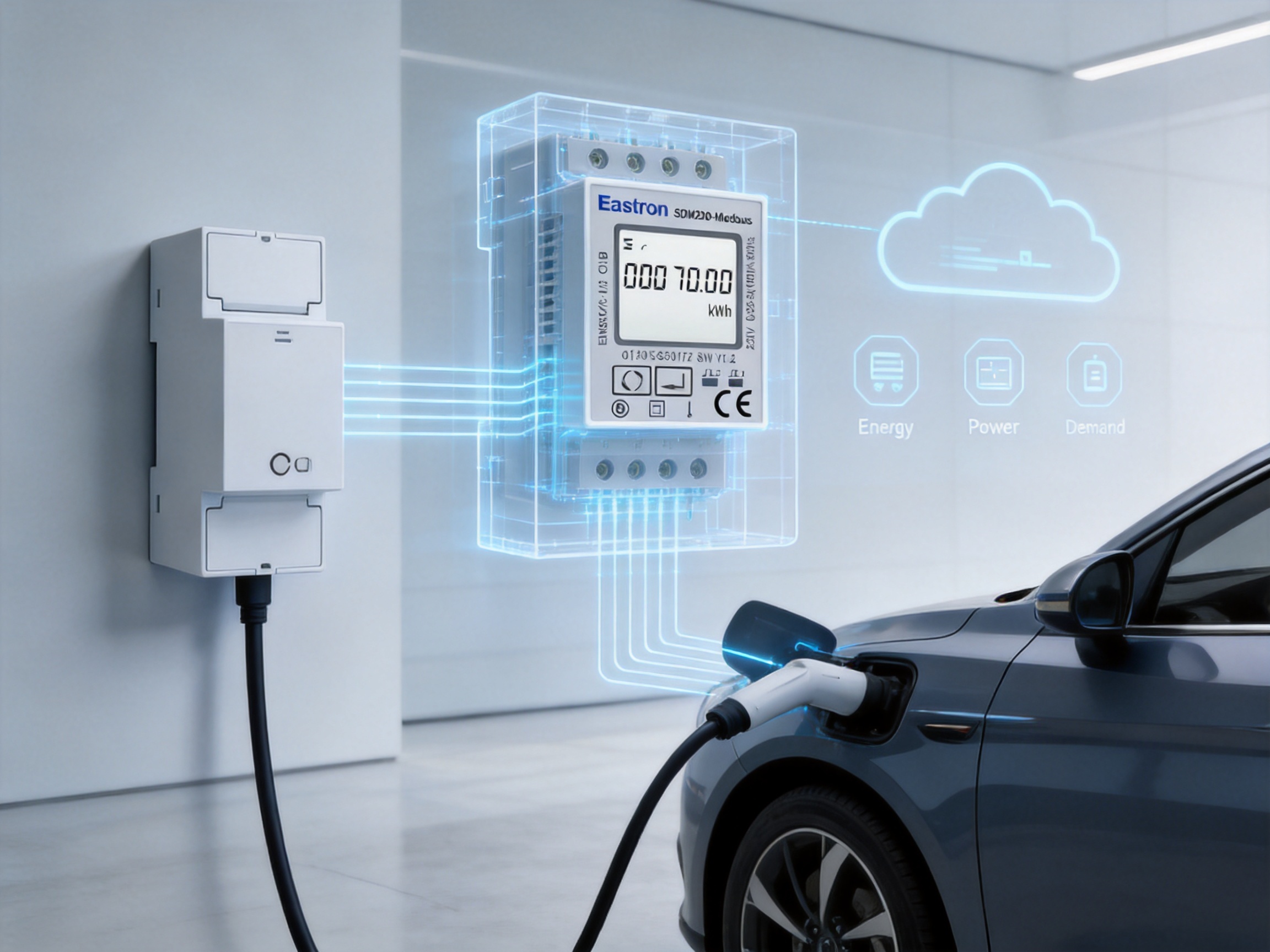
A metering product is only as dependable as the company and manufacturing system behind it. Eastron Electronic Co., Ltd., headquartered in Jiaxing, China near Shanghai, Hangzhou, and Jiangsu, is a high-tech manufacturer and supplier of electricity products and energy measurement solutions. The company develops and produces electricity meters, power analyzers, current sensors, communication modules, and management systems.
The company’s broad product portfolio reflects long-term experience in electrical measurement technology. Products such as electronic kWh meters, multi-function energy meters, MID energy meters, ETL energy meters, DC energy meters, power analyzers, current transformers, relays and switches, PTB and Eichrecht energy meters, UL and ETL energy meters, and gateways demonstrate a strong foundation in measurement, communication, certification, and system integration.
For the SDM220-Modbus, this background is important because EV charging metering draws from several technical disciplines. It requires accurate metrology, durable hardware, reliable communication firmware, compact mechanical design, regulatory compliance, and manufacturing consistency. A company with experience across multiple categories is better positioned to optimize all these elements together.
Eastron continues to invest in research and development of new technologies and new products for electricity metering. Its development teams in China and the UK support product innovation and help maintain a competitive edge. Cooperation with leading universities and institutions further strengthens technology development.
For customers, strong R&D capability means the meter is not merely assembled from generic components. It is supported by engineering knowledge in embedded systems, metrology algorithms, hardware design, communication protocols, and product compliance. This is especially important for smart metering, where firmware stability and communication reliability are as important as hardware accuracy.
Product reliability depends heavily on validation. Eastron has established its own professional laboratory capable of performing EMC, LVD, accuracy, and environmental tests according to IEC, EN, GB, and UL standards. This internal laboratory capability supports faster product development, better quality control, and more rigorous verification before products reach customers.
EMC testing helps ensure that the meter can operate reliably in environments with electrical noise, switching devices, contactors, chargers, and communication equipment. LVD testing supports electrical safety. Accuracy testing verifies measurement performance. Environmental testing helps evaluate product behavior under temperature, humidity, and other operating conditions. Together, these tests help improve product dependability in real-world installations.
The company follows the ISO 9001 quality management system, and its production is approved by SGS according to MID standards. For a MID approved meter, manufacturing consistency is essential. The certification is not only about a design passing a test; it also requires controlled production processes so that manufactured units remain consistent with the approved type.
This is a critical advantage for charger manufacturers and project buyers. When a meter is used in a certified or billing-related system, consistency between units matters. A quality management system helps control components, assembly steps, calibration, inspection, documentation, and traceability. SGS-approved production according to MID standards adds another layer of confidence.
The company holds many patented technologies in software, embedded software, and hardware. It has been recognized as a High-tech Enterprise and a High-tech R&D Centre of Electricity Application. These recognitions indicate sustained technical investment rather than short-term production activity.
In energy metering, patents and embedded software capability are highly relevant. Modern meters require accurate signal processing, stable parameter calculation, tamper-resistance considerations, memory management, communication mapping, and user interface design. Strong embedded software capability helps support reliable Modbus communication and accurate multi-function data output.
Installers and system integrators value products that are easy to wire, configure, and maintain. The SDM220-Modbus supports 1P2W wiring and DIN rail mounting, which are familiar in electrical distribution and charger assembly. The direct 100A design helps reduce auxiliary components, and the compact 36mm width simplifies panel planning.
For communication integration, RS485 Modbus RTU is a widely understood protocol. A charger controller can poll the meter for energy and electrical values. Energy management software can record session data and analyze charger performance. A gateway can collect data from several meters and transmit it to a cloud platform or building management system.
The communication address range of 1 to 247 supports networked systems. The transmission distance of up to 1000 meters is valuable for installations where meters are located in distribution boards while controllers or gateways are placed elsewhere. Configurable baud rate, parity, and stop bits make the meter adaptable to different communication architectures.
Two pulse outputs provide additional flexibility. For example, one pulse output could be used for a charger controller, while another could support an independent monitoring or verification system. This makes the meter suitable for applications where data redundancy or compatibility with legacy equipment is useful.
In residential charging, homeowners often want to understand how much energy is used by their vehicle separately from household consumption. The SDM220-Modbus can provide accurate energy records and real-time electrical values. When connected to a home energy management system, it can support load management and charging optimization.
In multi-tenant environments, energy allocation is important. A MID approved meter helps support fair measurement when electricity costs are assigned to individual users. The compact DIN rail format is useful in distribution cabinets where many circuits must be monitored.
Workplace charging may involve employee reimbursement, visitor charging, or fleet vehicle records. The meter’s communication capability allows energy data to be collected automatically. Demand and power readings can help facility managers understand charging impact on the building’s electrical load.
For retail sites, hotels, parking areas, and commercial properties, charging data may be used for customer billing or internal cost analysis. MID approval, multi-function measurement, and Modbus integration make the product suitable for professional charging infrastructure.
Fleet operators need accurate records for energy cost control, vehicle operation analysis, and sustainability reporting. The SDM220-Modbus can provide the electrical data needed to monitor single phase charging points and integrate them with fleet energy management platforms.
EV charging is becoming part of a broader smart energy ecosystem. Buildings increasingly combine solar generation, battery storage, flexible loads, demand response, and energy monitoring platforms. In this environment, the meter is not only a billing instrument; it is a data node.
The SDM220-Modbus supports this role by providing detailed electrical parameters through Modbus RTU. Real-time power data can help control charging output. Voltage and current data can support safety and diagnostics. Energy data can be used for reporting. Power factor and frequency can contribute to power quality analysis.
When combined with gateways and management systems, the meter can support remote monitoring and energy visualization. Facility managers can identify consumption trends, compare charging points, and detect abnormal behavior. Charger manufacturers can use meter data to improve user interfaces and backend reporting.
Because the product is compact and cost-effective for single phase systems, it can be widely deployed across many charging points. This makes it possible to collect granular data instead of relying only on upstream bulk metering. Granular measurement is essential for accurate billing, fault diagnosis, and optimized energy use.

EV charging loads can be demanding because they often run continuously at high current. The meter must handle not only the maximum current value but also the thermal and operational stress of repeated charging sessions. The SDM220-Modbus is specified for direct load up to 100A, making it suitable for the current level expected in 7kW AC charging applications.
Measurement stability over time is also important. If a meter drifts or behaves inconsistently, charging records may become unreliable. The company’s testing capabilities, accuracy standards, quality management system, and MID production approval contribute to long-term measurement confidence.
Communication reliability is another critical factor. In smart charging systems, communication interruptions can affect session reporting or control logic. RS485 Modbus RTU is well suited to electrically noisy industrial-style environments when wiring and termination are properly implemented. The meter’s configurable communication settings help integrators adapt it to different systems.
The combination of robust electrical design, certified accuracy, and established manufacturing quality makes the product a strong candidate for EV charger OEM integration and project-based installation.
EV charger manufacturers need components that help them create competitive products. A meter that is compact, certified, communication-ready, and suitable for direct high-current measurement can reduce engineering complexity and improve charger value. The SDM220-Modbus meets these needs by combining several important features in one device.
Integrators benefit from a meter that is easy to install and connect. The DIN rail format, 1P2W system compatibility, Modbus RTU interface, and pulse outputs fit common electrical and control practices. The 100A direct design reduces dependency on external current transformers and lowers the chance of installation errors.
Project owners benefit from measurement transparency. MID approval and recognized accuracy standards support confidence in energy records. Multi-function data helps identify electrical issues, monitor performance, and manage energy use.
Compared with meters that focus only on low-cost energy counting, this product provides a more complete solution. Compared with larger industrial meters, it provides a compact and application-focused format for single phase EV charging. This balance is one of its strongest competitive advantages.
Eastron’s products and services have been supplied to more than 50 countries across Europe, Asia-Pacific, America, the Middle East, and Africa. This international experience is valuable because metering requirements vary by market, and EV charging projects often require products that can meet regional expectations for certification, documentation, and support.
The company’s professional technical support and after-sales service teams help customers select products, solve integration issues, and maintain systems. For OEM customers, technical support can be especially important during charger development, Modbus integration, certification preparation, and mass production.
The company’s mission is to create value for customers and grow together with partners. Its corporate values of integrity, pragmatism, refinement, and innovation align well with the demands of electricity metering, where precision, reliability, and long-term service are essential.
For customers selecting a metering partner, manufacturing strength is as important as product specification. A supplier with R&D capability, testing laboratories, certified production, broad product experience, and global service history provides stronger long-term assurance.
When selecting an energy meter for EV charging, buyers should consider several factors. The first is electrical compatibility. For a 7kW single phase AC charger, a 230V 1P2W meter with 100A direct load capability is well matched. The second is certification. MID approval is important for applications where metering values may be used for billing or formal energy allocation.
The third factor is communication. If the charger or management system needs detailed real-time data, Modbus RTU is a strong choice. The fourth factor is physical size. A 2-module 36mm meter helps conserve enclosure space. The fifth factor is manufacturer support. A meter from a company with testing capability, quality management, and international experience reduces project risk.
The SDM220-Modbus aligns well with these criteria. It offers certified active energy measurement, detailed multi-function data, RS485 Modbus RTU, pulse outputs, direct 100A capability, and compact DIN rail mounting. This makes it a strong candidate for OEM EV charger design, distribution board metering, and smart charging infrastructure.
It is designed for single phase AC EV charging metering, especially 7kW AC EV charging piles. Its 1P2W design, 230V rated voltage, and maximum 100A direct load capability make it suitable for many residential, commercial, and semi-public single phase charging installations.
In typical applications within its rated range, it does not require external current transformers because it supports direct load measurement up to 100A. This simplifies installation, saves space, and reduces wiring complexity.
The meter can measure active energy, reactive energy, current, voltage, power, power factor, frequency, demand, and other parameters. This makes it suitable for both billing-related energy measurement and smart monitoring functions.
MID approval shows that the meter has been assessed according to EU Directive 2014/32/EU. For EV charging, this is important when energy values are used for billing, reimbursement, cost allocation, or official energy records.
The SDM220-Modbus uses RS485 with Modbus RTU protocol. It also provides two pulse outputs, allowing it to work with both intelligent digital systems and conventional energy counting applications.
Yes. Through Modbus RTU, charger controllers or energy management systems can read voltage, current, power, energy, and other values. This supports real-time monitoring, load management, session records, and remote data collection.
The meter has a 2-module DIN rail design with a width of 36mm. This compact size is useful in EV charger housings and distribution boards where installation space is limited.
Active energy accuracy complies with IEC 62053-21 Class 1.0 and EN 50470-1/3 Class B. Reactive energy measurement complies with IEC 62053-23 Class 2 and IEC 61557-12 Class 2.
A basic kWh meter may only record energy consumption. This product provides multi-function measurement, RS485 Modbus RTU communication, two pulse outputs, bi-directional measurement, MID approval, and 100A direct connection in a compact DIN rail format.
Accurate metering depends on consistent manufacturing, calibration, testing, and quality control. Eastron has R&D teams, a professional laboratory for EMC, LVD, accuracy, and environmental tests, ISO 9001 quality management, SGS-approved MID production, patented technologies, and international service experience.
The SDM220-Modbus is a strong solution for single phase EV charging metering because it combines certified accuracy, compact installation, direct 100A load measurement, multi-function electrical monitoring, Modbus RTU communication, pulse outputs, and bi-directional measurement. These features address the real requirements of modern EV charging systems, where reliable energy data is essential for billing, control, diagnostics, and energy management.
Its advantages over many competing meters are clear. It avoids the complexity of external current transformers in many applications, saves DIN rail space with a 36mm 2-module design, supports smart system integration through RS485 Modbus RTU, and provides MID approved measurement confidence. For 7kW AC EV charging piles, it offers a practical and well-balanced metering platform.
The manufacturing strength behind the product further increases its value. With advanced R&D, professional testing laboratories, patented technologies, ISO 9001 quality management, SGS-approved MID production, and global market experience, Eastron provides not only a meter but also a reliable engineering and manufacturing foundation. For EV charger manufacturers, integrators, and project owners seeking accurate and future-ready metering, this product represents a dependable choice.
European Parliament and Council. Directive 2014/32/EU on Measuring Instruments.
International Electrotechnical Commission. IEC 62053-21: Electricity Metering Equipment, Particular Requirements for Static Meters for Active Energy.
International Electrotechnical Commission. IEC 62053-23: Electricity Metering Equipment, Particular Requirements for Static Meters for Reactive Energy.
European Standard. EN 50470-1 and EN 50470-3: Electricity Metering Equipment.
International Electrotechnical Commission. IEC 61557-12: Electrical Safety in Low Voltage Distribution Systems, Performance Measuring and Monitoring Devices.
Modbus Organization. Modbus Application Protocol Specification.
Eastron Electronic Co., Ltd. Product information and technical data for SDM220 Series single phase multi-function energy meters.
Your email address will not be published. Required fields are marked *

We develop and produce high performance electricity meters, power analyzers, current sensors, communication modules and management systems. China Custom Smart Meters Manufacturers and Factory
Address:NO 52, Dongjin Road, Nanhu, Jiaxing, Zhejiang, China
Copyright @ Eastron Electronic Co., Ltd. All rights reserved Electricity Meters Manufacturers
