

 English
 Español
 Deutsch
 中文简体
中文简体

Product Consultation
Your email address will not be published. Required fields are marked *
Europe's Solar and Energy Storage Transition: Transforming the Power System Infrastructure for a Renewable Future
Jul 10,2026
Power Systems Are Becoming “Real-Time Systems”: Why Data Is More Critical Than Electricity
Jul 06,2026
New EPBD Regulations Drive HVAC Energy Transparency and Boost Demand for Smart Meters
Jul 07,2026Content
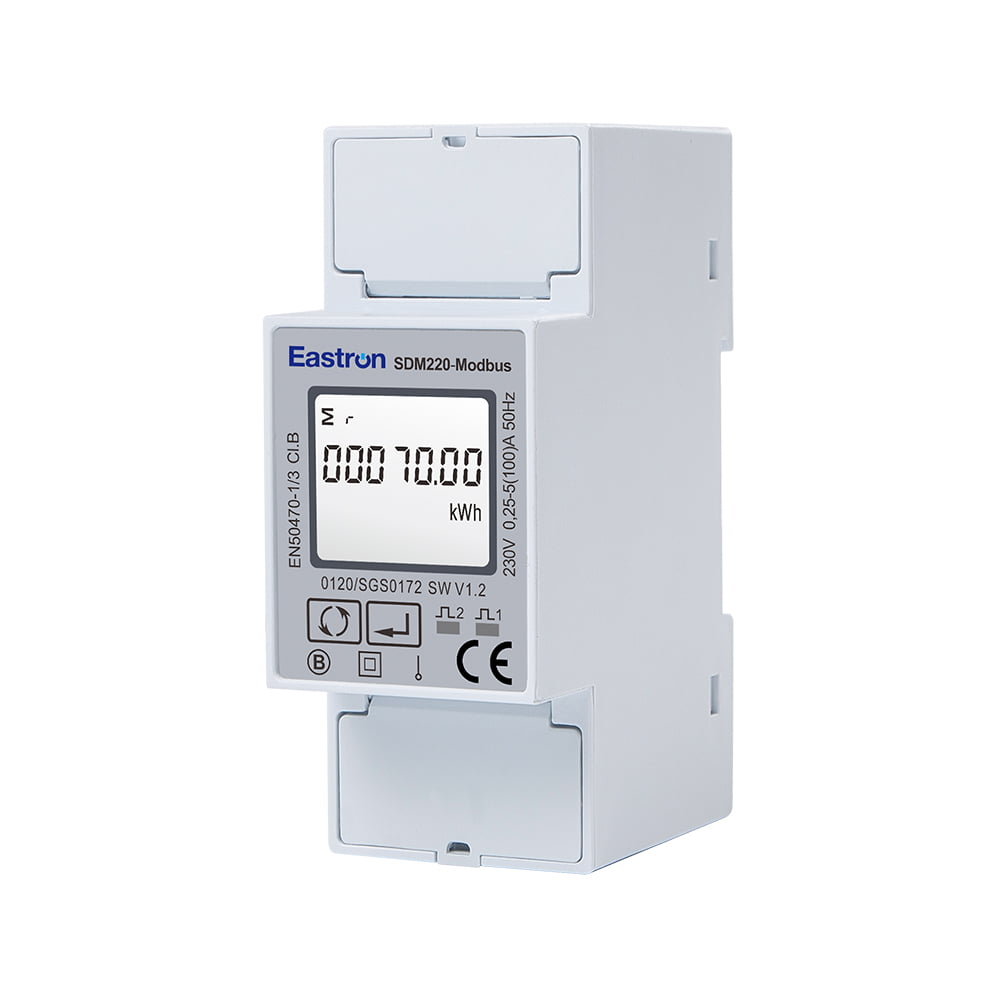
Modbus 100A Din Rail Single Phase MID Energy Meter
Single-phase energy monitoring has become a central requirement in residential buildings, light commercial facilities, solar photovoltaic installations, EV charging points, rental properties, small workshops, and distributed energy systems. As electrical loads increase and energy costs become more important to manage, installers and system integrators need meters that are compact, accurate, communication-ready, and simple to deploy. The Modbus 100A DIN rail single phase MID energy meter described in this article is designed to meet that demand by combining direct-load metering, multi-function measurement, certified energy accuracy, RS485 Modbus communication, pulse outputs, and a DIN rail enclosure only 36 mm wide.
The product, identified as SDM220-Modbus, is a single phase multi-function energy meter for 1P2W or 1P+N AC systems. It measures active energy, reactive energy, current, voltage, power, power factor, frequency, demand, and other important electrical parameters. With a maximum direct load current of 100A, it can serve applications where many competing single-phase meters require an external current transformer or a larger panel footprint. Its MID compliance under EU Directive 2014/32/EU, with active energy accuracy according to IEC 62053-21 Class 1.0 and EN 50470-1/3 Class B, makes it suitable for regulated metering applications where recognized performance and traceability matter.
Beyond measurement, the meter is built for data integration. RS485 Modbus RTU communication allows remote reading and configuration in energy management platforms, building automation systems, gateways, and supervisory control systems. Two pulse outputs provide compatibility with legacy data loggers and pulse-counting equipment. Bi-directional measurement makes the unit especially useful in solar PV applications where imported and exported energy must be measured clearly. The LCD with backlight improves readability during commissioning, inspection, and maintenance, even in poorly lit distribution cabinets.
This article examines the product in depth, including its technical architecture, competitive advantages, communication capabilities, application scenarios, manufacturing background, quality assurance strengths, and practical value for installers, system designers, and end users. It also includes a structured Q&A section and reference notes at the end.
The Modbus 100A DIN rail single phase MID energy meter is a compact two-module device designed for single-phase AC measurement. It is built for 1P2W wiring and is mounted on standard DIN rail. The enclosure width of 36 mm allows it to be installed in crowded consumer units, distribution boards, solar cabinets, and energy monitoring panels without requiring excessive space.
Although compact, the meter provides multiple measurement functions that are often associated with larger power meters. It measures kilowatt-hours, watts, volts, amps, power factor, hertz, and demand values. These readings allow users to understand not only how much energy has been consumed, but also how the electrical load behaves. This is important for efficiency analysis, abnormal load detection, solar performance evaluation, billing support, and energy-saving projects.
The meter supports direct current measurement up to 100A. This is a major practical benefit because direct connection reduces installation complexity. In many installations, a current transformer adds wiring, consumes space, requires correct ratio configuration, and introduces additional selection and accuracy considerations. A direct 100A meter is easier to specify and easier to install for many single-phase circuits.
The unit also provides communication flexibility. RS485 Modbus RTU is a widely used industrial protocol, making the meter suitable for integration with gateways, energy management systems, data acquisition modules, PLC systems, and monitoring platforms. The communication address range of 1 to 247 allows multiple units to be connected on a single RS485 network. Transmission distance can reach up to 1000 meters under suitable wiring and network conditions, providing strong flexibility in buildings, industrial sites, and distributed metering projects.
For applications that still rely on pulse collection, the two pulse outputs provide practical compatibility. This dual approach, with both digital communication and pulse outputs, gives the meter a broader range of deployment possibilities than meters that offer only one data interface.
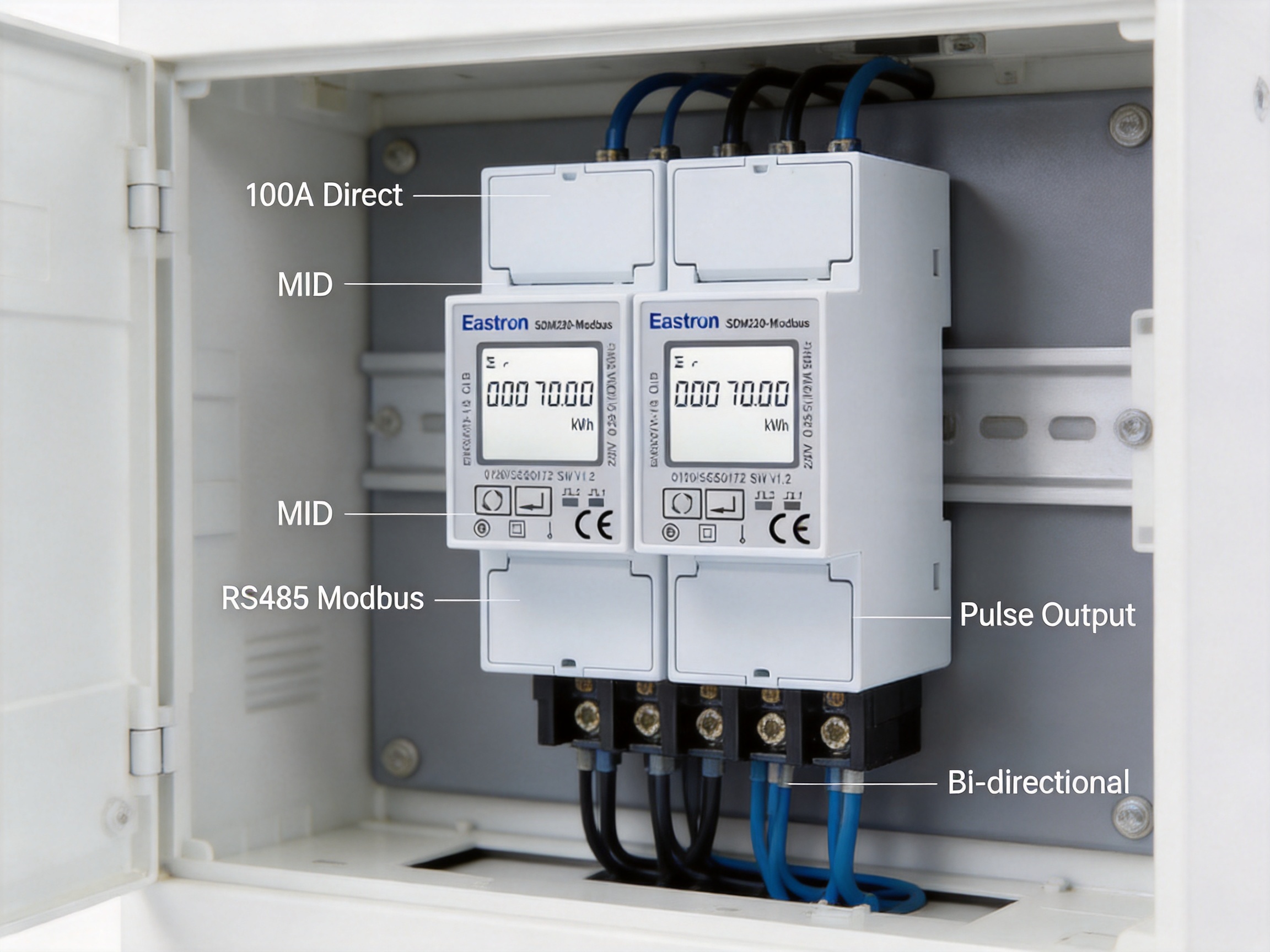
The product is designed around several essential features that make it suitable for professional electrical metering and energy monitoring applications. Its core feature set includes direct 100A current input, multi-function measurement, MID-certified active energy metering, bi-directional energy measurement, RS485 Modbus RTU communication, pulse outputs, backlit LCD display, and a compact DIN rail housing.
The meter measures RMS values on a single phase AC system. RMS measurement is important because many modern electrical loads are not purely resistive. Power supplies, variable-speed devices, LED drivers, and electronic equipment can produce non-linear waveforms. Accurate RMS measurement improves the reliability of readings in real-world installations.
The active energy accuracy is specified according to IEC 62053-21 Class 1.0 and EN 50470-1/3 Class B. This supports confidence in energy billing, tenant sub-metering, energy allocation, and compliance-driven measurement. Reactive energy is specified according to IEC 62053-23 Class 2 and IEC 61557-12 Class 2. Voltage and current accuracy are both specified at 0.5% of range maximum, while power accuracy is 1% of range maximum. Frequency accuracy is 0.2% of mid-frequency, and power factor accuracy is 1% of unity, or 0.01.
The meter is rated for a nominal current of 5A and a maximum current of 100A. The minimum current is 0.25A, and the starting current is 20mA. The rated voltage is 230V, with an operational voltage range of 80% to 120% of nominal voltage. These values make the meter appropriate for common single-phase supply environments.
Communication parameters are flexible. The RS485 Modbus RTU interface supports communication addresses from 1 to 247, baud rates from 1200 bps to 9600 bps, parity options of none, odd, or even, and stop bit settings of 1 or 2. The default parity setting is none. Such flexibility helps installers match the meter to existing network settings and supervisory equipment.
The following table summarizes the main specification areas for the meter.
Specification Area |
Details |
Practical Benefit |
System Type |
Single phase AC, 1P2W or 1P+N |
Suitable for residential, commercial, solar, and sub-metering applications |
Maximum Current |
100A direct load |
Reduces the need for external current transformers in many installations |
Rated Voltage |
230V |
Compatible with common single-phase electrical systems |
Active Energy Accuracy |
IEC 62053-21 Class 1.0 and EN 50470-1/3 Class B |
Supports reliable and certified energy measurement |
Reactive Energy Accuracy |
IEC 62053-23 Class 2 and IEC 61557-12 Class 2 |
Useful for load analysis and power quality awareness |
Communication |
RS485 Modbus RTU |
Integrates with gateways, monitoring software, and automation systems |
Pulse Outputs |
Two pulse outputs |
Compatible with pulse counters and legacy data collection devices |
Display |
Backlit LCD |
Improves readability during installation and maintenance |
Width |
Two modules, 36 mm |
Saves panel space in compact distribution boards |
Measurement Direction |
Bi-directional |
Ideal for solar PV import and export energy monitoring |
One of the strongest advantages of this single-phase meter is its 100A direct-load capacity. In many practical installations, 100A is a meaningful threshold. It covers a wide range of household main circuits, commercial branch circuits, small industrial loads, EV charging support circuits, and renewable energy monitoring points. A meter that can directly carry up to 100A simplifies installation compared with CT-operated meters.
Current transformers are useful in high-current applications, but they also introduce extra steps. Installers must select the correct CT ratio, install the CT in the correct orientation, route secondary wiring, confirm terminal polarity, and configure the meter correctly. Errors in CT ratio or wiring direction can cause incorrect readings. Direct measurement eliminates many of these potential mistakes, making installation faster and reducing commissioning risk.
Compared with lower-rated direct meters, such as 45A or 63A devices, a 100A model offers greater application flexibility. A contractor can standardize on one meter for more projects instead of stocking several current ratings. This is particularly valuable for panel builders, energy monitoring service providers, and electrical distributors that want to reduce inventory complexity.
Direct 100A capability also supports retrofit work. Many existing single-phase systems do not have extra panel space for CTs, terminal blocks, and additional wiring. A two-module meter can often be installed with minimal redesign. This makes it practical for upgrading older installations to digital monitoring without replacing the entire distribution board.
MID certification is a major differentiator for energy meters used in Europe and in projects that value recognized metrological compliance. The Measuring Instruments Directive 2014/32/EU establishes requirements for measuring instruments, including electricity meters, placed on the market for regulated applications. A meter assessed and certified under MID gives installers, energy managers, landlords, operators, and end users greater confidence in the integrity of measurement data.
The meter described here has been assessed and certified as meeting the requirements of EU Directive 2014/32/EU. The EU Type Examination Certificate Number is 0120/SGS0172. This certification background is important when energy data is used for billing, cost allocation, tenant metering, or official reporting. While application requirements vary by country and project type, MID certification is widely recognized as a strong indicator of metrological quality.
Compared with non-certified basic meters, a MID energy meter provides stronger assurance that measurement performance has been verified against defined standards. This can reduce disputes in shared buildings, rental properties, commercial parks, and managed facilities. When users see that a meter follows recognized standards such as EN 50470-1/3 Class B, they are more likely to trust the readings.
For system integrators, certified meters help strengthen the credibility of the complete energy management solution. A dashboard or billing platform is only as reliable as its field measurement devices. By using an MID-certified device at the measurement point, the entire system benefits from a stronger technical foundation.
Energy management is no longer limited to reading kilowatt-hours once per month. Modern systems require detailed electrical parameters to identify inefficiency, diagnose problems, verify solar performance, detect overload conditions, and support automation decisions. The meter supports this shift by providing multi-function measurement in a compact DIN rail form factor.
Active energy measurement indicates how much usable electrical energy is consumed or generated over time. Reactive energy provides additional insight into inductive or capacitive characteristics of loads. Current and voltage readings help identify circuit loading and supply quality. Power readings show real-time demand, while power factor measurement indicates how effectively the load converts electrical power into useful work. Frequency measurement helps confirm system stability, and demand data supports load profiling.
These measurements are useful for both technical and financial reasons. A facility manager may use energy readings to allocate costs between tenants or departments. An installer may use voltage and current readings to verify proper operation after installation. A solar operator may use bi-directional energy readings to distinguish import and export. A maintenance engineer may use power factor and demand trends to identify abnormal load behavior.
Compared with simple kWh-only meters, this multi-function approach provides richer data from the same installation point. That means fewer devices are needed in the panel, fewer wiring tasks are required, and system complexity is reduced. In competitive terms, a compact meter that provides both certified energy measurement and expanded electrical parameters offers stronger value than a basic billing meter or a simple pulse-only device.
RS485 Modbus RTU remains one of the most widely adopted communication methods for industrial and building energy monitoring. Its popularity comes from simplicity, robustness, multi-drop capability, and broad compatibility. The meter uses RS485 and Modbus RTU, allowing it to communicate with many gateways, controllers, data loggers, and software platforms.
In a typical installation, multiple meters can be connected along an RS485 bus. Each meter is assigned a communication address from 1 to 247. A gateway or master device polls each meter and collects data such as kWh, voltage, current, power, power factor, and frequency. This data can then be displayed locally, transmitted to a cloud platform, exported to a building management system, or used for billing and reporting.
The supported transmission distance of up to 1000 meters offers design flexibility in larger buildings or distributed sites. Baud rates from 1200 bps to 9600 bps allow compatibility with different communication environments. Parity and stop bit options make it easier to integrate with existing networks. These practical settings are important because energy monitoring projects often involve mixed devices from different generations and manufacturers.
Compared with meters that provide only a pulse output, a Modbus meter provides far more information. Pulse outputs typically provide energy count data, while Modbus can deliver multiple electrical parameters and configuration values. This makes Modbus a better choice for intelligent monitoring, troubleshooting, and remote management. Compared with meters that rely only on proprietary communication, Modbus gives system designers more freedom and reduces vendor lock-in.
Although Modbus communication is a powerful feature, pulse outputs remain valuable in many applications. The meter includes two pulse outputs, enabling connection to pulse counters, remote displays, data loggers, and legacy energy management equipment. This is especially useful in retrofit projects where an existing monitoring system already collects pulse signals from meters.
Pulse outputs are simple, reliable, and easy to understand. Each pulse represents a defined quantity of energy, and the receiving device counts pulses over time. This method is not as data-rich as Modbus, but it is highly compatible and widely used. Having both pulse outputs and Modbus communication gives the meter a competitive edge because it supports both older and newer monitoring architectures.
In some projects, pulse output can also serve as a secondary data path. For example, a system may use Modbus for detailed monitoring while pulse data is used for independent verification or connection to a separate billing counter. This flexibility can be important in facilities where different stakeholders need different types of data.
Bi-directional measurement is an increasingly important feature as more homes and businesses install solar PV systems, battery storage, and other distributed energy resources. In a traditional load-only installation, electricity flows in one direction from the grid to the consumer. In a solar PV system, energy may flow from the grid to the building at night or during high consumption, while excess solar generation may flow from the building back toward the grid during periods of surplus generation.
A meter with bi-directional measurement can distinguish these operating conditions more effectively than a simple one-directional meter. This helps solar owners understand import and export behavior, evaluate self-consumption, and analyze system performance. It also supports monitoring of net energy flows in applications where generation and consumption occur at the same connection point.
For installers, bi-directional capability reduces the risk of choosing the wrong meter for a renewable energy project. A meter designed only for consumption may not provide the necessary data when reverse energy flow occurs. By selecting a bi-directional model, system designers gain additional flexibility for current and future energy configurations.
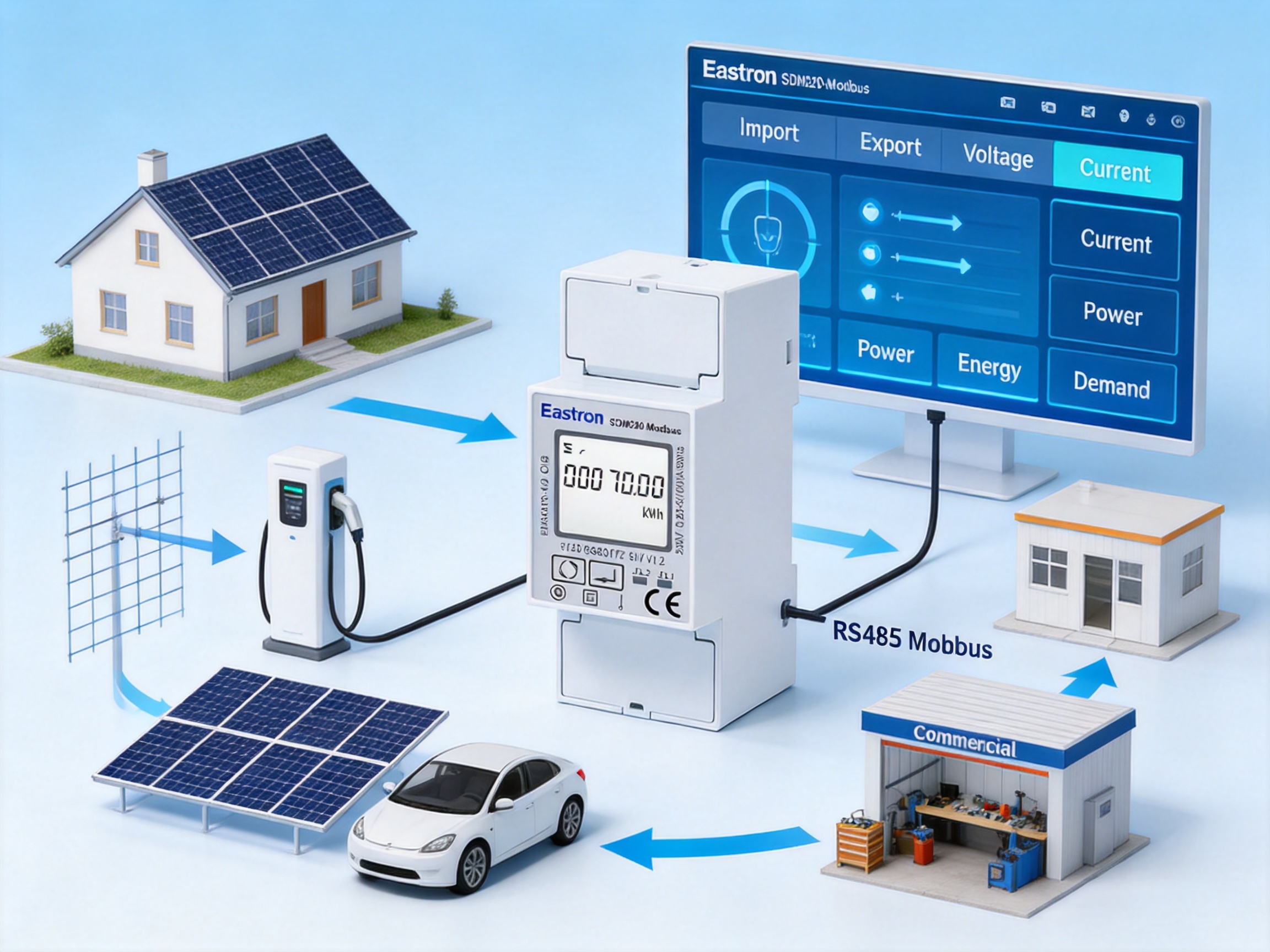
Panel space is often one of the most difficult constraints in electrical installations. Distribution boards can be crowded with circuit breakers, residual current devices, surge protection devices, contactors, communication gateways, terminals, and control devices. A meter that occupies only two modules, or 36 mm of DIN rail width, is easier to fit into existing panels and new designs.
The compact width is particularly valuable when multiple meters are required. In apartment buildings, commercial units, EV charging clusters, and multi-circuit monitoring projects, the total panel footprint can quickly become a major cost factor. A two-module meter allows more metering points to be installed in less space. This can reduce enclosure size, improve layout flexibility, and make maintenance access easier.
Compared with wider multi-function meters, the compact format provides a stronger balance between measurement capability and installation efficiency. It delivers advanced readings and communication without demanding a large amount of panel space. For panel builders, this helps create cleaner, denser, and more cost-effective solutions.
A good energy meter must be easy to read during installation and service. The backlit LCD display supports clear local viewing of measurement values and settings. This is useful when commissioning the meter, checking wiring, confirming load behavior, or troubleshooting communication issues.
In real electrical rooms and distribution cabinets, lighting is often limited. A backlit display helps technicians avoid mistakes and reduces the need for additional lighting tools. Local display access is also important when communication has not yet been configured. An installer can still verify basic readings directly from the meter before connecting the device to a monitoring platform.
Compared with meters that rely only on remote communication or have non-backlit displays, the backlit LCD improves usability and reduces field service time. This practical advantage may seem simple, but it has real value for electricians and maintenance teams.
The market includes many single-phase meters, but not all offer the same combination of certification, communication, current rating, compact size, and multi-function capability. The Modbus 100A DIN rail single phase MID energy meter stands out because it combines several high-value characteristics in one device.
Against basic mechanical or electronic kWh meters, it offers digital multi-parameter measurement, Modbus communication, pulse outputs, and a backlit LCD. Against pulse-only meters, it offers richer data through RS485 Modbus RTU. Against non-certified meters, it offers MID-certified measurement confidence. Against lower-current direct meters, it offers 100A capacity. Against CT-operated meters used in similar current ranges, it offers simpler wiring and fewer external components. Against larger multi-function meters, it offers a narrow two-module DIN rail profile.
This combination creates an advantage not based on one feature alone, but on total installation value. The meter helps reduce panel space, wiring work, configuration complexity, inventory variation, and integration barriers. It also supports future-ready monitoring by delivering data through an open and widely used communication protocol.
For distributors and contractors, this broad feature set makes the product easier to recommend across multiple project types. For end users, it provides accurate and accessible energy information. For system integrators, it provides dependable field data for software platforms. For renewable energy installers, it supports bi-directional monitoring in solar PV applications.
The meter can be used in a wide variety of single-phase applications. In residential settings, it can monitor whole-home consumption, sub-circuits, solar PV import and export, heat pump circuits, EV charging circuits, or tenant usage. Its compact size is helpful in domestic consumer units where space is limited.
In commercial buildings, the meter can support tenant sub-metering, shop unit monitoring, office energy allocation, lighting circuit monitoring, and equipment-level measurement. The Modbus interface allows facility managers to collect data from multiple meters and analyze consumption trends across a building.
In solar PV systems, bi-directional measurement helps track energy flows between the grid, building loads, and generation system. This information can support self-consumption analysis, export monitoring, and performance verification. When connected to a gateway, solar energy data can be displayed remotely and used for long-term reporting.
In EV charging installations, a 100A direct meter can measure charging energy for single-phase charging points or related circuits. The communication function allows integration into management platforms, while MID certification may support applications where accurate energy accounting is required.
In industrial and workshop environments, the meter can monitor single-phase equipment, auxiliary circuits, small production lines, or departmental consumption. Multi-function readings help maintenance teams understand load conditions and identify abnormal operating patterns.
In energy service company projects, the meter can serve as a field data source for efficiency analysis, measurement and verification, and cost-saving programs. Because it provides both energy and electrical parameters, it can support more detailed analysis than a simple kWh meter.
Energy meters become more powerful when connected to gateways and software platforms. Through RS485 Modbus RTU, this meter can be integrated into local and remote monitoring systems. A gateway can collect data from the meter and transmit it to a cloud server, building management system, supervisory control platform, or local dashboard.
This integration enables automatic meter reading, trend analysis, alarm generation, load comparison, tenant billing support, and energy-saving evaluation. Instead of manually recording readings, operators can view energy data in real time or generate periodic reports. This saves labor and reduces the risk of manual transcription errors.
Because Modbus is widely understood, integration is often straightforward for experienced system integrators. The configurable address, baud rate, parity, and stop bit settings allow the meter to fit into many communication networks. This is especially useful in mixed installations where multiple device types share one RS485 line.
The meter can also work alongside gateways offered within the broader product category ecosystem. When meters, gateways, and management systems are properly coordinated, users gain a complete energy measurement solution rather than a standalone device. This is important for modern energy management, where data visibility is as valuable as the meter itself.
A reliable energy meter depends not only on circuit design and specifications, but also on manufacturing capability, quality control, calibration processes, component selection, and long-term engineering expertise. The company behind this meter, Eastron Electronic Co., Ltd., is headquartered in Jiaxing, China, near Shanghai, Hangzhou, and Jiangsu. This location provides access to an advanced industrial supply chain, skilled engineering resources, and efficient logistics networks.
The company develops and produces electricity meters, power analyzers, current sensors, communication modules, and management systems. This broad product range is significant because it indicates experience across the full energy measurement ecosystem. A manufacturer that understands meters, sensors, communication interfaces, and software systems can design products that are easier to integrate and more practical in real installations.
Research and development is supported by energetic and innovative teams in China and the United Kingdom. This international development structure helps combine manufacturing efficiency with application insight from mature energy markets. Cooperation with leading universities and institutions further supports technical progress and product innovation.
The company has established its own professional laboratory capable of performing EMC, LVD, accuracy, and environmental tests according to IEC, EN, GB, and UL standards. This in-house testing capability is a major strength. It allows engineers to verify product performance during development, identify potential weaknesses early, and maintain consistent quality during production. For customers, it means the product is supported by systematic technical validation rather than simple assembly.
The company follows the ISO 9001 quality management system, and its production is approved by SGS according to MID standards. ISO 9001 supports process control, traceability, corrective action, supplier management, and continual improvement. SGS approval under MID-related production requirements supports confidence in metrological consistency. Together, these systems help ensure that each meter is produced under controlled conditions.
Energy meters must operate accurately over time in electrical environments that may include voltage variation, electromagnetic interference, temperature changes, installation differences, and load fluctuations. Advanced testing is therefore essential. The manufacturer’s professional laboratory supports EMC testing, LVD testing, accuracy verification, and environmental testing according to recognized standards.
EMC testing helps ensure the meter can operate reliably in environments with electromagnetic disturbances and does not generate unacceptable interference. This is important because electrical panels often contain switching devices, inverters, relays, contactors, and communication equipment. A meter with poor EMC performance may produce unstable readings or communication problems.
LVD testing addresses electrical safety requirements. Energy meters are connected directly to live circuits, so insulation, clearance, creepage, thermal performance, and protection against electrical hazards are critical. Compliance with low-voltage safety expectations helps protect installers, users, and equipment.
Accuracy testing verifies that the meter measures energy and electrical parameters within specified limits. For MID and Class B applications, consistent accuracy is essential. Calibration and verification processes help ensure that meters leaving production meet performance requirements.
Environmental testing supports confidence in durability. Meters may be installed in distribution boards exposed to varying temperatures, humidity, vibration, and other conditions. Environmental validation helps confirm that the design remains stable under expected service conditions.
Compared with suppliers that rely heavily on external testing only at the end of development, a manufacturer with internal laboratory capability can test more frequently, iterate faster, and maintain closer control over product quality. This strengthens both product reliability and development speed.
The manufacturer’s product categories include applications, electronic kWh meters, multi-function energy meters, MID energy meters, ETL energy meters, DC energy meters, power analyzers, systems and solutions, current transformers, relays and switches, PTB and Eichrecht energy meters, UL and ETL energy meters, and gateways. This wide portfolio matters because energy measurement projects often require more than one device type.
For example, a project may need single-phase meters for residential units, three-phase meters for main distribution, current transformers for high-current circuits, gateways for data transmission, and software for energy visualization. A supplier with a broad product ecosystem can support project consistency and simplify procurement.
The Modbus 100A DIN rail single phase MID energy meter benefits from this ecosystem. Its communication capability aligns with gateway and system solutions. Its metering design reflects experience in MID and multi-function energy measurement. Its direct 100A construction complements the availability of CT-operated meters for higher-current applications. This allows customers to select the right product for each point in an installation while maintaining a consistent technical approach.
The meter is designed for DIN rail installation in a single-phase 1P2W system. Correct wiring is essential for safety and accuracy. Installers should follow the wiring diagram, observe terminal markings, ensure proper conductor sizing for the load current, and comply with local electrical regulations. Because the meter supports up to 100A direct load, attention should be paid to terminal tightening torque, conductor type, protection devices, and heat dissipation in the enclosure.
During commissioning, the backlit LCD can be used to verify voltage, current, power, and energy readings. If the meter is used in a Modbus network, the installer should configure or confirm the communication address, baud rate, parity, and stop bit settings. Each device on the RS485 bus must have a unique address. Proper cable selection, shielding, polarity, termination, and network topology help maintain stable communication, especially over long distances.
For pulse output applications, the receiving device should be compatible with the pulse output characteristics and programmed according to the required pulse constant. Pulse wiring should be separated from noisy power cables when possible to reduce signal interference.
For solar PV applications, it is important to confirm the measurement direction and verify import/export readings during operation. The bi-directional function is valuable, but it must be interpreted correctly within the monitoring system. Energy management software should be configured to label and report imported and exported energy clearly.
Installers benefit from a compact meter that is easy to mount, supports direct 100A circuits, and provides local display readings. The two-module width makes panel layout easier, while direct connection reduces extra CT wiring. The availability of Modbus and pulse outputs means the same product can be used in different monitoring environments.
System integrators benefit from the Modbus RTU interface, configurable communication parameters, and multi-function data set. These features make it easier to connect the meter to dashboards, gateways, and supervisory systems. The MID certification and standard-based accuracy also strengthen the credibility of the data collected.
End users benefit from better energy visibility. They can understand consumption, demand, voltage, current, power factor, and solar import/export patterns. This information supports cost control, efficiency improvements, and informed decision-making. In tenant or cost-allocation applications, certified measurement helps build trust between building owners and occupants.
Distributors benefit from a versatile product that covers many application categories. Because it combines high current capacity, compact size, certification, and communication, it can serve as a go-to single-phase meter for many customers. This can simplify stocking and improve sales efficiency.
Accurate metering is one of the foundations of energy efficiency. Users cannot manage what they cannot measure. By providing detailed energy and electrical data, the meter supports practical efficiency actions such as identifying high-consumption circuits, verifying equipment schedules, detecting standby loads, comparing tenant consumption, and evaluating solar PV utilization.
In buildings, sub-metering often reveals energy waste that remains invisible at the main meter level. For example, lighting circuits may remain active outside business hours, equipment may draw unexpected current, or tenants may consume energy unevenly. With multi-function measurement and remote communication, these issues can be detected faster.
In renewable energy applications, bi-directional metering supports better understanding of self-consumption and export behavior. This can guide decisions about battery storage, load shifting, and energy management strategies. As distributed energy grows, meters like this become essential components of smarter and more sustainable electrical systems.
When selecting an energy meter, buyers often compare specifications such as current rating, accuracy, communication, and dimensions. However, the manufacturer’s capability is equally important. A meter is a precision instrument, and long-term reliability depends on design discipline, component quality, calibration control, production consistency, and testing depth.
Eastron Electronic Co., Ltd. has built its position through electricity metering products and energy measurement solutions supplied to more than 50 countries across Europe, Asia-Pacific, America, the Middle East, and Africa. International supply experience helps the company understand different standards, installation practices, customer expectations, and environmental requirements.
The company holds patented technologies in software, embedded software, and hardware, and has been recognized as a High-tech Enterprise and High-tech R&D Centre of Electricity Application. These capabilities are relevant because modern energy meters are embedded electronic systems. Firmware stability, communication reliability, measurement algorithms, and hardware design all influence field performance.
The company’s mission to create value for customers and grow together with partners is reflected in its combination of product quality, technical support, and after-sales service. For professional buyers, supplier support can be as important as the product itself, especially in projects involving communication setup, system integration, and compliance requirements.

The meter is designed for single-phase AC systems, commonly described as 1P2W or 1P+N systems. It is suitable for 230V nominal voltage installations with an operational voltage range of 80% to 120% of nominal voltage.
The meter supports a maximum direct load current of 100A. This allows it to be used in many single-phase applications without requiring an external current transformer.
Yes. The meter supports RS485 Modbus RTU communication. It offers address settings from 1 to 247, baud rates from 1200 bps to 9600 bps, parity options of none, odd, or even, and 1 or 2 stop bits.
Modbus RTU is widely used in building automation, industrial monitoring, gateways, and energy management systems. It allows remote reading of multiple electrical parameters and supports integration into larger monitoring platforms.
Yes. The meter includes two pulse outputs. These outputs are useful for pulse counters, legacy monitoring systems, data loggers, and applications that require simple energy pulse collection.
Yes. The meter supports bi-directional measurement, making it suitable for solar PV applications where both imported and exported energy may need to be monitored.
The meter measures active energy, reactive energy, current, voltage, power, power factor, frequency, demand, and other electrical values. This makes it more informative than a basic kWh-only meter.
Active energy measurement follows IEC 62053-21 Class 1.0 and EN 50470-1/3 Class B. Reactive energy follows IEC 62053-23 Class 2 and IEC 61557-12 Class 2.
MID certification indicates that the meter has been assessed under the European Measuring Instruments Directive. It supports confidence in metering accuracy and is valuable in applications involving billing, cost allocation, and regulated measurement requirements.
The meter is a two-module DIN rail device with a width of 36 mm. This compact size helps save space in distribution boards and control panels.
A backlit LCD improves readability in dark panels and electrical cabinets. It helps installers and maintenance personnel check values and settings during commissioning and service.
For circuits up to 100A, direct measurement can simplify installation because it avoids external current transformers, CT secondary wiring, and ratio configuration. CT meters remain useful for higher-current circuits, but a direct 100A meter is often more convenient for typical single-phase applications.
Pulse-only meters typically provide energy count information. This meter provides both pulse outputs and Modbus communication, allowing access to richer data such as voltage, current, power, power factor, frequency, and demand.
The manufacturer has professional testing capability for EMC, LVD, accuracy, and environmental tests according to IEC, EN, GB, and UL standards. It follows ISO 9001 quality management and its production is approved by SGS according to MID standards.
It can be used in residential energy monitoring, tenant sub-metering, commercial buildings, solar PV systems, EV charging circuits, workshops, small industrial systems, and energy management projects.
The Modbus 100A DIN rail single phase MID energy meter is a strong solution for modern single-phase energy monitoring. It combines the practical convenience of 100A direct-load measurement with the intelligence of multi-function electrical parameter monitoring. Its MID-certified active energy measurement supports confidence in billing and cost allocation applications, while its RS485 Modbus RTU communication enables integration into digital energy management systems.
The product’s two pulse outputs extend compatibility with traditional monitoring equipment, and its bi-directional measurement makes it suitable for solar PV and distributed energy applications. The compact two-module 36 mm DIN rail design makes it easy to install in space-limited panels, while the backlit LCD improves field usability. These features create a balanced product that serves installers, system integrators, distributors, and end users.
Compared with many competing meters, its advantage lies in the combination of features rather than a single specification. It offers 100A direct measurement, MID certification, Modbus communication, pulse outputs, multi-function readings, bi-directional operation, compact size, and manufacturing support from a company with advanced laboratory testing, ISO 9001 quality management, SGS-approved MID production, and international energy measurement experience.
As buildings, homes, solar systems, and commercial facilities continue to demand better energy visibility, meters like this become essential components of smarter infrastructure. They help transform raw electrical consumption into actionable data, supporting efficiency, transparency, sustainability, and better decision-making.
International Electrotechnical Commission. IEC 62053-21: Electricity Metering Equipment, Particular Requirements for Static Meters for Active Energy.
International Electrotechnical Commission. IEC 62053-23: Electricity Metering Equipment, Particular Requirements for Static Meters for Reactive Energy.
European Committee for Standardization. EN 50470-1 and EN 50470-3: Electricity Metering Equipment for Active Energy.
European Union. Directive 2014/32/EU on Measuring Instruments.
International Electrotechnical Commission. IEC 61557-12: Electrical Safety in Low Voltage Distribution Systems, Power Metering and Monitoring Devices.
International Organization for Standardization. ISO 9001: Quality Management Systems Requirements.
Modbus Organization. Modbus Application Protocol Specification.
Product technical materials for SDM220-Modbus single phase multi-function energy meter.
Your email address will not be published. Required fields are marked *

We develop and produce high performance electricity meters, power analyzers, current sensors, communication modules and management systems. China Custom Smart Meters Manufacturers and Factory
Address:NO 52, Dongjin Road, Nanhu, Jiaxing, Zhejiang, China
Copyright @ Eastron Electronic Co., Ltd. All rights reserved Electricity Meters Manufacturers
