

 English
 Español
 Deutsch
 中文简体


Product Consultation
Your email address will not be published. Required fields are marked *
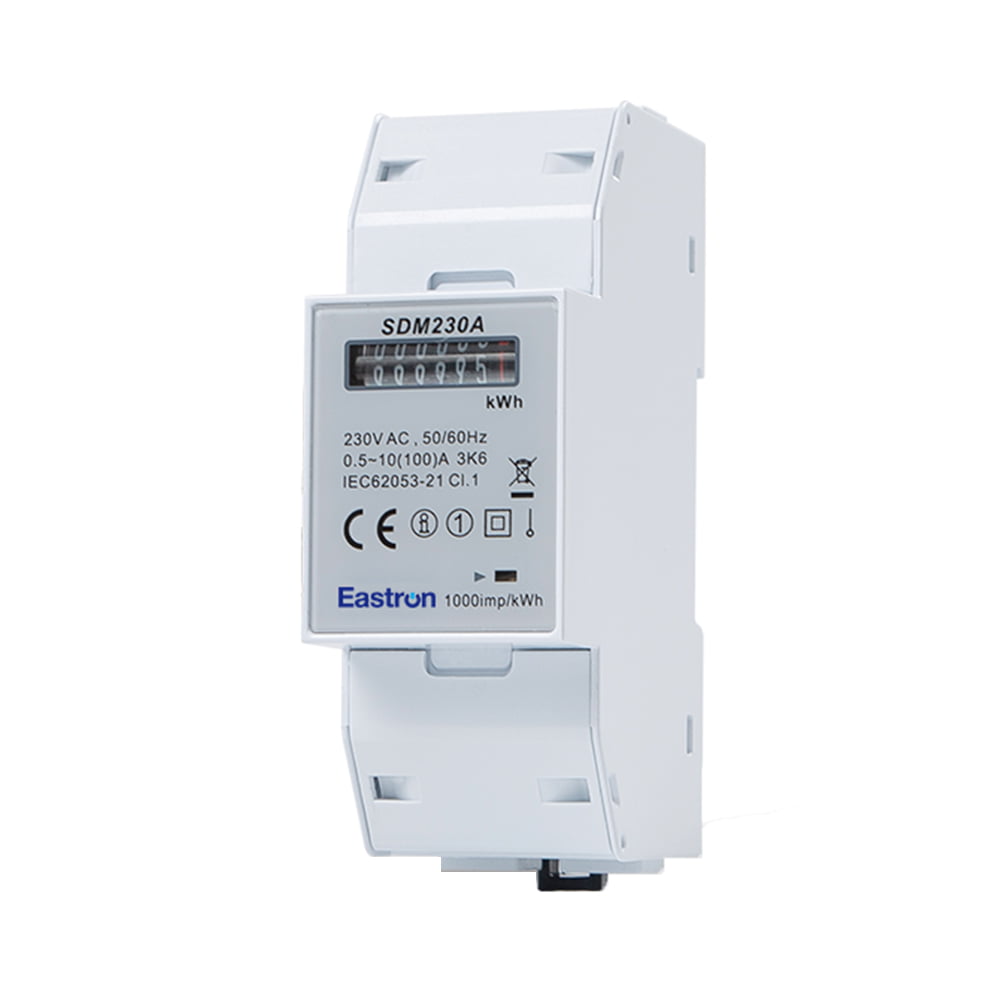
Analog Display 100A Din Rail Single Phase Electronic kWh meter with Pulse Output
Aug 11,2022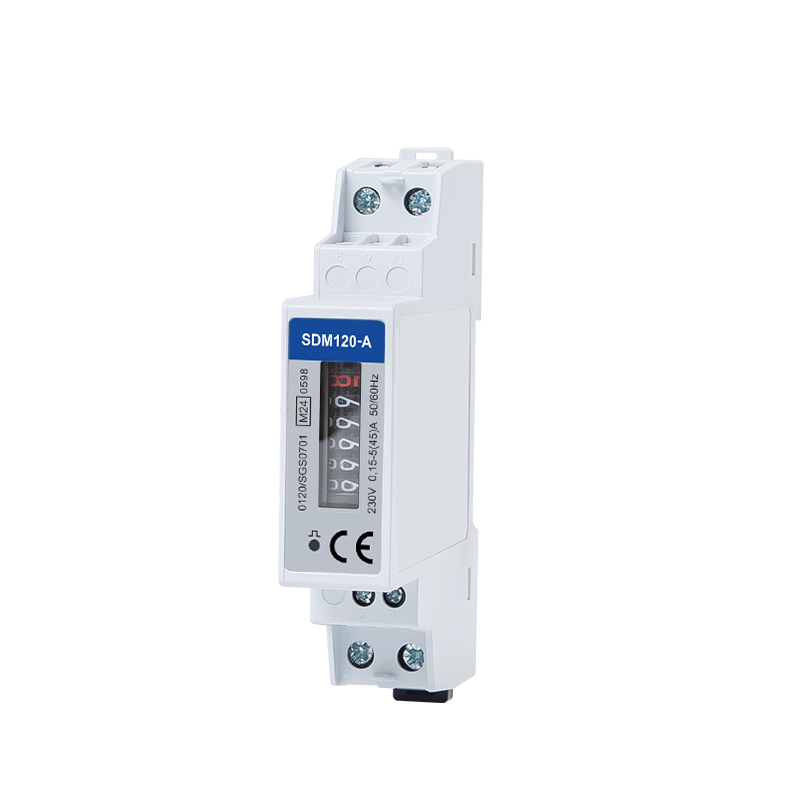
Analog Display Din Rail Single Phase Electronic kWh meter with Pulse Output
Aug 11,2022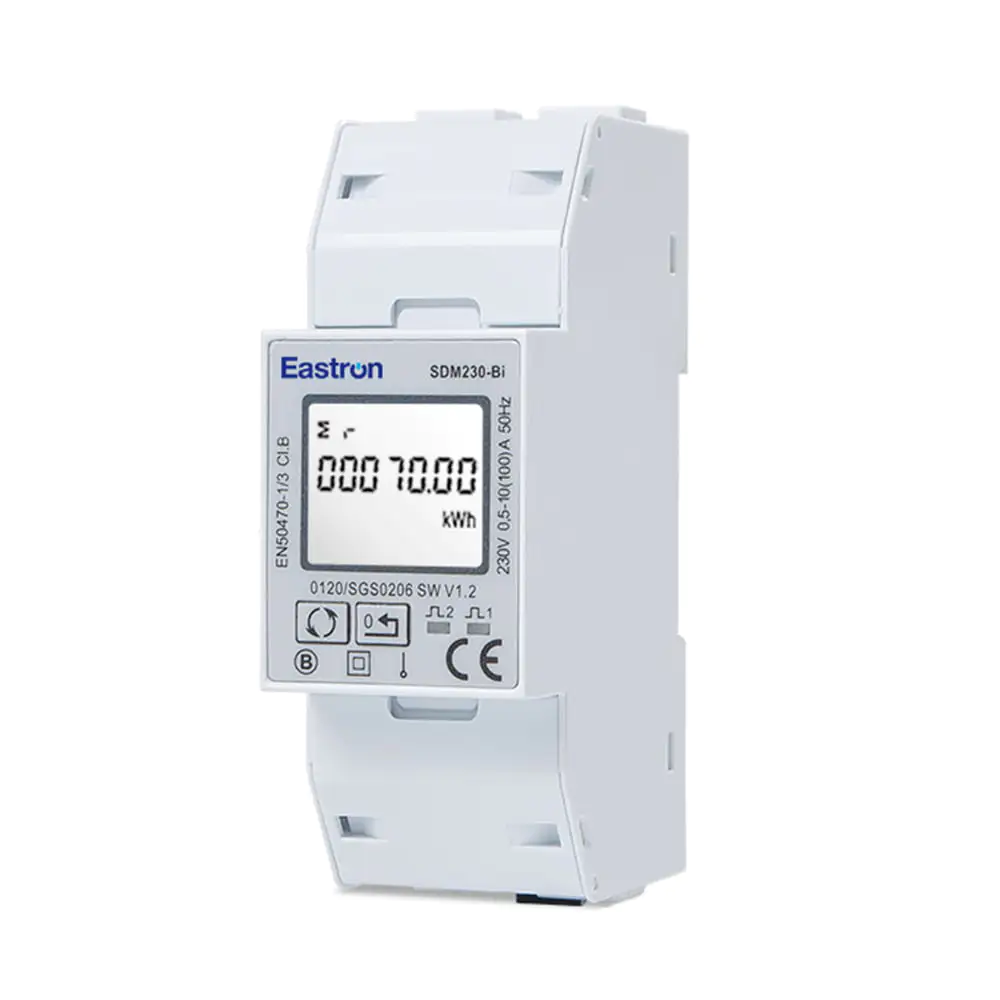
Resettable Bi-directional Din Rail Single Phase Electronic kWh meter with Pulse Output
Aug 11,2022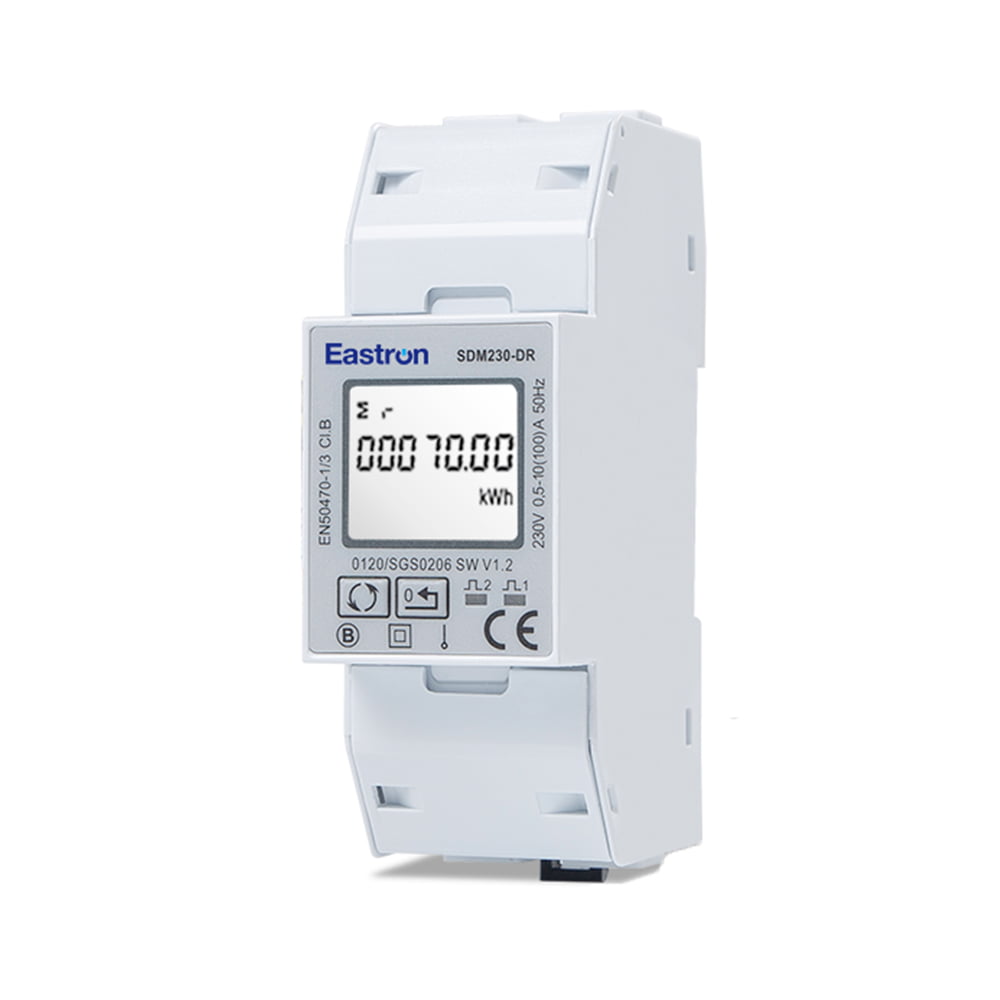
Resettable Din Rail Single Phase Electronic kWh meter with Pulse Output
Aug 11,2022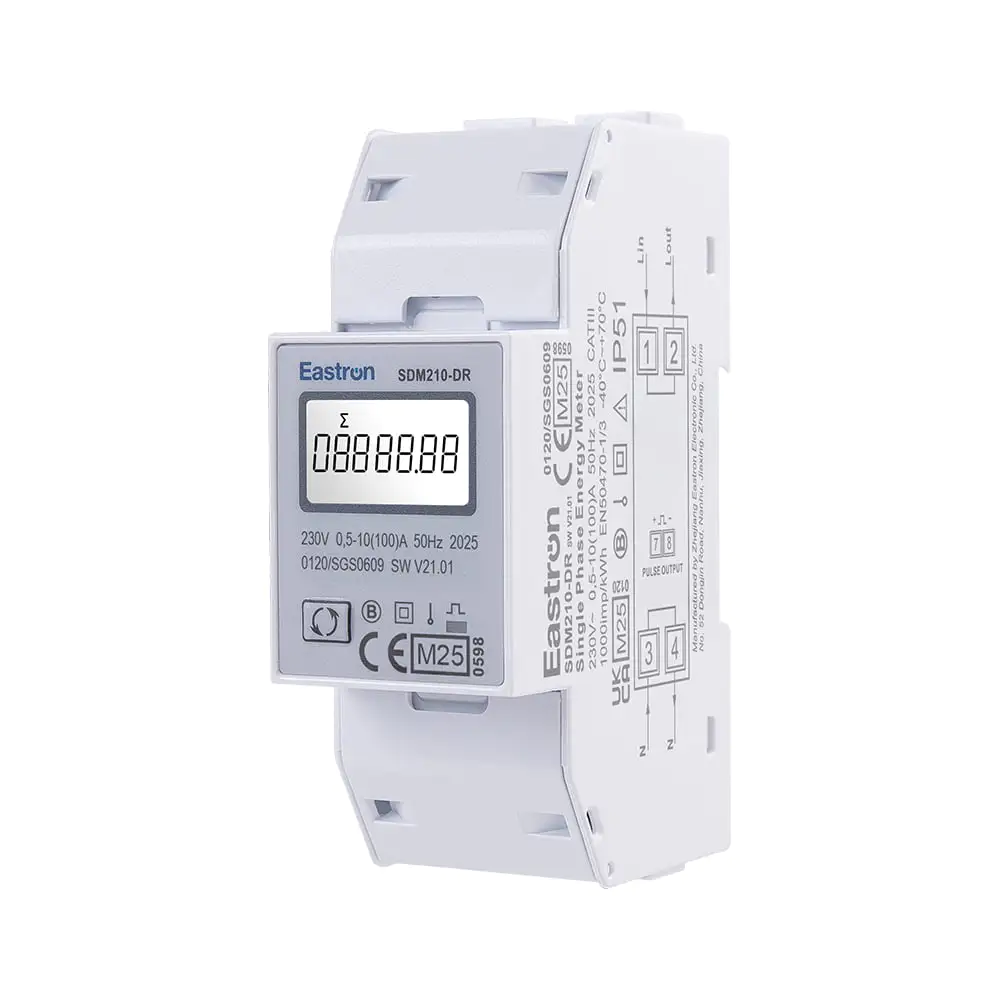
Resettable Din Rail Single Phase Electronic Energy meter with Pulse Output
Aug 11,2022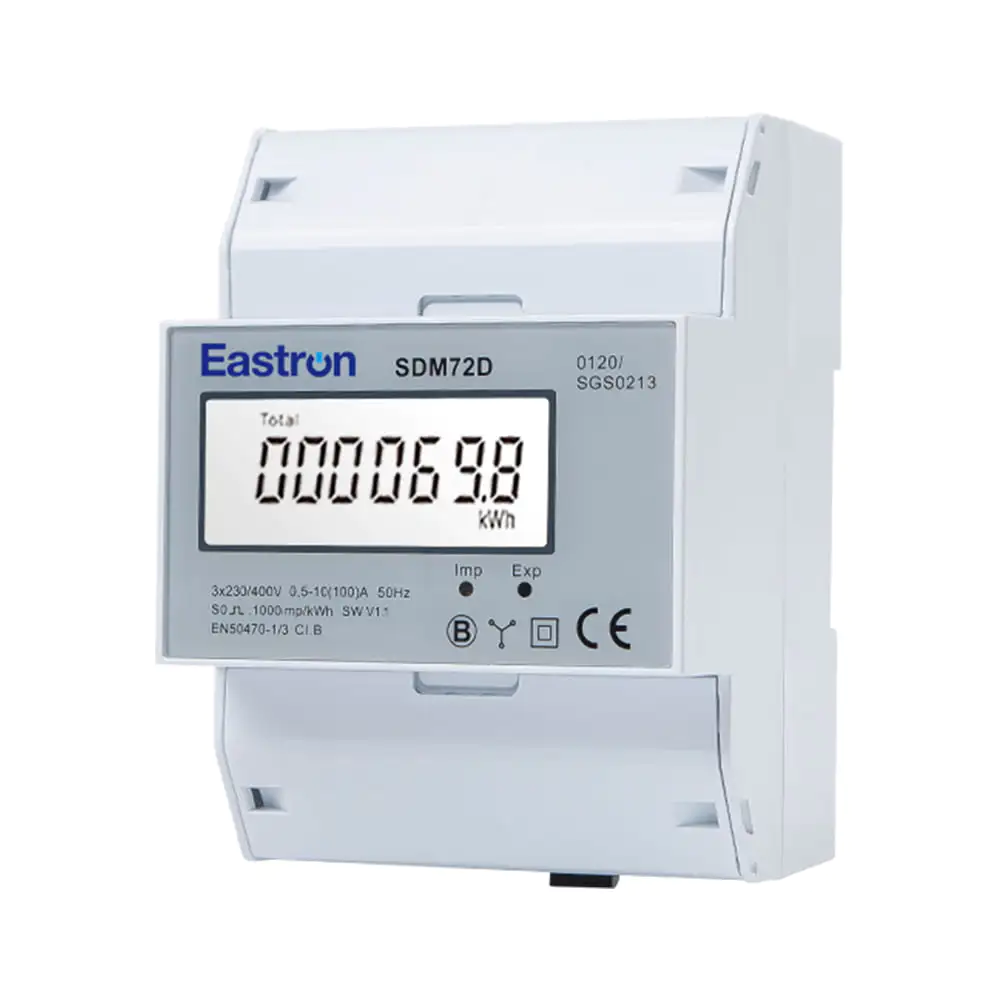
Din Rail Three Phase Electronic kWh meter with Pulse Output
Aug 11,2022Content
Reliable energy measurement is essential for modern commercial buildings, industrial facilities, distributed electrical systems, and energy-management projects. As electricity prices rise and organizations pursue more detailed consumption control, a basic totalizing meter is often no longer sufficient. Users increasingly need a compact instrument that can measure three-phase energy, display real-time power, withstand demanding installation conditions, and provide information to a wider monitoring or control system.
The SDM72DR resettable DIN rail three-phase electronic kWh meter with pulse output is designed for these requirements. It is a direct-connected, three-phase, four-wire meter for systems rated at 3 × 230/400 V AC and loads up to 100 A. The unit measures active energy in kilowatt-hours and power in watts, displays readings on an LCD, and provides a resettable partial-energy function for monitoring consumption over a selected period.
Its compact DIN rail format, four-module width, direct-load capability, pulse output, and practical measurement functions make it suitable for sub-metering and cost-conscious energy-monitoring applications. At the same time, the product benefits from the engineering, testing, and manufacturing capabilities of Eastron Electronic Co., Ltd., a specialist manufacturer of electricity meters, power analyzers, current sensors, communication modules, and energy-management products.
Three-phase power systems are widely used in commercial properties, factories, workshops, data rooms, retail premises, agricultural installations, and building-services equipment. Motors, pumps, compressors, heating equipment, ventilation systems, refrigeration units, and production machinery commonly operate on three-phase supplies. Measuring only the total site current or relying on a utility bill does not reveal how much energy is being used by individual departments, machines, tenants, or circuits.
A dedicated three-phase sub-meter provides a clearer view of consumption. It can be installed at a distribution board, machine supply, tenant connection, plant room, or secondary panel. By measuring energy at the point where it is consumed, the operator can identify waste, compare operating areas, allocate costs, and verify whether energy-saving measures are producing measurable results.
The SDM72DR is intended for three-phase four-wire systems. This configuration is common in low-voltage electrical distribution because it provides three phase conductors and a neutral conductor. The meter measures the electrical conditions of the three-phase AC system and calculates active energy consumption for display and pulse transmission.
In practical terms, the meter can support applications such as:
• Monitoring a small commercial building or office floor.
• Measuring energy used by a workshop or production line.
• Sub-metering an apartment block, retail unit, or rented business area.
• Tracking power consumption by pumps, fans, compressors, and HVAC equipment.
• Monitoring temporary installations and site distribution boards.
• Providing pulses to a building-management system or data logger.
• Comparing energy usage before and after an efficiency improvement.
• Measuring consumption within a solar, storage, or auxiliary electrical installation where the meter is suitable for the system design.
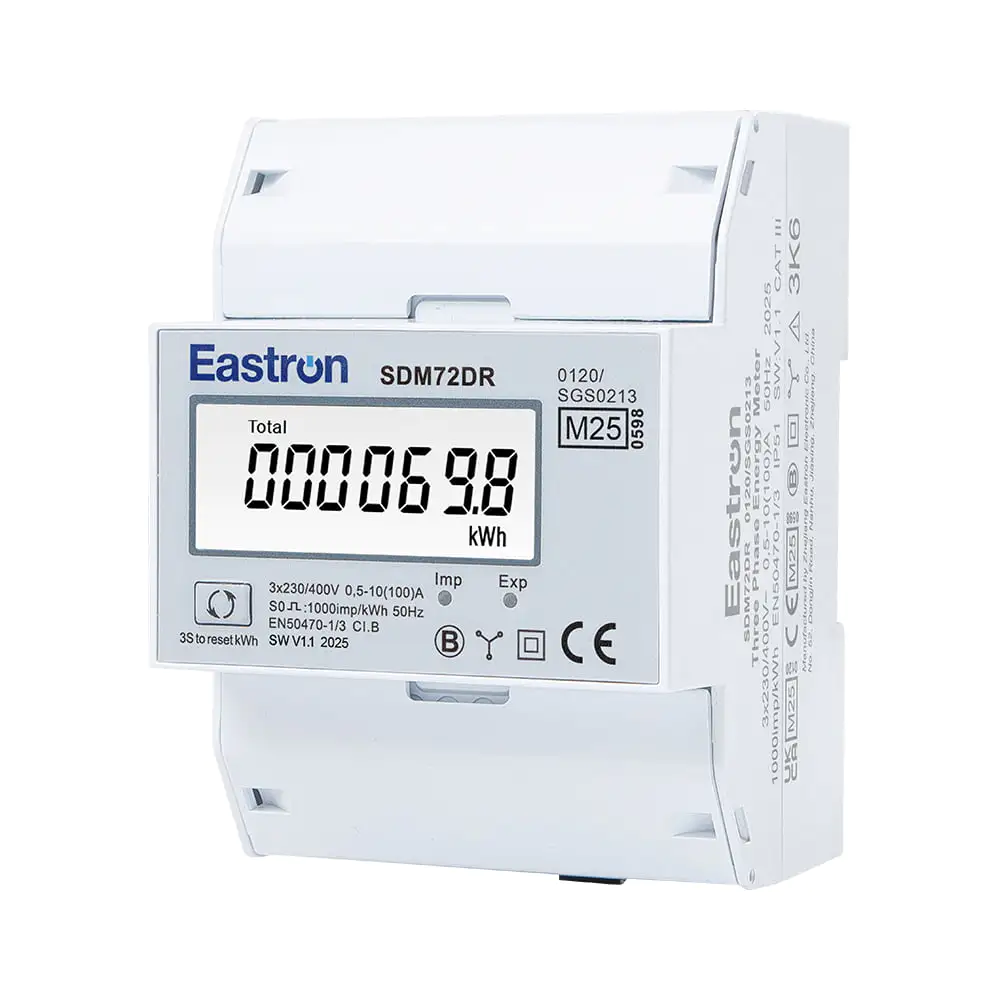
The SDM72DR is a resettable DIN rail three-phase four-wire electronic kWh meter with pulse output. It is specified for direct connection to loads up to 100 A and is intended for a nominal three-phase voltage of 3 × 230/400 V AC.
The meter measures active energy and power. Active energy is displayed in kilowatt-hours, while power is displayed in watts. The LCD provides a direct local indication, allowing users and maintenance personnel to read the meter without connecting a separate display or computer.
A key feature is the resettable energy function. In addition to supporting energy tracking, the meter allows a partial or accumulated energy value to be reset. This is useful when consumption must be measured during a defined period, production run, tenancy period, maintenance interval, or operational trial.
The unit occupies four DIN rail modules, equivalent to approximately 72 mm in width. This compact form factor helps conserve space inside distribution boards and control cabinets. It also supports a neat, standardized installation using commonly available DIN rail mounting systems.
The main product characteristics are summarized below.
| Item | Specification |
|---|---|
| Product model | SDM72DR |
| Meter type | Three-phase four-wire electronic active-energy meter |
| System configuration | 3P4W |
| Nominal voltage | 3 × 230/400 V AC |
| Maximum direct load | 100 A |
| Display | LCD |
| Measured quantities | Active energy in kWh and power in W |
| Energy function | Resettable partial energy |
| Communication-related output | Pulse output for active energy |
| Installation format | DIN rail |
| Width | Four modules, approximately 72 mm |
| Energy accuracy classification | IEC 62053-21 Class 1.0 and EN 50470-1/3 Class B |
One of the most important practical advantages of the SDM72DR is its ability to accept a direct load of up to 100 A. A direct-connected meter measures current through its internal current path, avoiding the need for external current transformers in applications within the specified current range.
For smaller and medium-sized circuits, direct connection can simplify the electrical design. There is no need to select, install, or separately wire a current transformer. This can reduce the number of components inside a panel and make commissioning more straightforward. It can also reduce potential measurement errors associated with incorrectly selected CT ratios, reversed CT polarity, loose secondary wiring, or inaccurate CT configuration.
Direct connection is particularly useful for sub-metering applications where the circuit current is known to remain within the meter’s permitted range. Examples include individual commercial units, small workshops, lighting and socket distribution boards, office floors, auxiliary plant, and compact machinery installations.
However, direct connection must always be designed according to the actual electrical installation. The stated 100 A maximum is a product limit, not a recommendation to exceed the rated capacity of the associated conductors, protective equipment, terminals, or distribution board. A qualified electrical professional should confirm conductor size, short-circuit protection, isolation arrangements, enclosure suitability, and local installation requirements.
The three-phase four-wire arrangement allows the meter to be used on a system with three phase conductors and neutral. The meter is designed to measure RMS values on a three-phase AC system. Its measurement architecture supports the calculation of active energy and power across the connected phases.
Using a dedicated three-phase meter is generally more informative than combining separate single-phase meters. A single integrated instrument provides a unified measurement point, a consistent display, and a simpler installation footprint. It also reduces the need to compare several separate displays or combine readings manually.
For balanced and unbalanced loads, proper wiring remains essential. Each phase must be connected to the correct terminal, the neutral connection must be made correctly, and the phase sequence and load orientation should be checked during commissioning. Incorrect wiring can produce inaccurate measurements or prevent the device from operating as intended.
The meter is suitable for energy-monitoring projects that require active-energy measurement rather than a complete power-quality analysis. Where an installation also requires harmonic analysis, voltage imbalance analysis, frequency monitoring, demand calculation, or extensive communications, a more advanced multifunction power analyzer may be appropriate. The SDM72DR offers a focused solution for users who primarily need dependable active-energy and power measurement.
Resettable Din Rail Three Phase Electronic kWh meter with Pulse Output
Active energy is the electrical energy actually consumed by equipment and is normally expressed in kilowatt-hours. It is the quantity used for many billing, allocation, operational, and energy-efficiency purposes. By measuring active energy directly at a sub-circuit, the SDM72DR helps users understand where electricity is being consumed and how consumption changes over time.
The meter also measures power in watts. Power is an instantaneous or near-real-time indication of the rate at which energy is being used. While kilowatt-hours answer the question “How much energy has been consumed?”, watts help answer “How much power is being used now?” This distinction is valuable for identifying equipment operating states, peak operating periods, unexpected loads, and equipment that has been left running.
For example, a facility manager can use the power display to observe whether a motor is operating, whether a heating load has switched on, or whether an apparently idle area continues to draw energy. The energy reading can then be used to quantify the total consumption over a shift, day, week, or other monitoring period.
The specified power accuracy is 1% of maximum range. Active-energy performance is specified as IEC 62053-21 Class 1.0 and EN 50470-1/3 Class B. These classifications indicate that the meter is intended for practical active-energy measurement in commercial and industrial applications, subject to correct installation, operating conditions, and applicable standard requirements.
Many energy meters provide a cumulative reading that continues increasing throughout the service life of the product. A cumulative value is useful, but it may be inconvenient when users need to measure energy during a particular interval. The SDM72DR addresses this requirement with a resettable energy function.
Resettable energy can be used to establish a new measurement period. An operator may record the previous reading, reset the partial value, and then monitor consumption during a defined period. This makes the function useful for:
• Short-term energy audits.
• Tenant or department consumption checks.
• Production-batch monitoring.
• Equipment commissioning.
• Temporary energy-saving trials.
• Comparison of weekday and weekend operation.
• Monitoring energy usage after maintenance.
• Measuring consumption during a seasonal operating period.
Resettable measurement is especially valuable where a permanent building-management platform is not available. A maintenance technician can obtain useful information directly from the local LCD without installing a full software system. At the same time, the pulse output provides a path for integrating energy data into a larger monitoring arrangement if required.
The pulse output provides an electrical representation of active-energy consumption. Each pulse corresponds to a defined increment of measured energy according to the product configuration. An external data logger, controller, energy-management gateway, or building-management system can count these pulses and calculate accumulated energy.
Pulse output is a practical alternative to more complex digital communications when the main requirement is energy accumulation. It can be used in applications where an existing controller already supports pulse inputs, or where a simple and robust interface is preferred.
Typical uses include:
• Sending energy pulses to a programmable logic controller.
• Connecting the meter to a remote energy logger.
• Feeding consumption data into a building-management system.
• Recording energy usage through an industrial data-acquisition module.
• Combining several meters in a centralized monitoring cabinet.
• Supporting tenant billing or internal cost allocation systems.
Pulse-based systems should be engineered with attention to pulse value, input compatibility, cable routing, isolation, maximum cable length, and signal configuration. The receiving device must be compatible with the meter’s output specifications. The pulse output should not be treated as a general-purpose power contact or used outside its intended electrical limits.
Compared with a meter that provides only a local display, the pulse output gives the SDM72DR greater flexibility. It can operate as a stand-alone instrument for local reading or as a measurement component within a wider energy-monitoring architecture.
Space inside electrical panels is often limited. A meter that occupies excessive width can require a larger enclosure, additional wiring, or costly panel modifications. The SDM72DR uses a four-module DIN rail housing with a width of approximately 72 mm. This makes it compact enough for many distribution boards while retaining a local LCD and dedicated terminals.
DIN rail mounting also simplifies mechanical installation. The meter can be fitted alongside circuit breakers, residual-current devices, contactors, surge protection, terminal blocks, and other modular components. A standardized housing helps panel builders create a consistent layout and makes replacement easier when service is required.
A compact design has advantages beyond enclosure size. Shorter internal wiring runs can improve panel organization. Clearer separation between protective devices and measurement equipment can make inspection easier. A standardized enclosure can also reduce installation time in projects that require multiple identical sub-meters.
Although the product is compact, the installer must still observe the required clearances, terminal access, conductor bending radius, heat dissipation conditions, and enclosure protection level. The final installation should comply with the applicable electrical code and the manufacturer’s wiring instructions.
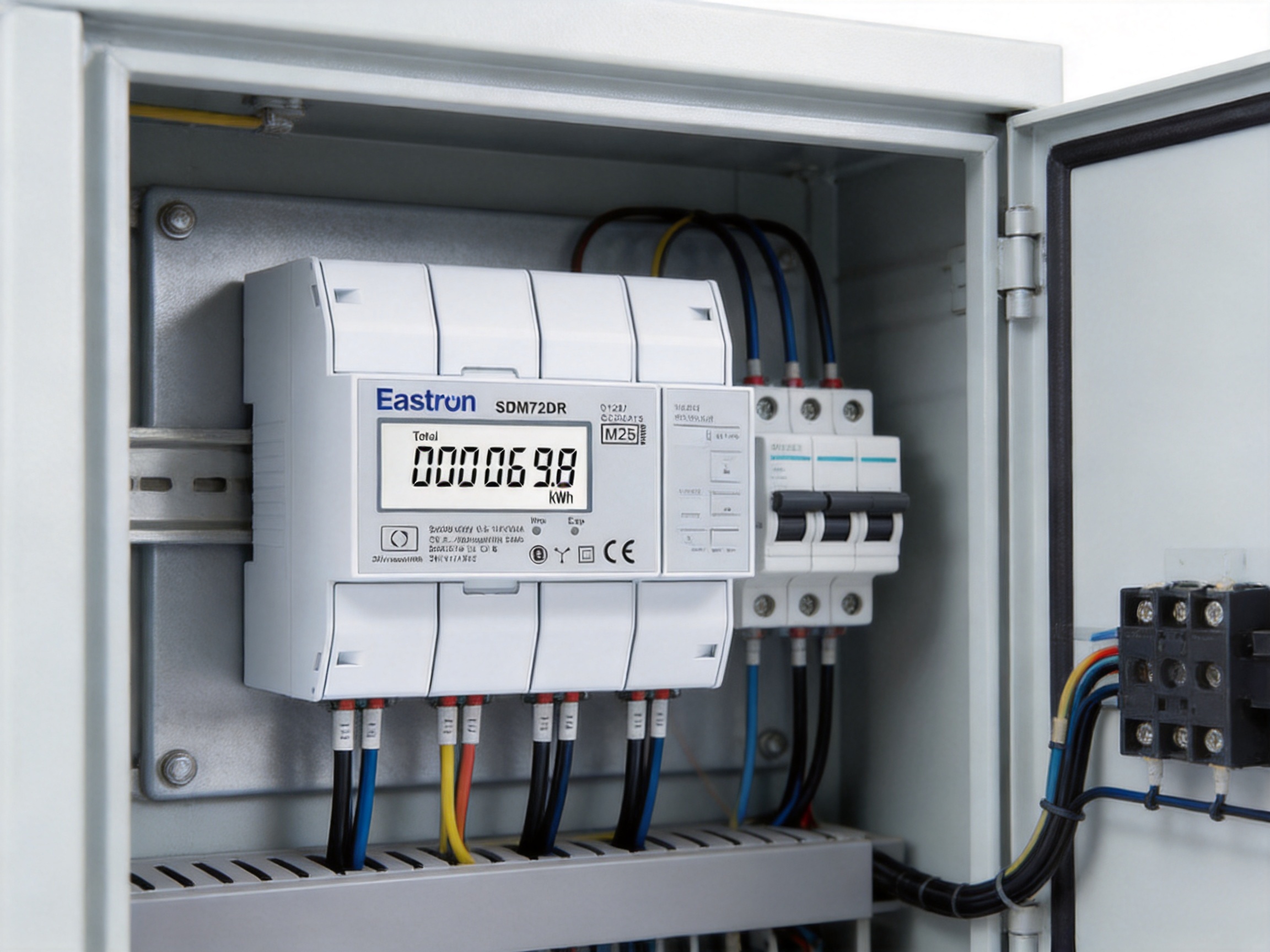
The market includes a wide range of energy meters, from simple single-phase counters to advanced multifunction analyzers. The SDM72DR occupies a useful middle position: it provides more capability than a basic totalizing counter while remaining focused and compact.
Compared with a basic meter that only displays accumulated kWh, the SDM72DR offers power measurement, a resettable energy value, and pulse output. These additional functions allow users to investigate current operating conditions, measure defined time periods, and integrate the meter into a monitoring system.
Compared with a CT-dependent meter, the direct 100 A version can reduce installation complexity for appropriately sized circuits. There are fewer external measurement components and fewer configuration variables. This can be particularly helpful for smaller projects where a full CT installation would add unnecessary cost and space requirements.
Compared with a large multifunction power analyzer, the SDM72DR can be more economical and easier to install when the application does not require harmonics, waveform analysis, demand profiles, communication registers, or extensive power-quality data. The focused feature set avoids paying for functions that may not be needed.
Compared with separate single-phase meters, an integrated three-phase instrument presents a more unified solution for a three-phase four-wire circuit. It reduces the number of displays and can simplify the connection to a pulse-based monitoring system.
| Requirement | Basic kWh Counter | SDM72DR | Advanced Power Analyzer |
|---|---|---|---|
| Three-phase four-wire measurement | May be unavailable | Yes | Usually available |
| Direct connection up to 100 A | Product dependent | Yes | Often requires CTs or external sensors |
| Local LCD | Usually available | Yes | Yes |
| Active-energy measurement | Yes | Yes | Yes |
| Power measurement in watts | Sometimes unavailable | Yes | Yes |
| Resettable energy | Often unavailable | Yes | Product dependent |
| Pulse output | Product dependent | Yes | Often available |
| Harmonic and power-quality analysis | No | No | Often available |
| Installation footprint | Usually compact | Four modules | Often larger |
| Best suited to | Simple energy counting | Focused three-phase sub-metering | Detailed electrical analysis |
The comparison is not intended to suggest that one meter type is suitable for every application. Instead, it demonstrates why selecting a product according to the actual measurement requirement is important. The SDM72DR is strongest where accurate active-energy measurement, local display, resettable tracking, and pulse integration are needed without the complexity of a full power-quality analyzer.
Commercial buildings frequently contain several tenants, departments, or equipment zones connected to a common supply. A main utility meter may show total consumption but cannot identify which areas are responsible for that usage. Installing sub-meters can improve transparency and support fairer cost allocation.
The SDM72DR can be installed for a retail unit, office floor, restaurant, workshop, storage area, or shared-services circuit, provided the voltage and current ratings are suitable. Its direct measurement capability is useful for circuits within the 100 A maximum, while the pulse output can connect each meter to a central logger.
Building operators can use the measured power value to identify out-of-hours consumption. If power remains high overnight, the operator can investigate lighting, heating, ventilation, refrigeration, IT equipment, or other loads. The energy function then quantifies the effect of corrective action.
The resettable energy function can also support tenant transitions. At the start of a lease or billing period, a partial reading can be reset after the previous value has been recorded. This creates a simple reference for the next monitoring period, subject to the project’s billing procedures and any legal requirements that apply to revenue metering.
Small and medium-sized industrial facilities may need to monitor individual machines or process areas without installing a complex supervisory system. The SDM72DR can provide local measurement for motors, pumps, compressors, heating equipment, conveyors, and auxiliary services.
Power measurement can help maintenance staff identify changes in operating behavior. A motor that draws substantially more or less power than expected may require inspection. A compressor that cycles excessively may indicate air leakage or control problems. A pump with abnormal power behavior may have a mechanical or hydraulic issue. The meter does not replace specialized condition-monitoring equipment, but it can provide a useful electrical indication.
In production environments, the resettable energy feature can be used to compare energy consumption across production runs. When combined with production records, the measured kWh can help calculate energy per unit of output. This can support process improvement and energy-efficiency programs.
Pulse output allows energy values to be collected without requiring every meter to have a sophisticated communications interface. A programmable controller or data-acquisition unit can count pulses from multiple machines and present the information on a central screen.
Energy-efficiency projects depend on measurement. Without a baseline, it is difficult to confirm whether a new control strategy, lighting upgrade, motor replacement, insulation improvement, or operating procedure has delivered the expected result.
The SDM72DR can be used to establish a baseline for an electrical circuit. The operator can record the initial cumulative reading or reset the partial-energy value before the project begins. After a defined evaluation period, the new reading can be compared with historical data, production levels, occupancy, weather, or operating hours.
Power readings add further context. A reduction in total energy may result from shorter operating hours rather than improved efficiency. By observing power during active operation, users can better distinguish between changes in load level and changes in runtime.
When connected to a pulse counter or logger, the meter supports regular data collection. Even a simple time-stamped energy record can reveal load profiles, weekend patterns, unexpected startup events, and gradual changes in consumption.

Measurement accuracy is an important consideration when selecting an energy meter. The SDM72DR is specified for active-energy measurement according to IEC 62053-21 Class 1.0 and EN 50470-1/3 Class B. These references provide a recognized basis for evaluating active-energy meter performance.
The stated power accuracy is 1% of maximum range. Actual performance depends on factors such as voltage stability, current level, frequency, power factor, temperature, wiring, installation quality, and the characteristics of the load. No meter should be evaluated only by its headline accuracy classification; the complete application conditions must also be considered.
Correct installation is essential for achieving the expected performance. The supply voltage must be within the specified range, the phases must be connected to the correct terminals, and the neutral conductor must be properly connected. Terminals should be tightened according to appropriate practice, and the meter should be protected against conditions outside its rated environment.
For applications involving legal billing, revenue settlement, or regulated measurement, users should confirm whether the product’s certification and approval status meet the requirements of the local authority. A general sub-metering product and a legally approved revenue meter are not automatically interchangeable.
Product quality is influenced not only by the circuit design but also by the manufacturer’s development process, production controls, testing capability, and after-sales support. Eastron Electronic Co., Ltd. has developed a broad product portfolio covering electricity meters, power analyzers, current sensors, communication modules, and energy-management systems.
This product range gives the company experience across several layers of the energy-measurement industry. A manufacturer that develops both meters and related monitoring equipment can better understand the requirements of panel builders, system integrators, facility managers, and industrial users.
The company’s engineering activities include hardware, embedded software, and software development. These capabilities are relevant to electronic energy meters because measurement accuracy, display behavior, pulse generation, protection functions, configuration logic, and data integration all depend on the coordination of hardware and firmware.
According to the supplied company information, the company operates development teams in China and the United Kingdom and cooperates with universities and research institutions. Such cooperation can support the introduction of new measurement technologies and help maintain a pipeline of product improvements.
The company also reports that it holds patented technologies in software, embedded software, and hardware. Patents alone do not guarantee that a product is suitable for every application, but they indicate continued investment in technical development and product differentiation.
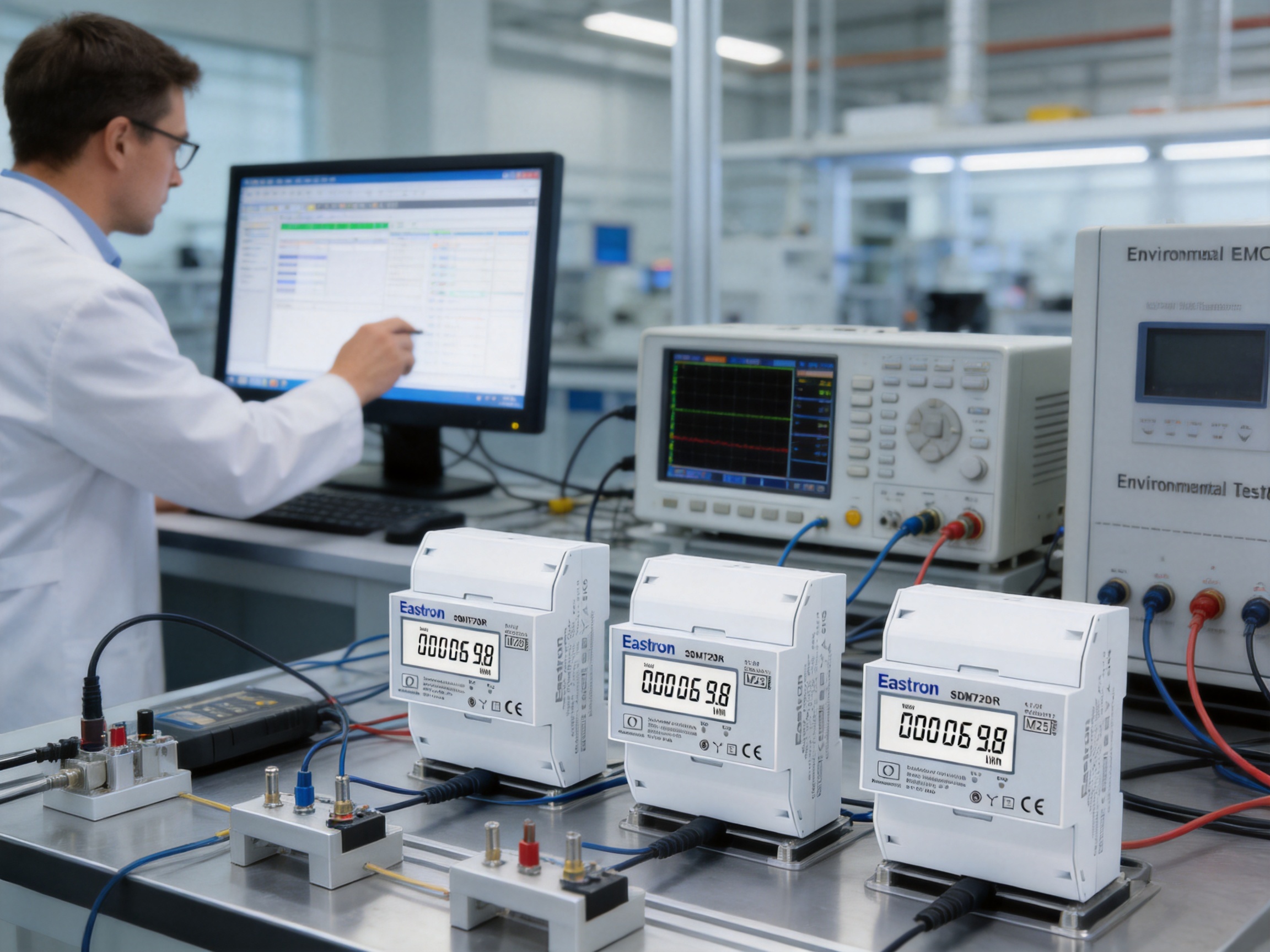
Electronic meters must perform reliably in electrical environments that may include switching transients, electromagnetic interference, temperature variation, vibration, and long operating periods. Laboratory testing is therefore a central part of product development and manufacturing quality.
Eastron has established a professional laboratory capable of performing EMC, LVD, accuracy, and environmental tests according to IEC, EN, GB, and UL-related requirements. These testing capabilities allow product designs to be evaluated under controlled conditions before they are released or supplied to customers.
EMC testing helps assess whether the meter can operate correctly in the presence of electromagnetic disturbances and whether it produces unacceptable interference. Low-voltage testing evaluates electrical safety-related characteristics. Accuracy testing checks measurement behavior against applicable performance requirements, while environmental testing examines operation under specified temperature and other environmental conditions.
In-house or closely controlled testing can provide several advantages. It allows engineers to identify design weaknesses earlier, shorten feedback cycles, investigate field issues more efficiently, and validate design changes before mass production. It also supports more consistent quality control across different product families.
The company follows an ISO 9001 quality-management system, according to the supplied information. A quality-management system helps organize design control, purchasing, production, inspection, documentation, corrective action, and customer-service processes. While certification should always be verified for the specific product and current certification period, a structured quality system is an important foundation for reliable manufacturing.
For a DIN rail meter, consistency between units is important. Electrical terminals, display components, measurement circuits, pulse-output behavior, enclosure dimensions, and mounting features must remain within their intended tolerances. Consistent production reduces installation variation and makes replacement or expansion projects easier.
Manufacturing discipline is particularly important for meters used in multi-point sub-metering systems. If several meters are installed across one facility, inconsistent display behavior or output characteristics can complicate commissioning and data analysis. A stable product platform helps system integrators standardize their panel designs and operating procedures.
Eastron’s broad experience in electricity products supports the development of repeatable manufacturing processes. The company supplies products to customers in more than 50 countries across Europe, Asia-Pacific, America, the Middle East, and Africa, according to the provided company profile. International supply experience requires attention to documentation, packaging, product variants, regional requirements, and technical support.
The company also reports that its production has been approved by SGS according to MID standards. Customers should confirm the exact scope and applicability of any certification for their intended project, but external assessment can provide additional confidence in controlled production and conformity processes.
Installation should be carried out by qualified personnel familiar with low-voltage electrical systems. Before work begins, the circuit must be isolated and verified dead using approved procedures. The meter’s wiring diagram and technical documentation should be consulted because terminal arrangements and output connections must be correctly identified.
Important installation considerations include:
• Confirming that the system is a three-phase, four-wire AC network.
• Verifying the nominal voltage is compatible with 3 × 230/400 V AC operation.
• Confirming that the direct load will not exceed 100 A.
• Selecting suitable upstream protection and isolation equipment.
• Connecting each phase and neutral conductor to the correct terminals.
• Checking conductor cross-section and terminal capacity.
• Separating pulse-output wiring from high-energy conductors where appropriate.
• Confirming that the receiving device is compatible with the pulse output.
• Inspecting terminal tightness and polarity before energizing.
• Checking the display and measured values during commissioning.
The meter should be installed in a suitable enclosure that protects it from excessive moisture, dust, mechanical damage, and unauthorized access. Ambient temperature, humidity, altitude, vibration, and other environmental conditions should remain within the product’s specified operating limits.
After installation, commissioning should include a visual inspection and an electrical verification. The installer should confirm that the LCD activates correctly, the expected phase connections are present, and the displayed values respond when known loads are switched on or off.
A simple functional check can begin with a low or stable load. The operator can observe whether power increases when the load is energized and whether the energy register advances over time. If a pulse output is connected, the receiving controller or logger should be checked to confirm that pulses are detected and counted correctly.
Where possible, the meter reading can be compared with a calibrated reference instrument. The comparison should be performed under stable conditions and with the relevant voltage, current, and load characteristics recorded. Small differences may arise because of instrument accuracy, connection methods, power factor, load variation, and measurement timing.
If readings appear abnormal, the installer should check phase order, neutral connection, terminal tightness, load direction, protective devices, and the configuration of the external pulse counter. Troubleshooting should be performed only by personnel with appropriate electrical competence.
A pulse-output energy meter can be integrated into systems with relatively simple hardware. A controller receives the pulses, applies the meter’s pulse constant, and accumulates the resulting energy value. The system may then display daily consumption, monthly totals, alarm conditions, or comparisons between circuits.
For a multi-meter project, each meter can be connected to an individual input channel. The monitoring software can assign a name to each channel, such as “Workshop Compressor,” “Office Floor 2,” or “Retail Unit A.” This creates a more useful operating picture than a collection of unidentified numerical readings.
Pulse data can also be combined with other information. For example, energy consumption can be compared with production quantity, occupancy, outdoor temperature, operating hours, or equipment status. Such comparisons help organizations identify whether increased energy use is caused by higher output, longer runtime, inefficient operation, or equipment faults.
Pulse systems should include appropriate data validation. A missing pulse signal, unexpectedly high pulse rate, or sudden zero-consumption period may indicate a communication fault, disconnected meter, power outage, or genuine change in load. Monitoring software should distinguish between these possibilities wherever practical.
The SDM72DR direct-load version is intended for circuits up to 100 A. Direct connection is often the simplest option when the current remains within the product’s rating. For larger circuits, or where the installation design requires electrical separation, a CT-operated meter may be more suitable.
The supplied technical information also identifies CT-related input characteristics for associated product variants, including CT primary settings from 1 A to 9999 A and CT secondary options of 1 A or 5 A. These values should not be assumed to apply to the direct-connected SDM72DR itself. The exact model, wiring method, CT ratio, and configuration must be confirmed from the relevant product documentation.
CT selection requires careful attention to primary current, secondary current, accuracy class, burden, insulation, physical dimensions, installation orientation, and short-circuit protection of the CT secondary circuit. A CT-operated system can support higher currents, but it also introduces additional components and configuration requirements.
The direct version therefore has a clear advantage for appropriately sized circuits: it avoids CT selection and ratio programming. The CT version has a clear advantage where current is too high for direct connection or where the panel architecture calls for instrument transformers. Selecting the correct version is more important than choosing the most technically complex option.
Panel builders need products that are easy to mount, wire, identify, and service. The four-module DIN rail form factor allows the meter to fit into familiar modular layouts. Its local LCD reduces the need for a separate display, while the pulse output provides a straightforward connection to a monitoring controller.
The focused feature set can also simplify project specification. Instead of selecting a multifunction analyzer with numerous unused parameters, a system integrator can specify a dedicated active-energy meter for circuits where only kWh, watts, local display, resettable energy, and pulse output are required.
For larger projects, using a consistent meter family can simplify procurement and training. Installation teams can become familiar with one wiring approach, one display format, and one commissioning procedure. Replacement stock can also be easier to manage when the same product is used across several panels.
System integrators should nevertheless verify all project-specific requirements before ordering. These may include pulse value, supply arrangement, meter approval status, environmental rating, enclosure requirements, communication architecture, terminal configuration, and local regulations.
Facility managers benefit from measurement that is understandable and actionable. The SDM72DR presents energy and power locally, making it possible to inspect a circuit without opening a software application. The resettable function supports periodic checks, while the pulse output enables automated collection if the facility later expands its monitoring system.
The meter can also improve communication between technical and financial teams. Instead of discussing only total electricity bills, facility staff can report consumption by area or equipment group. This supports more informed budgeting, maintenance planning, and sustainability reporting.
Because the meter is compact and modular, it can often be incorporated into existing distribution-board upgrades. A project may begin with a few high-priority circuits and expand later as the value of the data becomes clear.
Responsible product selection requires understanding what the meter does not measure. The SDM72DR is designed for active energy and power measurement. It is not described as a full power-quality analyzer, revenue-grade billing instrument for every jurisdiction, or a replacement for protective equipment.
Users requiring voltage, current, frequency, power factor, reactive energy, apparent energy, harmonics, transients, demand, or waveform capture should consider a multifunction energy meter or power analyzer with those functions. Likewise, users with currents above 100 A should evaluate a CT-operated solution or another appropriately rated meter.
The pulse output is useful for energy accumulation, but it is not equivalent to a high-speed communications protocol. Projects requiring remote configuration, historical registers, alarms, time synchronization, or detailed multi-parameter data may require a meter with RS485, Modbus, Ethernet, wireless, or another digital interface.
These limitations do not weaken the product’s value. They clarify its position as a practical, purpose-focused three-phase sub-meter for direct-connected circuits within its specified rating.
Electronic meters generally require limited routine maintenance when installed correctly. Periodic inspection should include checking the enclosure, terminals, wiring condition, display operation, pulse signal, and signs of overheating or moisture ingress.
Connections should be inspected according to the facility’s electrical-maintenance procedures. Thermal imaging may be used by qualified personnel to identify abnormal heating at terminals or adjacent components. Any evidence of discoloration, burning, loose wiring, or mechanical damage should be investigated promptly.
The LCD should remain legible under normal operating conditions. If the display is difficult to read, the operator should check environmental conditions, enclosure lighting, condensation, and product status. Energy records should be backed up when they are used for operational analysis or cost allocation.
When a meter is replaced, the old cumulative reading, resettable reading, replacement date, and new meter identification should be documented. This preserves continuity in the site’s energy records.
An energy-management program does not need to begin with a highly complex platform. A practical approach is to measure a few important circuits first, establish a baseline, and expand gradually. The SDM72DR supports this staged strategy because it can provide local readings immediately and pulse data for later integration.
At the first stage, personnel can use the LCD to identify consumption patterns. At the second stage, pulse outputs can be connected to a local data logger. At the third stage, the logger can transfer data to a dashboard or reporting platform. This allows the monitoring system to grow with the organization’s needs and budget.
The product is therefore suitable not only for a single-meter installation but also for a scalable sub-metering architecture. Its value increases when the measured circuits are selected strategically, clearly labeled, and reviewed regularly.
Before specifying the SDM72DR, users should review the following points:
• Is the electrical system three-phase, four-wire?
• Is the nominal voltage compatible with 3 × 230/400 V AC?
• Is the maximum expected current no greater than 100 A?
• Is direct connection appropriate for the circuit?
• Is active energy the primary measurement requirement?
• Is local measurement of power in watts useful?
• Is resettable energy needed for periodic or temporary monitoring?
• Does the monitoring system accept the meter’s pulse output?
• Is a four-module, approximately 72 mm enclosure width suitable?
• Does the installation require a legally approved billing meter?
• Are the environmental and safety requirements satisfied?
• Will the product documentation and certification meet local project requirements?
Answering these questions before purchase helps prevent incorrect model selection and reduces installation delays.
The meter is designed for a three-phase, four-wire AC system, commonly identified as 3P4W. Its stated nominal system voltage is 3 × 230/400 V AC.
The SDM72DR supports a maximum direct load of 100 A, provided the complete installation is designed and protected appropriately. The circuit conductors and protective devices must also be suitable for the actual current.
The meter measures active energy in kilowatt-hours and power in watts. It is intended for active-energy sub-metering rather than comprehensive power-quality analysis.
The resettable energy function allows users to monitor consumption during a selected period. It can be useful for energy audits, tenant periods, production runs, equipment trials, and before-and-after efficiency comparisons.
Yes. The product includes an LCD energy display, allowing users to read the measured information directly at the distribution board or control cabinet.
The pulse output provides an active-energy signal to an external counter, controller, logger, gateway, or building-management system. The receiving device must be compatible with the output specifications.
The supplied product information identifies a pulse output but does not specify an RS485, Modbus, Ethernet, or wireless communication interface for the SDM72DR. If digital networking is required, users should confirm whether another model or an external pulse gateway is appropriate.
The meter occupies four DIN rail modules and has an approximate width of 72 mm.
For the direct-connected SDM72DR version, a current transformer is not required when the circuit is within the permitted direct-load range. CT-operated variants are available within the wider product family for applications that require transformer-based measurement.
Suitability for legal billing depends on the country, application, approval status, and applicable regulations. Users should confirm the exact certification and legal requirements before using any meter for revenue settlement or regulated billing.
The supplied information identifies active energy and power measurement. It does not specify reactive power, apparent power, harmonics, or waveform analysis. Applications requiring these functions should use a suitable multifunction energy meter or power analyzer.
Installation should be performed by qualified electrical personnel who understand low-voltage distribution systems, isolation procedures, protective devices, and applicable electrical regulations.
The SDM72DR is manufactured by Eastron Electronic Co., Ltd., a China-based developer and supplier of electricity meters, power analyzers, current sensors, communication modules, and energy-measurement solutions.
The company reports capabilities in hardware, embedded software, software development, laboratory testing, EMC, low-voltage safety, accuracy, and environmental evaluation. It also follows an ISO 9001 quality-management system and supplies products internationally.
The SDM72DR is a practical solution for three-phase four-wire active-energy measurement in commercial, industrial, and building-services applications. Its combination of direct measurement up to 100 A, 3 × 230/400 V AC compatibility, LCD display, watt measurement, resettable energy, pulse output, and compact four-module DIN rail housing addresses the needs of many sub-metering projects.
Its strongest advantage is balance. The meter provides more information and integration flexibility than a basic kWh counter, while avoiding the complexity and cost of a full power-quality analyzer when those advanced functions are unnecessary. Direct connection can simplify installations on appropriately rated circuits, and the pulse output allows the product to participate in a broader energy-monitoring system.
The manufacturing background of Eastron Electronic Co., Ltd. further supports the product’s market position. The company’s experience across electricity meters, power analyzers, sensors, communication modules, and energy-management systems, together with reported laboratory, engineering, quality-management, and international supply capabilities, provides a foundation for dependable product development and production.
For users seeking a compact and focused three-phase energy meter, the SDM72DR is well suited to circuit-level monitoring, energy audits, operational analysis, cost allocation, and efficiency projects. Correct model selection, professional installation, proper commissioning, and compliance with local requirements remain essential to achieving the best results.
IEC 62053-21, Electricity Metering Equipment: Particular Requirements for Static Meters for Active Energy.
EN 50470-1, Electricity Metering Equipment: General Requirements, Tests, and Test Conditions.
EN 50470-3, Electricity Metering Equipment: Particular Requirements for Static Meters for Active Energy.
ISO 9001, Quality Management Systems: Requirements.
Manufacturer product information for the SDM72DR three-phase four-wire electronic kWh meter.
Manufacturer technical information concerning DIN rail energy meters, pulse-output energy meters, CT-operated meters, and energy-measurement solutions.
Your email address will not be published. Required fields are marked *

We develop and produce high performance electricity meters, power analyzers, current sensors, communication modules and management systems.
Address:NO. 52, Dongjin Road, Nanhu, Jiaxing, Zhejiang, China
Copyright @ Eastron Electronic Co., Ltd. All rights reserved
