

 English
 Español
 Deutsch
 中文简体


Product Consultation
Your email address will not be published. Required fields are marked *
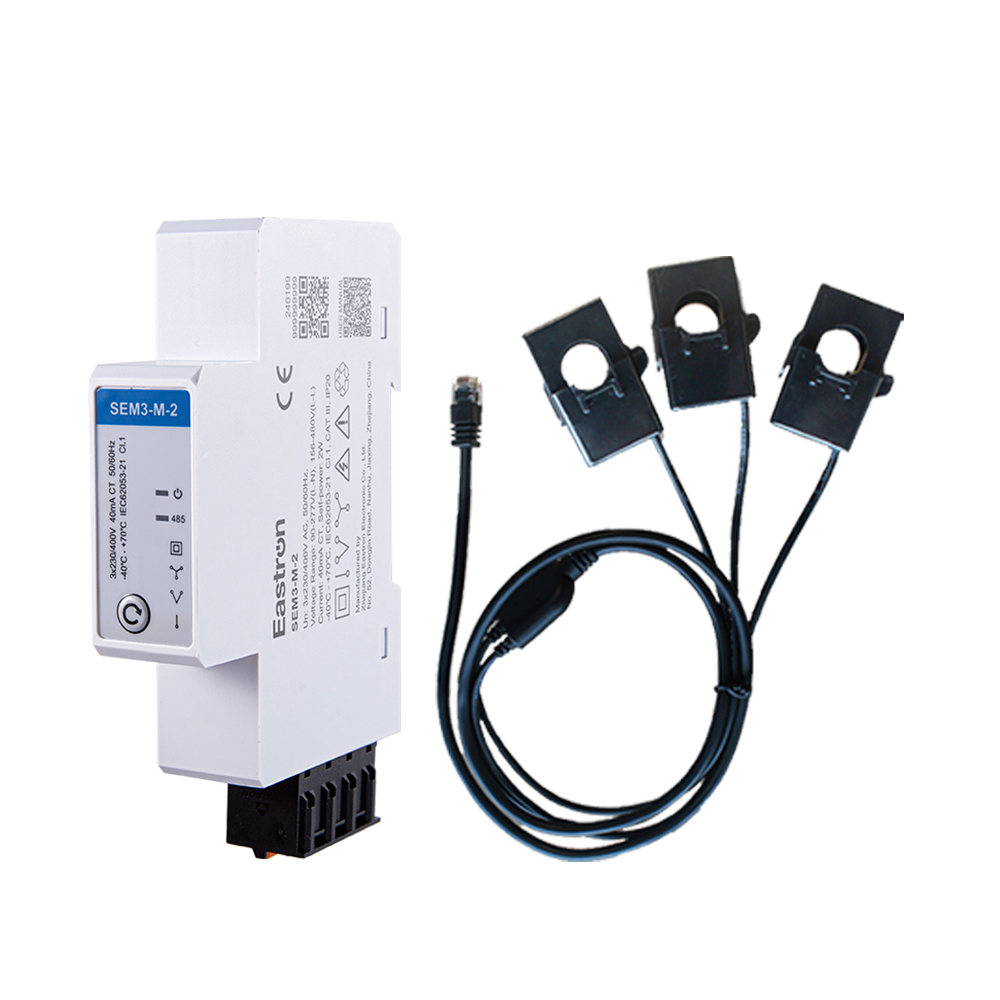
RS485 CT Connection Three Phase Din Rail Energy Meter for PV Metering
May 30,2025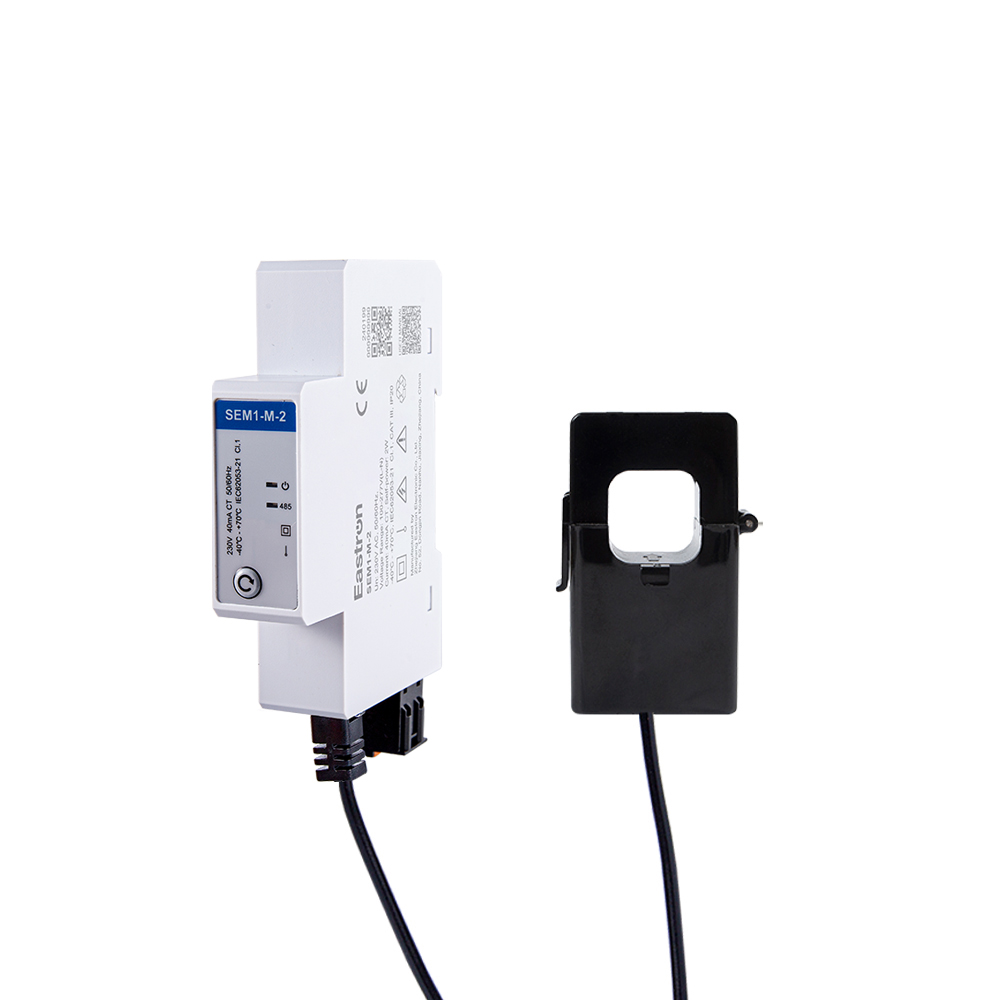
CT Type RS485 Modbus Single Phase Din Rail Energy Meter for PV Metering
May 30,2025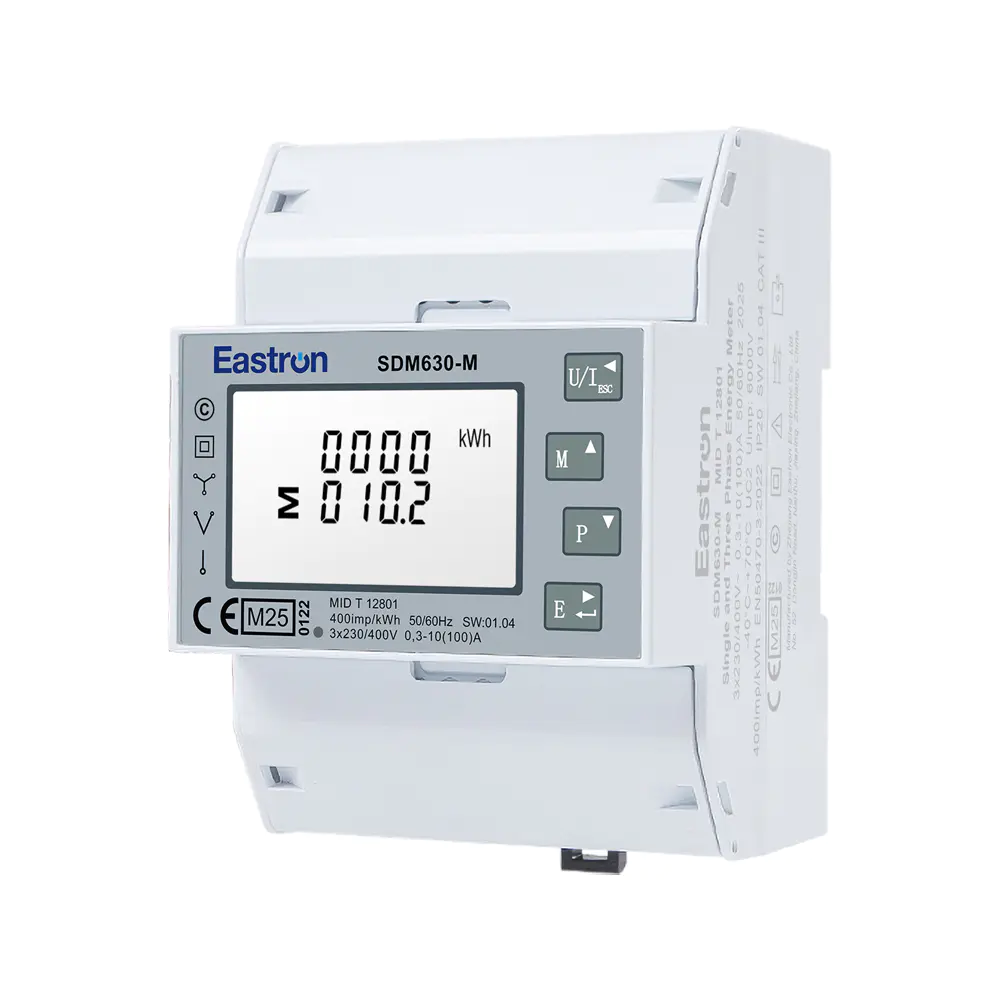
MID UL Certified Din Rail Three Phase Multi-function Energy Meter for EV Charging Metering
Aug 02,2022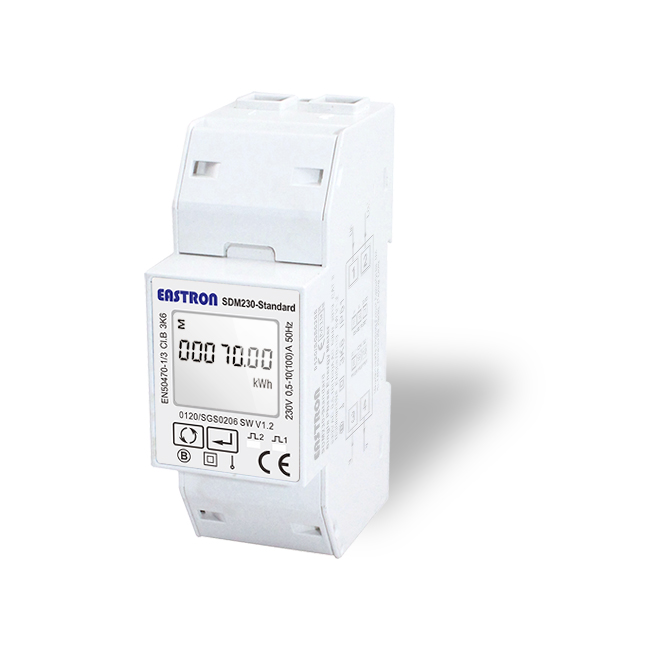
RS485 Modbus Din Rail Single Phase Electronic kWh Meter
Aug 11,2022
MID/UL CT Type Din Rail Three Phase Multi-function Energy Meter for EV Charging Metering
Nov 24,2022
MID & UL Approved Three Phase Din Rail Type Multi-function Energy Meter for EV Charging Metering
Nov 24,2022Content

Modern electrical installations require more than a simple kilowatt-hour reading. Industrial facilities, commercial buildings, charging infrastructure, renewable energy systems, apartment developments, and distributed control panels increasingly need accurate energy measurement, flexible communication, event monitoring, and dependable operation in a compact enclosure. The SDM630-DI addresses these requirements by combining direct current measurement up to 100 A, multifunction electrical analysis, digital input capability, RS485 Modbus RTU communication, bidirectional energy measurement, and MID certification in one DIN rail-mounted meter.
Designed for three-phase applications while also supporting selected single-phase configurations, this meter provides a practical bridge between conventional electrical metering and connected energy management. It can be used as a local display instrument, a submeter, a billing-related measurement device, or a data source for building management and industrial automation systems. Its four-module, 72 mm housing helps installers save valuable panel space without sacrificing measurement functions or communication capability.
Manufactured by Eastron Electronic Co., Ltd., the product benefits from a development and production background focused on electricity meters, power analyzers, current sensors, communication modules, and energy measurement solutions. The company’s laboratory infrastructure, engineering teams, standards-based testing, and international supply experience support the meter’s suitability for demanding applications.
The SDM630-DI is a digital input RS485 Modbus DIN rail three-phase MID energy meter intended for direct connection applications up to 100 A. It measures the main electrical characteristics of a network and presents the results on its integrated display. At the same time, its communication interface allows measurement data and selected meter parameters to be integrated into supervisory software, programmable logic controllers, gateways, energy dashboards, and building automation platforms.
The meter is suitable for 3P4W three-phase four-wire systems, 3P3W three-phase three-wire systems, and 1P2W single-phase two-wire systems. This flexibility reduces the number of separate meter models that an installer or system designer needs to manage. A single product family can therefore be applied to different distribution arrangements, provided that the electrical system and installation comply with the specified operating conditions and wiring instructions.
Its principal functions include active energy measurement in imported and exported directions, reactive energy measurement, active power, reactive power, apparent power, voltage, current, frequency, power factor, total harmonic distortion, and maximum demand. These measurements provide a broader view of electrical behavior than a basic energy counter can offer.
The two digital inputs add another layer of practical functionality. They can be used as status or pulse-related inputs within a control and monitoring design, depending on the system architecture and configuration. For example, a digital input may be connected to an external contact, auxiliary device, operating-state signal, or other low-voltage control indication. This enables the meter to participate in a wider monitoring scheme rather than functioning as an isolated measurement instrument.
RS485 communication using Modbus RTU makes the SDM630-DI suitable for centralized data collection. Multiple devices can share a communication bus, with individual addresses assigned across the permitted address range. This is especially useful where a project includes several feeders, tenant circuits, production lines, solar inverters, battery systems, or charging points.
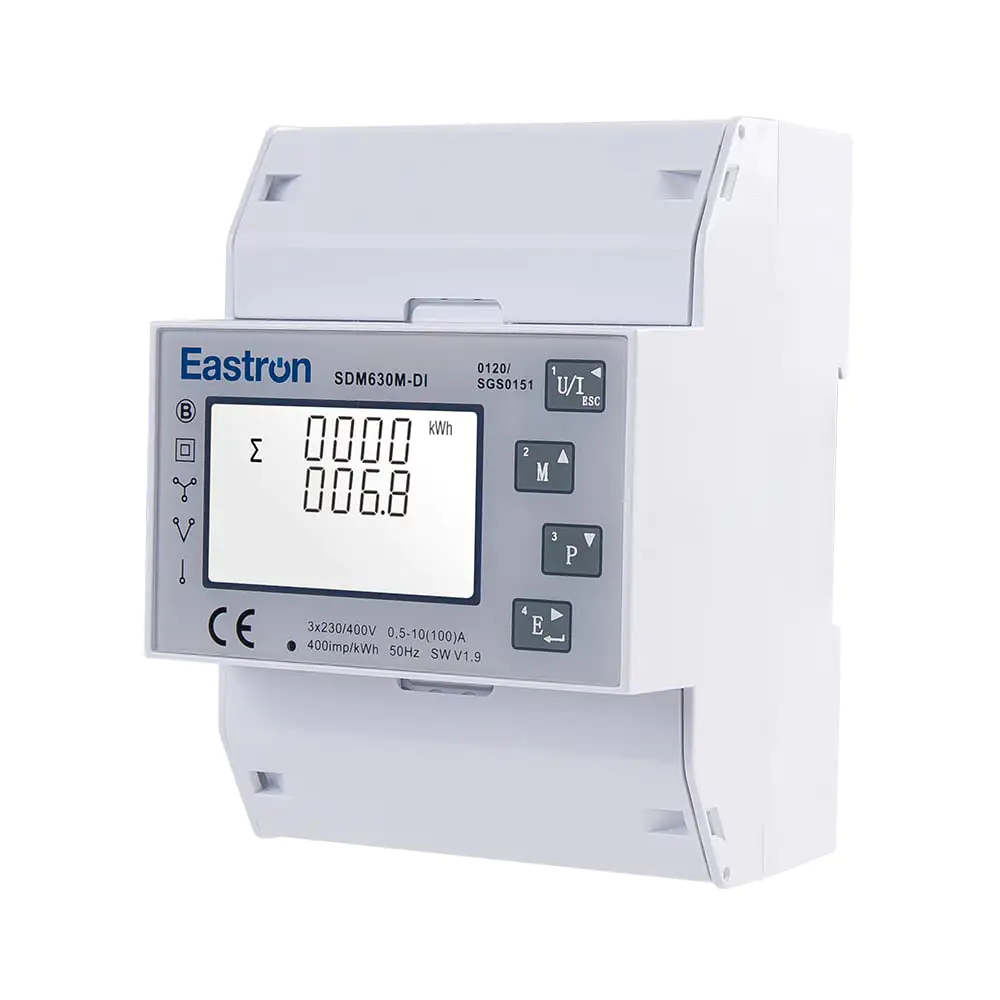
Digital Input RS485 Modbus Din Rail Three Phase MID Energy Meter
One of the most important practical advantages of the SDM630-DI is its ability to support direct current measurement up to a maximum of 100 A. A direct-connected meter can simplify an installation when the circuit current falls within the stated operating range. It avoids the need for separate current transformers in many small and medium-sized distribution applications, reducing the number of components, wiring points, and possible sources of installation error.
The specified rated current is 10 A, the maximum current is 100 A, and the minimum current is 0.3 A, with a starting current of 40 mA. These values give system designers a defined operating framework for selecting the meter and evaluating expected load conditions. Installers should always confirm the actual load profile, conductor size, protective device rating, environmental conditions, and applicable local regulations before commissioning the meter.
Direct connection can also make the panel layout more straightforward. Instead of allocating space for external current transformers and their secondary wiring, the installer can route the intended conductors through the meter’s current terminals according to the wiring diagram. The result is a compact and easily documented measurement point.
A basic energy meter normally focuses on accumulated kilowatt-hours. The SDM630-DI provides a much wider range of measurements, allowing users to understand not only how much energy has been consumed or exported but also how the electrical system is operating.
Voltage and current readings help identify abnormal supply conditions and uneven loading. Active power indicates the real rate of energy transfer, while reactive power and apparent power support a more complete evaluation of system demand. Power factor can reveal inefficient loading or the influence of inductive and capacitive equipment. Frequency measurement helps confirm supply stability. Total harmonic distortion can assist with identifying waveform distortion caused by variable-speed drives, switch-mode power supplies, LED systems, data-center equipment, and other nonlinear loads.
Maximum demand measurements are particularly valuable for facilities where electricity charges or infrastructure sizing are influenced by peak demand. The meter measures maximum demand current and power over preset periods of up to 60 minutes. This can help operators identify peak-loading events, evaluate load scheduling, and determine whether energy-saving measures are reducing demand rather than merely reducing total consumption.
Electrical systems are becoming increasingly interactive. A site may consume energy from the utility grid during some periods and export energy from photovoltaic generation, battery storage, or another local source during others. A meter that records only forward energy may not provide a complete picture of this operating pattern.
The SDM630-DI supports bidirectional measurement, including imported, exported, and total energy values. This makes it suitable for applications involving distributed generation, self-consumption analysis, net energy monitoring, energy storage systems, and other installations where power flow can change direction.
Bidirectional measurement also supports better reporting. Operators can distinguish between energy received by a facility and energy delivered back to the network. This separation is useful for energy balances, internal allocation, renewable generation analysis, and system performance reviews.
The meter has been assessed and certified as meeting the requirements of European Union Directive 2014/32/EU. Its active energy accuracy is specified as Class B/C according to EN 50470-3:2022 and Class 1/0.5 according to IEC 62053-21, while reactive energy is specified as Class 2 according to IEC 62053-23.
MID certification is important in applications where the meter may be used for legally relevant measurement, subject to the conditions of the applicable national implementation, installation requirements, verification rules, and intended use. It provides a recognized framework for evaluating metering performance and gives project stakeholders greater confidence when selecting equipment for sub-billing, tenant allocation, public infrastructure, or other regulated energy measurement applications.
Certification does not remove the need for correct installation. Accuracy depends on appropriate wiring, secure terminals, suitable voltage and current conditions, correct configuration, and compliance with the relevant installation environment. Nevertheless, MID conformity is a significant advantage over general-purpose meters that may be intended only for monitoring or non-billing applications.
| Parameter | Specification |
|---|---|
| Measurement type | RMS measurement including harmonics on three-phase AC systems |
| Supported networks | 3P4W, 3P3W, and 1P2W |
| Voltage accuracy | ±0.5% |
| Current accuracy | ±0.5% |
| Frequency accuracy | ±0.2% |
| Power factor accuracy | ±0.01 |
| Active power accuracy | ±1% |
| Reactive power accuracy | ±1% |
| Apparent power accuracy | ±1% |
| Active energy accuracy | Class 1/0.5 IEC 62053-21; Class B/C EN 50470-3:2022 |
| Reactive energy accuracy | Class 2 IEC 62053-23 |
| Rated voltage | 3 × 230/400 V AC |
| Operating voltage | 80% to 120% of rated voltage |
| Maximum direct current | 100 A |
The meter uses RMS measurement including harmonics on three-phase AC systems. This is relevant in installations where the waveform is not perfectly sinusoidal. A measurement approach that accounts for harmonic content can provide a more representative view of actual electrical conditions than simplified methods designed only for clean resistive loads.
Voltage and current accuracy of ±0.5% support dependable monitoring and energy analysis across a broad range of applications. Active, reactive, and apparent power accuracy of ±1% provides useful performance for facility management, equipment evaluation, and distribution studies. The power factor accuracy of ±0.01 helps users assess the relationship between real power and total apparent power with practical precision.
The operating voltage range is specified as 80% to 120% of the rated voltage. The nominal system voltage is 3 × 230/400 V AC. Engineers should verify the actual network voltage and connection arrangement before installation. The product is intended for compatible low-voltage AC systems, and it should not be connected to a circuit outside its electrical ratings.
RS485 Modbus RTU remains one of the most widely used communication methods in industrial and building energy systems. Its popularity comes from its simplicity, broad ecosystem, low infrastructure cost, and compatibility with many controllers and monitoring platforms. By incorporating RS485 Modbus RTU, the SDM630-DI can communicate with energy management software without requiring a proprietary communication network.
The communication address can be configured from 1 to 247. Transmission speeds range from 2400 bps to 115200 bps, allowing the network designer to balance communication speed and installation conditions. The meter supports none, odd, or even parity, with one or two stop bits. The default parity is none. The stated response time is less than 100 milliseconds, supporting responsive data collection in many monitoring applications.
The maximum transmission distance is specified as 1000 meters. Actual performance depends on cable quality, network topology, termination, electromagnetic conditions, baud rate, grounding practices, and the number of connected devices. A properly designed RS485 network should use suitable twisted-pair communication cable, correct polarity, appropriate termination where required, and a topology consistent with RS485 best practice.
Modbus communication can expose electrical data to a supervisory system, including voltage, current, power, energy, power factor, frequency, demand, and other supported parameters. It also allows central operators to review multiple meters from a single interface. This reduces the need for manual readings and supports automatic reports, alarms, trend analysis, and energy benchmarking.
The two digital inputs extend the meter’s usefulness beyond passive measurement. In a connected installation, status signals are often as important as electrical values. A system operator may need to know whether a feeder is enabled, whether an auxiliary contact is open or closed, whether a control device has changed state, or whether an external pulse or signal has been received.
By accepting two digital input signals, the SDM630-DI can provide additional contextual information to the monitoring system. Electrical data can then be interpreted alongside operating-state information. For example, a power increase may be associated with a machine being switched on, while zero energy consumption may be evaluated against the status of a disconnect device or operating contact.
The exact electrical connection and supported input behavior should be confirmed using the official product documentation before commissioning. External circuits must be designed within the input ratings, and appropriate isolation and protection must be provided where necessary.
Configuration is password protected, helping prevent unauthorized changes to important meter parameters. In a multi-user facility, uncontrolled modifications to the address, wiring mode, pulse settings, or measurement configuration could lead to incorrect data or communication conflicts. Password protection adds a basic but valuable layer of operational control.
For larger installations, project teams should establish a commissioning record that includes the meter address, communication settings, wiring mode, installation location, date of commissioning, and responsible technician. Maintaining this information improves troubleshooting and simplifies future expansion of the energy monitoring network.
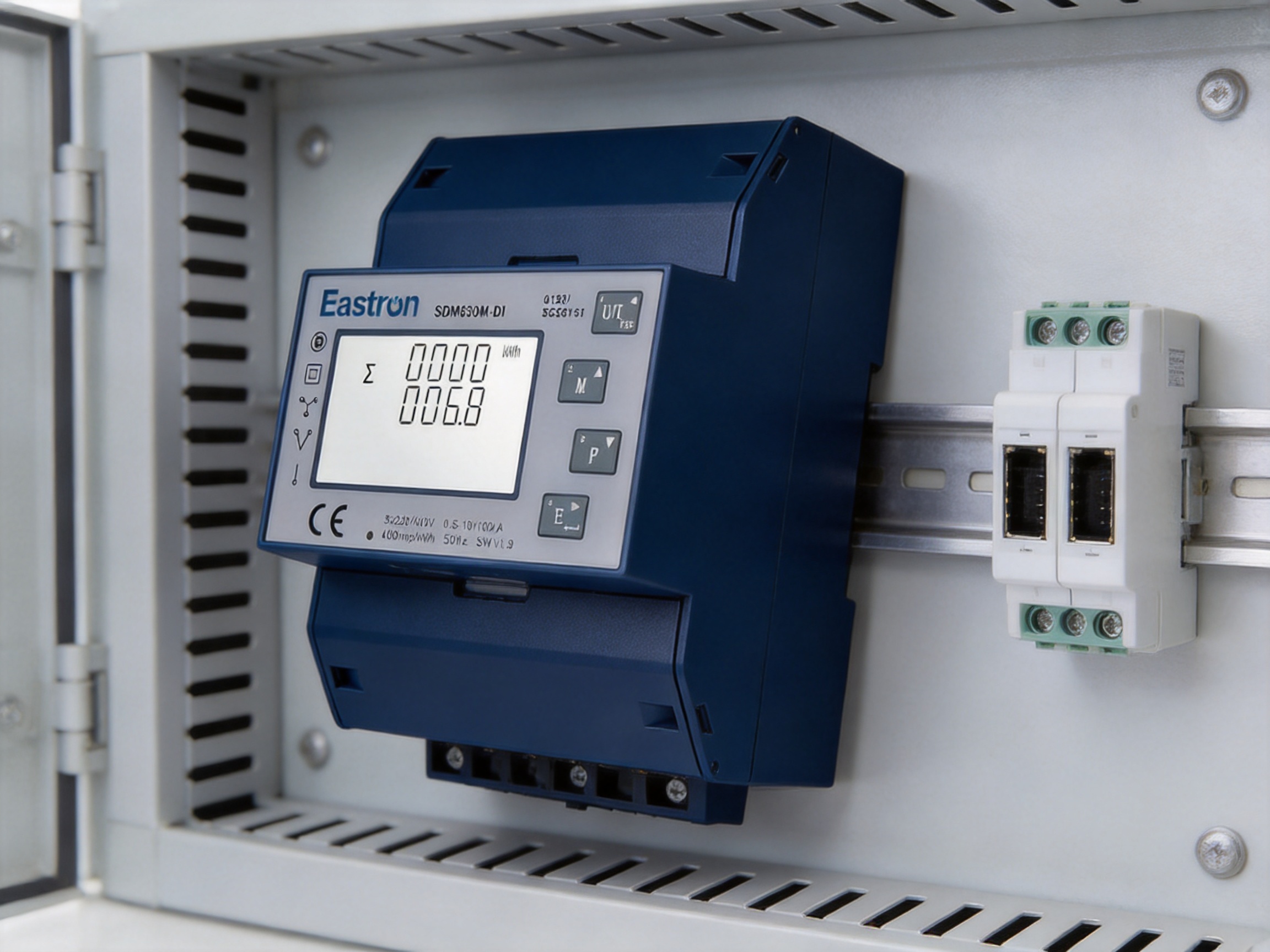
The four-module, 72 mm-wide DIN rail housing is designed for installation in electrical distribution boards and control cabinets. Compact dimensions are especially valuable in modern panels, where space is limited by circuit breakers, contactors, surge protection, terminal blocks, communication equipment, and future expansion requirements.
DIN rail mounting provides a familiar mechanical format for electrical installers. It supports consistent alignment with other modular devices and simplifies replacement or maintenance. The meter can be incorporated into new panels or added to an existing distribution board when sufficient space and electrical capacity are available.
The integrated display allows technicians and operators to view measurements locally without connecting a laptop or opening a separate software interface. Local access is useful during commissioning, troubleshooting, routine inspections, and quick verification of a circuit. Remote access through Modbus complements rather than replaces the display, giving users both local and centralized visibility.
When planning the installation, the designer should consider ventilation, ambient temperature, clearance from heat-producing equipment, accessibility, conductor bending radius, terminal torque, and segregation between power wiring and communication wiring. The panel should also provide suitable overcurrent protection and isolation equipment in accordance with local electrical codes.
Support for 3P4W, 3P3W, and 1P2W arrangements makes the product adaptable to different electrical architectures. Three-phase four-wire measurement is commonly used in systems with a neutral conductor and phase-to-neutral loads. Three-phase three-wire measurement is found in systems without a neutral connection. Single-phase two-wire support extends the product’s use to individual single-phase circuits and smaller installations.
Correct system selection is essential. The meter must be configured for the actual wiring arrangement, and the voltage terminals and current paths must be connected according to the approved diagram. Incorrect configuration can result in inaccurate readings, communication of misleading values, or unsafe conditions.
Office buildings, shopping centers, hotels, schools, and mixed-use developments often require submetering for tenants, departments, floors, or shared services. The SDM630-DI can provide local measurement and centralized communication for lighting, HVAC, elevators, pumps, kitchens, server rooms, and other building loads.
Because the meter measures both energy and electrical operating parameters, facility managers can move beyond monthly consumption totals. They can compare power factor between areas, identify demand peaks, observe voltage conditions, and assess the effect of energy-saving initiatives. Bidirectional measurement also supports buildings with rooftop solar generation or battery storage.
Manufacturing facilities commonly have several production lines or process areas with different operating schedules. Installing a meter at each important distribution point can help identify energy-intensive equipment and compare consumption with production output.
Power, current, demand, and power factor information can support maintenance and operational decisions. An unexpected current increase may indicate changing machine behavior, while high demand during a short production period may suggest opportunities for load scheduling. Harmonic-related measurements can help specialists investigate the electrical effects of drives, rectifiers, welders, and other nonlinear equipment.
Photovoltaic installations and battery energy storage systems create bidirectional power flows. The SDM630-DI can measure energy imported from the grid and energy exported to the grid, helping users understand self-consumption and export behavior.
In a solar-plus-storage installation, meters may be positioned at the grid connection point, generation output, battery inverter, and selected loads. Communication data can then be incorporated into an energy management platform. The compact DIN rail form factor makes the product suitable for many control cabinets associated with distributed energy systems.
Electric vehicle charging sites need accurate energy information for load management, cost allocation, operational analysis, and network planning. A meter installed at a charging circuit can provide energy and power information to a supervisory system. When multiple charging points operate simultaneously, maximum demand data can help operators evaluate site loading and avoid unnecessary capacity charges.
The product’s communication capability allows charging infrastructure designers to integrate measurement data with a broader control system. Digital inputs may also provide status information from auxiliary components, subject to the design and ratings of the connected circuits.
In residential and mixed-use projects, individual circuits or common services may require separate energy measurement. The SDM630-DI can be considered for suitable distribution points where direct current measurement up to 100 A is sufficient and MID-related requirements apply.
Remote data collection reduces the need for manual meter access. It can also support transparent allocation of energy costs, provided the project complies with applicable legal, metrology, and billing requirements. The project owner and system integrator remain responsible for determining whether the selected meter and installation method are approved for the intended billing arrangement.
The SDM630-DI offers several advantages when compared with simple pulse-only meters or non-communicating energy counters. First, it combines energy measurement with a broad set of electrical parameters. This reduces the need to install separate instruments for voltage, current, power, frequency, power factor, and demand.
Second, the meter supports bidirectional measurement. A forward-only meter may be sufficient for a basic consumption circuit, but it is less suitable for installations with photovoltaic generation, storage, regeneration, or changing power flows.
Third, RS485 Modbus RTU provides a standardized path to automation and data platforms. A pulse-only meter can communicate accumulated energy but normally requires additional equipment to collect and interpret the signal. Modbus can provide a richer dataset and simplify integration with established industrial controllers and building management systems.
Fourth, the two digital inputs give the product more contextual awareness than a meter that only measures electrical quantities. This can reduce the requirement for a separate status input module in certain control panel designs.
Fifth, the four-module housing uses panel space efficiently. A larger multifunction analyzer may offer similar measurements but occupy more cabinet area or require external sensors. Conversely, a very small basic meter may save space but omit communication, demand, harmonic-related data, or MID certification.
Finally, MID certification and declared accuracy classes provide a stronger basis for regulated or commercially significant applications than an instrument intended solely for general monitoring. The correct choice always depends on the project requirements, but the SDM630-DI brings several commonly separate functions together in one device.
Eastron Electronic Co., Ltd. focuses on electricity products and energy measurement solutions. Its product development scope includes electricity meters, power analyzers, current sensors, communication modules, and management systems. This specialization creates a foundation for developing products that combine measurement hardware, embedded software, communications, and practical installation requirements.
For a multifunction meter, expertise in only one area is not enough. Accurate voltage and current acquisition must work together with firmware calculations, display management, data storage, communication registers, protection design, and mechanical packaging. A company with experience across these disciplines is better positioned to develop an integrated product rather than a collection of loosely connected functions.
The company has development teams in China and the United Kingdom and continues to invest in new technologies and products for electricity metering. Cooperation with universities and technical institutions contributes to ongoing product development and helps connect practical engineering with advances in measurement, communications, embedded systems, and energy management.
Research and development strength is especially important for products such as the SDM630-DI because market requirements continue to evolve. Energy meters are increasingly expected to support distributed generation, demand management, digital integration, harmonics evaluation, remote configuration, and regulated measurement. A product platform that can evolve with these requirements gives customers better long-term value.
Product reliability depends on controlled testing before equipment reaches the field. Eastron has established a professional laboratory capable of performing electromagnetic compatibility, low-voltage directive, accuracy, and environmental tests according to IEC, EN, GB, and UL standards.
Accuracy testing helps verify measurement performance across relevant voltage, current, power factor, frequency, and load conditions. EMC testing evaluates the product’s ability to operate correctly in the presence of electromagnetic disturbances and to limit unwanted emissions. Environmental testing helps assess performance under conditions such as temperature and humidity variation. Low-voltage safety testing contributes to evaluation of insulation, dielectric strength, and protection requirements.
These testing activities are important because a meter is installed in an electrical environment that may include contactors, motors, switching power supplies, variable-frequency drives, relays, and communication equipment. Laboratory validation helps identify design weaknesses before they become field failures.
The company operates according to the ISO 9001 quality management system, and its production has been approved by SGS according to MID standards. Standards-based quality management supports repeatable procedures for design control, purchasing, manufacturing, inspection, testing, documentation, and corrective action.
For customers, this process orientation is valuable because product quality should not depend only on individual assembly workers or final inspection. A mature quality system builds control into the complete product lifecycle. It also supports traceability, process improvement, supplier management, and consistent production across batches.
Eastron holds patented technologies in software, embedded software, and hardware. Intellectual property in these areas can support differentiated measurement algorithms, communication functions, display behavior, power management, protection techniques, or manufacturing methods.
Patents alone do not guarantee product performance, but they indicate continuing investment in technical development. When combined with laboratory testing, experienced engineering teams, and field feedback, proprietary technologies can help a manufacturer create products that are compact, functional, and easier to integrate.
The company’s products and services have been supplied to more than 50 countries across Europe, Asia-Pacific, the Americas, the Middle East, and Africa. International experience exposes a manufacturer to different electrical standards, installation practices, environmental conditions, communication requirements, and customer expectations.
This experience is useful for a product with MID-related positioning and multiple network configurations. Export-oriented manufacturing also requires attention to technical documentation, packaging, production consistency, support processes, and regulatory expectations in different markets.
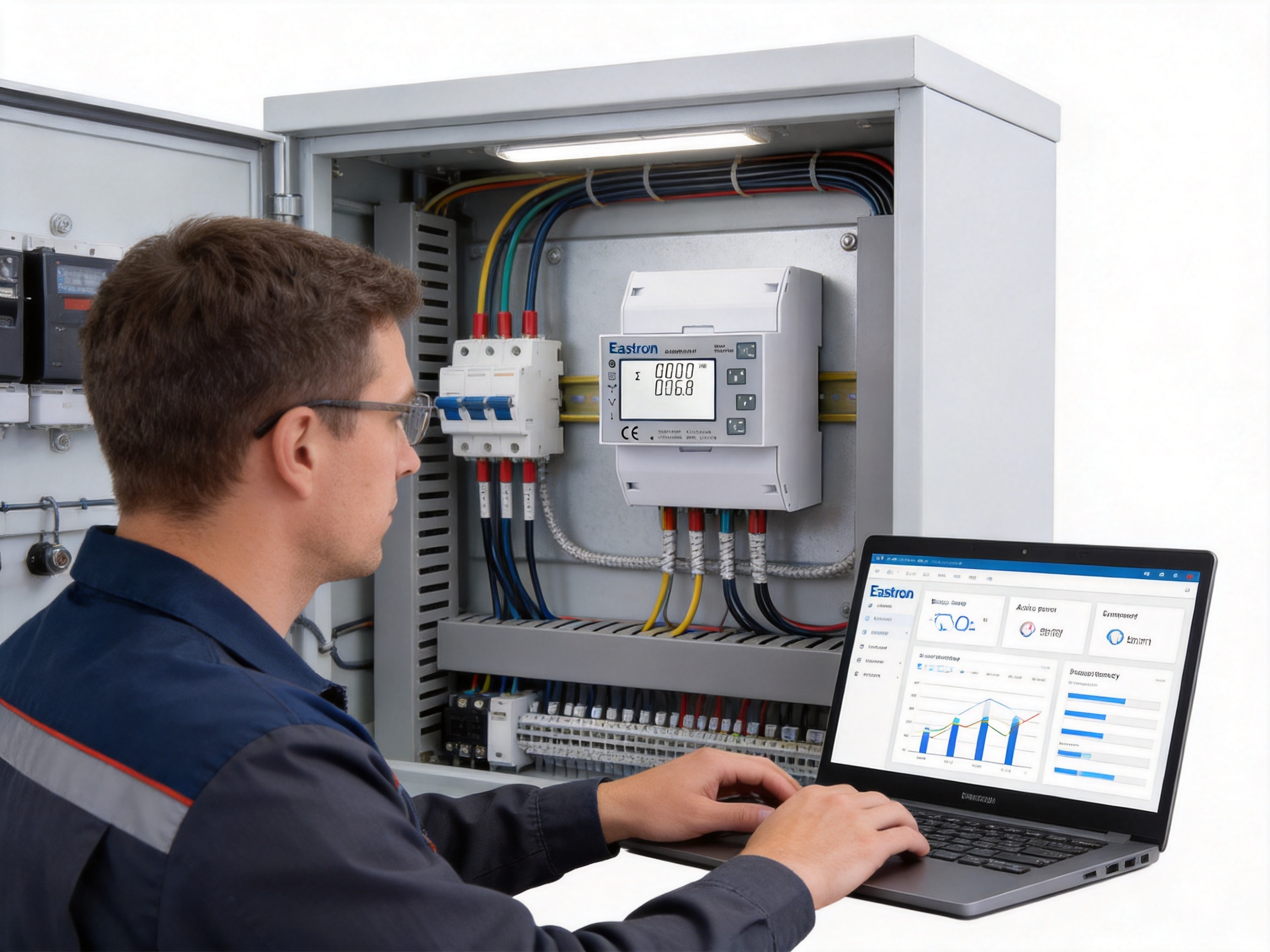
Before installing the SDM630-DI, the electrical designer should verify the system type, nominal voltage, maximum current, frequency, enclosure conditions, and intended measurement purpose. The meter is designed for compatible AC systems with a nominal voltage of 3 × 230/400 V and an operating range of 80% to 120% of the nominal voltage.
The maximum direct current is 100 A. The circuit must be evaluated to ensure that the meter will not be exposed to current beyond its rated capability. If a planned feeder exceeds the direct connection limit, an alternative meter or current-transformer-based solution should be selected instead.
The wiring arrangement must be identified as 3P4W, 3P3W, or 1P2W. The corresponding configuration should be selected in the meter, and all phase and neutral connections should follow the official wiring diagram. Current direction is important for bidirectional measurement. Reversed current connections can cause imported and exported energy values to be interpreted incorrectly.
Power should be isolated before work begins. Suitable circuit protection and a means of disconnection should be provided. Terminal connections must be tightened to the manufacturer’s specified torque, and conductors should be selected according to the circuit current, installation method, temperature, and applicable electrical code.
For RS485 communication, installers should separate communication cabling from high-energy conductors where practical. The bus should be planned with appropriate cable, polarity, addressing, and termination. Each meter must have a unique Modbus address. Baud rate, parity, and stop-bit settings must match the master device or software platform.
After installation, commissioning should include a visual inspection, verification of the wiring mode, confirmation of voltage readings, comparison of current readings with an appropriate reference instrument, verification of power direction, and a communication test. The digital inputs should also be tested using the intended external signals. All commissioning values and configuration settings should be recorded for future service.
The value of a multifunction meter increases when its data is used consistently. A building or factory may install several meters but gain little benefit if readings are not collected, organized, and reviewed. The SDM630-DI provides the measurement and communication foundation, while the broader energy management system turns that information into action.
Energy managers can use imported and exported energy data to create daily, weekly, monthly, and annual balances. Power and demand data can reveal when a facility reaches its highest load. Current information can support phase-load comparisons. Voltage and frequency trends can help identify supply issues. Power factor data can indicate whether correction equipment or load management should be reviewed.
THD-related information can assist qualified engineers in identifying circuits that may contribute to waveform distortion. This is increasingly relevant as facilities add electronic power supplies, variable-speed drives, LED lighting, data-processing equipment, and power conversion systems.
Digital input data can add operational context to energy trends. A facility may compare energy consumption with machine status, production schedules, or equipment availability. Such correlations can expose idle consumption, unexpected runtime, or inefficient operating sequences.
When data is available through Modbus, it can be incorporated into dashboards and automated alerts. A management platform might generate an alarm when demand exceeds a threshold, power factor falls below a target, voltage leaves an expected range, or an input changes state. These functions can shorten response time and help prevent small issues from becoming expensive operational problems.
A meter installed inside a distribution board may be expected to operate continuously for many years. Reliability therefore depends on electrical design, component selection, firmware quality, manufacturing control, and installation conditions. The SDM630-DI’s development and production environment is supported by testing capabilities covering accuracy, EMC, safety-related requirements, and environmental performance.
The local display helps technicians diagnose basic conditions without immediately relying on communication software. If a supervisory system stops receiving data, the display can help determine whether the issue is related to the network or to the measured circuit. Conversely, if the display shows an unexpected value, the communication system can be used to compare registers and confirm the data path.
Password-protected configuration reduces the risk of accidental changes. Consistent documentation is still important, particularly where multiple technicians or contractors work on the same installation. A clear record of settings helps maintain data continuity after maintenance or panel modifications.
The compact design can reduce cabinet size and simplify the addition of measurement points. In a project with many circuits, using a common product family also reduces training requirements and simplifies spare-parts planning. The ability to use one meter family across multiple supported wiring arrangements may help standardize procurement and engineering documentation.
The SDM630-DI is a strong fit when a project requires direct measurement up to 100 A, multifunction monitoring, bidirectional energy data, two digital inputs, RS485 Modbus RTU, and MID-related conformity. It is particularly suitable for low-voltage distribution boards, submetering systems, commercial facilities, industrial panels, renewable energy installations, and connected energy management projects.
Designers should compare the product’s specifications with the actual application rather than selecting a meter based only on nominal current. Important questions include whether the circuit is single-phase or three-phase, whether a neutral conductor is present, whether energy can flow in both directions, whether remote communications are required, whether demand data is needed, and whether the application involves legally relevant measurement.
Where the current exceeds 100 A, where the voltage differs significantly from the stated rating, or where special transformer ratios are required, a different meter configuration may be more appropriate. Similarly, projects requiring protocols other than Modbus RTU should verify the availability of a gateway or select a product with the required native interface.
Environmental conditions should also be considered. The designer should review the applicable product documentation for temperature limits, humidity, installation category, pollution degree, enclosure protection, and other conditions relevant to the intended panel. Correct product selection and installation are essential to preserve accuracy and safety.
The SDM630-DI is used for measuring and monitoring electrical energy and power parameters in compatible AC systems. It can measure active and reactive energy, voltage, current, power, power factor, frequency, demand, and other electrical characteristics while communicating data through RS485 Modbus RTU.
Yes. The meter supports bidirectional measurement and provides imported, exported, and total energy information. This makes it suitable for installations with solar generation, storage, regeneration, or other changing power-flow conditions.
The maximum direct current is 100 A. The specified rated current is 10 A, the minimum current is 0.3 A, and the starting current is 40 mA. The actual installation must remain within the meter’s ratings.
The meter supports three-phase four-wire systems, three-phase three-wire systems, and single-phase two-wire systems. The correct wiring mode must be selected and connected according to the official installation instructions.
For circuits within the specified direct connection range, the meter can be connected directly and does not require external current transformers. Circuits above the direct connection limit require a different measurement arrangement and should not be connected directly to this meter.
The SDM630-DI uses RS485 Modbus RTU. It supports communication addresses from 1 to 247, transmission speeds from 2400 bps to 115200 bps, selectable parity, and one or two stop bits.
The product provides two digital inputs. They can be incorporated into a broader monitoring or control design for suitable external status or signal circuits. The connected circuit must comply with the input requirements in the product documentation.
The meter has been assessed and certified as meeting the requirements of European Union Directive 2014/32/EU. Its active energy accuracy is stated according to EN 50470-3:2022 and IEC 62053-21. Whether it may be used for a particular legal billing purpose depends on local rules, installation conditions, verification requirements, and the exact application.
The meter occupies approximately four DIN rail modules, with a stated width of 72 mm. This compact format allows it to be installed in many modular distribution boards and control cabinets while conserving panel space.
The meter performs RMS measurement including harmonics on three-phase AC systems and includes total harmonic distortion among its multifunction measurement capabilities. THD data should be interpreted by qualified personnel in the context of the complete electrical system.
Configuration is password protected. This helps prevent unauthorized changes to important settings such as communication parameters and measurement configuration.
Installers should verify the network type, voltage, current, wiring direction, protective devices, terminal connections, communication address, baud rate, parity, stop bits, and digital input wiring. They should also confirm that readings and power direction are reasonable after energization.
The SDM630-DI is manufactured by Eastron Electronic Co., Ltd., a company focused on electricity meters, power analyzers, current sensors, communication modules, and energy measurement solutions.
The SDM630-DI combines the functions that modern energy systems increasingly require in a compact DIN rail package. Direct measurement up to 100 A simplifies many installations, while support for 3P4W, 3P3W, and 1P2W networks improves application flexibility. Multifunction measurement provides insight into voltage, current, power, power factor, frequency, demand, and harmonic-related conditions. Bidirectional energy measurement supports renewable generation and storage applications.
Its two digital inputs add operational context, and RS485 Modbus RTU enables integration with industrial automation, building management, and energy monitoring platforms. MID conformity and declared accuracy classes strengthen its position for applications where measurement quality and regulatory considerations are important.
Beyond the product specifications, the meter benefits from the manufacturer’s specialization in electricity measurement, international engineering resources, professional laboratory testing, ISO 9001 quality management, standards-based production, patented technologies, and experience supplying products to markets around the world. Together, these capabilities support a product intended not merely to display energy values, but to serve as a dependable component in connected electrical measurement systems.
For designers and installers seeking a compact, communicative, multifunction meter for compatible low-voltage applications, the SDM630-DI provides a balanced combination of measurement capability, integration flexibility, installation convenience, and certification-oriented performance.
IEC 62053-21, Electricity Metering Equipment: Particular Requirements for Static Meters for Active Energy.
IEC 62053-23, Electricity Metering Equipment: Particular Requirements for Static Meters for Reactive Energy.
EN 50470-3:2022, Electricity Metering Equipment: Particular Requirements for Static Meters for Active Energy.
European Union Directive 2014/32/EU on measuring instruments.
Modbus Application Protocol Specification, Modbus Organization.
RS485 Serial Communication Standard, Telecommunications Industry Association.
ISO 9001, Quality Management Systems: Requirements.
SDM630-DI product information, technical specifications, and installation materials supplied by the manufacturer.
Your email address will not be published. Required fields are marked *

We develop and produce high performance electricity meters, power analyzers, current sensors, communication modules and management systems.
Address:NO. 52, Dongjin Road, Nanhu, Jiaxing, Zhejiang, China
Copyright @ Eastron Electronic Co., Ltd. All rights reserved
