

 English
 Español
 Deutsch
 中文简体


Product Consultation
Your email address will not be published. Required fields are marked *
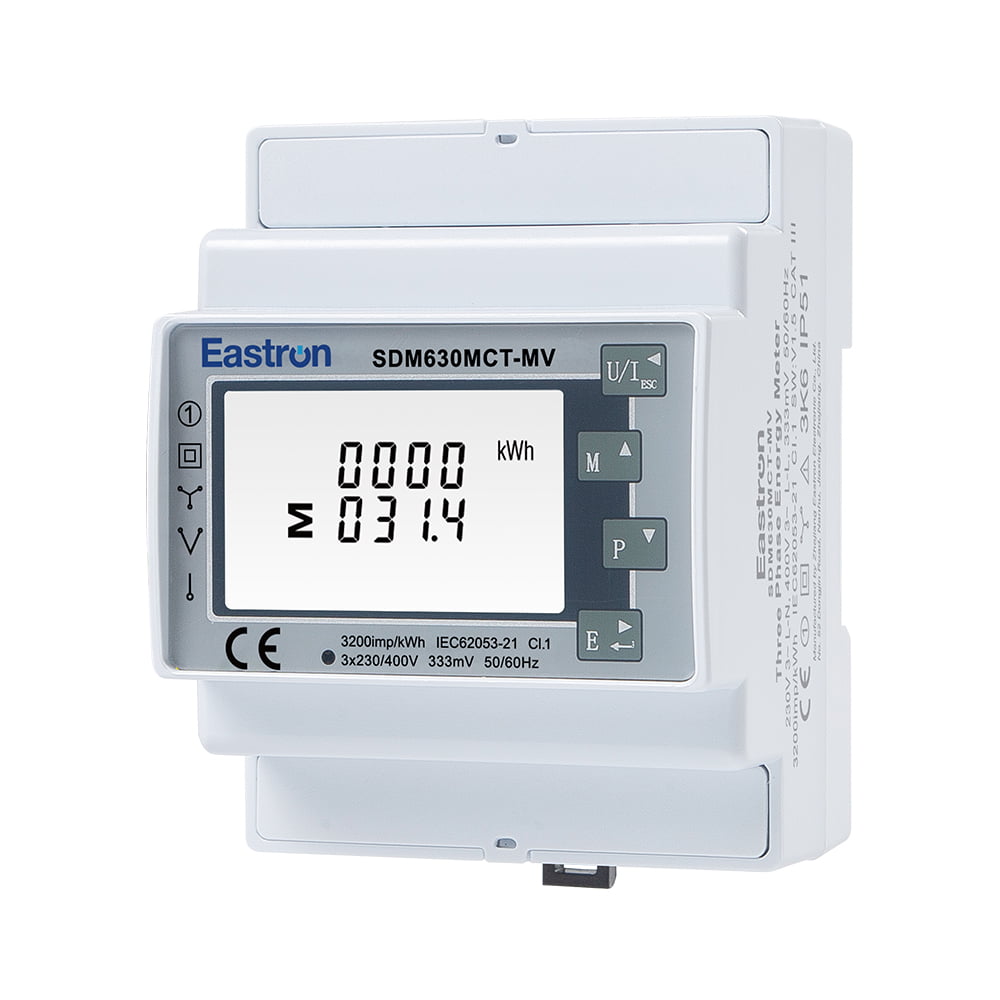
RCM CT Type Din Rail Three Phase Multi-function Solar PV /Zero Export Meter for PV Metering
Aug 03,2022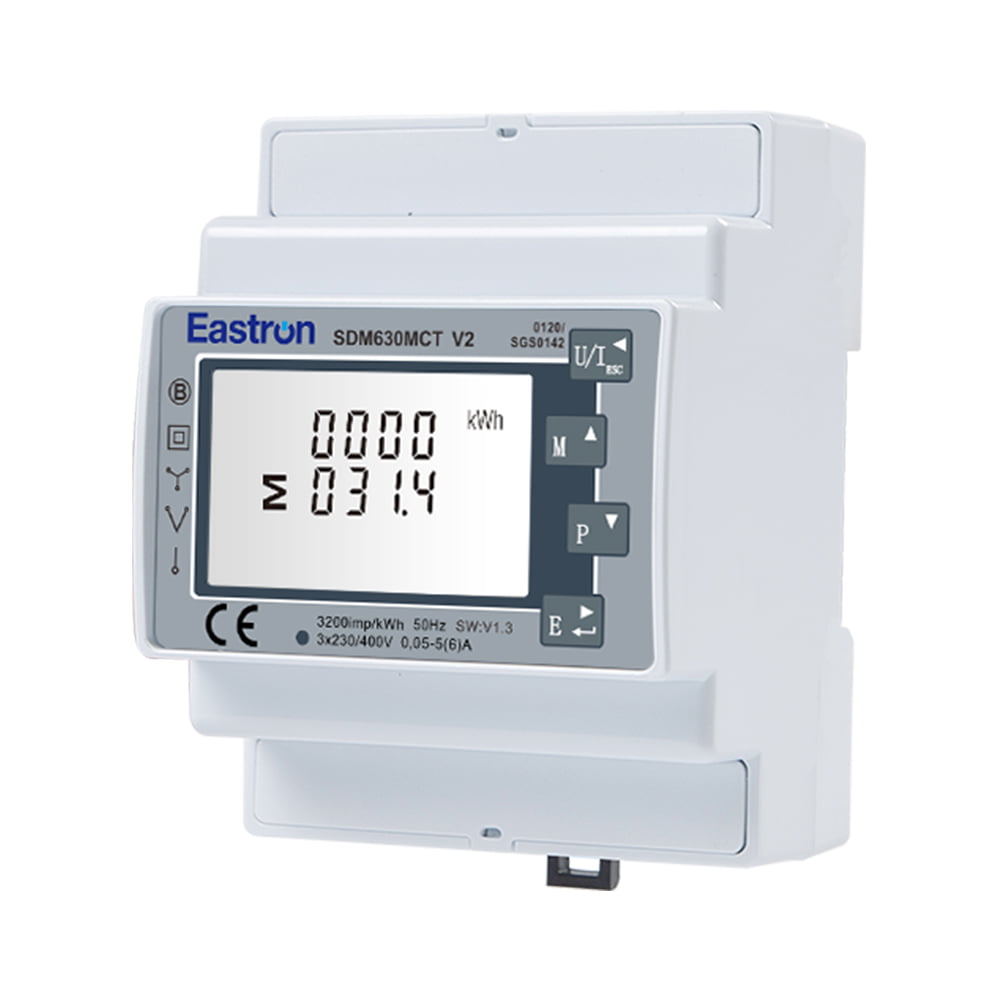
MID Approved CT Type Din Rail Three Phase Multi-function Solar PV /Zero Export Meter for PV Metering
Nov 24,2022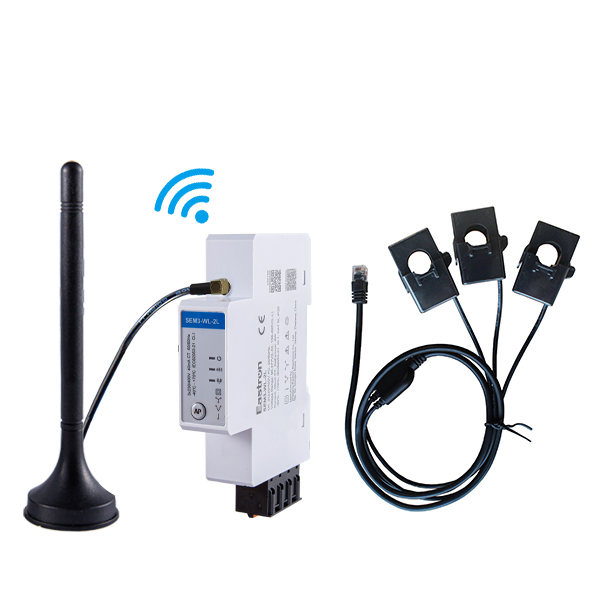
CT Type Three Phase Din Rail Wifi Energy Meter for PV Metering
May 30,2025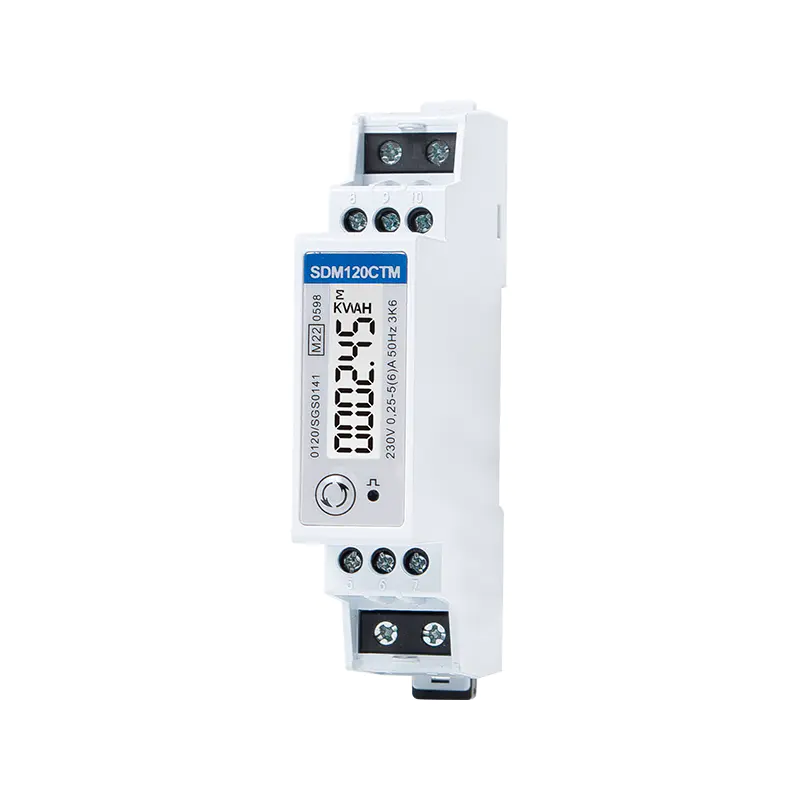
MID CT Type Din Rail Single Phase Multi-function Solar PV /Zero Export Meter for PV Metering
Nov 24,2022
CT Type RS485 Modbus Single Phase Din Rail Energy Meter for PV Metering
May 30,2025
RCM 40mA CT Input Din Rail Single Phase Multi-function Solar PV /Zero Export Meter for PV Metering
Nov 24,2022Content
In modern photovoltaic systems, energy measurement is no longer a passive function. It is a central part of system safety, performance optimization, grid compliance, load analysis, and intelligent energy management. A CT type three phase DIN rail WiFi energy meter designed for PV metering provides the precise visibility required by installers, facility managers, inverter manufacturers, and energy service providers. The SEM3-WL-2 is developed for this role, combining current transformer connection, three phase measurement, WiFi communication, RS485 Modbus communication, bidirectional energy monitoring, and multi-parameter data acquisition in a compact DIN rail format.
This product is especially valuable in solar PV and zero export applications, where fast, reliable, and accurate measurement of import and export energy is essential. Unlike basic kWh meters that only record accumulated consumption, this meter measures voltage, current, frequency, active power, reactive power, power factor, active energy, and reactive energy across common AC supply configurations. It can be used as one three phase energy meter or as three independent single phase meters, making it adaptable to both conventional distribution systems and mixed load monitoring scenarios.
CT Type Three Phase Din Rail Wifi Energy Meter for PV Metering
The SEM3-WL-2 is a new generation DIN rail mounted energy meter equipped with both WiFi and RS485 connectivity. It is designed for current transformer connection, which makes installation easier and safer in applications where direct current wiring is not practical or where loads may vary across different current ranges. The CT approach also improves flexibility because installers can select suitable CT ratios for different applications, including three phase PV systems, industrial equipment, smart buildings, commercial energy monitoring cabinets, and independent single phase load measurement.
The meter supports 1P2W, 3P4W, and 3P3W supply systems, allowing it to work with a wide range of electrical environments. Its rated voltage specification includes 3 x 230 V line-to-neutral and 400 V line-to-line systems, with a working voltage range of 90 to 277 V AC line-to-neutral and 156 to 480 V AC line-to-line. This broad input capability makes it suitable for many regional electrical standards and helps system designers standardize one metering solution across multiple project types.
One of the most practical features of the product is its ability to support either one three phase load or three independent single phase loads. In three phase mode, it serves as a comprehensive three phase power and energy meter. In single phase mode, three external CTs can be configured with different CT ratios, allowing the meter to monitor three separate loads independently. This function can reduce the number of meters required in distribution panels, saving space, wiring time, and system cost.
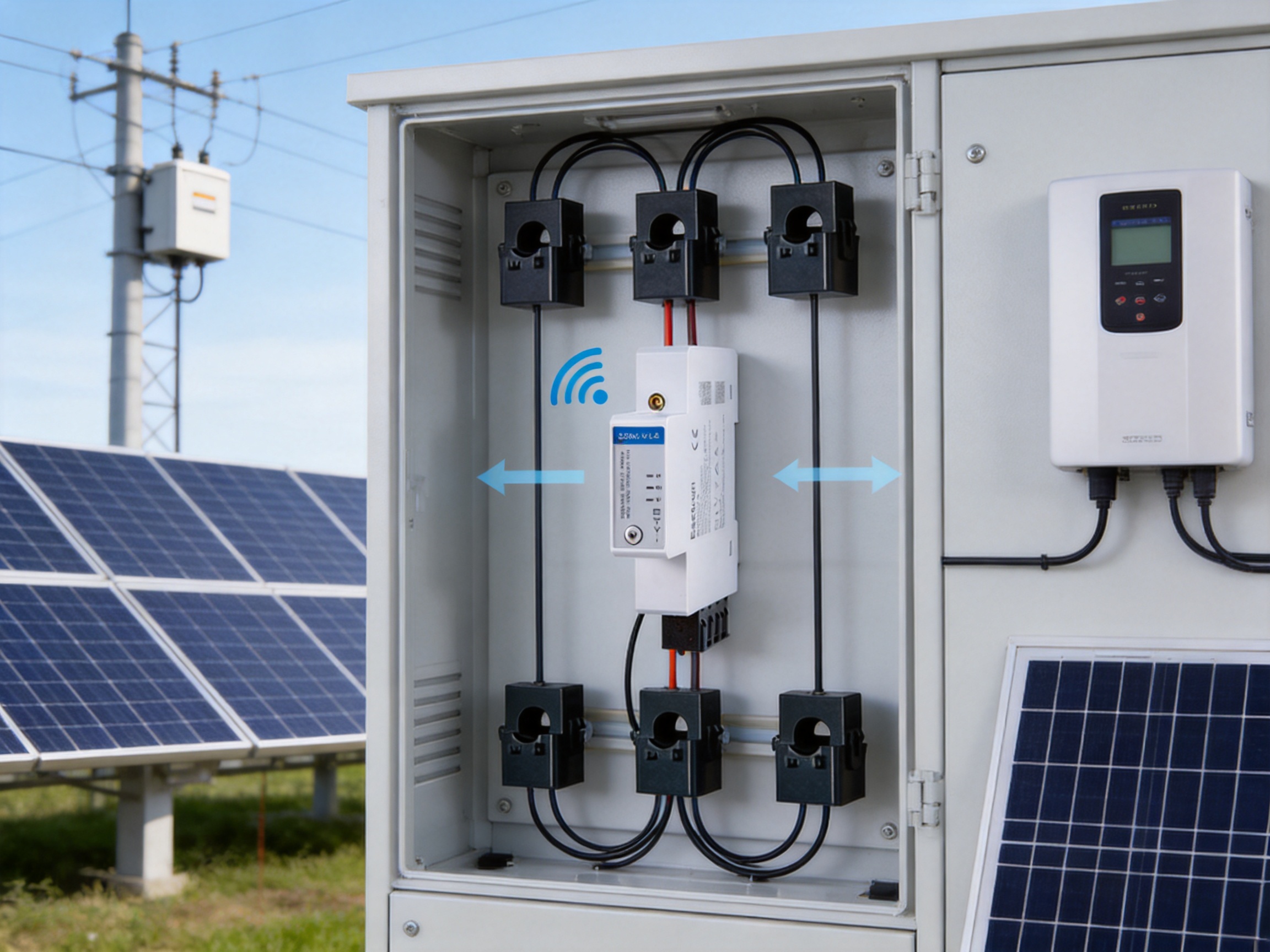
Solar PV installations often require bidirectional measurement. The system must know how much power is being imported from the grid and how much power is being exported back to it. In zero export systems, this information becomes even more critical because the inverter or energy management system must react quickly to prevent unwanted export. The SEM3-WL-2 supports bidirectional measurement of active and reactive energy, helping PV control systems manage power flow with greater confidence.
With active power data update rates of 50 ms through RS485 and 100 ms through WiFi, the meter provides responsive information for monitoring and control systems. Fast data response is particularly important when PV generation changes quickly due to passing clouds, load switching, or equipment start-up events. Slow meters can delay control action, causing unstable zero export regulation or inaccurate power balance. By offering rapid data refresh, this meter provides a stronger foundation for dynamic PV power management.
In PV applications, installers also value simple, repeatable wiring. The CT connection solution helps reduce interruption to existing power circuits and simplifies installation in retrofit projects. Instead of routing the full load current through the meter, the current is measured through external current transformers. This approach is more convenient in commercial buildings, factories, and distributed energy sites where high-current cables may already be installed and difficult to modify.
The primary advantage of the SEM3-WL-2 is the combination of measurement flexibility, communication diversity, compact mechanical design, and PV-oriented performance. Many conventional meters provide only RS485 communication or only basic energy accumulation. Some WiFi meters lack industrial communication compatibility. Some compact meters do not provide the configuration flexibility required for mixed three phase and single phase applications. This product addresses these limitations by integrating WiFi Modbus TCP, RS485 Modbus RTU, CT input, bidirectional metering, automatic phase sequence detection, and multi-parameter measurement in one device.
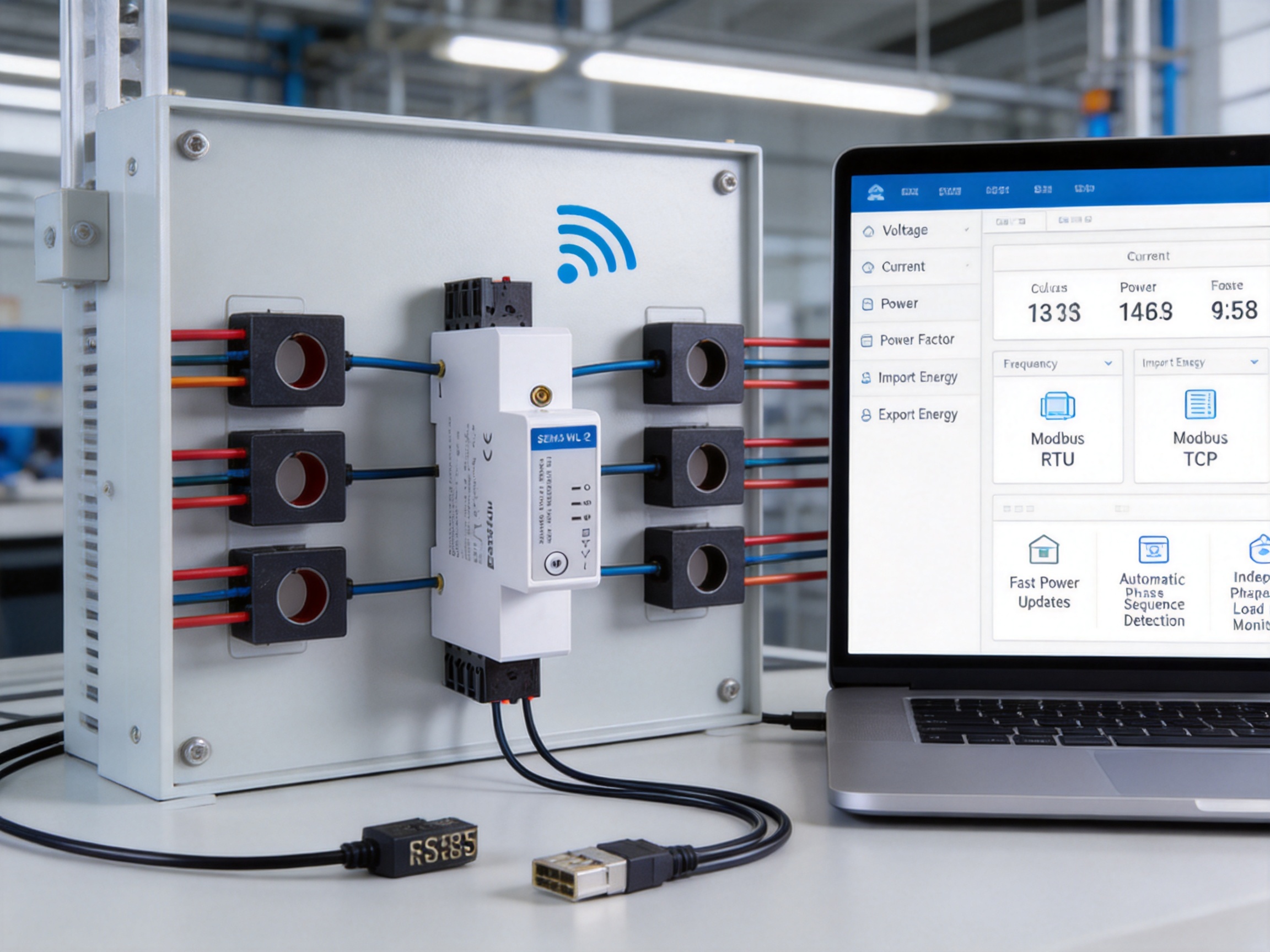
For system integrators, dual communication is a major benefit. RS485 Modbus RTU remains widely used in inverters, data loggers, gateways, and industrial controllers because it is stable, long-distance capable, and suitable for wired fieldbus networks. The SEM3-WL-2 supports RS485 transmission distance up to 1000 m, communication addresses from 1 to 247, half duplex transmission, floating point data, baud rates from 2400 bps to 115200 bps, and configurable parity and stop bits. This makes it compatible with many automation and energy management platforms.
WiFi communication adds convenience for smart energy systems, monitoring apps, gateway-free installations, and situations where wiring communication cables is difficult. The WiFi interface supports Modbus TCP, floating point data, 2.4 GHz to 2.5 GHz RF band, 802.11 b/g/n protocol, and practical communication ranges up to 30 m indoors and 50 m outdoors, depending on local conditions. This allows users to integrate metering data into networked energy platforms with less physical wiring.
Another competitive advantage is the automatic phase sequence detection and alarm function. Incorrect phase sequence can lead to wrong readings, commissioning delays, and incorrect interpretation of power direction. If the phase sequence is reversed, the meter issues an alarm, and the phase sequence can be adjusted through communication. This feature reduces troubleshooting time and helps installers complete projects faster and more reliably.
Feature |
Specification |
Practical Benefit |
Connection Type |
External CT connection |
Simplifies installation and supports flexible current ranges |
Supply Systems |
1P2W, 3P4W, and 3P3W |
Suitable for single phase, three phase four wire, and three phase three wire networks |
Communication |
WiFi Modbus TCP and RS485 Modbus RTU |
Supports both wireless and wired industrial integration |
Active Energy Accuracy |
Class 1 according to IEC 62053-21 |
Provides dependable kWh measurement for monitoring and management |
Power Accuracy |
±1% |
Supports reliable PV control and load analysis |
Voltage Accuracy |
±0.5% |
Improves visibility of supply quality and operating conditions |
Current Accuracy |
±0.5% from 4 A to 120 A, ±1% from 1 A to 4 A, ±3% from 0.06 A to 1 A |
Delivers practical performance across common operating ranges |
Data Update Rate |
50 ms through RS485 and 100 ms through WiFi for active power |
Supports responsive monitoring and zero export control |
WiFi Protocol |
802.11 b/g/n |
Compatible with common 2.4 GHz wireless networks |
RS485 Distance |
Up to 1000 m |
Suitable for larger buildings, plants, and distributed systems |
Accurate energy measurement depends on more than a kWh register. The quality of the measurement circuit, sampling method, calculation algorithm, signal conditioning, and communication stability all influence system performance. The SEM3-WL-2 measures RMS values including harmonics on three phase AC systems. This is important because modern electrical environments often include nonlinear loads, inverter outputs, variable speed drives, LED lighting, switching power supplies, and other equipment that can distort waveforms.
The meter measures voltage, current, frequency, active power, reactive power, active energy, reactive energy, power factor, imported energy, and exported energy. Energy is recorded in kWh and kVArh, providing both active and reactive energy visibility. For facility managers, this helps identify poor power factor, inefficient loads, energy waste, or abnormal operating conditions. For PV projects, import and export registers help evaluate how much generated energy is consumed on site and how much is sent to the grid.
The product offers ±1% power accuracy, Class 1 active energy accuracy according to IEC 62053-21, ±2% reactive energy accuracy, ±0.2% frequency accuracy, ±0.5% voltage accuracy, and a current accuracy profile suitable for a wide operating range. These specifications support practical energy management rather than simple indication. In real installations, accuracy is essential for evaluating system return on investment, comparing inverter output with building consumption, and verifying energy-saving strategies.
CT connected meters are often preferred for solar PV metering and industrial energy monitoring because they allow the measurement circuit to be separated from the main power conductor. This reduces wiring complexity and makes the meter easier to install inside distribution panels. It also avoids passing the full load current through the meter body, which can improve layout flexibility and make the metering system more convenient for higher current applications.
In retrofit applications, CT connection can be a decisive advantage. Many existing buildings do not have panel space or wiring arrangements suitable for direct connection meters. A CT meter allows an installer to place current transformers around existing conductors, connect voltage references, configure ratios, and begin monitoring with less disruption. For PV upgrades, energy storage additions, and energy management retrofits, this can reduce installation time and minimize downtime.
The ability to set different CT ratios for three independent single phase loads is also commercially useful. A site may have one main distribution feeder, one HVAC branch, and one EV charging circuit, each requiring a different measurement range. Instead of using three separate meters, the SEM3-WL-2 can monitor these loads in single phase mode with individual CT settings. This provides a more compact and economical solution while still delivering detailed multi-load data.
Panel space is always valuable. Distribution boards, PV combiner cabinets, inverter control panels, and energy management enclosures often contain protective devices, communication gateways, controllers, power supplies, relays, and terminal blocks. A compact DIN rail energy meter reduces the mechanical burden on the panel and gives designers more freedom to organize wiring and airflow. The SEM3-WL-2 is designed for DIN rail installation, making it easy to standardize in electrical cabinets.
Compared with bulky panel meters or separate communication modules, an integrated DIN rail meter helps simplify procurement and assembly. The installer does not need to add an external WiFi converter when wireless Modbus TCP is required, and the RS485 interface is available for conventional wired systems. This reduces component count and lowers the possibility of compatibility problems. For large projects, fewer components also mean easier stock control, faster assembly, and simpler maintenance.
Communication is one of the defining characteristics of intelligent metering. The SEM3-WL-2 provides both RS485 Modbus RTU and WiFi Modbus TCP, allowing the same product to serve different system architectures. In wired industrial applications, RS485 is often preferred because it is robust, predictable, and suitable for long cable runs. In smart building or smaller PV applications, WiFi may be preferred because it reduces wiring effort and can connect more easily to local network infrastructure.
Using Modbus RTU over RS485, the meter can be connected to inverters, programmable logic controllers, energy gateways, data acquisition devices, and building management systems. Modbus is widely recognized and easy to integrate, reducing software development time. The support for floating point data helps deliver measurement values in a usable format for professional monitoring platforms.
Using Modbus TCP over WiFi, the meter can transmit data through standard IP-based networks. This makes it suitable for energy management software, local monitoring dashboards, and gateway architectures where wireless access is desirable. The 2.4 GHz WiFi band and 802.11 b/g/n protocol provide practical compatibility with common network equipment. For installers, this flexibility means one meter can be used whether the project requires cable-based reliability or wireless convenience.
Zero export control requires the PV system to monitor grid-side power flow and adjust inverter output accordingly. If building load decreases suddenly while PV generation remains high, excess power may begin flowing toward the grid. A metering device must detect this quickly and provide accurate active power data to the control system. The SEM3-WL-2 supports active power update rates of 50 ms through RS485 and 100 ms through WiFi, enabling fast response for modern PV applications.
Fast update performance is especially valuable in installations with fluctuating loads. Motors, pumps, compressors, heating systems, elevators, and EV chargers can change demand quickly. If the PV control system receives delayed or unstable measurements, it may overcorrect or undercorrect. A meter with responsive active power output helps maintain smoother control and better compliance with grid export restrictions.
In addition, bidirectional measurement allows the system to distinguish between import and export conditions. This is fundamental for PV systems because the sign and direction of power flow determine inverter behavior. A meter that only records consumption is not sufficient for zero export. By measuring both imported and exported active and reactive energy, the SEM3-WL-2 gives the energy system a complete picture of grid interaction.
Three phase installation errors are common sources of commissioning delays. A reversed phase sequence or mismatched current and voltage connections can produce confusing readings, incorrect power direction, or unstable control behavior. The SEM3-WL-2 includes phase sequence automatic detection and alarm capability. If the phase sequence is reversed, the meter issues an alarm, helping the installer identify the issue promptly.
The phase sequence can also be adjusted through communication, which can reduce the need for physical rewiring in some cases. This is particularly helpful in panels where cable access is limited or where rewiring would increase downtime. For system integrators managing multiple installations, such commissioning-friendly functions reduce labor cost and improve consistency.
Competitor products may require manual verification with separate instruments or repeated wiring checks. By integrating automatic detection into the meter, this product provides a more intelligent installation experience. It also lowers the risk of leaving a system with incorrect phase configuration, which can affect data integrity and long-term performance.
Traditional DIN rail kWh meters are often limited to cumulative energy recording. They may not support reactive energy, bidirectional measurement, fast active power updates, configurable CT ratios, or network communication. For older systems, such limitations may have been acceptable. For PV, smart building, and industrial energy management, they are no longer sufficient.
The SEM3-WL-2 offers a more complete metering approach. It combines multi-parameter measurement with both wired and wireless communication. It can be used as a three phase meter or as three single phase meters. It supports automatic phase sequence detection. It provides data suitable for active monitoring, PV control, load profiling, and energy optimization. This makes it more useful than basic meters that only display local values or transmit limited energy registers.
Compared with meters that only use WiFi, the RS485 interface gives the product industrial compatibility and long-distance communication capability. Compared with meters that only use RS485, WiFi adds flexibility and reduces wiring effort in suitable applications. Compared with direct connected meters, CT input simplifies installation and improves adaptability. Compared with meters that lack fast data refresh, the 50 ms RS485 active power update rate provides better support for zero export control.
Smart buildings require reliable energy data at multiple levels: main incoming supply, floor distribution, tenant circuits, HVAC systems, lighting panels, EV charging stations, and renewable generation points. The SEM3-WL-2 can support these requirements by measuring multiple electrical parameters and transmitting data to management platforms. Its three phase and independent single phase operating flexibility makes it useful for both main circuits and branch circuits.
Facility managers can use the measured data to identify unusual consumption patterns, compare energy use between zones, detect poor power factor, and evaluate energy-saving measures. When combined with building automation systems, the meter can help optimize equipment scheduling, improve demand management, and support sustainability reporting. The WiFi interface can be useful in retrofit projects where communication wiring is difficult, while RS485 remains suitable for structured building management networks.
Industrial facilities often require measurement of motors, process lines, machines, compressors, pumps, and auxiliary equipment. Energy data can reveal operational inefficiencies, equipment degradation, abnormal loading, and opportunities for maintenance improvement. The SEM3-WL-2 measures current, voltage, power, energy, frequency, and power factor, giving users a broad view of equipment behavior.
The meter’s CT connection is particularly suitable for industrial panels where load currents may exceed the practical range of direct connected meters. Its RS485 communication distance up to 1000 m allows integration across larger production environments. With Modbus RTU, the meter can communicate with industrial controllers and supervisory systems. This makes it a practical device for energy dashboards, machine-level monitoring, and factory energy management programs.
As energy systems become more distributed, metering points multiply. A site may include PV generation, battery storage, grid connection, backup generators, EV chargers, and critical loads. Accurate bidirectional measurement helps determine how energy flows between these assets. The SEM3-WL-2 can support distributed energy monitoring by providing imported and exported active and reactive energy data, as well as instantaneous electrical values.
Energy storage systems often depend on accurate grid-side measurement to decide when to charge, discharge, or remain idle. A meter with fast active power updates improves responsiveness and helps energy management systems make better control decisions. In hybrid PV and battery applications, the ability to measure both three phase systems and independent single phase loads can simplify system design.
A high-quality energy meter is the result of strong design, controlled manufacturing, precision calibration, and rigorous testing. Eastron Electronic Co., Ltd. is a high-tech manufacturer and supplier of electricity products and energy measurement solutions. The company develops and produces electricity meters, power analyzers, current sensors, communication modules, and management systems. This broad product foundation supports the development of integrated metering solutions such as the SEM3-WL-2.
The company is headquartered in Jiaxing, China, near Shanghai, Hangzhou, and Jiangsu, giving it access to an advanced manufacturing ecosystem, skilled technical resources, and efficient logistics channels. Its development teams in China and the United Kingdom contribute to product innovation and help the company respond to evolving requirements in electricity metering, smart energy, PV monitoring, and communication technology.
Manufacturing strength is not only about production volume. It is about maintaining repeatable quality across every device. Eastron follows the ISO 9001 quality management system and has production approved by SGS according to MID standards. These quality practices help ensure that meters are produced under controlled procedures, with attention to component selection, assembly quality, calibration, inspection, and final verification.
Reliable metering products must withstand real electrical environments. Voltage disturbances, electromagnetic interference, temperature changes, humidity, mechanical handling, and long operating hours can all affect performance. Eastron has established a professional laboratory capable of performing EMC, LVD, accuracy, and environmental tests according to IEC, EN, GB, and UL standards. This internal testing capability strengthens product development and quality assurance.
EMC testing helps verify that a meter can operate in electrically noisy environments and does not create unacceptable interference. This is essential in PV and industrial applications where inverters, drives, switching power supplies, and communication devices may be installed nearby. LVD testing supports electrical safety validation. Accuracy testing confirms metering performance. Environmental testing helps evaluate durability under different operating conditions.
The company also holds patented technologies in software, embedded software, and hardware. For a communication-enabled meter such as the SEM3-WL-2, embedded software quality is especially important. Measurement calculations, Modbus mapping, communication stability, configuration logic, phase sequence detection, and data handling all depend on strong firmware design. A manufacturer with software and hardware capabilities can better control product performance from sensing to data output.
Energy metering is evolving rapidly. Requirements now include smart communication, PV integration, cloud connectivity, bidirectional energy accounting, real-time monitoring, power quality awareness, and compact installation. Eastron continues to invest in research and development of new technologies and new products for electricity metering. Cooperation with universities and institutions helps introduce advanced technologies into its product development process.
This R&D foundation is reflected in the SEM3-WL-2. The product is not merely a basic meter with an added communication port. It is designed around modern metering requirements: WiFi and RS485 connectivity, fast power updates, CT flexibility, multiple supply modes, import and export measurement, automatic phase sequence detection, and compact DIN rail installation. These functions show an understanding of real installation challenges and modern energy system needs.
Products and services from the company have been supplied to more than 50 countries across Europe, Asia-Pacific, America, the Middle East, and Africa. Global application experience is important because metering products must adapt to different grid structures, installation habits, communication requirements, and compliance expectations. A manufacturer with broad market experience can better support customers with practical technical guidance.
The company emphasizes technical support and after-sales service. For energy meters used in PV and industrial systems, support can be critical. Installers may need help with CT ratio configuration, Modbus register interpretation, communication settings, WiFi setup, phase sequence issues, or integration with inverters and monitoring platforms. A product backed by professional support reduces project risk and improves customer confidence.

Correct installation is essential for accurate metering. In a CT connected three phase system, the installer must ensure that voltage inputs correspond to the correct phases and that each CT is oriented correctly according to power flow direction. The automatic phase sequence detection function helps identify phase sequence problems, but careful wiring practice remains important. Commissioning should include verification of voltage readings, current readings, power direction, and communication response.
When used in zero export applications, the meter should typically be installed at the grid connection point or another location specified by the PV control design. This allows the control system to detect net import or export. The communication method should be selected according to control requirements. RS485 may be preferred where deterministic wired communication and long distance are important. WiFi may be appropriate where cabling is difficult and the network environment is stable.
CT ratio selection should match the expected load current. Oversized CTs may reduce accuracy at very low currents, while undersized CTs may saturate or be unsuitable for peak load conditions. The SEM3-WL-2 provides current accuracy specifications across different current ranges, helping users evaluate practical measurement expectations. In single phase multi-load mode, each CT ratio should be configured according to its respective load.
Energy data becomes valuable when it is integrated into control and analysis platforms. The SEM3-WL-2 supports standard Modbus protocols, which simplifies data integration. Modbus RTU through RS485 is widely used in electrical equipment, while Modbus TCP through WiFi is convenient for IP-based systems. This dual-protocol approach allows the meter to connect with different types of inverters, gateways, controllers, and software platforms.
Measured values can be used for real-time dashboards, historical trend analysis, alarm generation, energy cost allocation, PV self-consumption analysis, and equipment performance comparison. For example, a building operator can compare PV generation, grid import, and main load demand over time. An industrial user can evaluate whether equipment energy consumption changes during different production shifts. A PV installer can verify whether zero export control is responding correctly to load changes.
Because the meter provides floating point data, system developers can handle values directly without excessive conversion complexity. This reduces integration errors and simplifies programming. For large installations with multiple devices, configurable RS485 addresses from 1 to 247 allow multiple meters to share a network, while WiFi can provide alternative connectivity for selected locations.
Installers and integrators need products that reduce uncertainty. A meter that supports multiple supply systems, flexible CT ratios, wired and wireless communication, and automatic phase sequence detection can be used across many projects. This reduces the need to stock multiple specialized models and helps installation teams become familiar with one versatile device.
Commissioning time is also a major cost factor. Features such as fast data updates, Modbus compatibility, clear measurement parameters, and phase sequence alarms help installers identify issues quickly. In PV systems, where grid-side metering must coordinate with inverter control, reliable communication and accurate bidirectional data can prevent repeated site visits and troubleshooting delays.
For OEMs and solution providers, the product’s combination of features supports system standardization. It can be incorporated into PV cabinets, energy storage control panels, smart building packages, industrial monitoring units, and gateway-based energy management systems. A compact DIN rail form factor makes it easy to integrate mechanically, while Modbus communication makes it easy to integrate digitally.
End users benefit from better energy visibility, improved PV utilization, and more reliable monitoring. In a commercial building, the meter can help reveal when electricity is imported, when PV is exported, and how loads behave across phases. In an industrial facility, it can provide insight into equipment energy demand and power factor. In a residential or small commercial PV system, it can support smarter control and clearer performance evaluation.
Energy prices and grid regulations make accurate metering increasingly important. Users who understand their energy flow can make better decisions about load scheduling, PV expansion, energy storage investment, power factor correction, and demand reduction. The SEM3-WL-2 provides the measurement foundation for these decisions by delivering multi-parameter, bidirectional, communicable data.
In many competitor solutions, users must choose between a basic wired meter, a wireless consumer meter, or a separate communication converter. This can create compromises. A basic wired meter may be reliable but inconvenient to install in modern smart systems. A wireless consumer meter may be easy to connect but lack industrial protocol compatibility or detailed three phase measurement. A converter-based system may add cost and create more points of failure.
The SEM3-WL-2 reduces these compromises by integrating WiFi and RS485 into the same meter. It supports Modbus TCP and Modbus RTU, making it suitable for both smart network and industrial fieldbus environments. Its CT connection supports practical installation in real panels. Its bidirectional measurement supports PV and zero export applications. Its phase sequence detection supports faster commissioning. Its ability to operate as one three phase meter or three single phase meters gives it flexibility that many standard meters do not provide.
The meter’s fast active power update capability also distinguishes it in PV control scenarios. While some meters are sufficient for monthly energy reading or simple monitoring, zero export systems require responsive power data. The 50 ms RS485 update rate and 100 ms WiFi update rate for active power make the product better aligned with dynamic energy control requirements.
The growth of distributed PV, energy storage, EV charging, and smart buildings will increase the need for flexible metering. Products that only serve one narrow application may become less useful as systems become more integrated. A meter that can measure three phase and single phase loads, communicate through wired and wireless protocols, and support bidirectional PV measurement is better positioned for long-term use.
The SEM3-WL-2 fits this direction. It can serve today’s PV zero export project and tomorrow’s energy management upgrade. It can be used in a smart building panel, a factory energy monitoring system, a solar inverter cabinet, or a distributed energy installation. Its combination of compact design, communication flexibility, and measurement capability gives it lasting value across changing energy infrastructure.
The meter is designed to measure electrical parameters and energy in three phase and single phase systems, especially for solar PV, zero export, smart building, and industrial energy monitoring applications. It provides bidirectional measurement, multi-parameter data, WiFi Modbus TCP, and RS485 Modbus RTU communication.
Zero export systems need fast and reliable grid-side power measurement. The meter provides bidirectional active power and energy measurement and supports active power update rates of 50 ms through RS485 and 100 ms through WiFi. This helps PV controllers detect import and export conditions quickly.
Yes. The meter can be used as one three phase energy meter or as three individual single phase energy meters. In single phase mode, three external CTs can be configured with different CT ratios for three independent loads.
It supports Modbus RTU through RS485 and Modbus TCP through WiFi. RS485 is suitable for stable wired communication over long distances, while WiFi is convenient for networked monitoring where communication cabling is difficult.
The meter supports 1P2W, 3P4W, and 3P3W systems. It measures voltage, frequency, current, power, active energy, reactive energy, imported energy, exported energy, and power factor.
The active energy accuracy is Class 1 according to IEC 62053-21. This level is suitable for dependable monitoring, energy management, and PV performance analysis.
Automatic phase sequence detection helps identify reversed phase sequence during installation. If the phase sequence is reversed, the meter issues an alarm, reducing commissioning time and helping prevent incorrect measurement results.
CT connection allows current measurement without passing the full load current through the meter. This simplifies installation in existing panels, supports higher-current applications through suitable CT selection, and allows flexible CT ratio configuration.
WiFi is useful where wireless access is convenient, but industrial applications often prefer RS485 for longer distance and stable wired communication. This meter provides both options, allowing users to choose according to the project environment.
The manufacturer follows ISO 9001 quality management, has production approved by SGS according to MID standards, and operates a professional laboratory for EMC, LVD, accuracy, and environmental testing according to IEC, EN, GB, and UL standards. These capabilities support consistent quality and reliable performance.
The SEM3-WL-2 CT type three phase DIN rail WiFi energy meter is a strong solution for PV metering, zero export control, smart building monitoring, industrial energy analysis, and distributed energy systems. Its value lies in combining features that are often separated across different devices: CT connection, three phase and single phase flexibility, bidirectional measurement, multi-parameter monitoring, WiFi Modbus TCP, RS485 Modbus RTU, fast active power updates, compact DIN rail installation, and automatic phase sequence detection.
For installers, it simplifies wiring and commissioning. For system integrators, it provides communication flexibility and standardized integration. For PV control systems, it delivers fast and directional power data. For end users, it provides clearer insight into energy consumption, generation, import, export, and power quality. Compared with conventional meters and many competitor solutions, it offers a more complete and future-ready metering platform.
Behind the product is a manufacturer with extensive experience in electricity meters, power analyzers, current sensors, communication modules, and energy management systems. With strong R&D capability, professional laboratory testing, quality management, patented technologies, and global service experience, the product is supported by a robust manufacturing and engineering foundation. As solar PV, energy storage, smart buildings, and industrial energy management continue to expand, this type of intelligent, communicable, and flexible metering device will play an increasingly important role in efficient and reliable energy systems.
International Electrotechnical Commission. IEC 62053-21: Electricity Metering Equipment, Particular Requirements for Static Meters for Active Energy.
International Electrotechnical Commission. IEC 61000 Series: Electromagnetic Compatibility Standards for Electrical and Electronic Equipment.
International Electrotechnical Commission. IEC 61557-12: Electrical Safety in Low Voltage Distribution Systems, Performance Measuring and Monitoring Devices.
Modbus Organization. Modbus Application Protocol Specification.
International Organization for Standardization. ISO 9001: Quality Management Systems Requirements.
Photovoltaic Power Systems Engineering Guidelines for Grid-Connected Inverter and Energy Metering Applications.
Your email address will not be published. Required fields are marked *

We develop and produce high performance electricity meters, power analyzers, current sensors, communication modules and management systems.
Address:NO. 52, Dongjin Road, Nanhu, Jiaxing, Zhejiang, China
Copyright @ Eastron Electronic Co., Ltd. All rights reserved
