

 English
 Español
 Deutsch
 中文简体
中文简体

Product Consultation
Your email address will not be published. Required fields are marked *
Europe's Solar and Energy Storage Transition: Transforming the Power System Infrastructure for a Renewable Future
Jul 10,2026
Power Systems Are Becoming “Real-Time Systems”: Why Data Is More Critical Than Electricity
Jul 06,2026
New EPBD Regulations Drive HVAC Energy Transparency and Boost Demand for Smart Meters
Jul 07,2026Content
Modern electrical installations require energy meters that are accurate, compact, easy to install, and reliable over long service lives. The LCD display DIN rail single phase electronic kWh meter with pulse output is designed for exactly this purpose. Built for 1P2W single phase AC systems, with direct load capability up to 45A, it provides active energy measurement in a narrow 18mm DIN rail form factor. For residential distribution boards, small commercial cabinets, solar generation monitoring, sub-metering panels, charging points, light industrial circuits, and equipment-level energy tracking, this meter offers a practical balance of simplicity, accuracy, space saving, and system integration.
The product described in this article is the SDM120-D, a single phase two wire kWh meter with LCD display and pulse output. It belongs to the category of single phase electronic kWh meters and is part of a broader energy measurement portfolio that includes electronic kWh meters, multi-function energy meters, MID energy meters, ETL energy meters, DC energy meters, power analyzers, current transformers, relays, switches, gateways, and metering systems. Its core design goal is straightforward: to measure active energy dependably, display consumption clearly, and provide a pulse output for remote counting or energy management integration.
Although the meter is compact, its application value is significant. Many competing meters either occupy more panel width, require external current transformers for moderate current loads, provide less convenient pulse integration, or are not optimized for simple DIN rail installations. This meter addresses those issues with a one-module 18mm housing, 45A direct input, LCD reading, pulse output for active energy, and standards-based measurement performance. For installers and system integrators, these characteristics can reduce cabinet space, wiring complexity, installation time, and long-term maintenance concerns.
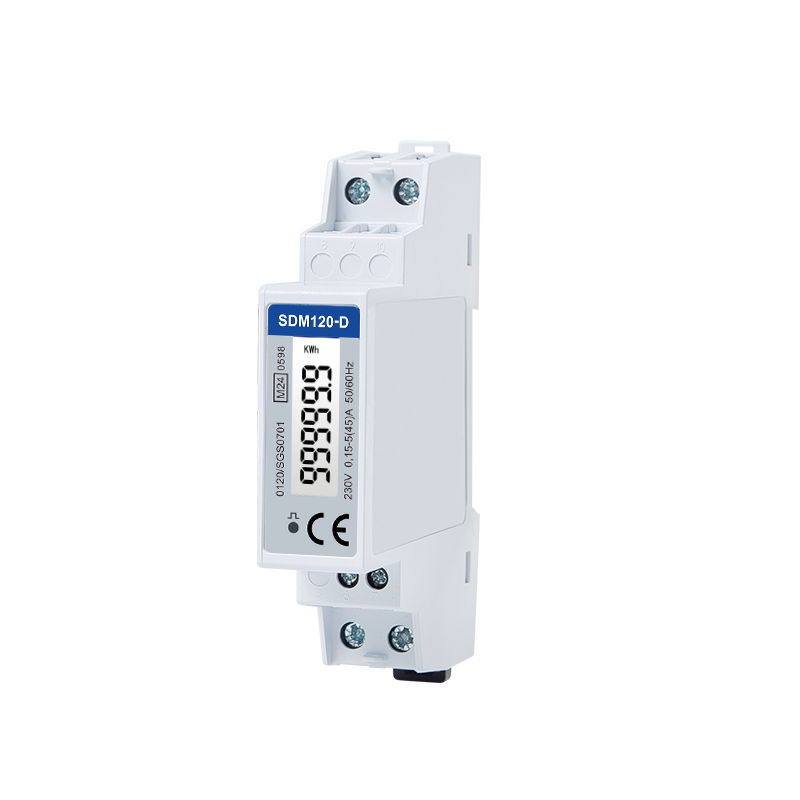
LCD Display Din Rail Single Phase Electronic kWh meter with Pulse Output
The SDM120-D is a DIN rail mounted single phase electronic kWh meter suitable for 1P2W systems. It measures active energy on a single phase AC circuit and presents the data through an LCD display. The meter supports pulse output for active energy, enabling connection to external monitoring devices, data loggers, building management systems, gateways, or energy management platforms that count pulses and convert them into consumption data.
Its rated voltage is 230V, and its operation voltage range is 80% to 120% of the rated voltage. The rated current is 5A, while the maximum current is 45A. The minimum current is 0.15A, and the starting current is 20mA. These values make it suitable for a wide range of single phase circuits, from low-load monitoring to direct metering of higher-current branch circuits within its rated range.
The meter uses RMS measurement on a single phase AC system, helping it reflect real electrical conditions more accurately than simplified measurement approaches. Accuracy is specified according to IEC62053-21 Class 1/0.5 and EN50470-3:2022 Class B/C, depending on the configuration and applicable interpretation. These references are important because electricity metering is not only about showing numbers; it is about producing repeatable and trustworthy results under recognized technical standards.
The product’s physical form is one of its most important advantages. A width of one module, or 18mm, allows it to fit into distribution boards where space is limited. In many existing panels, adding a meter after installation can be difficult because the available DIN rail space is already occupied by circuit breakers, protection devices, relays, contactors, and terminals. A compact 18mm meter helps solve that problem. It can be used for new installations and retrofit projects with less impact on panel layout.
Item |
Specification |
Practical Benefit |
System Type |
Single phase two wire, 1P2W, 1P+N |
Suitable for common residential, commercial, and light industrial circuits |
Measured Parameter |
Active energy |
Provides essential kWh consumption data for billing reference, monitoring, and energy saving |
Display |
LCD display |
Allows direct local reading without additional tools |
Output |
Pulse output for active energy |
Supports remote monitoring, data logging, and integration with energy management systems |
Rated Current |
5A |
Defines standard current reference for accurate measurement operation |
Maximum Current |
45A direct load |
Reduces the need for external current transformers in many small installations |
Starting Current |
20mA |
Helps detect low consumption and improves monitoring sensitivity |
Rated Voltage |
230V |
Matches many common single phase AC electrical networks |
Operating Voltage |
80% to 120% of rated voltage |
Supports stable operation across normal voltage variation |
Width |
1 module, 18mm |
Saves valuable DIN rail space in compact panels |
Accuracy References |
IEC62053-21 Class 1/0.5; EN50470-3:2022 Class B/C |
Provides standards-based confidence in metering performance |
Panel space is one of the most common limitations in electrical projects. In a residential consumer unit, there may be very little free DIN rail space after the installation of main switches, residual current devices, miniature circuit breakers, surge protection devices, contactors, and terminal blocks. In small commercial boards, the challenge is similar but often more complicated because multiple sub-circuits may require monitoring. A meter that occupies only 18mm can be installed where a wider device would be impossible or would require costly panel modification.
Compared with larger single phase meters, the 18mm form factor reduces the physical footprint without sacrificing the essential functions required for active energy measurement. This offers a competitive advantage in retrofit sub-metering projects, where the installer must often work inside existing cabinets. Instead of replacing the cabinet or reorganizing the entire electrical layout, the installer can often add this compact meter with minimal disturbance.
For equipment manufacturers, compact size also supports better product design. A manufacturer of vending machines, small production equipment, EV charging accessories, heat pump systems, solar monitoring boxes, or rental power distribution boards can include metering functionality inside a limited enclosure. The meter’s narrow width helps preserve internal space for protection, control, communication, and wiring clearance.
Space saving also improves scalability. If a building owner wants to monitor several single phase circuits separately, using one-module meters may allow multiple metering points within a single panel. With wider meters, the same monitoring plan could require additional enclosures or a redesigned panel. Therefore, compactness is not merely a visual or mechanical convenience; it can influence project cost, installation feasibility, and future expansion.
The meter’s maximum direct load capability of 45A is a major practical advantage. Some energy metering solutions require external current transformers when circuit current exceeds a relatively low threshold. Current transformers are useful in high-current systems, but they add cost, wiring complexity, installation space, and potential error sources if selected or installed incorrectly. For many single phase branch circuits up to 45A, direct connection is simpler and more economical.
Direct load capability benefits installers because it reduces the number of components in the metering circuit. Fewer components mean fewer terminals, fewer connections, fewer labeling requirements, and fewer opportunities for wiring mistakes. It can also reduce commissioning time. Instead of verifying CT ratios, CT direction, secondary wiring, and matching configuration settings, the installer can wire the load through the meter according to the wiring diagram and confirm operation.
For end users, direct metering can improve long-term reliability. External current transformers introduce additional mechanical and electrical interfaces. If a CT secondary circuit is loose, reversed, open, or mismatched, measurement results may be inaccurate. A direct-connected meter avoids many of these risks in applications within its current rating.
In competitive terms, the 45A capacity makes the meter attractive for apartment sub-metering, small offices, individual machine circuits, utility room loads, garage supplies, heating control panels, and photovoltaic generation monitoring points. It provides enough current range for many practical single phase applications while staying compact and easy to install.
A local LCD display remains valuable even in the age of connected energy systems. Digital platforms, gateways, and remote dashboards are useful, but the ability to walk to a panel and read energy directly is still essential for commissioning, maintenance, verification, tenant discussions, and troubleshooting. The LCD display gives users immediate visibility of active energy consumption without requiring a laptop, mobile application, or communication network.
Compared with meters that rely only on communication outputs, a built-in LCD display provides independence. If a monitoring system is offline, if a gateway has not been commissioned, or if a cable is damaged, the meter can still show accumulated kWh locally. This is especially useful for maintenance teams who need to verify whether a load has been consuming energy over time.
The display also helps during installation. After wiring, an installer can energize the circuit and confirm that the meter is operating. In systems where the pulse output is connected to another device, the LCD can serve as a reference point for checking whether pulse counts correspond to the meter’s accumulated active energy. This improves commissioning confidence.
For property managers, the LCD can simplify energy allocation checks. In a multi-tenant site, workshop, shared facility, or rental unit, a visible kWh value supports transparent discussions about consumption. Even when the meter is used only for internal reference rather than legal billing, clear local reading can reduce disputes and improve operational awareness.
The pulse output for active energy is one of the product’s most important system-level features. A pulse output converts measured energy into a series of electrical pulses that can be counted by external devices. This allows the meter to be integrated into wider monitoring systems without requiring a complex communication protocol in the meter itself.
Pulse output is widely used because it is simple, robust, and compatible with many data acquisition platforms. A building energy management system, programmable controller, pulse counter, gateway, or remote monitoring unit can count pulses and calculate kWh consumption. This approach is particularly useful in applications where the user wants reliable energy data but does not need advanced real-time electrical parameters from every metering point.
Compared with meters that offer only visual display, pulse output provides a path toward automation. Energy data can be collected periodically, stored, analyzed, compared, and reported. Facility managers can identify abnormal consumption, allocate costs, verify energy-saving measures, or monitor generation output. The meter therefore supports both simple standalone reading and connected energy management.
Pulse output can also reduce integration complexity in cost-sensitive projects. Advanced communication meters with Modbus, M-Bus, Ethernet, or wireless interfaces are powerful, but they may be unnecessary for simple kWh counting. A pulse output meter provides a practical middle ground: more useful than a display-only device, but simpler and often more economical than a full communication meter.
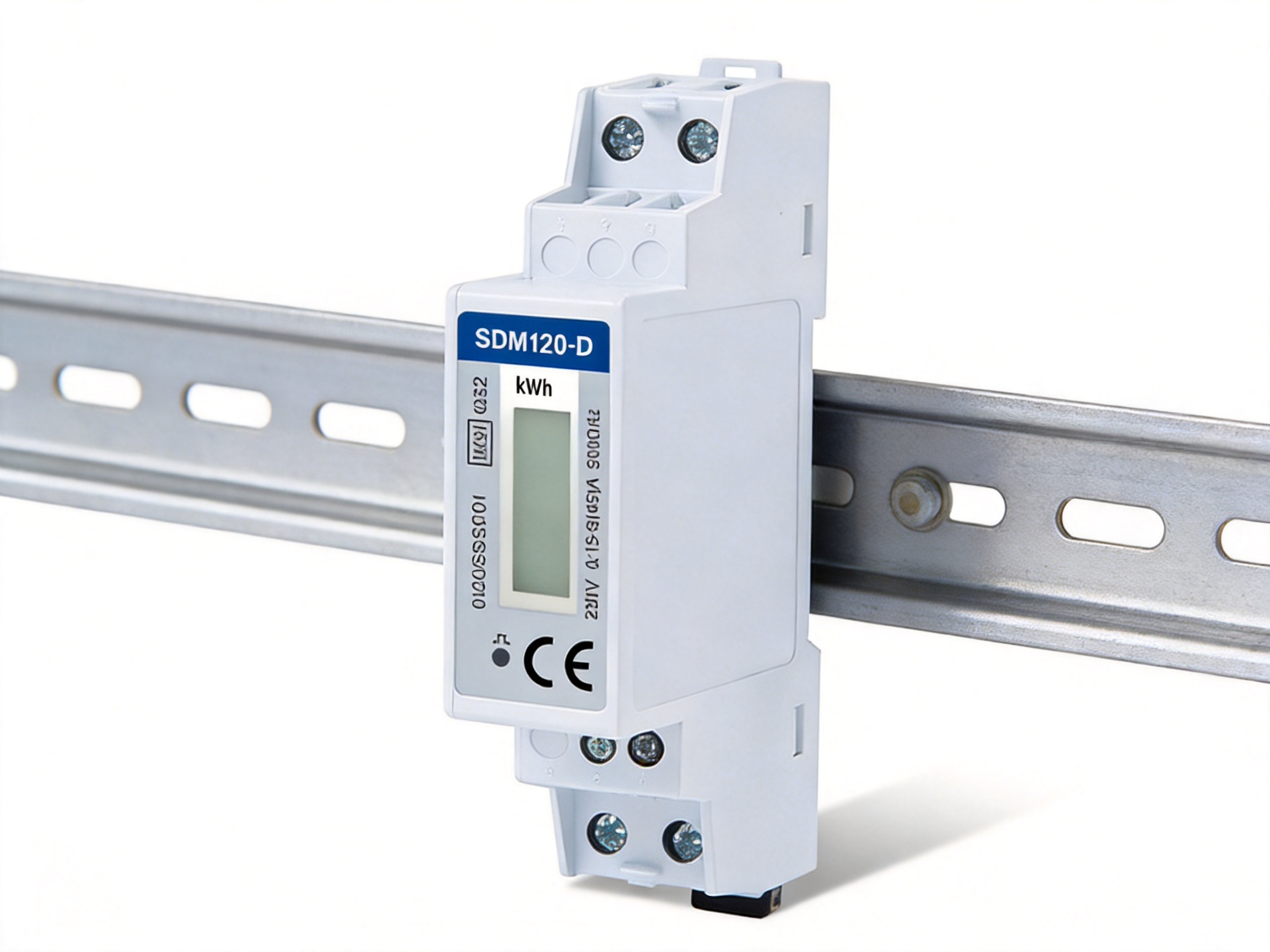
The primary purpose of any kWh meter is accurate energy measurement. The SDM120-D is designed to measure active energy in single phase AC systems using RMS measurement. RMS-based measurement is important because real electrical loads are not always simple resistive loads with perfect sine wave current. Modern homes and businesses use switch-mode power supplies, LED drivers, inverters, motor controls, chargers, and electronic devices that can introduce non-linear current waveforms. A meter intended for modern installations must measure under realistic operating conditions.
The product references IEC62053-21 Class 1/0.5 and EN50470-3:2022 Class B/C. These standards are meaningful because they define accuracy classes and test expectations for electricity meters. While project requirements vary by country and application, compliance with recognized metering standards provides confidence that the device has been designed and evaluated according to established industry norms.
Accurate measurement is important not only for billing-related applications but also for energy management. If a facility manager invests in efficiency upgrades, the value of the energy data depends on the meter’s ability to measure consistently. If a solar installation owner wants to track generation, the monitoring device must provide reliable readings over time. If a landlord wants to allocate electricity costs fairly between units, measurement stability matters. In all of these cases, the meter’s accuracy framework supports better decisions.
The starting current of 20mA also contributes to useful performance. Low starting current helps the meter begin registering consumption at low load levels. In practical terms, many devices consume small standby power continuously. A meter with reasonable low-current sensitivity can help capture these small but persistent loads, improving the completeness of energy monitoring.
The product is designed for single phase two wire systems, also described as 1P2W or 1P+N. This is one of the most common electrical supply arrangements for homes, small shops, office circuits, small renewable energy systems, and many equipment-level applications. By focusing on this common system type, the meter avoids unnecessary complexity while delivering the essential functions most users need.
Single phase metering should be simple to install and understand. The wiring arrangement must be clear, the display must be readable, and the output must be easy to connect. The product’s design supports these expectations. It is not overloaded with unnecessary controls or excessive size. Instead, it emphasizes practical measurement, direct load connection, LCD indication, and pulse output.
Compared with multi-function meters that measure many parameters and require more configuration, a dedicated single phase kWh meter is easier for non-specialist maintenance staff to use. It can be installed at the circuit level to answer a direct question: how much active energy has this load consumed? In many energy management projects, this simple answer is more valuable than a large collection of unused electrical parameters.
This focused design can also support reliability. Simpler devices with fewer configuration dependencies can be less vulnerable to commissioning errors. When a meter is installed for basic kWh tracking, a straightforward architecture reduces training requirements and makes the installation easier to standardize across multiple sites.
When evaluating a compact single phase kWh meter, buyers often compare width, current capacity, display method, output options, accuracy references, installation convenience, manufacturing reliability, and supplier capability. The SDM120-D is competitive because it combines several desirable attributes in one product rather than optimizing only one feature.
First, the one-module 18mm width gives it an advantage over wider DIN rail meters. Many competing meters occupy two modules or more. While this may seem minor on a single device, it becomes important when several meters are installed together. In dense distribution boards, every module matters. A narrower product helps reduce enclosure size or preserve space for future expansion.
Second, the 45A direct input is highly practical. Some compact meters have lower direct current ratings, which limits their application range. Others may require current transformers, which add installation complexity. The ability to meter up to 45A directly gives installers more flexibility and makes the device suitable for many branch circuits without additional components.
Third, the combination of LCD display and pulse output creates dual usability. Display-only meters are limited to manual reading, while output-only devices are inconvenient during commissioning and local verification. This meter supports both local and remote use. A user can read kWh at the cabinet and also send pulse data to a monitoring system.
Fourth, standards-based accuracy references distinguish the meter from low-cost devices with unclear performance claims. In energy measurement, a low purchase price can become expensive if the data is unreliable. The product’s references to IEC and EN accuracy classes support confidence in both design and application.
Fifth, the manufacturing background behind the product adds value. A meter is not only a plastic enclosure with electronics inside; it is the result of component selection, circuit design, firmware, calibration, environmental testing, safety evaluation, production control, and after-sales support. Eastron Electronic Co., Ltd. brings experience in electricity meters, power analyzers, current sensors, communication modules, and energy management solutions, which strengthens the product’s credibility.
In residential settings, the meter can be used to monitor total consumption of a small dwelling, a specific distribution circuit, an appliance group, a rental unit, a workshop, a garage, or a home energy system. The compact DIN rail design allows installation in consumer units where space may be limited. The LCD display enables homeowners, landlords, or maintenance technicians to read consumption directly.
For rental properties, sub-metering can improve transparency. A landlord may want to monitor electricity use for a separate apartment, shared facility, heating system, or common area. A compact kWh meter with LCD display provides a clear accumulated reading. If connected to a pulse counting system, the same meter can support periodic remote records without manual site visits.
For energy-conscious households, circuit-level metering can reveal consumption patterns. For example, a homeowner may want to know how much energy is used by an electric water heater, heat pump, electric vehicle charging circuit, or workshop equipment. Installing a dedicated meter on that circuit provides more specific information than a whole-house utility meter alone.
Because the meter is straightforward and compact, it can support gradual energy monitoring upgrades. A homeowner or installer can begin with one important circuit and expand later if needed. The 18mm width makes such expansion more feasible inside existing boards.
Small commercial buildings often include multiple loads that deserve separate energy tracking: lighting, air conditioning, refrigeration, office equipment, vending machines, server cabinets, production tools, signage, and tenant spaces. A compact single phase kWh meter can help identify where electricity is used and where savings may be possible.
In shops, cafés, clinics, small offices, and workshops, energy costs can be significant but not always well understood. Installing meters at selected circuits helps managers compare consumption between equipment groups or operating periods. The pulse output allows energy data to be collected automatically, reducing the need for manual reading.
In light industrial applications, the meter can monitor single phase machines or auxiliary circuits. Maintenance teams can use kWh data to evaluate operating hours indirectly, detect unusual consumption, or support internal cost allocation. For example, if a machine consumes energy while idle due to heaters, fans, or standby electronics, a dedicated meter can reveal that hidden load.
The product’s direct 45A capacity is especially useful in commercial and light industrial environments, where branch circuits may carry more current than typical household appliance circuits. As long as the application remains within the meter’s ratings and local installation rules, direct metering simplifies implementation.
The product information notes that an anti-reverse measurement version is available and is widely used in solar generation energy measurement. Solar systems often require clear monitoring of generated energy, consumed energy, exported energy, or dedicated inverter output. A compact DIN rail kWh meter can be installed in a solar combiner or distribution enclosure to track the active energy associated with a specific AC output.
In solar monitoring, directionality can matter. Depending on system design, the user may want to record only generated energy and avoid reverse counting under certain operating conditions. A uni-directional, anti-reverse measurement version can be valuable in such cases. It helps ensure that the accumulated reading corresponds to the intended energy direction.
The pulse output is also beneficial in renewable energy applications. Many solar monitoring systems can accept pulse inputs from energy meters and convert them into generation curves or cumulative production reports. This allows the meter to serve as a simple and robust measurement point in a larger renewable energy data system.
For small photovoltaic installations, compactness is particularly important. Solar AC distribution boxes may be small and already contain isolators, protection devices, surge protection components, and terminals. A one-module meter gives designers more flexibility and helps maintain a clean panel layout.
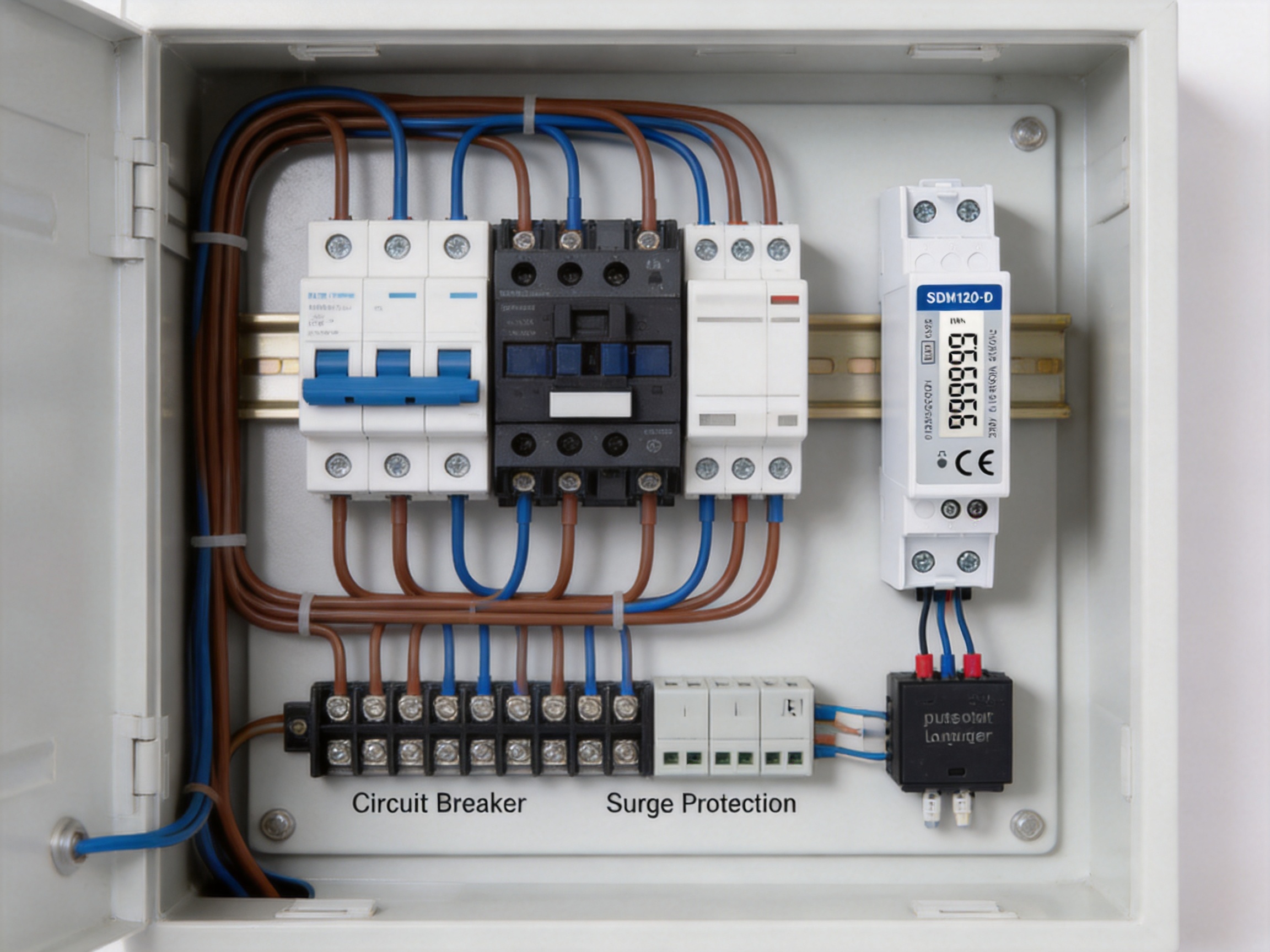
A dependable energy meter requires much more than a good specification sheet. It requires disciplined manufacturing, qualified engineering teams, reliable supply chains, accurate calibration, and systematic quality management. Eastron Electronic Co., Ltd., headquartered in Jiaxing, China near Shanghai, Hangzhou, and Jiangsu, is a high-tech manufacturer and supplier of electricity products and energy measurement solutions. The company develops and produces electricity meters, power analyzers, current sensors, communication modules, and management systems.
The company’s broad product range is an advantage because energy measurement is increasingly interconnected. A manufacturer that understands only one simple meter may be limited when customers require system-level integration. In contrast, experience across meters, analyzers, sensors, gateways, and management systems helps the company design products that fit into real electrical monitoring environments.
Research and development is another strength. The company continues to invest in new technologies and new products for electricity metering. Development teams in China and the United Kingdom contribute to innovation, product improvement, and adaptation to different market requirements. Cooperation with universities and institutions supports the introduction of advanced technologies into products.
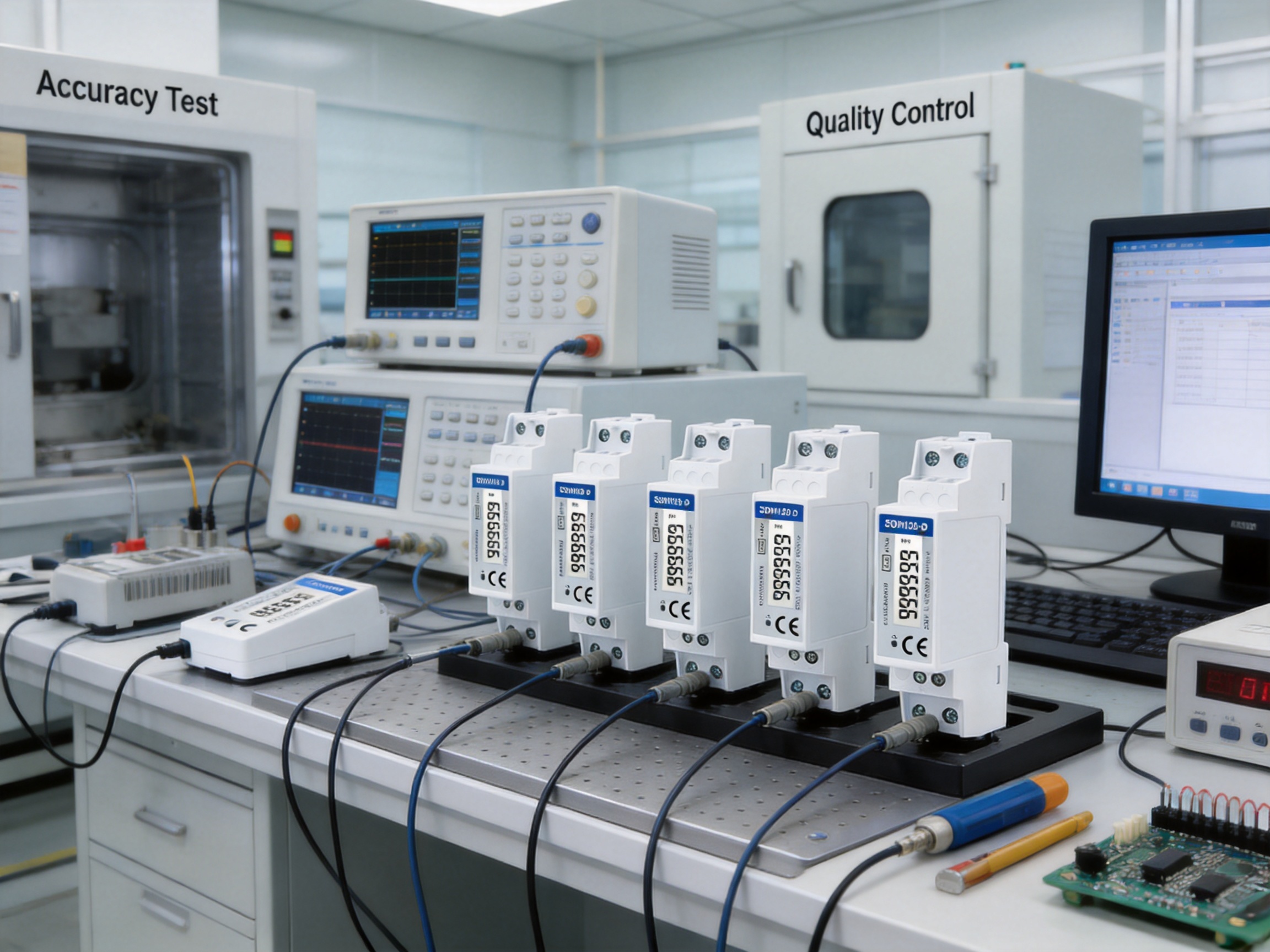
The company has also established its own professional laboratory capable of EMC, LVD, accuracy, and environmental tests according to IEC, EN, GB, and UL standards. This is highly relevant to meter reliability. Electrical meters are installed in environments where they may face voltage variation, electromagnetic interference, temperature changes, humidity, mechanical stress, and long operating hours. Laboratory testing helps identify weaknesses before products reach customers.
Quality management is supported by ISO 9001 systems, while production is approved by SGS according to MID standards. The company also holds patented technologies in software, embedded software, and hardware and has been recognized as a High-tech Enterprise and High-tech R&D Centre of Electricity Application. These capabilities indicate a manufacturing culture that values engineering depth, process control, and long-term product development rather than short-term assembly alone.
In electricity metering, manufacturing precision directly affects product performance. The accuracy of a meter depends on stable electronic components, reliable circuit boards, correct assembly, calibrated measurement circuits, firmware consistency, and final verification. Advanced manufacturing processes must therefore cover the entire product lifecycle, from design validation to outgoing inspection.
A strong production process begins with component selection. Components used in metering circuits must support stable performance over temperature, voltage variation, and time. Resistors, sensors, measurement chips, capacitors, power supply components, terminals, displays, and protective elements must be selected according to electrical and environmental requirements. Poor component quality can cause drift, failure, or inaccurate measurement.
Printed circuit board assembly must be controlled carefully. Soldering quality, component placement, cleaning, inspection, and handling all influence reliability. For compact meters, internal space is limited, so layout and assembly consistency are especially important. A one-module meter must fit measurement electronics, display interface, power supply, terminals, output circuitry, and enclosure features into a narrow body without compromising safety clearance or heat performance.
Calibration is essential. Energy meters must be adjusted and verified against reference equipment to ensure measurement accuracy. A professional manufacturer uses controlled calibration procedures, traceable references, and systematic recording. This helps ensure that each meter leaving production performs within its specified accuracy class.
Environmental testing further strengthens confidence. Meters may be installed in distribution cabinets exposed to seasonal temperature changes, dust, humidity, and electrical noise. Tests related to environmental performance help confirm that the meter can maintain function under expected conditions. EMC testing verifies resistance to electromagnetic disturbances and control of emissions. LVD-related testing supports electrical safety. Accuracy testing confirms measurement performance under defined load conditions.
Process traceability is also important. If a field issue occurs, a manufacturer with strong quality systems can trace production batches, component sources, test results, and process records. This supports continuous improvement and faster technical support. For customers, such traceability reduces risk because problems can be investigated scientifically rather than guessed.
The meter’s design philosophy can be described as practical function with professional reliability. It is not intended to overwhelm users with unnecessary complexity. Instead, it focuses on the most important requirements for many single phase metering projects: active energy measurement, clear display, pulse output, compact size, direct current capacity, and recognized accuracy performance.
This focus is a strength. In many projects, a highly complex meter is not better if its extra functions are unused. Complexity can increase cost, configuration time, training requirements, and troubleshooting difficulty. A compact kWh meter with pulse output offers a leaner approach: it performs the required measurement and provides a simple signal for integration.
At the same time, simplicity does not mean low quality. The product benefits from the company’s experience in broader metering technologies, laboratory testing, and quality systems. This combination allows the meter to remain user-friendly while still being supported by professional engineering and manufacturing capabilities.
For installers, the result is a product that is easy to specify and deploy. For system integrators, the pulse output supports data acquisition. For end users, the LCD display supports transparency. For panel builders, the 18mm width simplifies enclosure design. For energy managers, the standards-based measurement supports trustworthy data.
Any energy meter should be installed by qualified personnel according to local electrical regulations, wiring diagrams, and safety requirements. The meter is designed for DIN rail mounting and single phase two wire systems. The installer should verify that the circuit voltage, current, wiring arrangement, and environmental conditions match the product ratings before installation.
Because the meter supports direct load measurement up to 45A, correct conductor sizing and terminal tightening are important. Loose connections can cause heating, voltage drop, measurement instability, or safety hazards. Installers should follow proper torque requirements where specified and ensure that conductors are securely seated.
The pulse output should be connected according to the monitoring device requirements. Cable routing should minimize interference, especially in panels with contactors, drives, or high-current switching devices. If pulse data is used for remote energy monitoring, the commissioning process should include a comparison between the meter display and the pulse counting system to confirm correct scaling.
For solar applications or other directional measurement needs, the user should select the appropriate version. If anti-reverse or uni-directional measurement is required, this should be specified before purchase and confirmed during commissioning. Incorrect selection may lead to energy accumulation behavior that does not match the intended monitoring purpose.
The long-term value of a kWh meter is measured not only by purchase price but also by reliability, data usefulness, installation cost, maintenance effort, and compatibility with future monitoring needs. A compact meter with LCD display and pulse output can deliver strong lifetime value because it is simple, durable, and adaptable.
The 18mm width can reduce enclosure costs or avoid panel replacement. The 45A direct connection can reduce accessory costs. The LCD display can reduce maintenance time by allowing immediate local verification. The pulse output can support future data collection without replacing the meter. Standards-based accuracy can improve confidence in reported energy data. Manufacturing quality can reduce failure risk.
For organizations with multiple sites, standardizing on a compact and reliable single phase meter can simplify inventory, training, installation practices, and maintenance procedures. Technicians become familiar with the wiring, display behavior, and pulse integration method. This consistency lowers operational complexity.
Energy data also creates long-term value by supporting better decisions. Even a basic kWh meter can reveal whether a circuit is consuming more energy than expected, whether a tenant’s usage has changed, whether a solar system is producing as planned, or whether equipment is operating outside normal patterns. Over time, this information can contribute to energy savings, fair cost allocation, and improved asset management.
Eastron Electronic Co., Ltd. supplies products and services to more than 50 countries across Europe, Asia-Pacific, America, the Middle East, and Africa. This international experience matters because metering requirements vary across regions. Different markets may emphasize IEC standards, EN requirements, MID-related expectations, UL considerations, local installation habits, communication preferences, or documentation needs. A company active in many markets is better positioned to understand diverse customer requirements.
The company’s mission is to create value for customers and grow together with partners. This is reflected not only in product design but also in technical support and after-sales service. For energy measurement projects, customers often need more than a meter. They may need advice on product selection, installation, pulse output integration, system architecture, certification expectations, and troubleshooting. Professional support can reduce project risk.
The company’s values of integrity, pragmatism, refinement, and innovation align well with metering product development. Integrity is essential because measurement devices must be trusted. Pragmatism is reflected in practical product features such as compact size and direct input. Refinement appears in accuracy, manufacturing control, and product consistency. Innovation is supported by R&D investment, patented technologies, and continuing development of new products.
As energy monitoring becomes more important worldwide, manufacturers must provide both device-level reliability and solution-level understanding. The company’s portfolio of meters, analyzers, current transformers, relays, switches, gateways, and systems makes it capable of supporting customers from simple sub-metering to more advanced energy management solutions.
Energy efficiency begins with measurement. Without reliable consumption data, it is difficult to identify waste, verify improvements, or allocate costs accurately. The compact single phase kWh meter supports energy efficiency by making circuit-level measurement easier and more affordable.
In a building, total energy consumption may be known from the utility meter, but that does not explain which circuits or equipment are responsible. Sub-metering can reveal consumption by department, tenant, system, or machine. Once energy use is visible, users can take targeted action, such as adjusting operating schedules, replacing inefficient equipment, detecting standby loads, or maintaining systems that consume more energy than expected.
The pulse output enables trend analysis. When pulses are collected over time, users can build daily, weekly, or monthly consumption profiles. These profiles can show whether energy use occurs during non-working hours, whether weekend loads are higher than expected, or whether a solar generation system is underperforming. The LCD display provides a local reference, while the pulse output supports historical data collection.
For small businesses, this type of monitoring can support cost control without requiring a complex energy management system. For larger organizations, compact pulse-output meters can be deployed across many sub-circuits as part of a layered monitoring strategy.
It is designed for single phase two wire AC systems, also described as 1P2W or 1P+N systems. It is suitable for many residential, commercial, light industrial, and equipment-level single phase circuits.
The meter measures active energy, displayed as kWh. This makes it useful for consumption monitoring, sub-metering, energy allocation, equipment tracking, and solar generation measurement when the correct version is selected.
The one-module 18mm width saves DIN rail space. This is especially valuable in compact distribution boards, retrofit projects, solar boxes, and equipment enclosures where panel space is limited.
Yes. It supports direct load measurement up to a maximum current of 45A. This reduces the need for external current transformers in many single phase applications within the rated range.
The pulse output provides a signal corresponding to active energy consumption. External devices such as pulse counters, gateways, data loggers, controllers, or energy management systems can count the pulses and convert them into kWh data.
No. The built-in LCD display allows local reading. Remote monitoring is optional and can be achieved through the pulse output if the user connects it to a compatible device.
Its 18mm width allows easier installation in space-limited panels. Wider meters may require more DIN rail space, larger enclosures, or panel redesign. The compact size gives this meter an advantage in both new and retrofit projects.
Direct 45A metering is simpler for circuits within the meter’s rating. It reduces extra components, wiring, CT ratio configuration, and potential installation errors. CT-based metering remains useful for higher-current systems, but it is often unnecessary for smaller single phase circuits.
Yes, it can be used in solar generation energy measurement, especially when an appropriate uni-directional or anti-reverse measurement version is selected. The pulse output can also support solar monitoring systems.
The product information references IEC62053-21 Class 1/0.5 and EN50470-3:2022 Class B/C. These standards support confidence in the meter’s measurement performance.
Meter performance depends on design, components, calibration, testing, assembly quality, and long-term reliability. A manufacturer with professional laboratories, quality systems, R&D teams, and international experience can provide stronger assurance than a supplier focused only on low-cost assembly.
The manufacturer operates professional testing capabilities for EMC, LVD, accuracy, and environmental requirements according to IEC, EN, GB, and UL standards. It follows ISO 9001 quality management, has SGS-approved MID production, and holds patented technologies in software, embedded software, and hardware.
The LCD display DIN rail single phase electronic kWh meter with pulse output is a compact, practical, and reliable solution for active energy measurement in 1P2W systems. Its one-module 18mm width, 45A direct load capability, LCD display, pulse output, and standards-based accuracy references make it highly suitable for residential sub-metering, commercial monitoring, light industrial circuits, equipment energy tracking, and solar generation measurement.
Its advantages over typical competing products come from the combination of features rather than any single specification. It saves panel space, simplifies installation, supports direct reading, enables remote pulse-based monitoring, and reduces reliance on external current transformers for many circuits. These benefits can lower installation cost, improve system transparency, and support better energy management decisions.
The product is further strengthened by the manufacturing capabilities behind it. Eastron Electronic Co., Ltd. brings experience in electricity meters, power analyzers, sensors, communication modules, gateways, and energy management systems. Its R&D investment, professional laboratory testing, ISO 9001 quality management, SGS-approved MID production, patented technologies, and international service experience provide confidence that the meter is supported by a mature engineering and production foundation.
For installers, panel builders, energy managers, property owners, renewable energy integrators, and equipment manufacturers, this meter offers a dependable way to make energy visible. In a world where efficient energy use and transparent measurement are increasingly important, a compact and accurate kWh meter with pulse output is not a minor component; it is a practical foundation for smarter electrical management.
International Electrotechnical Commission. IEC 62053-21: Electricity Metering Equipment, Particular Requirements for Static Meters for Active Energy.
European Committee for Electrotechnical Standardization. EN 50470-3:2022: Electricity Metering Equipment, Particular Requirements for Static Meters for Active Energy.
International Organization for Standardization. ISO 9001 Quality Management Systems, Requirements.
International Electrotechnical Commission. IEC Standards for Electromagnetic Compatibility Testing and Electrical Safety Evaluation.
General technical documentation on DIN rail mounted electrical measurement devices and pulse-output energy metering applications.
Your email address will not be published. Required fields are marked *

We develop and produce high performance electricity meters, power analyzers, current sensors, communication modules and management systems. China Custom Smart Meters Manufacturers and Factory
Address:NO 52, Dongjin Road, Nanhu, Jiaxing, Zhejiang, China
Copyright @ Eastron Electronic Co., Ltd. All rights reserved Electricity Meters Manufacturers
