

 English
 Español
 Deutsch
 中文简体
中文简体

Product Consultation
Your email address will not be published. Required fields are marked *
Europe's Solar and Energy Storage Transition: Transforming the Power System Infrastructure for a Renewable Future
Jul 10,2026
Power Systems Are Becoming “Real-Time Systems”: Why Data Is More Critical Than Electricity
Jul 06,2026
New EPBD Regulations Drive HVAC Energy Transparency and Boost Demand for Smart Meters
Jul 07,2026Content
Modern electrical measurement is increasingly shaped by the need to monitor higher currents, more compact distribution systems, fast load variations, and energy behavior that cannot always be captured conveniently with conventional current transformers. The 5A output single phase integrator for Rogowski coil measurement, model ESCT-A05, is designed for precisely this environment. It converts the signal from a flexible Rogowski coil into a standard 5A AC rms output, allowing engineers, panel builders, energy managers, and testing specialists to integrate Rogowski coil measurement into systems that expect a conventional current transformer secondary signal.
The product is especially valuable where high-current conductors, busbars, difficult installation spaces, or retrofit projects make traditional solid-core current transformers inconvenient. A Rogowski coil can be opened, wrapped around a conductor, and installed in spaces where rigid magnetic-core devices may be too bulky or impractical. The ESCT-A05 integrator completes this measurement chain by delivering a usable, high-current secondary output suitable for secondary CT measurement, high-power load analysis, impulsive current monitoring, and DC ripple-related applications.
5A Output Single Phase Integrator for Rogowski Coil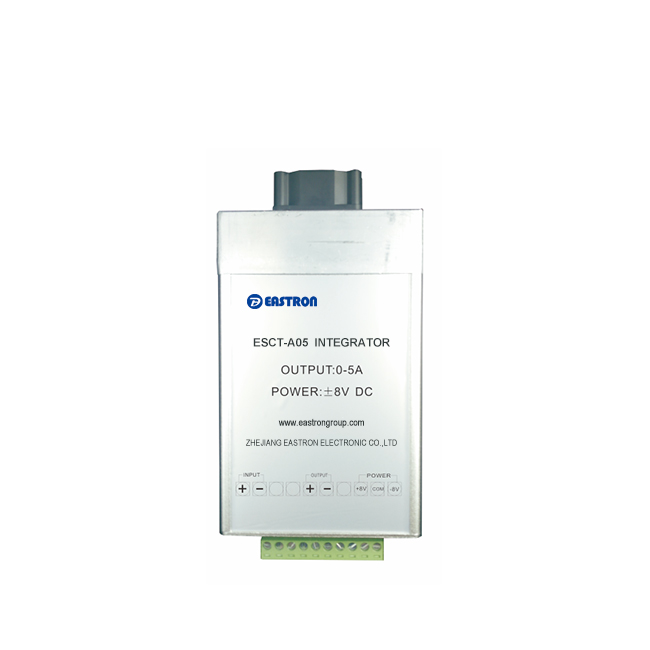
The ESCT-A05 is a 5A output single phase integrator for Rogowski coil systems. It is built in a shielded aluminium alloy enclosure and powered through two switch-mode power supply modules. Its purpose is to make the flexible Rogowski coil behave, from the receiving instrument’s perspective, more like a traditional current transformer output system. The integrator accepts the Rogowski coil signal and produces a 5A AC rms output, providing a bridge between flexible sensing and established metering or monitoring architecture.
Unlike a standalone Rogowski coil, which normally produces a voltage proportional to the rate of change of current, this integrator performs the necessary signal integration and conditioning. That makes the system much easier to apply in power analysis, distribution monitoring, industrial current measurement, and other electrical measurement tasks. With a read accuracy of 0.5% typical, high linearity of ±0.2% of reading over a significant range, and a bandwidth from 30 Hz to 5 kHz, the integrator is suitable for demanding current monitoring environments where both installation flexibility and measurement credibility are important.
The unit supports rated input ranges including 100 A, 600 A, 1000 A, 3000 A, and 6000 A when used with compatible Rogowski coils. This range makes the system adaptable for multiple current levels, from substantial industrial feeders to very high-current installations. It can be combined with different models and sizes of ESCT-RC Rogowski coils, allowing system designers to choose the coil size that best suits the installation space and conductor geometry.
The product’s most important advantage is that it combines the mechanical flexibility of a Rogowski coil with a familiar 5A rms output. Many meters, analyzers, relays, and monitoring systems are already designed around 5A current transformer inputs. By producing a 5A AC rms output, the integrator helps reduce the need to redesign measurement architectures when switching from conventional current transformers to Rogowski coil sensing.
Its high read accuracy of 0.5% typical supports reliable measurement performance across a wide operating range. The specified accuracy applies from 1% of rated current, with a minimum of at least 10 A, up to 100% of rated current at 25°C. This is especially useful in industrial and energy monitoring applications where the current may vary widely over time.
The integrator’s high linearity of ±0.2% of reading from 10% to 100% of range gives it a strong advantage in applications requiring stable proportional measurement. In practical terms, the output remains consistent with the input over a wide current range, helping users obtain dependable readings during load variation.
A bandwidth of 30 Hz to 5 kHz makes the product suitable not only for fundamental power frequency measurement but also for applications where transient behavior, harmonics, or rapidly changing current conditions are relevant. In many modern electrical installations, loads are no longer purely sinusoidal. Variable-frequency drives, inverters, power electronics, and switching supplies can introduce complex current waveforms. A wider bandwidth helps preserve more waveform information for analysis.
The unit’s maximum burden of 0.8 Ω and rated 5A output make it a practical interface for measurement chains requiring a robust secondary current signal. Its phase error of ≤0.5° supports applications where phase relationship is important, including power measurement and power quality assessment.
Item |
Specification |
Model |
ESCT-A05 |
Product Type |
5A output single phase integrator for Rogowski coil |
Rated Output |
5A AC rms |
Maximum Output |
5A AC rms |
Power Consumption |
80 W |
Bandwidth |
30 Hz to 5 kHz, -3 dB |
Maximum Burden |
0.8 Ω |
Measurement Method |
Secondary CTs to measure output of integrator |
Power Supply |
85–265 V AC/DC, powered from two 85–265 V to 8 VDC 40 W SMPS modules |
Rated Input Options |
100 A, 600 A, 1000 A, 3000 A, 6000 A |
Read Accuracy |
0.5% typical at 1%, minimum 10 A, to 100% of rated current at 25°C |
Phase Error |
≤0.5° |
Linearity |
±0.2% of reading from 10% to 100% of range |
Zero Drift |
≤0.05 A output at 0 A |
Temperature Drift |
200 ppm/°C |
Weight |
850 g |
Dimensions |
125 mm × 80 mm × 37 mm |
Operating Temperature |
-20°C to 70°C |
Storage Temperature |
-30°C to 90°C |
Relative Humidity |
80% maximum, without condensation |
Protection Degree |
IP20 |
A Rogowski coil is a highly useful current sensing device because it is flexible, lightweight, and capable of measuring large currents without the magnetic saturation issues associated with iron-core current transformers. However, the signal generated by a Rogowski coil must be integrated before it can represent the measured current accurately. This is where the ESCT-A05 becomes essential.
In traditional magnetic-core current transformers, the output is usually a secondary current proportional to the primary current. The receiving meter or analyzer is often designed to accept a 1A or 5A secondary signal. A Rogowski coil, by contrast, produces an output proportional to the derivative of current. Without an integrator, the raw coil signal is not directly equivalent to the primary current waveform. The integrator processes this signal and provides a conditioned output that can be used in practical measurement systems.
The advantage of the ESCT-A05 is not merely that it integrates the signal. It does so while providing a strong 5A rms output. This distinguishes it from low-level voltage-output integrators that may require specialized input channels. The ESCT-A05 enables users to connect flexible Rogowski coil measurement into systems where a conventional secondary current interface is expected.
One of the strongest competitive advantages of a Rogowski coil and integrator system is installation flexibility. Traditional current transformers can be difficult to install around existing busbars or cables, particularly if power cannot easily be disconnected. Split-core CTs address part of this challenge, but they are still rigid, bulky, and constrained by window dimensions. Flexible Rogowski coils can be installed around irregular conductor arrangements more easily.
The ESCT-A05 enhances this advantage by allowing the flexible sensing system to deliver a standardized 5A output. Instead of forcing the user to choose between installation convenience and compatibility with established measuring equipment, the product supports both. This makes it suitable for retrofitting existing power monitoring systems, upgrading high-current distribution cabinets, or adding measurement points to operational facilities.
Another advantage is performance under high-current conditions. Traditional CTs can become large, heavy, and expensive when designed for very high current ratings. They may also face magnetic saturation under overload or transient conditions. Rogowski coils do not contain a ferromagnetic core, which means they are naturally resistant to core saturation. When paired with an appropriate integrator, they can provide a practical solution for measuring currents up to thousands of amperes.
The product also offers measurement versatility. Its bandwidth from 30 Hz to 5 kHz allows it to capture more than basic power-frequency current. This is important for applications involving impulsive currents, harmonics, switching behavior, and load analysis. Many conventional CTs are optimized for standard frequency applications and may not perform as consistently at higher frequencies.
For panel manufacturers and system integrators, mechanical simplicity is an important advantage. A flexible coil can reduce installation time, simplify inventory, and make it easier to adapt to different conductor sizes. When combined with an integrator capable of providing a 5A rms output, the complete solution becomes easier to standardize across projects.
Many Rogowski coil integrators are designed to provide low-voltage outputs such as mV, V, or low-current signals. These may be appropriate for oscilloscopes, specialized power analyzers, or custom data acquisition systems, but they can be less convenient in electrical distribution environments where existing devices expect a 5A CT secondary signal. The ESCT-A05 is different because it is specifically designed to output 5A AC rms.
This output level makes the integrator well suited to applications where the user wants Rogowski coil flexibility without abandoning conventional current input structures. In practical installations, the cost of changing receiving instruments, wiring practices, documentation, and commissioning methods can be significant. A 5A output integrator can help reduce such transition costs.
The product’s accuracy and linearity specifications also support its competitive position. A 0.5% typical read accuracy and ±0.2% linearity help provide confidence for load analysis and monitoring applications. In addition, the phase error of ≤0.5° supports more accurate power-related calculations when the output is used in measurement chains concerned with current-voltage phase relationships.
Another important competitive point is the robust enclosure. The shielded aluminium alloy housing contributes to physical durability and electromagnetic shielding. In industrial electrical rooms, signal integrity can be challenged by electromagnetic noise, high-current busbars, switching equipment, and nearby power electronics. A shielded metal enclosure is a practical design choice for protecting sensitive signal processing circuits.
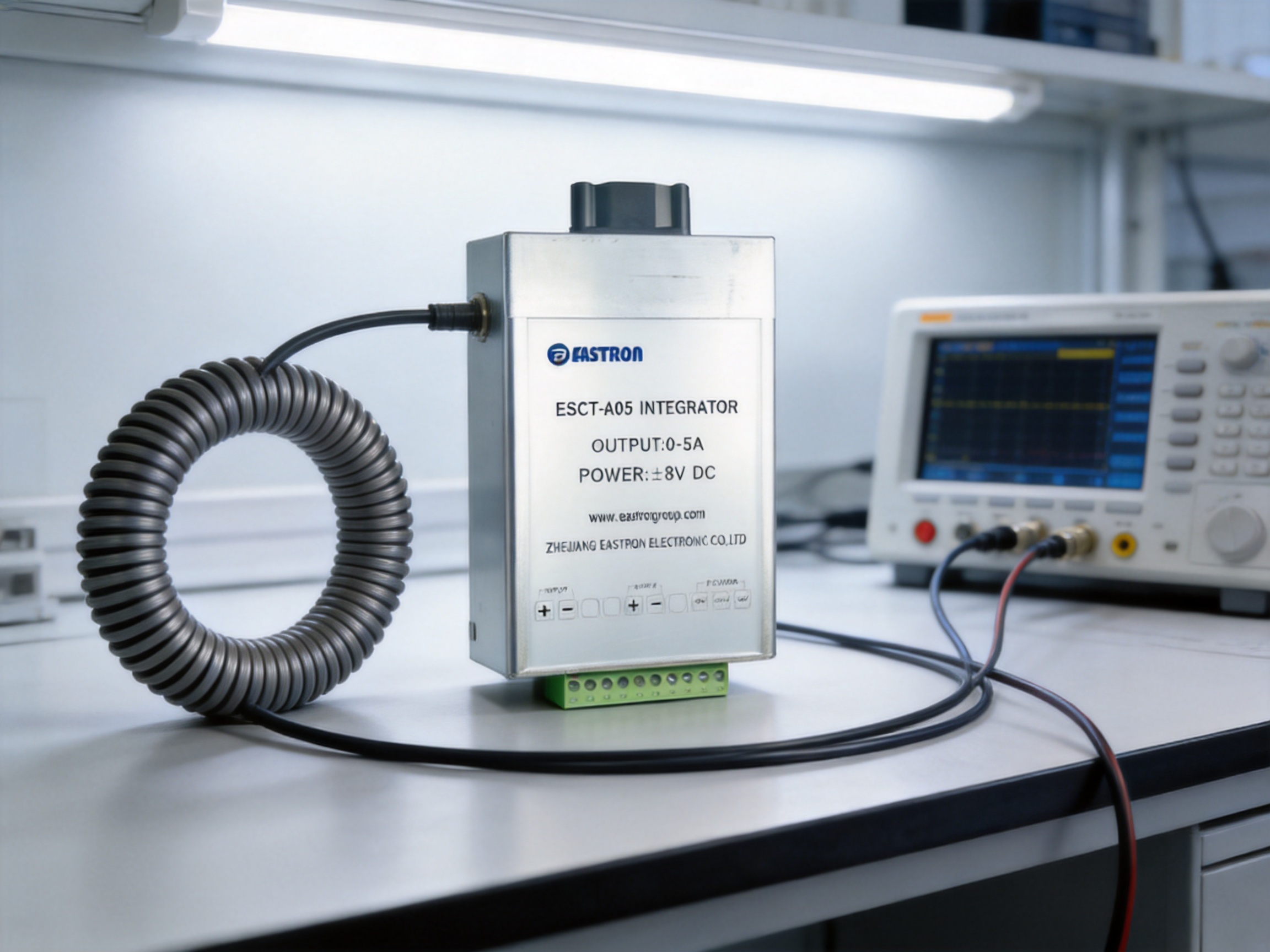
High power load analysis often requires measurement equipment that can be installed safely and conveniently while maintaining dependable signal quality. Large loads may include industrial machinery, transformers, motor control centers, large HVAC systems, charging infrastructure, and power distribution feeders. These applications can involve currents from hundreds to thousands of amperes.
The ESCT-A05 supports such environments through its compatibility with Rogowski coil input ranges up to 6000 A. The flexible coil can be placed around a conductor or busbar, while the integrator provides the conditioned 5A output. This combination is particularly useful when the conductor geometry is not suitable for a standard current transformer, or when retrofitting measurement to an existing installation.
Load analysis requires more than simply detecting current. It often involves understanding current magnitude, waveform shape, variation over time, and the relationship between current and voltage. The integrator’s bandwidth and phase performance help support this type of analysis. Its 30 Hz to 5 kHz bandwidth allows users to observe behavior beyond the fundamental frequency, while the phase error specification contributes to more meaningful power evaluation.
Impulsive current events can occur during switching operations, inrush events, capacitor bank energization, motor starts, power electronic transitions, or fault-related conditions. Measuring such events with traditional current transformers can be challenging, especially if the CT saturates or fails to capture waveform dynamics accurately. Rogowski coils are often valued in these cases because of their wide dynamic capability and lack of magnetic core saturation.
The ESCT-A05 makes Rogowski coil sensing more accessible for impulsive current monitoring by providing a processed output with useful bandwidth. While the device is not a replacement for every high-speed transient recorder, its specified bandwidth up to 5 kHz provides a practical range for many industrial monitoring and diagnostic tasks. The result is a measurement approach that is flexible, installation-friendly, and compatible with systems designed around current input signals.
Because the integrator has a specified zero drift of ≤0.05 A at 0 A, it also supports stable monitoring when no current is present or when the monitored current returns to low levels after an event. Stable zero behavior is important for avoiding false interpretation of background signal levels.
The product information notes suitability for DC ripple measurement. In many applications, the key measurement concern is not pure DC current but the alternating ripple component superimposed on a DC system. Examples can include rectifier outputs, battery systems, DC busbars in power electronics, and charging or conversion systems. Rogowski coils are fundamentally suited to changing current rather than steady DC, so their usefulness in DC systems is generally related to ripple, pulsation, or transient components.
When paired with the ESCT-A05, the Rogowski coil system can help observe AC components within a DC environment. The bandwidth range and 5A output can support analysis of ripple-related behavior where compatible secondary measurement arrangements are used. This can be valuable for diagnosing converter performance, checking power quality in DC-linked systems, or identifying abnormal ripple patterns that may indicate equipment issues.
Accuracy is central to the value of any measurement device. The ESCT-A05 provides 0.5% typical read accuracy from 1% of rated current, with a minimum current condition of at least 10 A, through 100% of rated current at 25°C. This specification helps users understand the practical operating zone in which the device is designed to provide reliable readings.
Linearity is equally important. A measuring system may be accurate at one point but less consistent across the range. The product’s ±0.2% of reading linearity from 10% to 100% of range supports confidence when measuring variable loads. For facilities with changing consumption patterns, motor cycling, load switching, or process-dependent current changes, this linearity contributes to more trustworthy trend analysis.
Phase error matters whenever the current signal is used alongside a voltage signal to calculate power, power factor, or energy-related values. The ESCT-A05 specifies phase error of ≤0.5°, making it suitable for applications where phase relationship should not be ignored. Lower phase error supports improved interpretation in power analyzers and energy monitoring systems.
Temperature drift is specified at 200 ppm/°C. In practical industrial environments, equipment may be exposed to changing ambient temperatures. A defined temperature drift specification helps engineers account for environmental influence when designing measurement systems and interpreting data.
Electrical loads have changed significantly in recent decades. Traditional resistive and inductive loads are now joined by variable-speed drives, inverter-based equipment, LED power supplies, server power supplies, solar inverters, battery systems, and other power electronic devices. These loads can draw non-sinusoidal current, generate harmonics, and create fast current changes.
A bandwidth of 30 Hz to 5 kHz helps the ESCT-A05 support more informative current measurement in such environments. The lower end covers standard power frequencies, while the upper end allows the measurement chain to capture a wider range of waveform components. This is useful for load profiling, troubleshooting, and identifying abnormal current behavior.
Compared with devices that are limited to narrow power-frequency measurement, the broader bandwidth gives engineers more diagnostic value. It can help reveal whether a load is behaving as expected, whether harmonic content is significant, or whether switching behavior is present. Although complete power quality analysis may require specialized instruments, the integrator provides a more capable current signal foundation than narrow-band alternatives.
The ESCT-A05 is housed in a shielded aluminium alloy enclosure. This is an important design feature because current measurement systems are often placed in electrically noisy environments. High-current conductors, switching devices, relays, contactors, drives, and power converters can generate electromagnetic interference. A shielded metal enclosure helps protect internal electronics and supports reliable signal processing.
The compact dimensions of 125 mm × 80 mm × 37 mm make the unit practical for installation in panels and measurement cabinets. At 850 g, it is substantial enough to reflect a robust build while remaining manageable for mounting. The IP20 protection degree indicates suitability for protected indoor electrical environments, such as control panels or cabinets where direct exposure to water, dust intrusion, or outdoor weather is not expected.
The operating temperature range of -20°C to 70°C supports use in many industrial and building electrical environments. Storage temperature from -30°C to 90°C provides additional resilience during transport, warehousing, and non-operating conditions. The relative humidity limit of 80% maximum without condensation should be observed to preserve reliability and safety.
The unit is powered from 85–265 V AC/DC, using two 85–265 V to 8 VDC 40 W switch-mode power supply modules. This wide supply input range is advantageous because it allows the product to be used in different electrical environments without requiring a highly specialized auxiliary supply. The ability to accept both AC and DC supply within the specified range increases installation flexibility.
Using switch-mode power supply modules supports efficient power conversion in a compact form factor. The product’s total power consumption is specified at 80 W. For system designers, this is a clear and practical figure for panel power budgeting, thermal planning, and auxiliary circuit design.
The use of two power supply modules also reflects the product’s need to deliver a strong 5A output. Compared with low-level signal integrators, a 5A output device requires a more capable power design. This is one reason the ESCT-A05 is particularly useful for applications that require a current output rather than only a voltage signal.
The specification notes that secondary CTs are used to measure the output of the integrator. This approach allows the 5A output to be incorporated into existing measurement systems that rely on current transformer principles. In installations where meters, analyzers, or protection-related devices are already standardized around CT input architectures, this is a practical advantage.
By placing the integrator between the Rogowski coil and the secondary measurement path, users can gain the benefits of flexible primary sensing while maintaining a familiar secondary measurement structure. This reduces the learning curve for technicians and helps align with established engineering practices.
For retrofit work, the benefit can be especially significant. Instead of replacing a wide range of downstream devices, the ESCT-A05 can allow the measurement front end to be upgraded to a Rogowski coil while preserving compatibility with 5A secondary current measurement expectations.
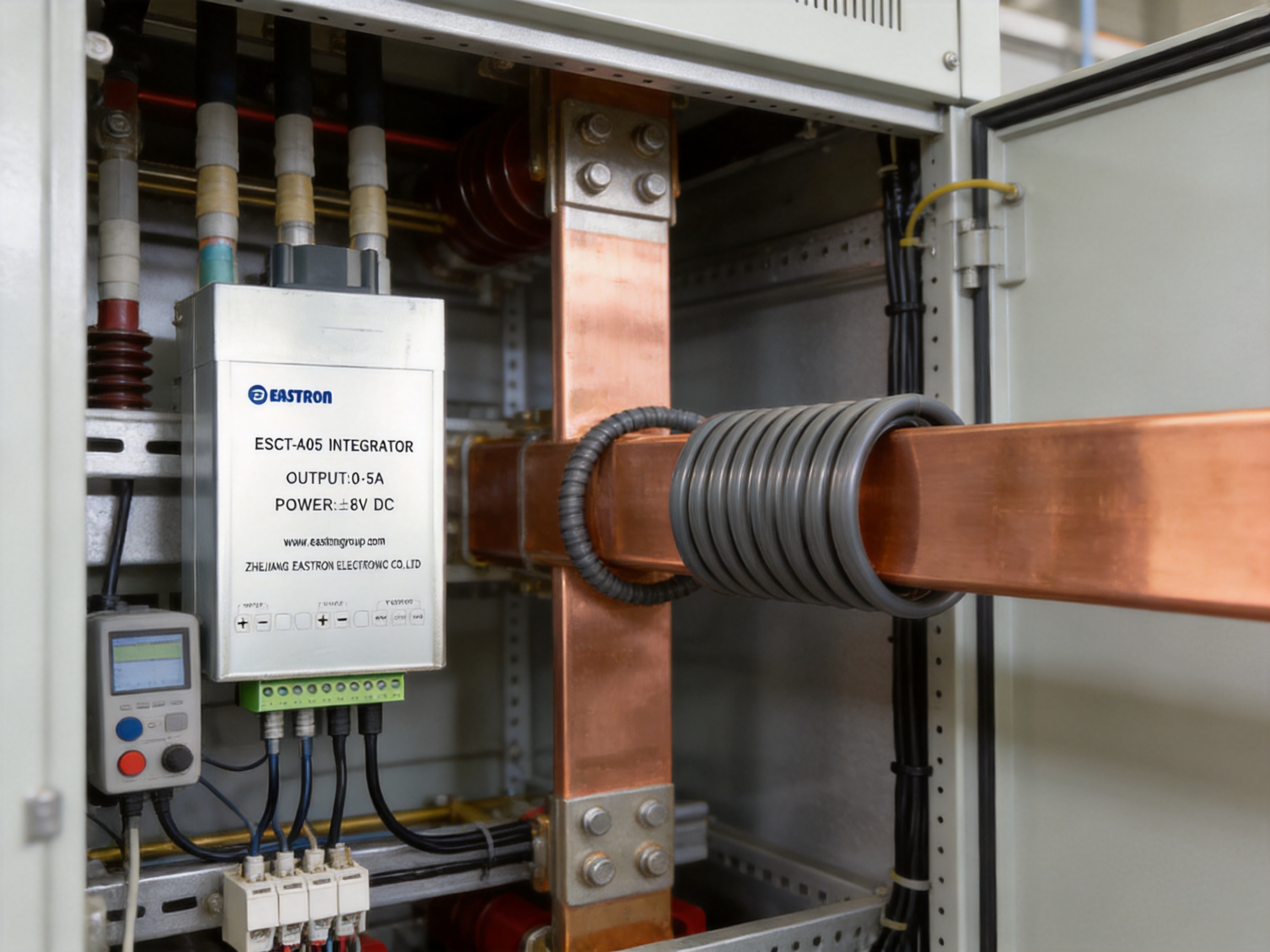
The value of an electrical measurement product depends not only on its design but also on the manufacturing strength behind it. Eastron Electronic Co., Ltd. is a high-tech manufacturer and supplier focused on electricity products and energy measurement solutions. Its product range includes electricity meters, smart meters, power analyzers, current sensors, communication modules, gateways, relays, switches, and management systems. This broad technical foundation supports the development of specialized products such as the ESCT-A05 integrator.
The company is headquartered in Jiaxing, China, near Shanghai, Hangzhou, and Jiangsu. This location places it within one of China’s most active industrial and technology regions, supporting access to supply chains, technical talent, logistics, and manufacturing infrastructure. For customers, this can translate into better production coordination, stable supply capacity, and efficient service response.
A major strength is the company’s continued investment in research and development. Development teams in China and the United Kingdom contribute to new technology and product innovation. Cooperation with universities and institutions further supports technical progress. For a product such as the ESCT-A05, this R&D background matters because current measurement requires deep understanding of electronics, electromagnetic behavior, signal conditioning, accuracy control, safety, and application engineering.
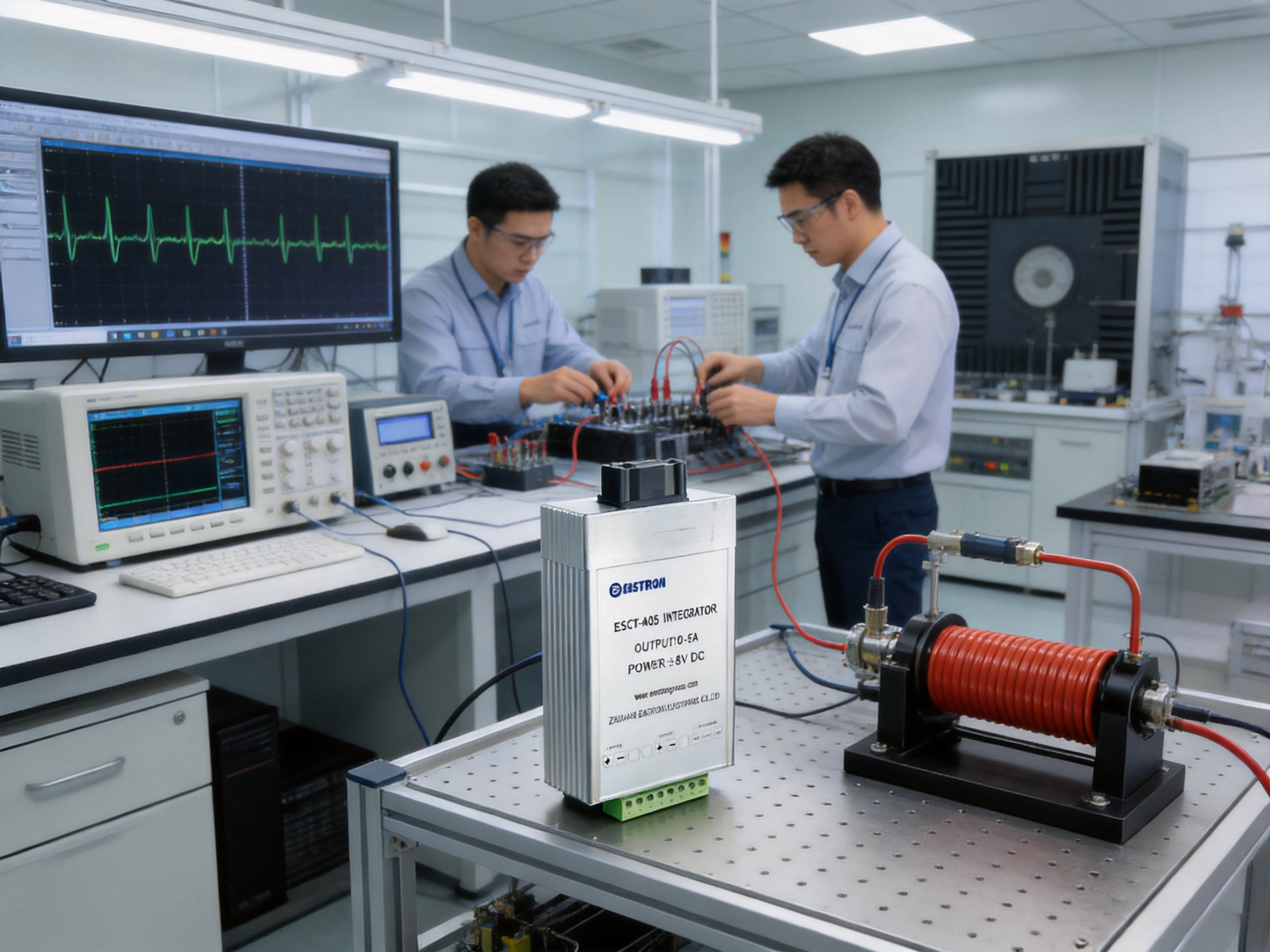
The company has established a professional laboratory capable of EMC, LVD, accuracy, and environmental testing according to IEC, EN, GB, and UL standards. This is a significant manufacturing and quality advantage. Measurement products must perform reliably in the real world, where electrical noise, temperature variation, humidity, and operating stress can affect performance. In-house testing capability allows design verification, process monitoring, and continuous product improvement.
The company follows the ISO 9001 quality management system, and its production has been approved by SGS according to MID standards. While the ESCT-A05 itself should be evaluated according to its own specification and intended use, the manufacturer’s broader quality system provides confidence that products are developed and produced within structured quality processes.
Producing a precision current measurement device requires more than assembling components. It requires controlled design, stable sourcing, accurate calibration, electrical verification, environmental consideration, and repeatable manufacturing processes. The ESCT-A05 benefits from a manufacturer with experience across energy metering, current sensing, power analysis, and communication-based monitoring systems.
Accuracy testing is especially important. A product specified at 0.5% typical read accuracy and ±0.2% linearity must be verified against controlled input conditions. The manufacturer’s professional laboratory capability helps ensure that measurement performance can be checked according to appropriate technical methods. This supports consistent production quality and helps reduce variation between units.
EMC testing capability is also important because the integrator may be installed in cabinets containing high currents and switching devices. Electromagnetic compatibility design and verification help improve reliability in practical environments. A shielded aluminium alloy enclosure is one visible part of this strategy, while internal circuit design, grounding considerations, power supply design, and layout control are also essential.
Environmental testing supports confidence over the operating temperature range of -20°C to 70°C. Temperature can affect electronic components, analog signal conditioning, power supplies, and measurement stability. By testing environmental performance, the manufacturer can better identify design weaknesses and validate product robustness.
LVD-related testing capability reflects attention to electrical safety and low-voltage requirements. For equipment powered from 85–265 V AC/DC, power input design, insulation, creepage and clearance, protection, and safe operation are all important engineering concerns. A manufacturer with testing infrastructure is better positioned to design and verify products for safe use.
The ESCT-A05 is suitable for a wide variety of electrical measurement scenarios. In high-current distribution panels, it can help measure feeders where conventional CT installation is difficult. In industrial facilities, it can support load analysis for large machines, furnaces, motors, production lines, or power conversion equipment. In testing laboratories, it can be used as part of a measurement setup for studying current behavior in high-power systems.
In building energy management, retrofitting current measurement onto existing cables can be challenging when panel space is limited. A flexible Rogowski coil combined with the ESCT-A05 integrator can simplify the installation and provide compatibility with 5A secondary measurement architecture. This is useful for energy audits, submetering upgrades, and monitoring of major electrical branches.
In renewable energy and power electronics applications, current waveforms may contain ripple or higher-frequency components. The product’s bandwidth and compatibility with different current ranges can support monitoring where waveform insight is needed. Examples include inverter output analysis, DC bus ripple investigation, and load current diagnostics.
For temporary measurement campaigns, flexible installation is highly valuable. Engineers may need to measure current for a limited period without permanently modifying switchgear or disconnecting major conductors. A Rogowski coil can be positioned more conveniently than many traditional CTs, and the ESCT-A05 provides the required signal conditioning.
Compared with fixed solid-core current transformers, the ESCT-A05 and Rogowski coil combination offers easier installation around existing conductors, better adaptability to large or irregular busbars, and reduced risk of magnetic core saturation. Solid-core CTs can provide excellent accuracy in appropriate applications, but they usually require conductor disconnection or installation during panel construction. For retrofit work, this can be a major limitation.
Compared with split-core CTs, the Rogowski coil solution is often more flexible in tight spaces. Split-core CTs are easier to install than solid-core CTs, but they remain mechanically rigid and are limited by their window dimensions. Rogowski coils can be selected in different sizes and routed around conductors more conveniently.
Compared with low-output Rogowski coil integrators, the ESCT-A05 offers the special advantage of a 5A AC rms output. This makes it more suitable for integration with measurement systems designed around standard CT secondary current. It reduces the need for specialized voltage input channels or custom scaling arrangements.
Compared with current probes used mainly for oscilloscopes, the ESCT-A05 is better aligned with electrical distribution and power monitoring environments. Oscilloscope probes are useful for waveform diagnostics, but they may not provide the standardized output or installation style required for panel-based monitoring systems. The ESCT-A05 is designed as a robust integrator for practical current measurement installations.
When applying the ESCT-A05, users should select a compatible Rogowski coil size and rated input range appropriate for the conductor and expected current. Correct coil placement is important for measurement accuracy. The coil should be installed around the intended conductor, and care should be taken to avoid enclosing unintended return conductors unless the purpose is to measure net current.
The output burden should not exceed the specified maximum of 0.8 Ω. Burden management is important because excessive burden can affect output performance. Wiring length, input impedance of connected devices, and secondary measurement arrangement should be considered during system design.
The power supply must be within the specified 85–265 V AC/DC range. Since power consumption is 80 W, the auxiliary supply and protective devices should be selected accordingly. Installation should be performed by qualified personnel following applicable electrical safety practices.
The unit has an IP20 protection degree and should be installed in a suitable enclosure or protected environment. It is not intended for direct outdoor exposure or wet locations unless additional protection is provided by the installation design. Humidity must remain non-condensing and within the specified limit.
Temperature conditions should also be considered. Although the operating range is wide, placing the unit near heat-generating equipment may affect long-term reliability. Proper panel ventilation and spacing can improve performance stability.
System integrators often need products that combine technical performance with installation efficiency. The ESCT-A05 supports this need by translating Rogowski coil flexibility into a standard 5A output. This allows integrators to design measurement systems that are easier to install, easier to adapt, and easier to interface with existing measurement hardware.
For repeat projects, the ability to pair the integrator with different Rogowski coil sizes is especially useful. Instead of redesigning the measurement method for every conductor size, the integrator can remain a consistent part of the system while the coil is selected according to the physical installation. This can simplify engineering documentation, procurement, and commissioning.
The manufacturer’s broad portfolio in meters, power analyzers, current transformers, relays, switches, gateways, and energy management solutions also supports system-level thinking. A company experienced in multiple parts of the energy measurement chain is better positioned to understand how an integrator must perform in real applications.
For end users, the product’s value lies in practical measurement confidence. Facilities increasingly need to understand how energy is used, where loads are changing, and how electrical systems behave under different operating conditions. The ESCT-A05 enables current monitoring in places where conventional CTs may be inconvenient.
By supporting high-current measurement with flexible installation, the product can help reduce downtime during measurement upgrades. In many facilities, shutting down power to install a solid-core CT is costly or unacceptable. A Rogowski coil system can often simplify such work, although safety procedures and qualified installation remain essential.
The 5A output also helps end users preserve investment in existing meters or monitoring devices. Rather than replacing entire measurement systems to accept low-level Rogowski coil signals, users can employ the ESCT-A05 to bridge the sensing technology to a familiar interface.
The ESCT-A05 is used as a 5A output single phase integrator for Rogowski coil current measurement. It converts the Rogowski coil signal into a 5A AC rms output for use in suitable measurement systems.
A Rogowski coil produces a signal related to the rate of change of current. An integrator processes that signal so it represents the measured current more directly. Without integration, the raw coil signal is not suitable for many standard current measurement applications.
Its key distinction is the 5A AC rms output. Many integrators provide low-level voltage outputs, while this model is designed to interface with systems that expect a conventional 5A current transformer-style signal.
When used with compatible Rogowski coils, the product supports rated input options including 100 A, 600 A, 1000 A, 3000 A, and 6000 A.
The read accuracy is 0.5% typical from 1% of rated current, with a minimum of at least 10 A, to 100% of rated current at 25°C. The linearity is ±0.2% of reading from 10% to 100% of range.
Yes. The product is suitable for high power load analysis and high-current monitoring when paired with the appropriate Rogowski coil. Its available input ranges extend up to 6000 A.
The product has a bandwidth of 30 Hz to 5 kHz, which supports measurement beyond basic power-frequency current. It can be useful for load analysis, impulsive current monitoring, and applications involving waveform components within its bandwidth.
The maximum burden is 0.8 Ω. System designers should ensure that the connected measurement arrangement and wiring remain within this limit.
The integrator is built in a shielded aluminium alloy enclosure, which supports mechanical robustness and helps protect the internal electronics in electrically noisy environments.
The product accepts 85–265 V AC/DC and is powered through two 85–265 V to 8 VDC 40 W switch-mode power supply modules. Power consumption is specified at 80 W.
The ESCT-A05 5A output single phase integrator for Rogowski coil measurement is a strong solution for users who need the installation flexibility of Rogowski coils and the practical compatibility of a standard 5A current output. It addresses a real challenge in modern electrical measurement: how to measure high currents in difficult spaces without abandoning familiar current transformer-based measurement architectures.
Its advantages include 0.5% typical read accuracy, ±0.2% linearity, ≤0.5° phase error, 30 Hz to 5 kHz bandwidth, a shielded aluminium alloy enclosure, and compatibility with multiple current ranges up to 6000 A. These features make it well suited for high power load analysis, impulsive current monitoring, and ripple-related measurement in changing current systems.
The product also benefits from the manufacturing strength of Eastron Electronic Co., Ltd., including experienced R&D teams, broad energy measurement expertise, professional laboratory capability, EMC and accuracy testing infrastructure, ISO 9001 quality management, and production experience in electricity meters, power analyzers, current sensors, gateways, and energy management systems.
For engineers, system integrators, panel builders, and facility managers, the ESCT-A05 offers a practical path toward flexible, high-current measurement. It combines advanced sensing adaptability with a familiar output format, making it a valuable component in modern energy measurement and electrical monitoring solutions.
1. Manufacturer product specification for ESCT-A05 5A output single phase integrator for Rogowski coil.
2. Manufacturer company profile and technical capability statement for energy measurement solutions.
3. IEC standards relating to electrical measurement equipment performance and environmental testing.
4. EN standards for low-voltage electrical equipment and electromagnetic compatibility evaluation.
5. General engineering literature on Rogowski coil current sensing and signal integration principles.
6. Power measurement application references for current transformer secondary signal systems and high-current monitoring.
Your email address will not be published. Required fields are marked *

We develop and produce high performance electricity meters, power analyzers, current sensors, communication modules and management systems. China Custom Smart Meters Manufacturers and Factory
Address:NO 52, Dongjin Road, Nanhu, Jiaxing, Zhejiang, China
Copyright @ Eastron Electronic Co., Ltd. All rights reserved Electricity Meters Manufacturers
