

 English
 Español
 Deutsch
 中文简体


Product Consultation
Your email address will not be published. Required fields are marked *
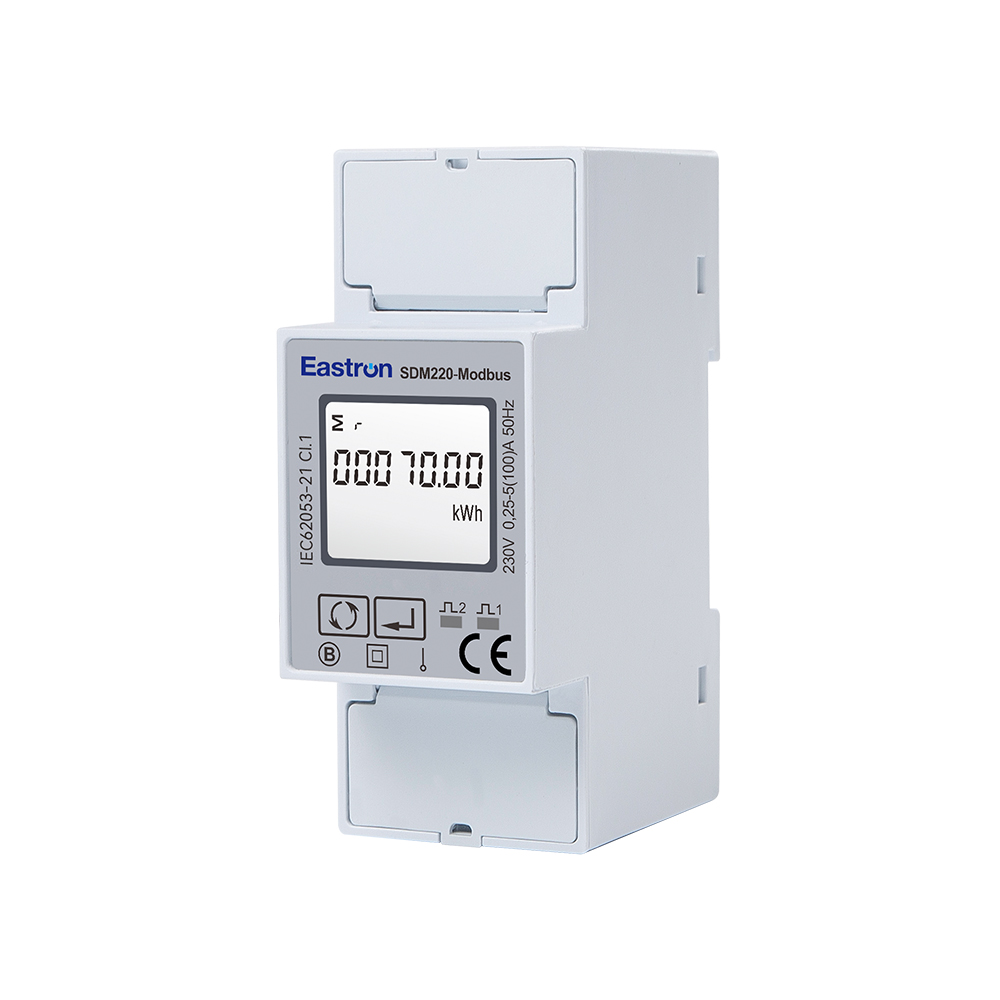
100A Single Phase Din Rail Multi-function Meter for EV Charging Metering
Aug 11,2022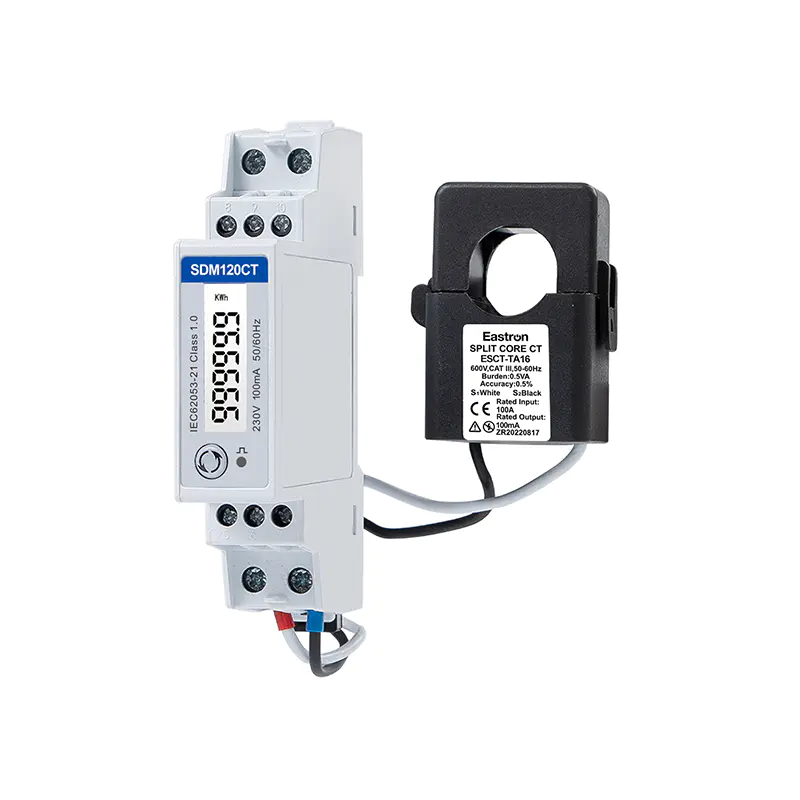
MID/RCM 100mA CT input Din Rail Single Phase Multi-function Solar PV /Zero Export Meter for PV Metering
Nov 24,2022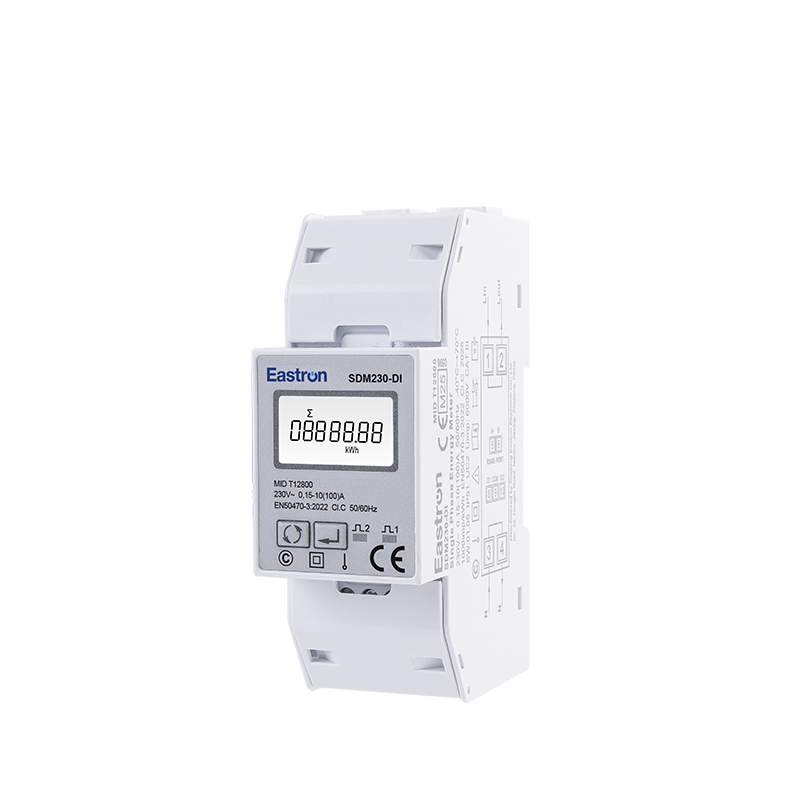
MID/ UL Approved Single Phase Din Rail Type Multi-function Energy Meter for EV Charging Metering
Nov 24,2022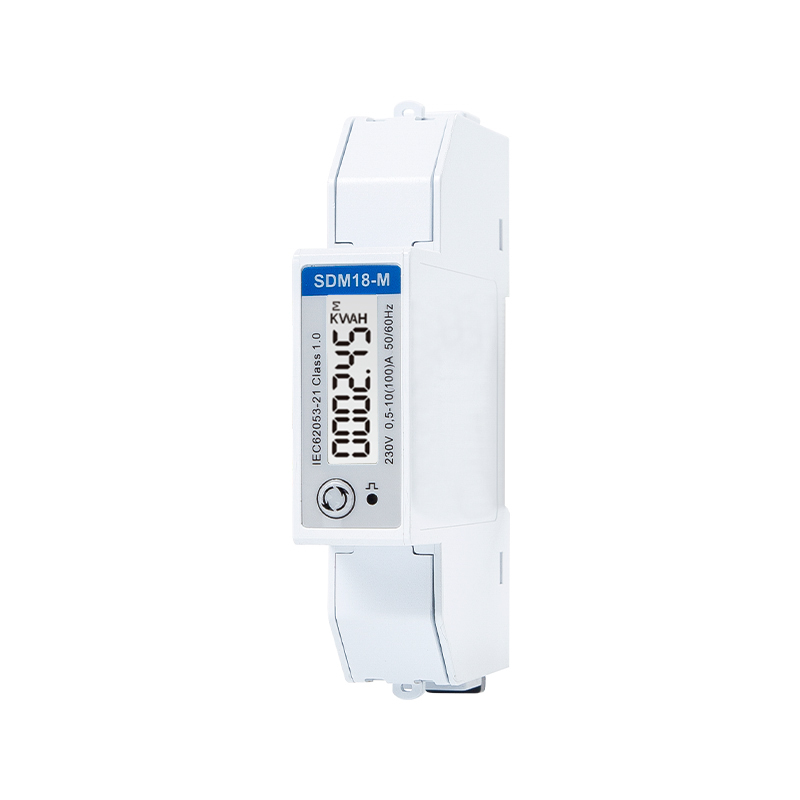
MID Approved Single Phase 100A Din Rail Type Multi-function EV meter for EV Charging Metering
Nov 24,2022
MID Approved Single Phase Energy Meter for EV Charging Metering
Nov 24,2022
Direct Type Three Phase Ethernet Modbus TCP Energy Meter for Data Center Metering
Nov 24,2022Content
Modern electrical installations require more than a simple kilowatt-hour reading. Property owners, facility managers, industrial operators, and energy service providers increasingly need accurate measurements of voltage, current, active power, reactive power, apparent power, power factor, frequency, demand, and bidirectional energy flow. They also need practical ways to collect this information remotely, integrate it with automated meter-reading platforms, and connect it to supervisory control and data acquisition systems.
The SDM230-Lora P2P is designed to address these requirements in a compact DIN-rail format. It is a single-phase, two-wire multifunction energy meter with direct-load measurement up to 100 A. Unlike many high-current meters that require external current transformers, this device can be connected directly to loads up to its specified maximum current. It combines local measurement and display functions with two pulse outputs, RS485 Modbus RTU access through the associated receiver module, and LoRa point-to-point wireless communication.
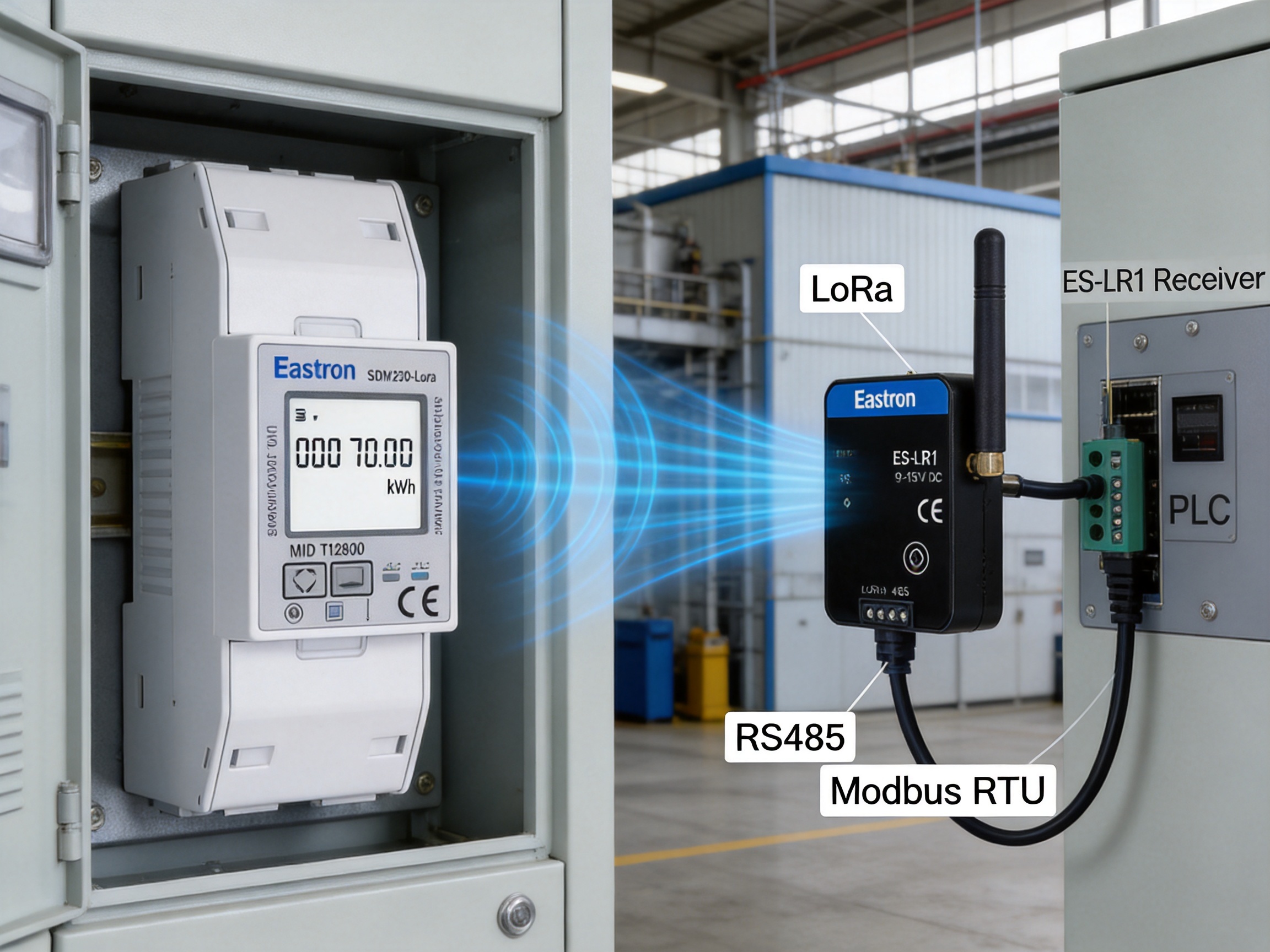
The system consists of two coordinated components: the SDM230-Lora meter and the ES-LR1 receiver module. The meter transmits data wirelessly through a private LoRa point-to-point connection, while the receiver provides an RS485 Modbus RTU interface for integration with a controller, data logger, building management system, or energy management platform. Because the communication arrangement is point-to-point, a gateway or network server is not required for the basic connection between the meter and receiver.
This architecture gives the product a useful position between conventional local energy meters and more complex networked smart-meter systems. It supports high-value electrical measurements, direct connection, remote data access, and flexible integration without requiring a complete wireless infrastructure. For residential complexes, commercial buildings, industrial facilities, distributed equipment, and Internet of Things energy projects, it offers a practical method of collecting reliable single-phase electrical data.
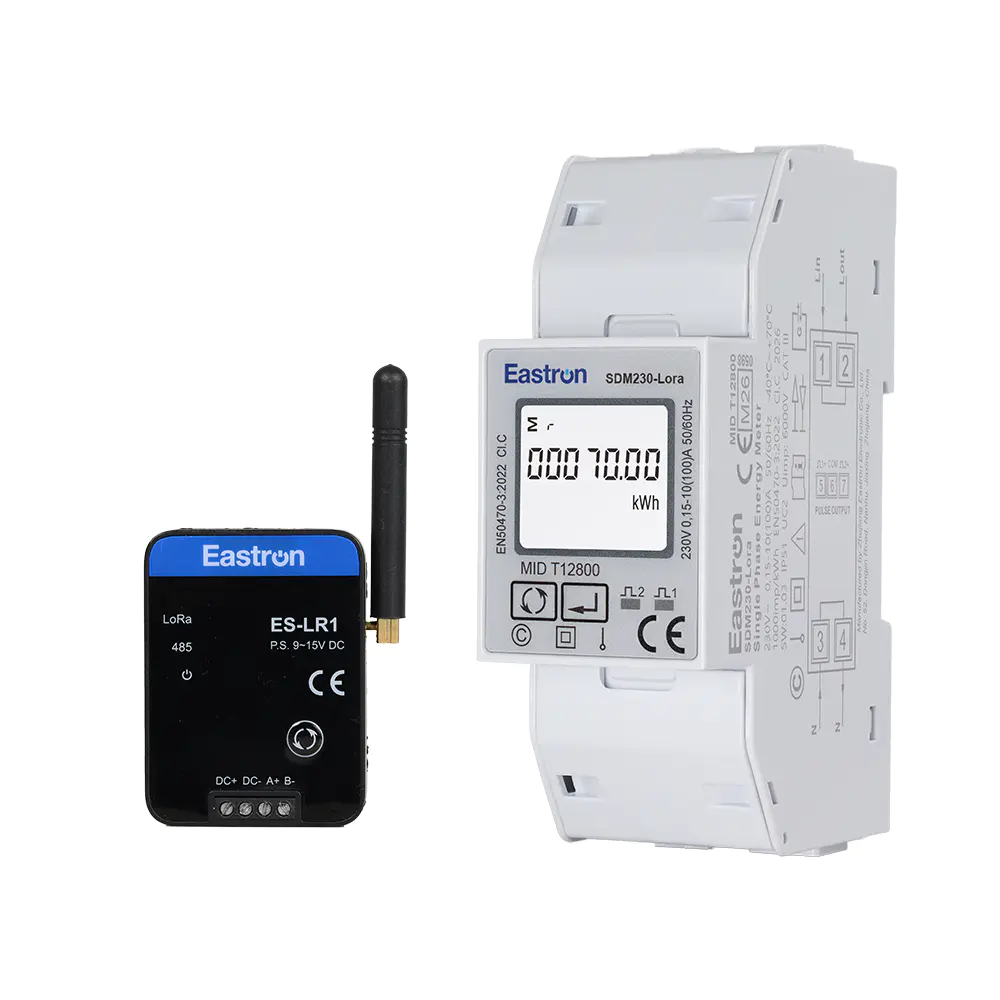
100A Direct Load LoRa Point-to-Point Din Rail Single Phase Multi-function Energy Meter
The meter is designed for 1P2W single-phase, two-wire electrical systems. Its rated voltage is 230 V, with a voltage operating range of 100 to 277 V AC line-to-neutral. The rated current is 10 A, while the maximum current reaches 100 A. The minimum current is specified as 0.15 A, allowing the meter to measure a broad operating range from light loads to substantial single-phase circuits.
Direct-load capability is one of the product’s most important practical features. A direct-load meter places the measured current through its own current path rather than relying on separate external current transformers. For installations within the 100 A limit, this can simplify panel design, reduce accessory requirements, and shorten installation time. It can also make commissioning easier because the installer does not need to select, mount, wire, and verify an external CT ratio for the primary measurement circuit.
The meter measures active energy in kilowatt-hours and reactive energy in kilovolt-ampere reactive hours. It supports imported and exported energy measurement, making it suitable for applications where power can flow in both directions. This is particularly relevant to sites with photovoltaic generation, battery systems, backup generation, bidirectional converters, or energy recovery equipment.
In addition to energy accumulation, the device measures voltage, current, frequency, active power, reactive power, apparent power, power factor, and maximum demand. The demand function can evaluate maximum demand current over a preset period of up to 60 minutes. These functions provide a more complete picture of electrical performance than a basic kWh meter.
| Feature | Specification | Application Value |
|---|---|---|
| System type | Single-phase, two-wire, 1P2W | Suitable for residential, commercial, and light industrial circuits |
| Rated voltage | 230 V | Matches common single-phase low-voltage installations |
| Voltage range | 100–277 V AC, line-to-neutral | Supports a wide range of operating conditions |
| Rated current | 10 A | Defines the reference current for measurement performance |
| Maximum current | 100 A | Enables direct connection for high-current circuits within the limit |
| Minimum current | 0.15 A | Allows measurement over a wide load range |
| Wireless communication | LoRa point-to-point | Supports remote data transmission without a gateway |
| Wired communication | RS485 Modbus RTU through ES-LR1 | Supports connection to automation and management systems |
| Pulse outputs | Two pulse outputs | Provides pulse-based energy or status integration |
| Energy direction | Bidirectional | Measures imported and exported energy |
A multifunction meter is valuable because it combines energy accounting with operational diagnosis. A kWh-only device can show how much energy has been consumed, but it cannot independently reveal whether a problem is caused by low voltage, excessive current, poor power factor, frequency variation, or reactive loading. By measuring several electrical parameters at the same time, the SDM230-Lora P2P can support both billing-related monitoring and technical maintenance.
Voltage measurement helps users confirm that a connected circuit is operating within an expected range. The meter supports line-to-neutral voltage from 100 to 277 V AC. Current measurement indicates the loading of the circuit and can assist with identifying overload conditions, abnormal consumption, or equipment that is operating outside its normal profile.
The specified measurement accuracy for voltage and current is listed as ±0.5% / ±0.2%, depending on the applicable performance level or configuration. This gives system designers a clear basis for evaluating the meter in monitoring and energy-management applications. Users should select the relevant accuracy class according to the requirements of their project, local regulations, and intended use.
Active power represents the power being converted into useful work, heat, light, or other energy forms. Reactive power reflects the energy exchanged by inductive and capacitive equipment. Apparent power combines the effects of active and reactive power and is useful when assessing the loading of electrical infrastructure.
Power factor indicates how effectively current is being converted into useful active power. A low power factor can increase current for the same active load, potentially increasing losses and reducing available system capacity. By providing power factor measurement with a specified resolution or accuracy of 0.01 / ±0.005, the device can support power-quality reviews and equipment-level energy analysis.
Active power accuracy is specified as ±1% / ±0.5%, while reactive power accuracy is specified as ±2%. Apparent power accuracy is specified as ±1% / ±0.5%. These specifications make the meter suitable for monitoring applications where users need more information than accumulated energy alone.
Frequency measurement is useful for confirming the operating condition of the supply and for identifying abnormal frequency behavior. The product specifies frequency accuracy of ±0.1% / ±0.05%.
Maximum demand measurement is important in buildings and facilities where electricity charges or equipment planning are influenced by peak demand. The meter can measure maximum demand current over a preset interval of up to 60 minutes. By recording the highest demand within the selected period, users can better understand when a circuit reaches its greatest loading and can evaluate load scheduling or capacity-management strategies.
The product supports both active and reactive energy measurement. Active energy performance is specified as Class 1 or Class 0.5 according to IEC 62053-21 and Class B or Class C according to EN 50470-3:2022. Reactive energy performance is specified as Class 2 according to IEC 62053-23.
These references provide recognized frameworks for evaluating energy-meter performance. The exact class and approval applicable to a particular model configuration should be verified against the product documentation and the requirements of the target market. For submetering, tenant allocation, equipment monitoring, and energy-management applications, the combination of accuracy specifications and communication functionality provides a strong foundation for dependable data collection.
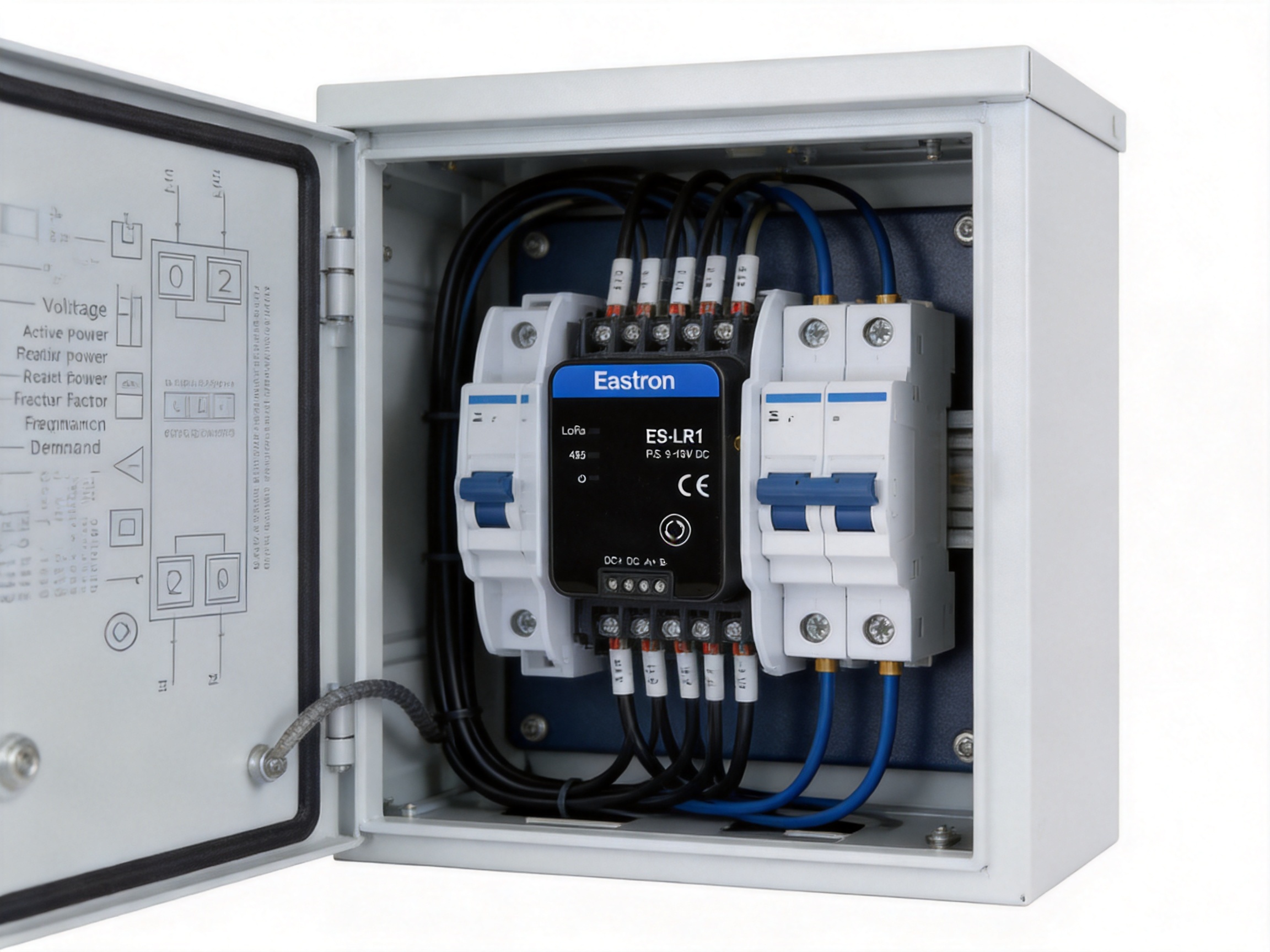
The defining communication feature of the system is its LoRa point-to-point architecture. The SDM230-Lora meter communicates directly with the ES-LR1 receiver module using a private protocol and transparent operating mode. The connection operates in the 868 MHz band, uses 125 kHz bandwidth, and supports a maximum transmit power of 22 dBm. The stated air data rate is 977 bps, with support for spreading factor SF10.
In a conventional wireless metering project, each field meter may communicate with a gateway. The gateway then communicates with a network server or cloud platform. Such an arrangement can be highly capable, but it may also introduce additional equipment, configuration steps, subscription considerations, and points of failure. A point-to-point arrangement is more focused: one meter communicates directly with its paired receiver.
This makes the system especially attractive for installations where a small number of meters must be connected to an existing controller or data-acquisition system. The receiver can expose the meter data through RS485 Modbus RTU, allowing a programmable logic controller, industrial computer, building automation controller, or energy management gateway to read the values using a familiar industrial protocol.
The product documentation identifies the ES-LR1 receiver as having an RS485 Modbus RTU interface and a LoRa interface. The receiver supports a communication address of 253, half-duplex transmission, floating-point data, and a maximum stated transmission distance of 1,000 m. Available serial speeds are 2,400, 4,800, 9,600, and 19,200 bps, with 9,600 bps as the default. Parity can be set to none, odd, or even, and one or two stop bits are available.
| Communication Item | SDM230-Lora Meter | ES-LR1 Receiver |
|---|---|---|
| Wireless interface | LoRa | LoRa |
| Protocol standard | Four-Faith private protocol | Four-Faith private protocol |
| Operating mode | Transparent mode | Transparent mode |
| Frequency band | 868 MHz | 868 MHz |
| Bandwidth | 125 kHz | 125 kHz |
| Maximum transmit power | 22 dBm | 22 dBm |
| Air data rate | 977 bps | 977 bps |
| Wired interface | Not specified as the primary receiver interface | RS485 |
| Wired protocol | — | Modbus RTU |
| Serial transmission | — | 2,400–19,200 bps |
| Maximum stated distance | Wireless point-to-point system | Up to 1,000 m, subject to conditions |
When compared with basic wired meters, the system can reduce the need for long communication cables between the meter location and the monitoring cabinet. When compared with gateway-dependent wireless systems, it can reduce network complexity for small or dedicated installations. When compared with meters requiring current transformers, direct measurement can simplify the current circuit. These combined advantages give the product a practical differentiation in retrofit and distributed-metering projects.
External current transformers are useful when current levels exceed the direct input capacity of a meter or when electrical isolation and flexible scaling are required. However, CT-based installations also require additional planning. The installer must select an appropriate ratio, ensure the polarity is correct, connect the secondary circuit correctly, and account for the physical size of the transformer and its wiring.
A direct-load meter rated for up to 100 A avoids these requirements for circuits that fall within its specified range. This can reduce the number of components in the panel and make the wiring arrangement easier to understand. A simpler installation may also reduce the risk of errors related to incorrect CT ratios, reversed polarity, loose secondary connections, or mismatched configuration settings.
The direct connection is particularly useful for single-phase feeders, apartments, commercial units, small production equipment, electric vehicle auxiliary circuits, distributed heating and cooling equipment, and individual renewable-energy loads. It is important that installation is performed by qualified electrical personnel and that the meter’s current, voltage, wiring, environmental, and safety limits are respected.
The DIN-rail format supports organized mounting inside electrical distribution boards and control cabinets. It allows the meter to be installed alongside protective devices, contactors, terminal blocks, communication equipment, and other control components. The compact modular approach is suitable for new panels as well as retrofit projects where cabinet space is limited.
Direct connection should not be interpreted as unlimited high-current capability. The maximum current is 100 A, and the complete installation must be designed with suitable protective devices, conductor sizes, terminal tightening, isolation procedures, temperature considerations, and enclosure requirements. The meter should not be used outside its stated electrical ratings.
Electricity is no longer consumed only in one direction. Distributed solar generation, batteries, microgrids, regenerative equipment, and export-capable power converters can cause energy to move from the local installation back toward the supply network. A meter that records only import energy may provide an incomplete picture of the site.
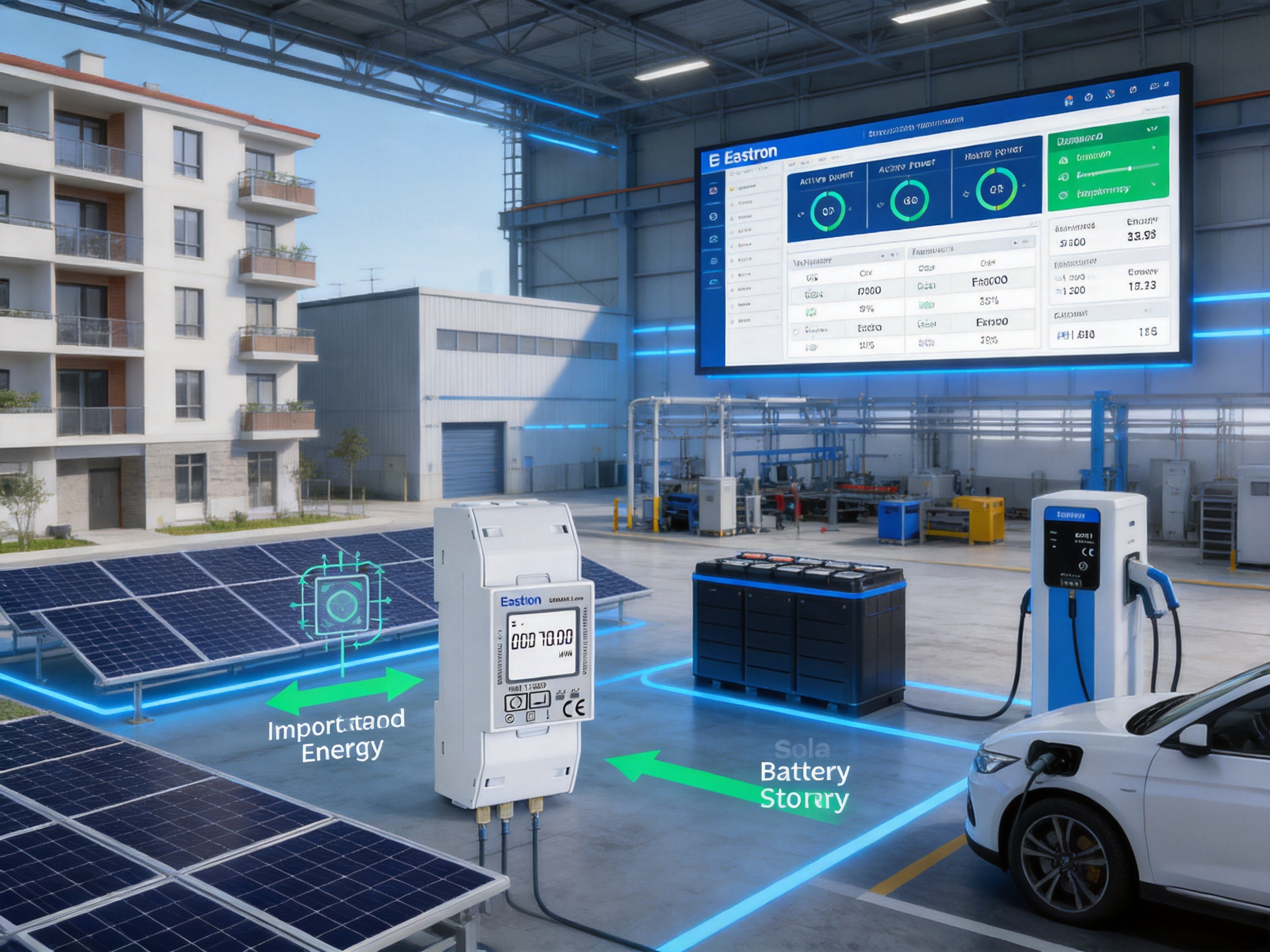
The SDM230-Lora P2P supports bidirectional measurement. It can measure imported or exported active and reactive energy, allowing users to distinguish energy entering and leaving the monitored circuit. This is useful for generation monitoring, self-consumption analysis, battery charging and discharging studies, and evaluation of power-flow behavior.
For example, a building with rooftop photovoltaic generation may consume energy from the utility during low-generation periods and export surplus energy during high-generation periods. A bidirectional meter can help record these changing conditions. Similarly, an industrial installation with energy recovery equipment can use directional measurements to analyze how much energy is returned to the electrical system.
Bidirectional measurement also supports more detailed dashboards. Instead of displaying one accumulated total, an energy management platform can present imported energy, exported energy, instantaneous power direction, and the relationship between local generation and demand. This supports better operational decisions and can help identify opportunities for load shifting or energy storage.
The meter provides two pulse outputs. Pulse outputs remain useful even in systems that use wireless communication because they offer a straightforward way to interface with legacy equipment, counters, indicators, or dedicated data-acquisition inputs. They can be used for pulse-based energy monitoring where the receiving equipment is designed to interpret meter pulses.
The ES-LR1 receiver adds an RS485 Modbus RTU interface. Modbus RTU is widely used in industrial automation, building management, plant monitoring, and energy-management systems. Its broad adoption means that system integrators can often connect the receiver to an existing controller or supervisory platform without developing a completely new communication method.
The receiver supports floating-point data. This is useful when monitoring parameters such as voltage, current, power, energy, frequency, or power factor, because many of these values require decimal precision. Serial parameters can be adjusted to match the host system, including baud rate, parity, and stop bits.
Communication response time is specified as less than 100 ms for the receiver. Actual system response will also depend on polling intervals, wireless conditions, controller performance, and the number of connected devices. For energy monitoring, the system can provide an efficient balance between timely data access and the low-bandwidth characteristics of long-range wireless communication.
In residential developments, the meter can be used for apartment submetering, common-area monitoring, heating equipment, water pumps, ventilation systems, and electric vehicle charging auxiliaries. Its direct 100 A capability can simplify installation for individual residential circuits, while the point-to-point wireless link can reduce the need to run communication cabling through occupied areas.
Property managers can use the collected data to compare consumption between units, identify unusual load patterns, and monitor shared infrastructure. When connected to a central system through RS485, the receiver can help consolidate data from distributed meters for reporting and operational analysis.
Commercial buildings often contain many electrically separate loads, including lighting, air conditioning, elevators, pumps, signage, server-room equipment, kitchen appliances, and tenant areas. Measuring these circuits individually can improve cost allocation and reveal where energy is being used.
The meter’s measurement of power factor, reactive power, and demand adds value beyond tenant billing. Facility managers can investigate peak-loading periods, evaluate equipment schedules, and identify circuits with consistently poor power factor. Wireless communication is also useful when meters are located in separate distribution boards or areas where new communication cabling would be disruptive.
Industrial sites use energy in a wide variety of ways. Motors, control systems, heaters, compressors, conveyors, test equipment, and auxiliary services may each have distinct electrical profiles. A multifunction meter can support equipment-level monitoring, preventive maintenance, and production-energy analysis.
The product is intended for single-phase circuits within its ratings, making it suitable for auxiliary equipment and individual branch circuits rather than every type of industrial feeder. Its Modbus RTU integration can connect measured data to a plant monitoring system, while bidirectional measurement can assist with applications involving drives, storage systems, or energy recovery.
Many Internet of Things energy projects require distributed sensors or meters that can transmit information without extensive wiring. A point-to-point LoRa meter can serve as a field measurement device, with the ES-LR1 acting as the local bridge to a controller or edge-computing platform.
The architecture is especially appropriate when the project owner wants wireless access at the meter level but prefers to keep the upper-level system on a controlled wired interface. RS485 can connect to an industrial gateway, and the gateway can then forward data to a private database, cloud application, or analytics platform according to the project design.
Product selection should always be based on the application, required accuracy, environmental conditions, certification needs, and communication architecture. Nevertheless, the SDM230-Lora P2P offers several advantages when compared with common alternatives.
A basic energy meter may display accumulated kWh and perhaps provide a pulse output. The SDM230-Lora P2P provides a wider measurement set, including voltage, current, active power, reactive power, apparent power, power factor, frequency, demand, and bidirectional energy. This allows the same device to support both energy accounting and electrical-performance analysis.
For loads up to 100 A, direct connection can reduce the hardware and configuration associated with external current transformers. This may lower installation complexity and make the metering circuit easier to inspect. CT-dependent designs remain valuable in higher-current or specialized installations, but direct measurement is often more convenient for branch circuits and distributed applications.
The point-to-point arrangement connects the meter directly to the ES-LR1 receiver without requiring a gateway or network server for the basic wireless link. This can be beneficial for a small installation, a dedicated machine, a remote panel, or a project where the customer already has a Modbus-compatible controller.
A fully wired architecture can be highly reliable, but installing communication cables may be difficult in existing buildings, remote plant areas, or completed commercial spaces. Wireless communication can reduce cabling work between the meter and receiver. It also provides greater flexibility when panels are distributed across a site.
Some systems use separate sensors for voltage, current, power, and energy. A multifunction meter consolidates these measurements in one calibrated device. Consolidation can reduce the number of components, simplify data mapping, and provide a consistent time relationship between electrical parameters.
The performance of an energy meter depends not only on its circuit design but also on engineering control, testing, calibration, production consistency, and after-sales support. The manufacturer describes itself as a high-tech producer of electricity meters, power analyzers, current sensors, communication modules, and energy-management systems. Its product development activities cover electricity measurement and related communication technologies.
The company has development teams in China and the United Kingdom and cooperates with universities and institutions. This combination of internal engineering and external technical cooperation can support the development of measurement hardware, embedded software, communication functions, and application-oriented products.
Manufacturing strength is also supported by laboratory capability. The company reports that its professional laboratory can conduct EMC, LVD, accuracy, and environmental tests according to IEC, EN, GB, and UL standards. These testing categories are important because a meter must perform accurately while also meeting requirements related to electromagnetic compatibility, electrical safety, and environmental operation.
Accuracy testing verifies measurement performance under defined conditions. EMC testing evaluates resistance to electromagnetic disturbances and limits on emissions. LVD-related testing addresses low-voltage safety requirements. Environmental tests can help assess performance under conditions such as temperature and humidity changes, depending on the specific test program.
The company also reports patented technologies in software, embedded software, and hardware. Intellectual property in these areas can contribute to measurement algorithms, display management, communication handling, protection methods, and product integration. It has been recognized as a High-tech Enterprise and High-tech R&D Centre of Electricity Application.
Quality management is another important manufacturing consideration. The company follows the ISO 9001 quality management system, and its production is approved by SGS according to MID standards. These qualifications and approvals should be evaluated together with the exact certification documents for the product version and target market, but they demonstrate an established focus on process control and regulated measurement production.
For international customers, manufacturing capability is strengthened by experience supplying products to markets across Europe, Asia-Pacific, America, the Middle East, and Africa. Such geographic reach requires attention to different electrical systems, communication expectations, regulatory frameworks, documentation requirements, and support practices.
| Manufacturing or Engineering Strength | Relevance to Customers |
|---|---|
| Professional laboratory capability | Supports EMC, safety, accuracy, and environmental evaluation |
| Testing against IEC, EN, GB, and UL-related requirements | Helps address international application and compliance expectations |
| ISO 9001 quality management system | Provides a structured framework for process and quality control |
| In-house hardware and software development | Supports integrated meter, communication, and management solutions |
| Patented technologies | Reflects investment in product innovation and technical differentiation |
| China and UK development resources | Combines regional engineering capabilities and market knowledge |
| International supply experience | Supports projects across multiple regions and application environments |
System integrators should define the required measurement points before selecting the meter. The product is intended for single-phase, two-wire systems. If a project contains three-phase loads, three-phase four-wire systems, or current levels above 100 A, other meter types or additional measurement equipment may be required.
The communication design should also be planned in advance. The meter and receiver are paired through the LoRa point-to-point arrangement, while the receiver communicates with the host system through RS485 Modbus RTU. Integrators should confirm the expected mounting locations, wireless path, antenna arrangement, electrical noise environment, serial settings, Modbus register mapping, and polling strategy.
The stated maximum transmission distance of 1,000 m should be treated as an application reference rather than a guarantee for every site. Actual wireless performance can be affected by walls, metal cabinets, reinforced concrete, terrain, interference, antenna placement, local regulations, and installation height. A site survey or practical signal test may be appropriate for larger or obstructed installations.
When installing the meter inside a metal enclosure, the antenna and receiver arrangement should be considered carefully. Metal structures can reduce wireless performance. The receiver should be positioned where it can communicate reliably with the meter while maintaining a suitable RS485 connection to the control system.
Modbus integration requires consistent serial parameters. The receiver supports several baud rates, parity options, and stop-bit selections. The host controller and receiver must use matching settings. The correct communication address and register definitions should be established during commissioning, and the system should be tested with realistic polling intervals.
Energy values should be interpreted correctly, particularly in bidirectional applications. The system designer should determine how imported energy, exported energy, reactive energy, instantaneous power, and power direction are represented in the data registers. Clear naming in the supervisory software can prevent confusion during operation.
Commissioning begins with a review of the electrical design. The installer should confirm that the supply voltage and current are within the meter’s ratings, that the circuit is a compatible 1P2W system, and that appropriate protective equipment is installed. Wiring should follow the approved diagram and local electrical regulations.
After energization, the displayed voltage and frequency should be compared with expected supply conditions. Current and power readings should be checked against a known or reasonably estimated load. If the circuit includes equipment with a variable operating profile, measurements should be observed under several load conditions.
For communication commissioning, the receiver should be connected to the RS485 host using the correct polarity and termination arrangement for the system design. The serial speed, parity, stop bits, and address should be verified. The integrator should confirm that the host can read the expected voltage, current, power, energy, power factor, frequency, and demand values.
Wireless commissioning should include a check of communication reliability at the intended operating location. If the receiver cannot communicate consistently, possible causes include excessive distance, obstructions, metal shielding, poor antenna placement, electromagnetic interference, or incorrect pairing parameters.
Routine maintenance should include visual inspection, terminal checks during scheduled electrical maintenance, review of communication status, and comparison of readings with expected load behavior. Sudden changes in current, power factor, or energy consumption can indicate equipment faults, operational changes, or wiring issues. Maintenance personnel should work under appropriate isolation and safety procedures.
Accurate submetering creates the foundation for informed energy management. Once consumption is measured at useful points, organizations can establish baselines, compare operating periods, identify abnormal usage, and evaluate improvement measures.
The meter can help users distinguish between energy consumption and electrical loading. For example, two circuits may consume similar amounts of energy but have very different peak currents or power factors. This distinction is important when planning circuit capacity, evaluating transformer or feeder loading, and managing demand.
Reactive power and power factor information can support decisions about motor operation, capacitor correction, equipment replacement, and load balancing. Frequency and voltage data can contribute to supply-quality reviews. Bidirectional energy data can help assess the performance of distributed generation and storage systems.
Wireless access can also make measurement more scalable. A project can begin with a small number of critical circuits and expand as the value of the data becomes clear. Because the receiver provides a standard industrial communication interface, the data can be incorporated into an existing monitoring architecture rather than requiring a completely separate platform.
The meter is designed for a single-phase, two-wire system, commonly identified as 1P2W. It measures line-to-neutral voltage and is not a substitute for a three-phase meter in a three-phase installation.
Yes. The product supports direct connection up to a maximum current of 100 A, so an external current transformer is not required for suitable circuits within the specified electrical limits.
The rated voltage is 230 V. The stated operating range is 100 to 277 V AC line-to-neutral.
Yes. It supports bidirectional measurement and can measure imported and exported active and reactive energy. This makes it suitable for applications involving solar generation, batteries, energy recovery, or other bidirectional power-flow equipment.
The point-to-point communication arrangement does not require a gateway or network server for the direct connection between the SDM230-Lora meter and the ES-LR1 receiver. The receiver can then provide RS485 Modbus RTU access to a host control or monitoring system.
The receiver provides RS485 communication using Modbus RTU. The wireless side uses a private protocol in transparent mode.
The ES-LR1 receiver has a stated maximum transmission distance of 1,000 m. Actual range depends on building construction, obstructions, antenna placement, interference, installation conditions, and local radio requirements.
The receiver supports 2,400, 4,800, 9,600, and 19,200 bps. The default speed is 9,600 bps. None, odd, and even parity options are available, as well as one or two stop bits.
The meter measures voltage, current, frequency, power factor, active power, reactive power, apparent power, active energy, reactive energy, and maximum demand. It also provides two pulse outputs.
Yes. The measurement functions and RS485 Modbus RTU interface through the ES-LR1 receiver support connection to automated meter-reading systems, SCADA systems, building management systems, industrial controllers, and IoT-based energy platforms.
Active energy is specified as Class 1 or Class 0.5 under IEC 62053-21 and Class B or Class C under EN 50470-3:2022. Reactive energy is specified as Class 2 under IEC 62053-23. The applicable class should be confirmed for the selected product version and project requirement.
Typical applications include residential complexes, commercial buildings, industrial facilities, distributed equipment, branch-circuit monitoring, energy management systems, and IoT measurement projects. The monitored circuit must remain within the product’s voltage, current, system, and installation limits.
Users should verify the electrical system type, rated voltage, maximum current, protective devices, conductor sizes, enclosure conditions, wireless path, receiver location, RS485 settings, and applicable local regulations. Installation and commissioning should be performed by qualified personnel.
The SDM230-Lora P2P combines several features that are often evaluated separately: direct 100 A measurement, multifunction electrical monitoring, bidirectional energy measurement, pulse outputs, wireless point-to-point communication, and Modbus RTU integration. This combination can reduce the complexity of distributed single-phase metering projects.
Its direct-load design can simplify the current circuit for installations within the specified limit. Its multifunction measurement capability provides more operational insight than a basic energy counter. Its LoRa point-to-point link can reduce dependence on communication cabling and gateway infrastructure. Its receiver module provides a practical bridge to established industrial control systems.
The product is also supported by a manufacturer with dedicated development resources, laboratory testing capability, quality-management practices, patented technologies, and experience in international electricity-measurement markets. These factors are important when selecting equipment for projects that require consistent production, technical documentation, integration support, and long-term supply.
For users seeking a compact single-phase meter for remote measurement, the system offers a balanced solution. It is not intended to replace every type of three-phase, high-current, revenue-grade, or utility-specific meter, but within its application range it provides a capable combination of measurement accuracy, installation convenience, wireless flexibility, and system compatibility.
Energy measurement is becoming increasingly distributed. Electrical data must be collected from apartments, commercial areas, industrial branches, renewable-energy systems, and individual machines, often without the cost or disruption of extensive communication wiring. A successful metering solution must therefore combine accurate measurement with practical installation and dependable integration.
The SDM230-Lora P2P addresses these needs through a direct-load single-phase meter rated up to 100 A, comprehensive electrical measurement functions, bidirectional energy recording, two pulse outputs, and LoRa point-to-point communication. The associated ES-LR1 receiver adds RS485 Modbus RTU access, allowing the meter to communicate with established monitoring and automation systems without requiring a gateway for the direct wireless connection.
Its advantages are particularly clear in distributed submetering, retrofit installations, commercial building monitoring, industrial auxiliary circuits, and IoT-based energy management. Direct measurement can simplify installation, while wireless communication can make remote data collection more practical. The manufacturer’s laboratory resources, quality systems, engineering capabilities, and international experience further support the product’s position as a professional energy-measurement solution.
When correctly selected, installed, configured, and commissioned, this meter can provide the electrical information needed to improve visibility, analyze demand, monitor bidirectional power flow, and support more efficient energy-management decisions.
IEC 62053-21, Electricity Metering Equipment: Particular Requirements for Static Meters for Active Energy.
IEC 62053-23, Electricity Metering Equipment: Particular Requirements for Static Meters for Reactive Energy.
EN 50470-3:2022, Electricity Metering Equipment: Particular Requirements for Static Meters for Active Energy.
Modbus Organization, Modbus Application Protocol and Modbus Serial Line Principles.
Product technical information for the SDM230-Lora P2P single-phase multifunction energy meter.
Product technical information for the ES-LR1 LoRa-to-RS485 receiver module.
ISO 9001, Quality Management Systems: Requirements.
General principles of electrical installation design, low-voltage protection, commissioning, and energy-management system integration.
Your email address will not be published. Required fields are marked *

We develop and produce high performance electricity meters, power analyzers, current sensors, communication modules and management systems.
Address:NO. 52, Dongjin Road, Nanhu, Jiaxing, Zhejiang, China
Copyright @ Eastron Electronic Co., Ltd. All rights reserved
