

 English
 Español
 Deutsch
 中文简体
中文简体

Product Consultation
Your email address will not be published. Required fields are marked *
Europe's Solar and Energy Storage Transition: Transforming the Power System Infrastructure for a Renewable Future
Jul 10,2026
Power Systems Are Becoming “Real-Time Systems”: Why Data Is More Critical Than Electricity
Jul 06,2026
New EPBD Regulations Drive HVAC Energy Transparency and Boost Demand for Smart Meters
Jul 07,2026Content
In today’s electrical infrastructure, accurate measurement is no longer a simple matter of recording energy consumption at the end of a billing period. Industrial facilities, commercial buildings, renewable energy sites, public infrastructure projects, and smart energy platforms all require meters that can measure multiple electrical parameters, communicate reliably, support digital monitoring, and remain stable under demanding operating conditions. A three phase multi-function energy meter with RS485 Modbus RTU is therefore a key component in modern energy management systems.
The SDM530-Modbus is designed for three phase four wire AC systems and provides a practical combination of direct 100A load connection, multi-parameter measurement, bi-directional energy monitoring, two pulse outputs, and RS485 Modbus RTU communication. It is a compact yet powerful device for applications that require dependable measurement of voltage, current, frequency, power, power factor, active energy, reactive energy, imported energy, and exported energy.
Compared with many conventional three phase meters, this model offers a strong balance between installation simplicity, communication capability, and cost efficiency. Its maximum 100A direct connection allows many users to avoid external current transformers in suitable applications, reducing panel complexity, wiring work, component cost, and installation time. At the same time, the integrated RS485 Modbus RTU interface makes the meter ready for building management systems, energy monitoring software, data loggers, gateways, industrial automation platforms, and remote supervision solutions.
Beyond the product itself, the manufacturer’s engineering and production strength also matter. Eastron Electronic Co., Ltd. has built its position around energy measurement products, smart meters, power analyzers, current sensors, communication modules, and energy management systems. With research and development teams in China and the UK, an in-house professional laboratory, ISO 9001 quality management, SGS-approved MID-standard production, and testing capabilities covering EMC, LVD, accuracy, and environmental performance according to major international standards, the company provides the manufacturing foundation required for reliable metering products.
Three Phase Multi-function Energy Meter with RS485 Modbus RTU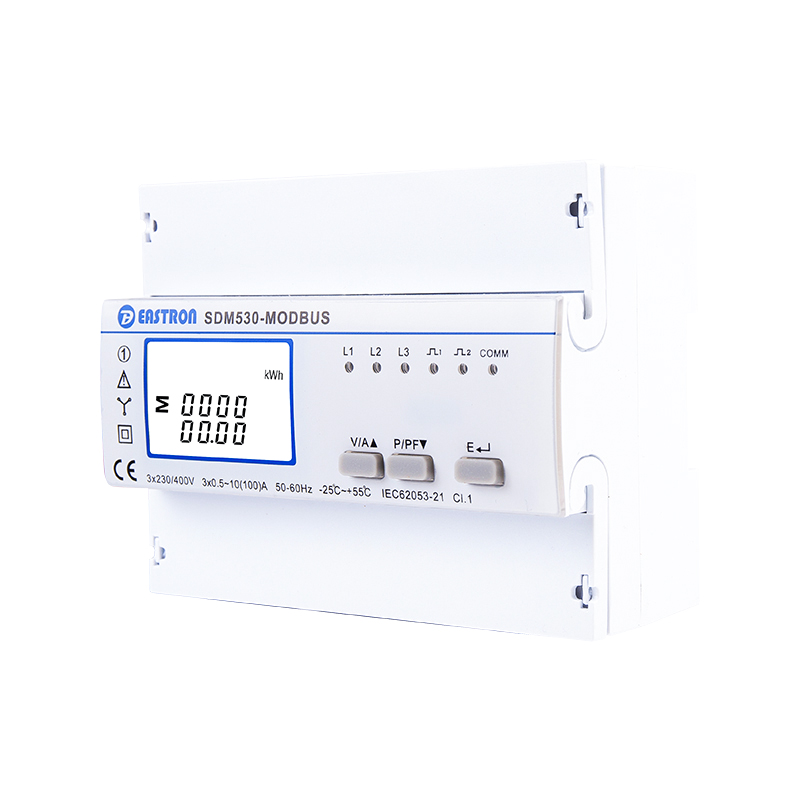
The SDM530-Modbus is a three phase multi-function energy meter for 3P4W electrical networks. It supports direct load measurement up to 100A, making it particularly useful in applications where the load level fits within the meter’s direct input capacity and where a compact, simplified installation is preferred. It is built in a 7-module DIN rail format, with dimensions of 100 mm x 125 mm x 65 mm, allowing it to fit into many electrical distribution boards and metering panels.
The meter measures and displays essential electrical characteristics of a three phase four wire supply. These include voltage, current, frequency, power, power factor, active energy, and reactive energy. It also supports imported and exported energy measurement, which is increasingly important in environments involving distributed generation, solar photovoltaic systems, energy storage, load balancing, and bi-directional energy flow.
Its communication configuration includes two pulse outputs and RS485 Modbus RTU. Pulse outputs are useful for traditional energy collection, monitoring relays, counters, and local energy data acquisition devices. RS485 Modbus RTU provides a widely adopted industrial communication method that can connect the meter to modern energy management systems. The communication address range from 1 to 247 allows multiple devices to operate on a shared bus, while the maximum transmission distance of 1000 m supports larger buildings, plants, and distributed metering layouts.
The meter’s password-protected configuration helps prevent unauthorized changes to communication settings, energy parameters, or operating preferences. This is important in commercial and industrial settings where measurement consistency, data integrity, and system reliability are essential.
Three phase power systems are widely used because they deliver electricity more efficiently for larger loads. Manufacturing equipment, elevators, HVAC systems, pumps, compressors, data centers, commercial kitchens, charging infrastructure, and industrial process lines frequently depend on three phase power. Monitoring only total kWh consumption is often not enough to understand how these systems behave.
A multi-function energy meter provides a broader electrical picture. Voltage readings can reveal supply quality or imbalance. Current readings can show phase loading and potential overload risk. Frequency measurement helps verify power stability. Power factor measurement can indicate inefficient reactive power conditions. Active energy shows useful energy consumption, while reactive energy helps identify loads that create additional grid stress. Imported and exported energy data helps operators distinguish between energy drawn from the grid and energy sent back to the grid.
With these measurements available through Modbus RTU, energy data becomes more than a display value on a meter. It becomes actionable information. Facility managers can track consumption trends, compare departments or circuits, identify abnormal load behavior, optimize demand, support carbon reporting, and improve maintenance planning. System integrators can use the meter as a reliable field data point in smart building, automation, or energy-saving projects.
One of the strongest advantages of the SDM530-Modbus is its maximum 100A direct load capability. Many three phase meters require external current transformers when measuring higher currents. CT-based systems are necessary in many high-current applications, but they add extra cost, occupy additional space, and require careful selection, wiring, polarity checking, and ratio configuration. Mistakes in CT wiring or configuration can lead to incorrect readings and time-consuming troubleshooting.
For installations within the direct measurement range, a 100A direct connected meter can simplify the entire process. Installers can connect the meter directly to the measured circuit without the need for external CTs. This reduces panel wiring, lowers accessory requirements, and helps avoid CT ratio errors. Compared with competitor meters that require current transformers at lower current levels, this direct connection design can deliver a meaningful advantage in both initial installation cost and long-term service convenience.
Electrical panels often have limited space. A metering solution must provide enough functionality without making the panel larger or more complex. The 7-module size of the SDM530-Modbus helps balance functionality and compactness. It provides three phase multi-function measurement, pulse output, and Modbus communication in a practical DIN rail package.
In retrofit projects, space can be especially valuable. Older distribution boards may not have been designed for digital metering, and adding extra devices can be difficult. A compact meter that combines measurement and communication features reduces the need for separate interface modules, making it easier to upgrade existing panels for modern monitoring.
Some basic meters only provide a pulse output, while some communication meters may focus mainly on digital networking. The SDM530-Modbus includes both two pulse outputs and RS485 Modbus RTU. This dual-output approach gives system designers more flexibility. A pulse output can be connected to a traditional counter or local monitoring device, while RS485 Modbus can simultaneously provide detailed parameter data to a supervisory system.
This is valuable when a project needs compatibility with existing equipment as well as readiness for future digital integration. For example, a building may already use pulse counters for energy collection, but the owner may later add a building management platform. A meter with both output methods reduces the need to replace devices during upgrades.
Modern electrical systems increasingly involve more than one direction of energy flow. Solar photovoltaic installations, battery systems, microgrids, regenerative drives, and distributed generation can all create conditions where energy is exported as well as imported. A meter that only measures consumption may fail to provide a complete energy picture.
The SDM530-Modbus supports bi-directional measurement, including imported and exported energy. This makes it suitable for applications where users need to monitor not only how much energy is consumed, but also how much is returned or generated. Compared with simpler competitor products that only focus on import energy, bi-directional measurement gives the meter stronger relevance in renewable energy and smart grid environments.
Energy efficiency projects depend on data quality. If a meter only reports kWh, it may show the result of consumption but not the cause. Multi-parameter measurement allows users to diagnose electrical conditions more deeply. Voltage, current, frequency, power, power factor, active energy, and reactive energy each contribute to a more complete understanding of system performance.
For example, high current on one phase may indicate load imbalance. Poor power factor may indicate reactive load issues and potential penalty charges. Voltage deviation may affect equipment life. Reactive energy can point to compensation requirements. Having these parameters available through one device makes the SDM530-Modbus more useful than a basic kWh meter.
Metering settings should not be changed casually. Communication addresses, baud rates, output settings, and measurement configurations can affect the entire monitoring system. The SDM530-Modbus protects configuration through password control, helping prevent unauthorized or accidental changes. In buildings with many service personnel or shared electrical rooms, this is an important safeguard.
The product’s specifications reflect its role as a three phase direct connected multi-function meter for indoor applications. The following table summarizes important parameters and their practical value.
Feature |
Specification |
Practical Benefit |
System Type |
Three phase four wire AC system, 3P4W |
Suitable for common commercial and industrial three phase distribution networks. |
Maximum Current |
100A direct load |
Reduces the need for external current transformers in suitable applications. |
Rated Current |
10A |
Provides a defined operating reference for direct measurement. |
Minimum Current |
0.5A |
Supports measurement across a practical current range. |
Starting Current |
40mA |
Allows the meter to begin recording at low current levels. |
Active Energy Accuracy |
IEC 62053-21 Class 1.0 |
Provides reliable active energy measurement for monitoring and management. |
Reactive Energy Accuracy |
IEC 62053-23 Class 2 |
Supports reactive energy monitoring for power quality and compensation analysis. |
Communication |
RS485 Modbus RTU |
Enables integration with industrial and building energy monitoring systems. |
Pulse Outputs |
Two pulse outputs |
Allows local energy counting or connection to legacy acquisition devices. |
Communication Address |
1 to 247 |
Supports multiple devices on a Modbus network. |
Transmission Distance |
1000 m maximum |
Useful for large sites and distributed metering systems. |
Transmission Speed |
1200 bps to 9600 bps |
Provides communication flexibility for different network requirements. |
Dimensions |
100 mm x 125 mm x 65 mm |
Fits compact DIN rail panel designs. |
Operating Temperature |
-25°C to 55°C |
Suitable for a broad range of indoor electrical environments. |
Protection Degree |
IP51 indoor |
Provides protection appropriate for indoor metering installations. |
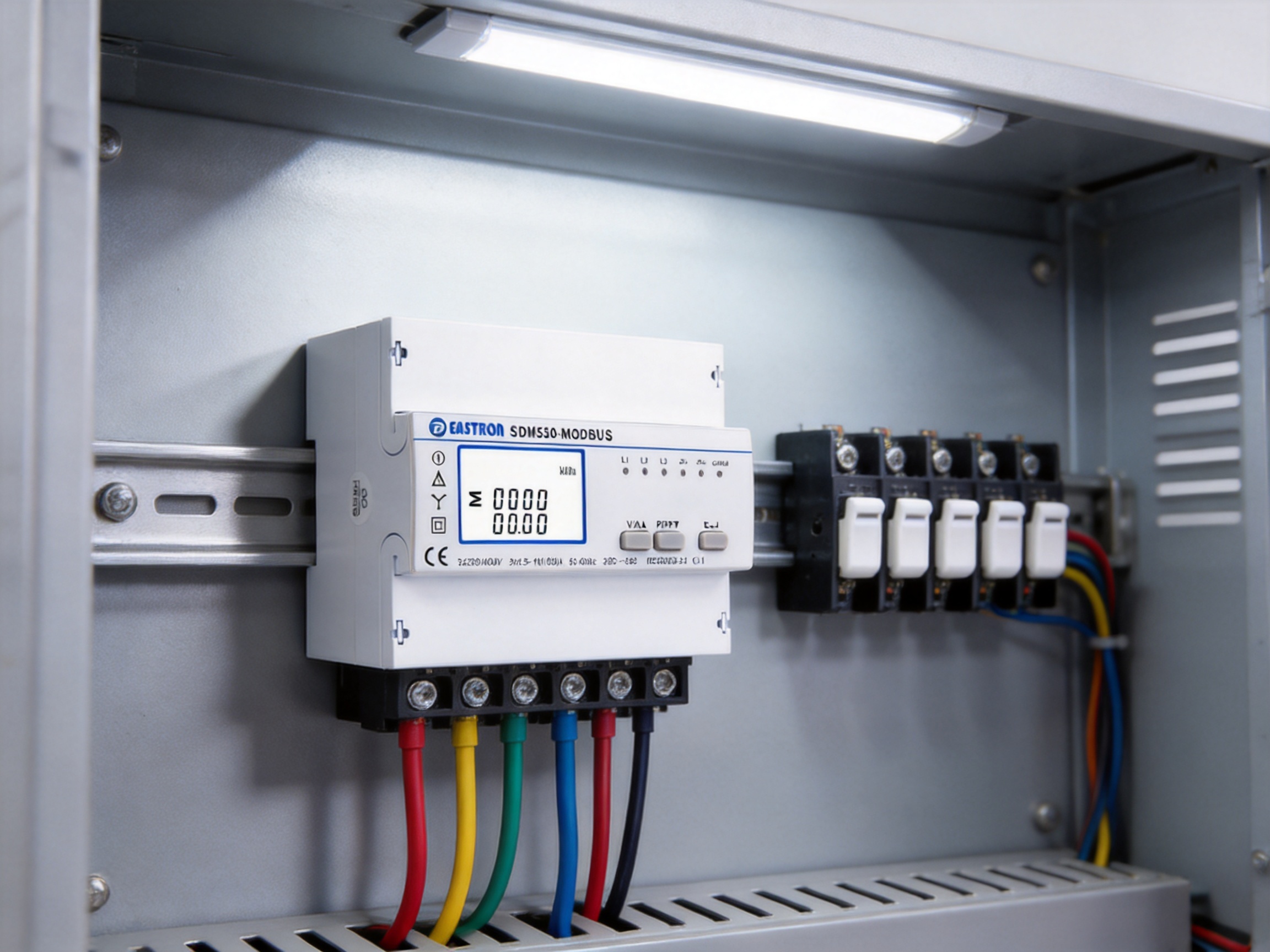
RS485 Modbus RTU is one of the most widely used communication methods in industrial and building automation. Its popularity comes from practical strengths: long-distance communication, multi-drop network capability, relative wiring simplicity, and broad compatibility with controllers, gateways, software platforms, and data acquisition devices.
The SDM530-Modbus supports RS485 and Modbus RTU with communication addresses from 1 to 247. This means many meters can be connected on the same RS485 bus, each with a unique address. A supervisory device can poll each meter and collect measurement data. In a shopping mall, for instance, meters can be installed for different tenants or distribution branches. In a factory, meters can be assigned to production lines, utility systems, workshops, and sub-panels. In a solar installation, meters can help monitor import and export energy at key connection points.
The maximum communication distance of 1000 m is advantageous for sites where electrical rooms and monitored loads are physically separated. While correct wiring practice, cable selection, termination, shielding, grounding, and network design remain important, the long-distance capability of RS485 makes the meter suitable for large buildings, industrial plants, campuses, and energy service projects.
The communication speed range from 1200 bps to 9600 bps allows system integrators to match the meter to the requirements of the network. Lower speeds can sometimes improve communication stability over longer cable runs or noisier environments, while higher speeds can support faster polling in smaller networks. Options for parity and stop bits further support compatibility with different Modbus masters and configuration standards.
Although digital communication is increasingly common, pulse outputs remain useful and widely accepted. A pulse output provides a simple representation of energy consumption through electrical pulses, which can be counted by external devices. This approach is easy to understand, robust, and compatible with many existing systems.
The SDM530-Modbus includes two pulse outputs, which expands monitoring flexibility. In some installations, one pulse output may be used for a local counter and another for a building automation input. In other cases, pulse outputs can provide redundancy or separate energy information depending on system design. The combination of pulse outputs and Modbus RTU gives the meter an advantage over products that provide only one type of output.
This dual-path data strategy is especially valuable in phased modernization projects. A facility may begin with pulse-based monitoring, then later migrate to full Modbus-based data collection. Because the meter supports both, the same installed hardware can continue serving the project as the monitoring system becomes more advanced.
The meter’s active energy accuracy is specified according to IEC 62053-21 Class 1.0, while reactive energy accuracy is specified according to IEC 62053-23 Class 2. Current and voltage measurements are specified at 0.5% of range maximum, frequency at 0.2% of mid-frequency, power at 1% of range maximum, and power factor at 1% of unity. These specifications support reliable everyday energy management, sub-metering, load monitoring, and electrical performance evaluation.
Accuracy is not only a laboratory number. In real installations, measurement reliability also depends on stable hardware design, consistent production processes, quality inspection, calibration discipline, and environmental durability. A meter used in a commercial or industrial facility must continue to perform over time despite temperature changes, electrical noise, load variation, and daily operational stress.
The product is designed for indoor applications with an IP51 degree of protection. It supports an operating temperature range of -25°C to 55°C and storage temperature from -40°C to 70°C. Humidity tolerance is specified at less than 95% RH at 50°C, non-condensing. These environmental characteristics support use in a variety of indoor distribution panels, utility rooms, equipment cabinets, and controlled industrial environments.
Installation efficiency is a major factor in total project cost. A meter that is technically capable but difficult to install can increase labor time, wiring errors, and commissioning delays. The SDM530-Modbus addresses this issue through direct connection, compact size, and integrated outputs.
Because it supports maximum 100A direct load measurement, it avoids external CTs in suitable applications. This simplifies wiring and reduces the number of components in the panel. It also avoids the need to verify CT ratio settings or correct CT polarity, both of which are common sources of metering errors in current transformer installations.
The meter’s vertical mounting position and DIN rail style fit common panel layouts. Its 7-module size makes it practical for both new construction and retrofit projects. Integrators can install the meter in distribution boards where space is limited while still gaining access to multi-parameter data and Modbus communication.
Password-protected configuration also improves commissioning control. Once communication address, baud rate, parity, and related settings are configured, the password protection helps reduce the risk of accidental changes during routine maintenance. This stability is important when many meters are connected to one monitoring system.
Commercial buildings often contain many different loads, including lighting, HVAC systems, elevators, tenant areas, kitchens, pumps, and office equipment. Installing three phase multi-function meters in key distribution points allows building operators to understand where energy is used and how electrical loads behave. With Modbus RTU communication, data can be sent to a building management system or energy monitoring platform.
The SDM530-Modbus is suitable for branch metering and sub-metering in these environments. Its direct 100A capability can reduce installation complexity in many distribution circuits, while bi-directional measurement supports buildings with rooftop solar or other distributed generation systems.
Factories and workshops require reliable energy data to control costs, allocate consumption, and improve production efficiency. Motors, compressors, welding equipment, heating systems, and process machinery can create dynamic electrical loads. A multi-function meter allows operators to observe power, current, voltage, frequency, and power factor, not only total energy use.
By integrating the meter with supervisory software through Modbus RTU, industrial users can compare energy use by line, shift, product batch, or production area. This supports energy audits, preventive maintenance, and equipment optimization. The 1000 m communication distance is helpful in large factories where meters may be distributed across multiple electrical rooms.
Bi-directional energy measurement makes the meter relevant for renewable energy applications. In systems with solar photovoltaic generation, energy may flow from the grid to the building at one time and from the building to the grid at another. Monitoring imported and exported energy helps users understand self-consumption, grid interaction, and generation benefits.
The meter can be used at distribution points, inverter output panels, or load connection points depending on project design. When connected through Modbus RTU, its data can support energy dashboards, performance reports, and operational analysis.
Energy service companies require dependable field devices to measure savings and validate project performance. A meter with direct connection, Modbus communication, and multi-parameter measurement can help reduce installation time while providing useful data for analysis. The SDM530-Modbus is well suited for projects where multiple sites or distribution points need to be monitored consistently.
Public buildings, transportation facilities, municipal utility sites, schools, hospitals, and service centers all benefit from accurate energy monitoring. These facilities often require long-term reliability and straightforward integration into centralized monitoring systems. The meter’s communication capability and compact design make it suitable for structured monitoring deployments across multiple panels or buildings.
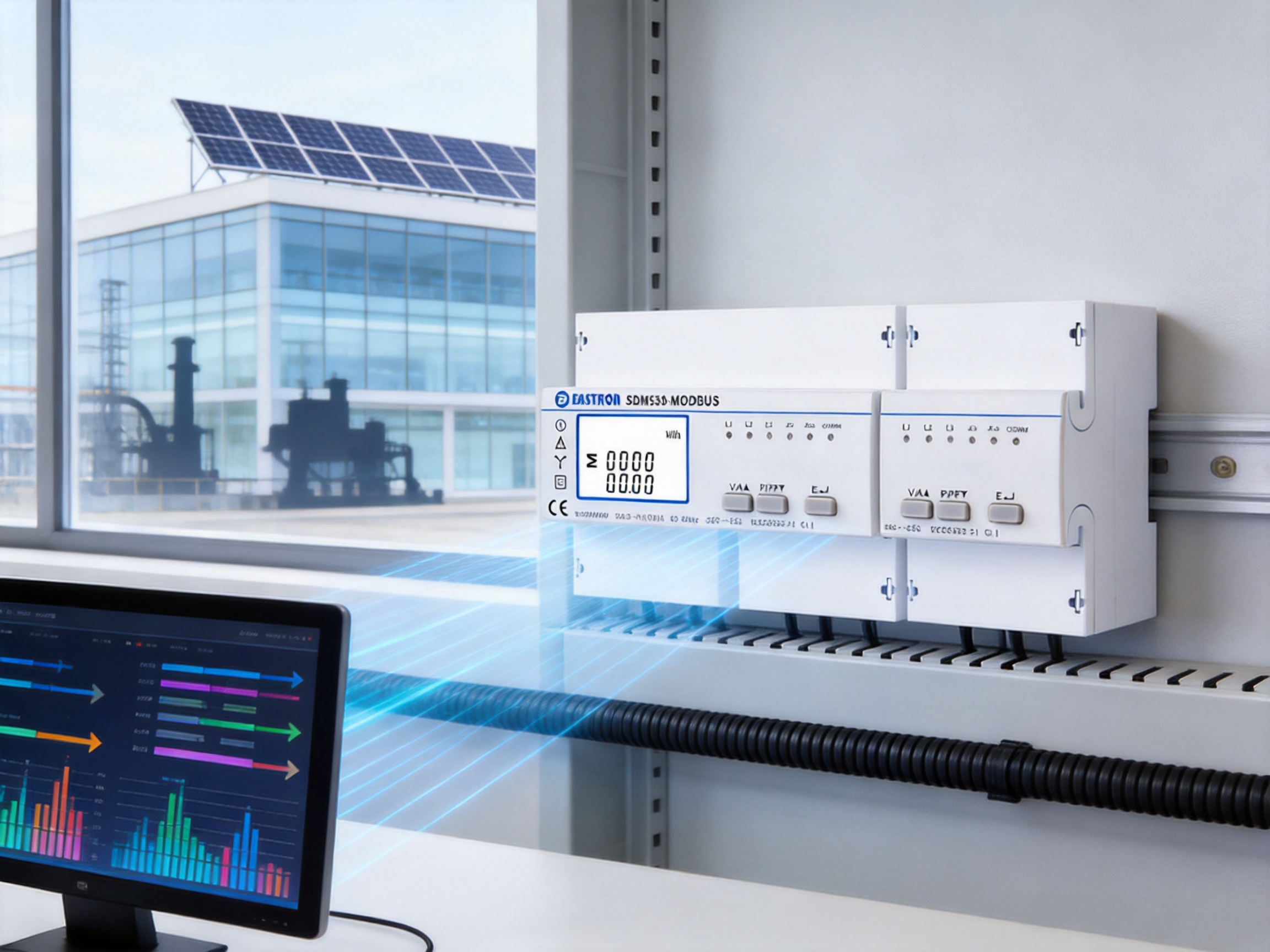
A high-quality energy meter depends on more than its circuit design. It depends on manufacturing discipline, component control, calibration, testing, research and development, quality management, and continuous improvement. Eastron Electronic Co., Ltd. has developed its business around electricity meters, smart meters, power analyzers, current sensors, communication modules, and energy measurement solutions. This focused product direction gives the company deep experience in metering technology and practical field requirements.
The company is headquartered in Jiaxing, China, near Shanghai, Hangzhou, and Jiangsu. This location provides access to strong industrial supply chains, logistics networks, engineering resources, and export channels. Its products and services have been supplied to more than 50 countries across Europe, Asia-Pacific, America, the Middle East, and Africa, which means its metering solutions are exposed to diverse installation practices, regulatory expectations, and environmental conditions.
Eastron continues to invest in research and development of new technologies and new products for electricity metering. Its development teams in China and the UK contribute to product innovation, embedded software, hardware design, communication functions, and market adaptation. This international engineering structure helps the company understand both manufacturing realities and application expectations from different regions.
For a product such as the SDM530-Modbus, R&D capability is essential. The meter must combine accurate measurement, stable signal processing, communication reliability, user-friendly configuration, electrical safety, and mechanical durability. Each function must work not as an isolated feature but as part of a dependable system. The presence of experienced development teams helps ensure that product design considers real installation requirements, long-term stability, and compatibility with energy management platforms.
The company has established its own professional laboratory capable of performing EMC, LVD, accuracy, and environmental tests according to IEC, EN, GB, and UL standards. This is a significant manufacturing advantage. When a meter manufacturer can test products internally during development and production improvement, it can identify issues earlier, refine designs faster, and maintain more consistent quality control.
EMC testing helps verify that the meter can operate in environments with electromagnetic interference and that it does not create unacceptable interference for other equipment. LVD-related testing supports electrical safety evaluation. Accuracy testing confirms measurement performance. Environmental testing helps verify that the meter can withstand temperature and humidity conditions within its intended operating range.
For customers, this laboratory capability means the product is supported by a quality process rather than only final assembly. It also shows that the manufacturer understands the importance of standards-based validation in electricity measurement products.
Eastron follows the ISO 9001 quality management system. ISO 9001 is important because it emphasizes documented processes, corrective action, continuous improvement, customer focus, and quality consistency. In energy meter manufacturing, consistent process control is essential. Even small variations in component quality, soldering, calibration, firmware handling, or final inspection can affect product reliability.
The company’s production is approved by SGS according to MID standards. This further demonstrates attention to metering compliance and production discipline. For customers selecting a meter supplier, these quality credentials help reduce procurement risk and provide confidence that the manufacturer has established systematic controls.
The company holds many patented technologies in software, embedded software, and hardware. Metering products increasingly depend on embedded intelligence, communication protocols, display logic, data handling, and secure configuration. Hardware and software must be developed together to deliver accurate and stable performance.
Technical experience is visible in the product’s combination of features: direct 100A measurement, two pulse outputs, Modbus RTU communication, multi-parameter readings, bi-directional energy measurement, and password-protected settings. This combination reflects a practical understanding of what installers, system integrators, and end users need in the field.
Many meters may appear similar from the outside, but long-term performance depends heavily on how they are engineered and produced. Advanced manufacturing strengths support the SDM530-Modbus in several ways.
Reliable metering starts with stable components. Current sensing, voltage sampling, communication circuits, power supplies, displays, terminals, and protective elements must all meet design requirements. A manufacturer with strong supply chain control and quality inspection can reduce variation between production batches. This improves product consistency and helps system integrators deploy multiple meters with predictable performance.
Energy meters require careful calibration and accuracy verification. The product’s active energy and reactive energy accuracy specifications must be supported by controlled testing. Manufacturing processes that include structured calibration and verification help ensure that meters leaving the factory meet required performance levels.
A three phase meter is connected to live electrical systems, so mechanical design, insulation, terminal quality, and enclosure material are important. The meter case material is self-extinguishing UL 94 V-0, supporting fire safety expectations for electrical equipment. Proper manufacturing control helps ensure that the mechanical and electrical design intent is maintained in production.
For a Modbus meter, communication stability is just as important as measurement accuracy. Firmware must correctly manage data registers, communication settings, timing, parity, stop bits, and address configuration. Password protection must operate reliably. A manufacturer with embedded software experience is better positioned to deliver stable communication behavior in real field networks.
Quality manufacturing includes final inspection, functional testing, and production traceability. For energy meters deployed across many sites, traceability helps support after-sales service, technical analysis, and continuous improvement. Eastron’s professional technical support and after-sales teams further strengthen the value of the product for distributors, contractors, and end users.
When choosing a three phase energy meter, buyers often compare price, accuracy, current input type, communication method, installation complexity, available parameters, physical size, and supplier reliability. The SDM530-Modbus performs strongly across these criteria.
Compared with basic kWh meters, it provides broader measurement data, including voltage, current, frequency, power, power factor, active energy, reactive energy, and import/export information. This makes it more useful for analysis, not just billing or consumption recording.
Compared with pulse-only meters, it provides RS485 Modbus RTU communication, enabling digital integration with modern monitoring systems. Pulse output remains available, so users do not lose traditional compatibility.
Compared with CT-operated meters in similar current ranges, it can reduce installation complexity by using direct connection up to 100A. This can lower component cost, save panel space, and reduce commissioning errors in applications where direct measurement is suitable.
Compared with larger multi-function meters, its 7-module size provides a compact panel solution without sacrificing essential three phase monitoring functions. This makes it suitable for both new projects and retrofit upgrades.
Compared with products from suppliers that only assemble devices without strong testing or R&D capacity, it benefits from the manufacturer’s metering specialization, in-house laboratory, international development teams, ISO 9001 quality system, and standards-based testing capabilities.
Energy efficiency cannot be managed effectively without measurement. The SDM530-Modbus helps create the data foundation for efficiency programs. By measuring multiple electrical parameters, it allows users to identify consumption patterns, detect abnormal load behavior, compare equipment performance, and verify improvements after upgrades.
For example, after replacing old lighting with LED lighting, a facility can compare energy consumption before and after the retrofit. After installing power factor correction, the facility can observe changes in reactive energy and power factor. After adjusting HVAC schedules, energy data can show whether the change produced real savings. In industrial applications, production managers can evaluate energy use per production unit or per operating hour.
Because the meter supports Modbus RTU, these data points can be collected automatically. Automated data collection reduces manual reading errors and enables trend analysis over time. This is important for companies working toward sustainability targets, energy cost reduction, and carbon management.
Traditional electricity systems were designed around one-way energy flow from power station to consumer. Modern energy systems are more complex. Buildings can generate energy, store energy, and sometimes export surplus energy. Electric vehicles, battery energy storage systems, and renewable generation all increase the need for detailed energy flow information.
Bi-directional measurement helps users understand this complexity. Imported energy indicates what is drawn from the grid or upstream source. Exported energy indicates what is sent back or supplied in the opposite direction. Without this distinction, energy data can be incomplete or misleading.
The SDM530-Modbus supports this modern requirement by measuring imported and exported energy. It can therefore support smart building projects, solar monitoring, microgrid analysis, and energy balancing systems. This advantage becomes increasingly important as more facilities add distributed generation and energy storage.
The mechanical design of a meter influences installation safety, durability, and service life. The SDM530-Modbus has a weight of approximately 650 g and dimensions of 100 mm x 125 mm x 65 mm. It is intended for vertical mounting and indoor use with IP51 protection. The meter case material is self-extinguishing UL 94 V-0, which is an important characteristic for equipment installed in electrical panels.
Its operating temperature range of -25°C to 55°C allows use in many indoor electrical environments, from cooler utility rooms to warmer equipment areas. The storage temperature range from -40°C to 70°C supports logistics and warehousing under varied conditions. Humidity tolerance below 95% RH at 50°C, non-condensing, helps ensure stability in typical indoor environments where condensation is controlled.
The specified mechanical environment is M1, and the pollution degree is 2. These specifications help define the intended use environment and support appropriate application selection.
The SDM530-Modbus is a strong choice when a project requires three phase four wire measurement, direct current measurement up to 100A, Modbus RTU communication, pulse output, compact DIN rail installation, and multi-parameter monitoring. It is especially suitable where avoiding CTs can reduce project complexity.
Before selecting the meter, users should confirm the system type, maximum load current, installation environment, panel space, communication requirements, and monitoring platform compatibility. Since the meter is intended for 3P4W AC systems and indoor applications, it should be installed according to appropriate electrical codes and manufacturer guidance. Qualified personnel should perform installation and commissioning.
For networks with many Modbus devices, system integrators should plan communication addresses, baud rate, parity, stop bits, cable type, bus topology, and termination. Careful RS485 network design helps ensure stable data collection, especially over long cable runs or in electrically noisy environments.

The meter is designed for three phase four wire AC systems, commonly described as 3P4W. This makes it suitable for many commercial, industrial, and building distribution applications.
The meter supports a maximum direct load current of 100A. In suitable applications, this allows installation without external current transformers, reducing cost and wiring complexity.
Yes. The meter supports RS485 Modbus RTU communication. It can be integrated with energy monitoring systems, building management systems, gateways, data loggers, and industrial control platforms.
The communication address range is 1 to 247, allowing multiple meters or devices to operate on the same Modbus network when each device has a unique address.
The specified maximum transmission distance is 1000 m. Actual communication performance depends on cable quality, wiring layout, termination, shielding, grounding, baud rate, and site conditions.
Yes. The meter includes two pulse outputs. These can be used for local energy counting, connection to legacy monitoring devices, or integration with pulse-based acquisition systems.
Yes. The meter supports bi-directional measurement, including imported and exported energy. This is valuable for renewable energy systems, distributed generation, and smart energy applications.
The meter measures and displays key characteristics of a three phase supply, including voltage, current, frequency, power, power factor, active energy, reactive energy, imported energy, and exported energy.
Active energy accuracy is specified according to IEC 62053-21 Class 1.0. Reactive energy accuracy is specified according to IEC 62053-23 Class 2.
Direct connection can eliminate the need for external current transformers in suitable circuits. This reduces component cost, saves panel space, simplifies wiring, and helps avoid CT ratio or polarity errors.
The meter has an IP51 indoor protection rating and is intended for indoor electrical environments. Outdoor use would require suitable protective enclosure design and compliance with installation requirements.
Password protection helps prevent unauthorized changes to settings. This supports data integrity and stable operation in commercial, industrial, and shared electrical environments.
The product is supported by a manufacturer with focused energy metering experience, R&D teams in China and the UK, an in-house laboratory for EMC, LVD, accuracy, and environmental testing, ISO 9001 quality management, SGS-approved MID-standard production, patented technologies, and international market experience.
The SDM530-Modbus three phase multi-function energy meter offers a practical and competitive solution for modern energy measurement. Its combination of 3P4W measurement, maximum 100A direct load capability, compact 7-module format, multi-parameter monitoring, bi-directional energy measurement, two pulse outputs, and RS485 Modbus RTU communication makes it suitable for a wide range of commercial, industrial, renewable energy, and energy management applications.
Its advantages are especially clear when compared with basic kWh meters, pulse-only devices, or CT-dependent meters in comparable current applications. Direct connection can reduce cost and simplify installation. Modbus communication enables digital integration. Bi-directional measurement supports modern energy systems. Multi-parameter data helps users understand not only how much energy is consumed, but also how the electrical system is performing.
The value of the product is further strengthened by the manufacturer’s advanced production and engineering capabilities. Eastron Electronic Co., Ltd. brings specialized experience in electricity metering, international R&D resources, an in-house standards-based testing laboratory, quality management systems, patented technologies, and global service experience. These strengths help transform the meter from a simple measuring device into a reliable component of long-term energy management infrastructure.
For projects seeking accurate three phase monitoring, simplified installation, communication readiness, and strong manufacturing support, this meter provides a balanced and future-oriented choice.
International Electrotechnical Commission. IEC 62053-21: Electricity Metering Equipment, Particular Requirements for Static Meters for Active Energy.
International Electrotechnical Commission. IEC 62053-23: Electricity Metering Equipment, Particular Requirements for Static Meters for Reactive Energy.
International Electrotechnical Commission. IEC 60529: Degrees of Protection Provided by Enclosures.
International Organization for Standardization. ISO 9001: Quality Management Systems Requirements.
Modbus Organization. Modbus Application Protocol Specification.
Underwriters Laboratories. UL 94: Tests for Flammability of Plastic Materials for Parts in Devices and Appliances.
SGS. MID Production Approval and Conformity Assessment Practices for Measuring Instruments.
Your email address will not be published. Required fields are marked *

We develop and produce high performance electricity meters, power analyzers, current sensors, communication modules and management systems. China Custom Smart Meters Manufacturers and Factory
Address:NO 52, Dongjin Road, Nanhu, Jiaxing, Zhejiang, China
Copyright @ Eastron Electronic Co., Ltd. All rights reserved Electricity Meters Manufacturers
