

 English
 Español
 Deutsch
 中文简体
中文简体

Product Consultation
Your email address will not be published. Required fields are marked *
Europe's Solar and Energy Storage Transition: Transforming the Power System Infrastructure for a Renewable Future
Jul 10,2026
Power Systems Are Becoming “Real-Time Systems”: Why Data Is More Critical Than Electricity
Jul 06,2026
New EPBD Regulations Drive HVAC Energy Transparency and Boost Demand for Smart Meters
Jul 07,2026Content
Accurate electricity measurement has become a central requirement in residential buildings, commercial facilities, solar photovoltaic systems, electric vehicle charging installations, industrial workshops, and utility-level monitoring projects. As electricity costs rise and distributed energy systems become more common, users need compact metering devices that can do more than simply count kilowatt-hours. They need a meter that measures energy and power, communicates with control systems, supports remote reading, fits neatly into modern electrical panels, and complies with recognized metrological standards. The RS485 Modbus DIN rail single phase MID energy meter described in this article is designed for exactly these needs.
This single phase multi-function energy meter, identified by the model SDM230-Std, is a compact DIN rail device for 1P2W single phase networks. It supports a maximum direct load of 100A, provides LCD indication with backlighting, offers two pulse outputs, and includes RS485 Modbus RTU communication for integration into building management systems, monitoring platforms, gateways, and energy management software. It is also approved under the requirements of EU Directive 2014/32/EU, commonly known as MID, making it suitable for applications where billing-related confidence and recognized measurement performance are required.
Unlike simple electromechanical or basic electronic kWh meters, this product combines active energy measurement, power measurement, bi-directional measurement, local display, pulse output, and serial communication in a compact 2-module 36mm DIN rail width. The direct 100A connection capability reduces the need for external current transformers in many single phase installations, saving panel space, installation time, wiring cost, and commissioning complexity. For installers, system integrators, and energy service providers, these practical advantages can make a major difference in both project cost and long-term operating reliability.
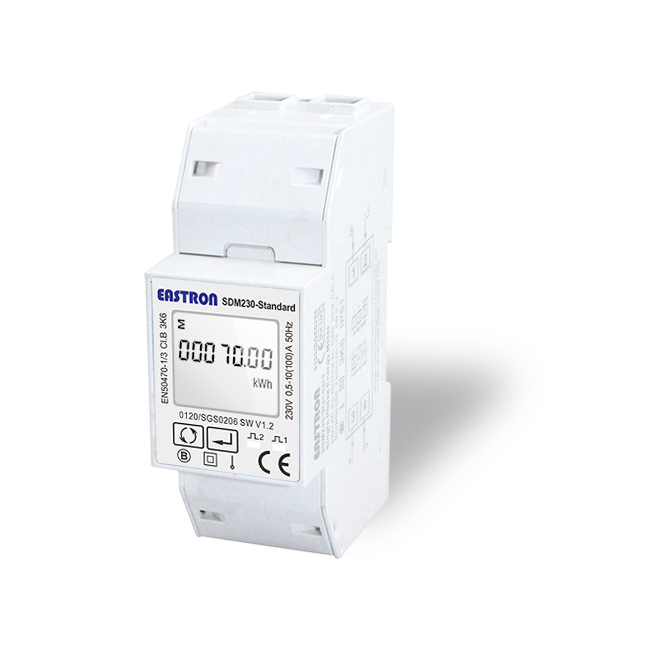
RS485 Modbus Din Rail Single Phase MID Energy Meter
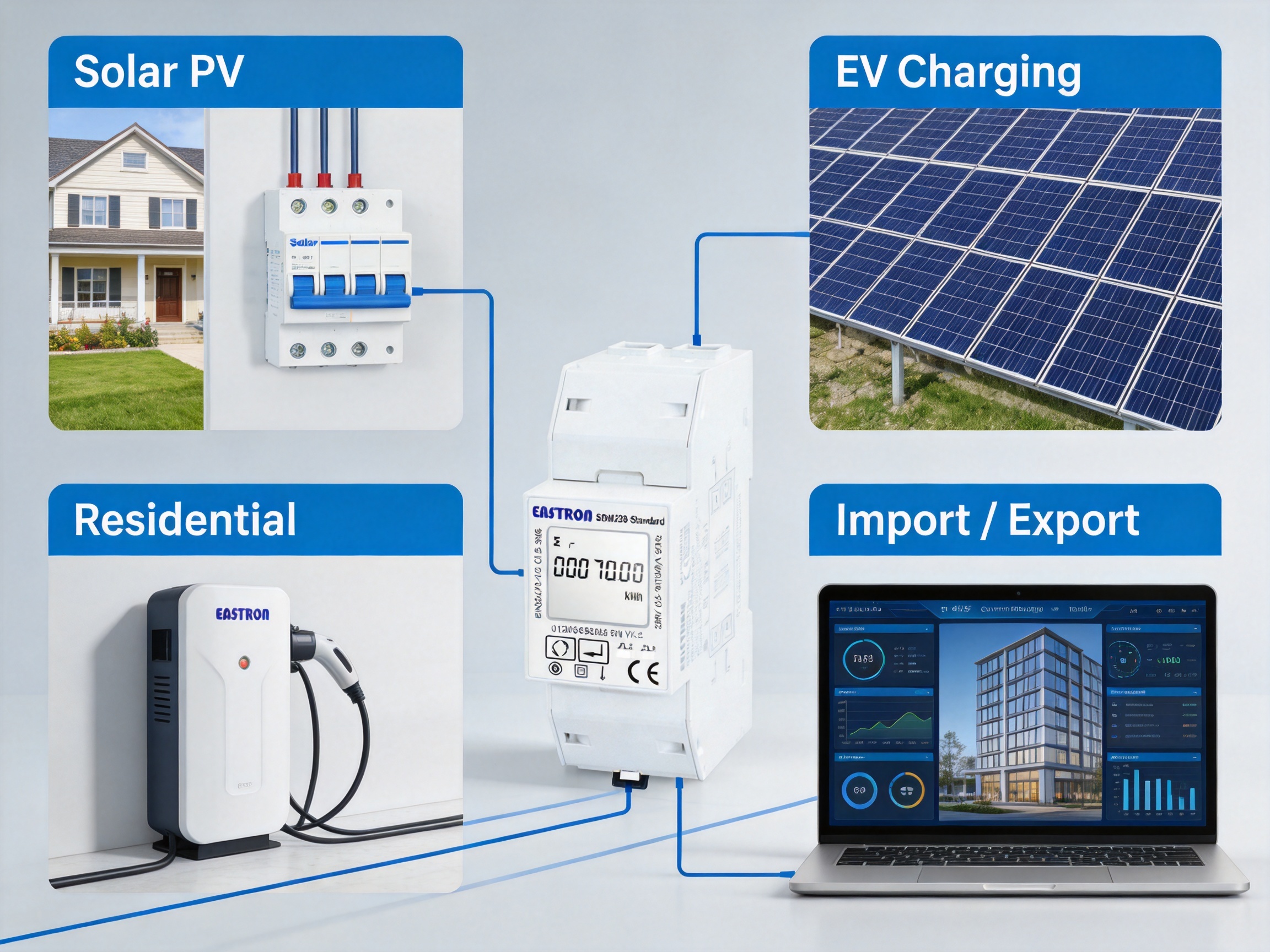
The RS485 Modbus DIN rail single phase MID energy meter is a 1P2W LCD kWh meter designed for direct connection applications up to 100A. It is built for modern electrical distribution panels where space is limited and data accessibility is essential. The product is especially suitable for measuring energy consumption in residential distribution boards, apartment sub-metering systems, small commercial premises, solar PV monitoring, EV charging circuits, industrial sub-circuits, and utility-related metering points.
The meter measures kWh and W, allowing users to read active energy accumulation as well as real-time power. This is useful because an energy total alone does not explain how a load behaves. A power reading helps identify peak usage, equipment operation patterns, abnormal standby consumption, or sudden changes in connected load. When this information is transmitted by RS485 Modbus RTU, it can be collected by a local gateway, supervisory control system, energy platform, or data logger for analysis and reporting.
The device supports bi-directional measurement, an increasingly important feature in renewable and prosumer environments. In traditional electrical systems, energy generally flows in one direction, from the grid to the load. In solar PV or battery-related applications, energy may flow in both directions depending on generation, consumption, and storage behavior. Bi-directional measurement makes the meter more flexible for installations where import and export conditions must be observed.
The product also includes two pulse outputs and one communication port. Pulse outputs remain valuable in metering systems because they provide a simple, robust method for energy counting and can be connected to pulse counters, data acquisition devices, or legacy monitoring systems. RS485 Modbus RTU provides a more advanced digital communication method, allowing remote reading of measurement values and configuration parameters. The combination of pulse and Modbus communication gives the meter compatibility with both traditional and modern monitoring architectures.
The meter is designed around practical field requirements. Its rated current is 10A, with a maximum current of 100A, minimum current of 0.5A, and starting current of 20mA. These current specifications indicate that the unit can work across a broad range of real-world load conditions, from light standby consumption to high-current single phase circuits. For many residential and light commercial circuits, the 100A direct load capacity is especially important because it eliminates the extra components required by transformer-operated metering.
The communication interface follows RS485 and Modbus RTU, a widely adopted industrial communication standard. RS485 is valued for its long-distance capability, noise resistance, and multi-drop networking. The meter supports communication addresses from 1 to 247, half duplex transmission, floating point data type, transmission distance up to 1000m, transmission speeds from 1200bps to 19200bps, parity options including none, odd, and even, stop bits of 1 or 2, and response time of less than 100ms. These features make the device suitable for integration into various supervisory and monitoring systems.
| Feature | Specification | Practical Benefit |
|---|---|---|
| Network Type | 1P2W single phase | Suitable for common residential, commercial, and single phase sub-metering circuits |
| Maximum Direct Load | 100A | Reduces or eliminates the need for external CTs in many installations |
| Display | Backlit LCD | Improves readability in electrical cabinets and low-light environments |
| Measured Values | kWh and W | Provides both accumulated energy and real-time power information |
| Communication | RS485 Modbus RTU | Enables remote reading and integration with monitoring systems |
| Pulse Outputs | Two pulse outputs | Supports energy counting and compatibility with pulse-based systems |
| Measurement Direction | Bi-directional | Useful for solar PV, export/import monitoring, and modern distributed energy systems |
| Width | 2 modules, 36mm | Saves DIN rail space in compact distribution boards |
| Certification | MID approved | Supports applications requiring recognized metering compliance |
| Transmission Distance | Up to 1000m | Allows flexible communication wiring in buildings and facilities |
A major advantage of this meter is its combination of compact size and high direct current capability. Many metering installations face a trade-off between compact form factor and high load capacity. Some meters require external current transformers for higher-current circuits, adding cost, wiring complexity, and potential accuracy issues if CT selection or orientation is incorrect. By supporting up to 100A direct load in a 36mm DIN rail format, this meter offers a practical balance between installation simplicity and measurement capability.
Compared with basic kWh meters that only provide local readings, the inclusion of RS485 Modbus RTU significantly improves system value. A local display is useful for on-site inspection, but modern energy management requires centralized data. With Modbus communication, readings can be collected automatically by gateways, controllers, or energy management systems. This reduces manual meter reading, minimizes human recording errors, and enables trend analysis, alarms, reporting, and load optimization.
Compared with meters that provide only one pulse output or no digital interface, the dual pulse output plus Modbus design is more versatile. Pulse outputs can be used for simple consumption counting, while Modbus can provide richer data access. This dual approach helps projects that must connect to existing pulse-based infrastructure while also preparing for future digital monitoring upgrades. For system integrators, this flexibility can reduce inventory complexity because one meter can serve a wider range of project types.
Another competitive strength is MID approval. In many markets, energy measurement equipment must demonstrate compliance with recognized metrological requirements, especially when readings are used for cost allocation, tenant billing, charging, or energy accountability. MID approval helps build confidence in the measurement performance and regulatory suitability of the meter. While certification alone does not replace proper installation and system design, it is a crucial factor when selecting a meter for serious energy management applications.
Bi-directional measurement is also a forward-looking advantage. Older meters and basic sub-meters are often designed around one-way consumption only. In contrast, modern electrical networks increasingly include solar PV, battery storage, microgeneration, and EV charging. A meter that can handle bi-directional measurement is better suited to facilities where energy flow may vary over time. This capability makes the product more adaptable as users add renewable generation or update energy strategies.
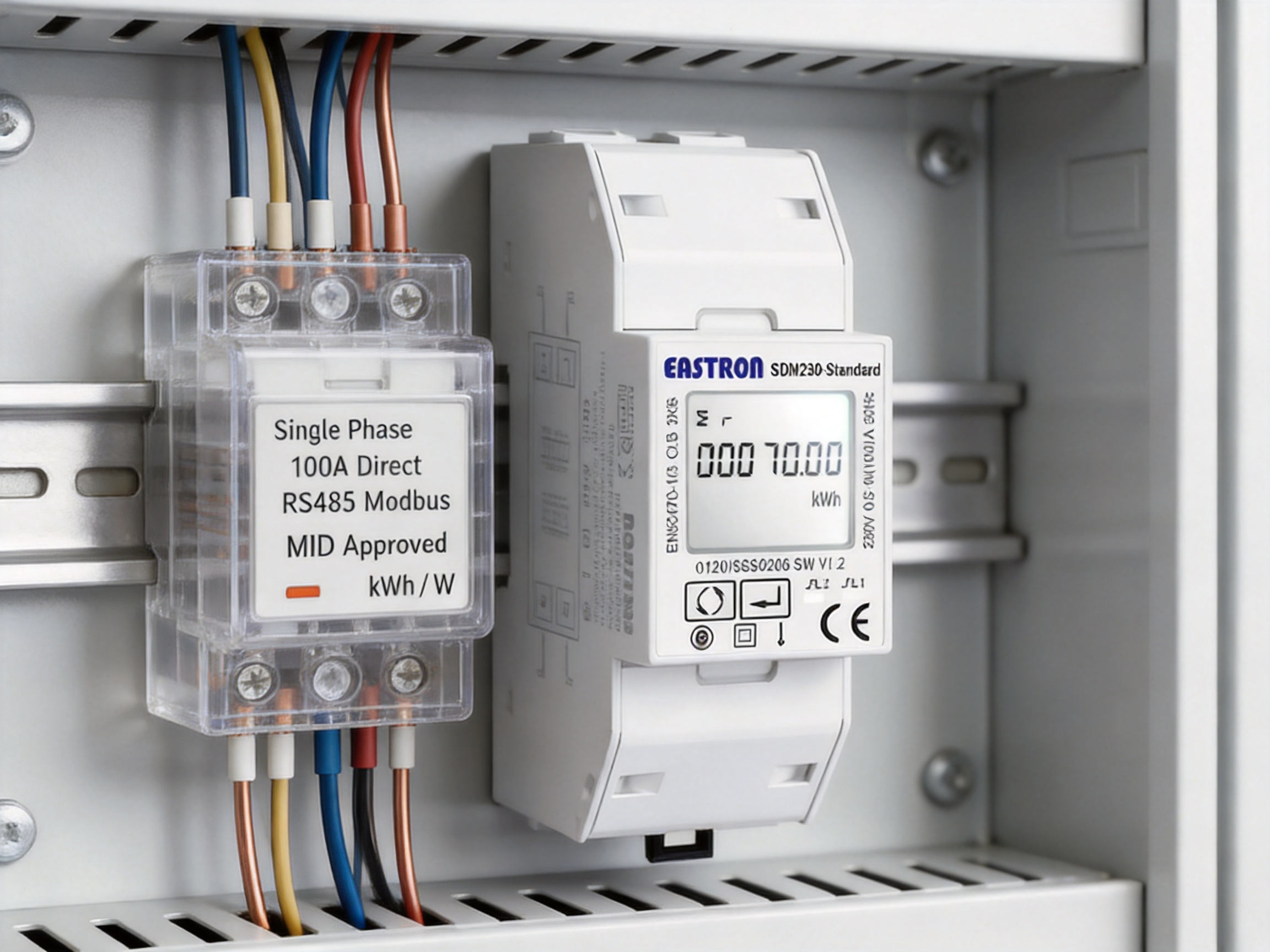
Direct connection up to 100A can simplify many single phase metering projects. When a meter requires external current transformers, the installer must choose the correct CT ratio, install CTs in the correct orientation, wire secondary circuits properly, and confirm configuration settings. Errors in any of these steps can lead to inaccurate readings or commissioning delays. A direct-connected meter reduces these variables by allowing the load conductor to connect through the meter without an external current transformer.
This has several practical benefits. First, it saves component cost because CTs, CT terminal blocks, and additional wiring may not be necessary. Second, it saves installation space, which is often limited in residential and commercial distribution boards. Third, it reduces installation time, an important factor when many meters must be installed in an apartment building, EV charging facility, or energy retrofit project. Fourth, it reduces the probability of wiring mistakes, especially in projects handled under tight schedules.
For users, direct connection also supports a cleaner and more understandable installation. Maintenance personnel can identify the metering path more easily, and fewer components mean fewer possible failure points. In applications where electrical cabinets are frequently inspected, a compact and straightforward layout improves serviceability. For project owners, this can translate into lower lifecycle cost and fewer support issues.
RS485 Modbus RTU remains one of the most widely used communication methods in electrical metering and industrial automation. Its popularity comes from its simplicity, stability, and broad compatibility. Many building management systems, data loggers, gateways, PLCs, and energy platforms can read Modbus registers. This makes the meter easy to integrate into new systems and retrofit projects.
The meter supports communication addresses from 1 to 247, allowing multiple devices to share the same RS485 network when properly wired and configured. This is useful in multi-meter installations such as apartment blocks, commercial tenant spaces, EV charging banks, and industrial distribution boards. With half duplex transmission and adjustable baud rates from 1200bps to 19200bps, the communication settings can be adapted to different system requirements.
The maximum transmission distance of 1000m is valuable for larger buildings and distributed electrical rooms. In practical installations, communication performance depends on cable type, topology, grounding, shielding, termination, electromagnetic environment, and the number of connected devices. However, RS485 is well known for performing reliably over significant distances when installed according to good engineering practice.
The response time of less than 100ms supports efficient polling in monitoring systems. In energy management, data does not always need millisecond-level speed, but responsive communication helps when multiple meters are read on one bus. Faster responses can reduce scan time and improve the user experience in dashboards or commissioning tools.
Although digital communication is increasingly important, pulse output remains a trusted and simple method for energy measurement integration. A pulse output generates pulses corresponding to measured energy. These pulses can be counted by a data logger, gateway, pulse counter, or building management input module. In many existing systems, pulse input infrastructure is already installed, and replacing it entirely with digital communication may not be economical.
The inclusion of two pulse outputs improves flexibility. A project may use one pulse output for a central monitoring system and another for a local counter or independent verification device. In some installations, pulse output can act as a backup data channel alongside Modbus communication. This helps improve confidence in metering data and allows staged system upgrades.
Pulse outputs are also easy for technicians to understand and test. In troubleshooting scenarios, observing pulse behavior can quickly confirm whether the meter is registering energy. For applications where simplicity and robustness are priorities, pulse output remains a practical feature.
A backlit LCD display is an important usability feature. Electrical cabinets are often installed in basements, utility rooms, outdoor enclosures, plant rooms, and low-light environments. A readable display helps electricians, inspectors, and maintenance personnel confirm readings without using additional lighting or connecting a computer. This reduces inspection time and improves safety by minimizing unnecessary handling inside cabinets.
Local display also supports commissioning. Before communication systems are fully configured, technicians can check whether the meter powers up, measures load, and displays expected values. If a monitoring system shows unexpected data, the local display can help determine whether the issue is related to the meter, communication wiring, register mapping, or software configuration.
MID approval is a major reason this meter is attractive for professional energy measurement. The European Measuring Instruments Directive 2014/32/EU establishes requirements for measuring instruments placed on the market for specific uses. For electricity meters, MID approval indicates that the product has been assessed according to relevant metrological performance and conformity requirements.
In applications such as tenant billing, sub-billing, cost allocation, EV charging settlement, and energy service contracts, measurement confidence is essential. A low-cost non-approved meter may appear attractive at the purchase stage, but it can create disputes if readings are questioned. A MID approved meter provides a stronger foundation for transparent energy accounting.
MID approval also reflects the manufacturer's commitment to controlled production and quality processes. Producing metering devices that meet such standards requires attention to design, component selection, calibration, testing, documentation, and production consistency. This is where manufacturing strength becomes as important as product features.
In residential environments, the meter can be used for whole-home energy monitoring, apartment sub-metering, rental unit energy allocation, heat pump circuit monitoring, solar PV import/export observation, and EV charging circuit measurement. Its compact 2-module width is especially useful in domestic distribution boards where space is limited. The direct 100A load capability is suitable for many residential single phase supplies and high-current household circuits.
For homeowners, the meter provides visibility into electricity consumption. When connected to a monitoring system, the data can reveal daily usage patterns, standby loads, peak demand periods, and the effect of energy-saving measures. For landlords and property managers, accurate sub-metering supports fair cost distribution and encourages responsible energy use.
In apartment buildings, multiple meters can be connected through RS485 Modbus to a gateway. The gateway can collect readings automatically and send data to a platform for reporting. This reduces manual reading work and supports more frequent data collection. Instead of reading once per month, managers can analyze consumption daily or even more often depending on system design.
Solar PV systems often require accurate monitoring of energy import, export, and local consumption. A bi-directional single phase meter is well suited to these requirements. When a household or small commercial building generates solar power, energy may flow from the grid to the building during low generation periods and from the building to the grid during surplus generation periods. A meter capable of bi-directional measurement helps capture this behavior.
When integrated with an inverter monitoring system, gateway, or energy management platform, the meter can contribute to a clearer picture of energy balance. Users can understand how much electricity is consumed locally, how much is exported, and when grid dependence occurs. This information can guide decisions about battery storage, load scheduling, EV charging timing, or tariff optimization.
The 100A direct connection capability is useful in many single phase solar installations because it keeps the measurement design simple. The compact DIN rail housing also fits well into PV distribution enclosures and control panels.
Electric vehicle charging is one of the fastest-growing areas for energy metering. EV chargers can represent significant loads, and charging sessions may need to be measured for cost allocation, user reporting, energy management, or load balancing. The meter's direct 100A capacity and Modbus communication make it suitable for many single phase EV charging installations.
In residential EV charging, the meter can help track the energy consumed by the charger separately from the rest of the home. This is useful for expense reimbursement, solar charging analysis, or understanding vehicle energy cost. In commercial or workplace charging, Modbus communication allows metering data to be collected by a central controller or charging management system.
For multi-charger sites, multiple meters can be networked on RS485. This supports centralized data collection and can help operators monitor usage across charging points. When combined with energy management software, metering data may also support demand control strategies to avoid overloading electrical infrastructure.
Industrial facilities often need sub-metering for machines, workshops, production lines, lighting circuits, HVAC equipment, compressed air systems, and auxiliary loads. While large industrial loads may require three phase meters or CT-operated devices, many single phase circuits still need accurate monitoring. This meter provides a compact solution for those circuits.
Power measurement in watts helps maintenance teams identify operating states. For example, a machine auxiliary circuit may show a predictable power profile during normal operation. If consumption changes unexpectedly, it may indicate equipment malfunction, control problems, or inefficient operation. Energy measurement in kWh supports cost allocation and efficiency analysis over time.
Utility-related applications may include distribution board monitoring, small service metering, remote site energy measurement, and equipment enclosure monitoring. The RS485 interface allows integration with remote terminal units or gateways, while the pulse outputs support simpler telemetry designs.
A reliable energy meter is not only the result of a good circuit design. It also depends on disciplined manufacturing, controlled calibration, robust testing, and long-term engineering capability. The company behind this product is a high-tech manufacturer and supplier of electricity products and energy measurement solutions headquartered in Jiaxing, China, near Shanghai, Hangzhou, and Jiangsu. This location provides access to strong industrial supply chains, transportation networks, engineering talent, and international trade resources.
The company develops and produces electricity meters, power analyzers, current sensors, communication modules, and management systems. This broad product scope is important because modern metering projects often require more than a single device. A manufacturer with experience across meters, sensors, communication modules, gateways, and systems is better positioned to understand integration requirements and real-world customer challenges.
Continuous investment in research and development supports product improvement and new technology adoption. Energetic and innovative development teams in China and the United Kingdom contribute to product competitiveness, while cooperation with leading universities and institutions helps bring advanced technologies into product development. This international and collaborative approach is particularly valuable in metering, where standards, communication protocols, grid practices, and customer requirements vary across regions.
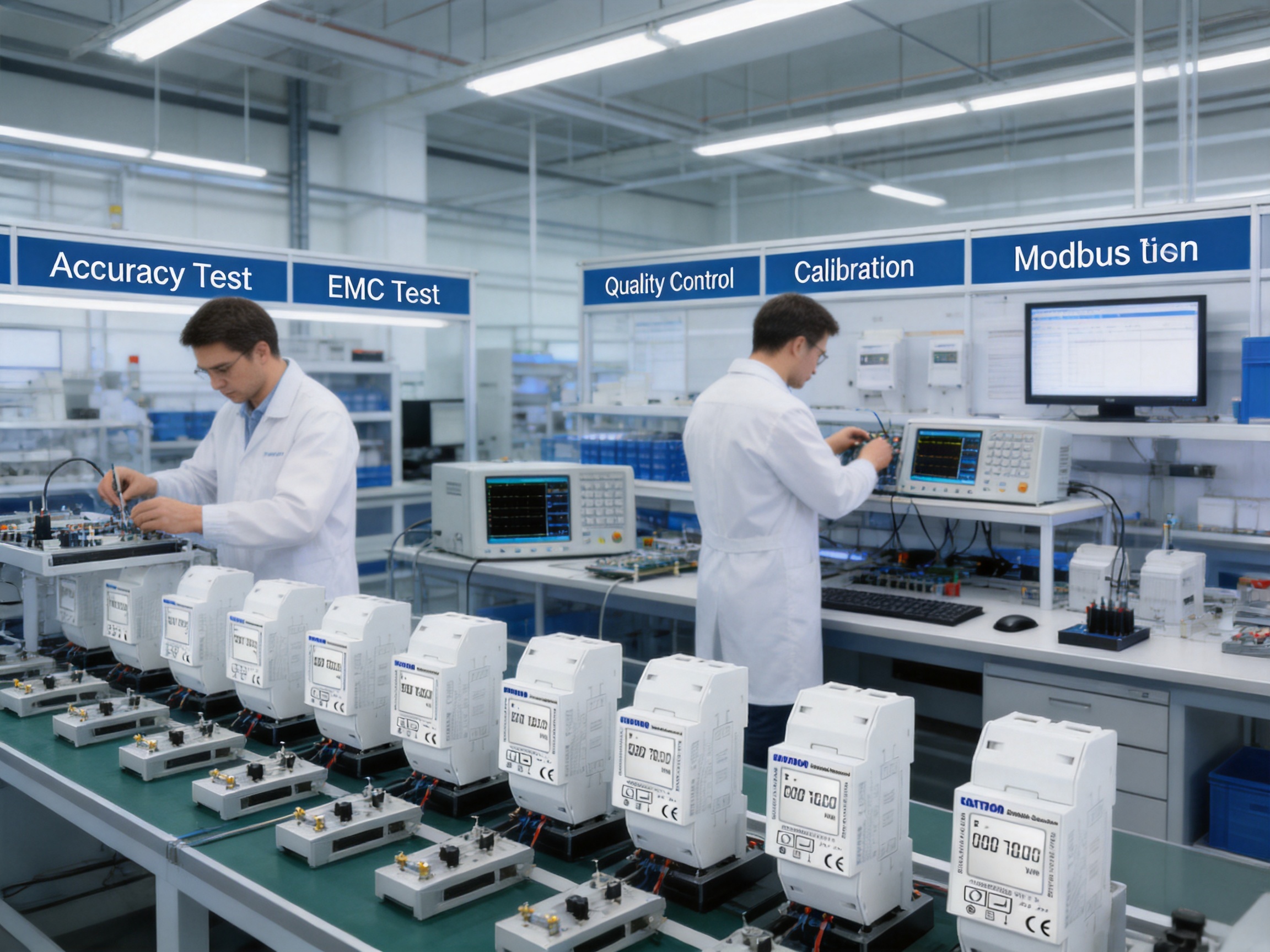
The company has established its own professional laboratory capable of performing EMC, LVD, accuracy, and environmental tests according to IEC, EN, GB, and UL standards. This laboratory capability is a major advantage over manufacturers that rely only on external testing at the final certification stage. Internal testing allows engineers to validate designs earlier, identify weaknesses faster, and improve product robustness before mass production. It also supports consistent quality control during ongoing production.
EMC testing helps verify that meters can operate in electromagnetic environments commonly found in electrical installations. LVD-related testing addresses electrical safety requirements. Accuracy testing confirms that metering performance stays within required limits. Environmental testing evaluates how products behave under temperature, humidity, and other conditions. Together, these test capabilities support reliability and customer confidence.
The company follows the ISO 9001 quality management system, and its production is approved by SGS according to MID standards. ISO 9001 provides a framework for process control, quality documentation, corrective actions, continuous improvement, and customer-focused management. SGS approval related to MID production supports confidence that approved products are manufactured under controlled conditions. For energy meters, this production control is critical because metrological performance must be repeatable from unit to unit.
The company also holds many patented technologies in software, embedded software, and hardware, and has been recognized as a High-tech Enterprise and High-tech R&D Centre of Electricity Application. These recognitions reflect technical capability beyond simple assembly. Embedded software is particularly important for modern meters because it handles measurement algorithms, display operation, communication protocols, parameter settings, and data processing. Strong software capability helps ensure stable communication, accurate calculation, and user-friendly operation.
Producing a meter for professional applications requires control at many stages. Component selection must support long-term stability, electrical safety, measurement accuracy, and communication reliability. Printed circuit board assembly must be consistent. Soldering quality, insulation distances, terminal strength, housing materials, display assembly, firmware programming, calibration, and final inspection all affect the end product.
In a high-quality manufacturing environment, each meter must be assembled according to controlled work instructions. Testing should verify not only basic power-up operation but also measurement accuracy, display performance, communication response, output functions, and safety-related characteristics. For a Modbus meter, communication testing is especially important because data integration is often the main reason customers choose the product.
Calibration is another critical process. Energy meters must accurately measure voltage, current, power, and energy over defined operating ranges. Calibration procedures align the measurement system to required accuracy limits. A professional manufacturer uses dedicated equipment and documented processes to ensure repeatable calibration. This is particularly important for MID approved products, where measurement integrity is a core requirement.
Traceability is also valuable. In professional production, records can link products to production batches, test results, firmware versions, and quality checks. If a customer reports an issue, traceability helps the manufacturer investigate quickly and provide targeted support. This reduces downtime and improves after-sales service.
System integrators look for products that are easy to specify, install, commission, and support. This meter offers several benefits in that regard. Its DIN rail form factor matches standard electrical panel practice. Its 36mm width supports dense installations. Its 100A direct connection capability simplifies design for many single phase circuits. Its Modbus RTU interface supports widely used communication tools. Its pulse outputs provide additional integration options. Its MID approval supports projects where recognized metering compliance is important.
The availability of a communication address range from 1 to 247 allows integrators to create multi-meter networks. Adjustable baud rate, parity, and stop bit settings make the device adaptable to existing Modbus environments. Floating point data type support can simplify data interpretation in compatible software systems. Response time under 100ms helps when polling many devices.
The local display reduces commissioning risk. If communication readings appear incorrect, technicians can compare them with LCD readings. If the meter displays expected values but the supervisory system does not, the issue may be in wiring, addressing, register mapping, or software. This makes troubleshooting more efficient.
Although the meter is designed for convenient installation, professional electrical practice remains essential. Installers should confirm that the application is single phase 1P2W and that the load current does not exceed the meter's specified maximum. Wiring should follow the product wiring diagram and local electrical regulations. Terminals should be tightened correctly, conductor sizes should be appropriate, and the installation environment should meet applicable requirements.
For RS485 communication, twisted pair cable is generally recommended, and shielding may be useful in electrically noisy environments. Correct polarity, bus topology, termination, and grounding practice can significantly affect communication quality. Each device on the Modbus network should have a unique address. Baud rate, parity, and stop bit settings should match the master device or gateway.
During commissioning, technicians should verify voltage presence, load current, LCD operation, energy accumulation, pulse output behavior, and Modbus communication. A simple commissioning checklist can prevent many common issues. For example, if multiple meters are installed, addresses should be documented clearly in the panel schedule. If software is used, register maps and scaling should be checked before handover.
In billing or cost allocation applications, commissioning records are especially important. Recording installation date, meter serial number, location, initial reading, communication address, and circuit description creates a reliable baseline. This helps avoid disputes and simplifies future maintenance.
The value of a meter extends beyond the purchase price. A low-cost meter that is difficult to install, lacks communication, occupies excessive space, or causes data reliability problems may become expensive over time. Conversely, a compact and communicative meter can reduce lifecycle cost by simplifying installation, supporting remote reading, and improving energy visibility.
With Modbus communication, the meter can help automate energy reporting. Manual meter reading consumes time and is vulnerable to transcription errors. Automated data collection can support daily, hourly, or more frequent reporting depending on the monitoring system. This enables better decision-making. Facility managers can identify inefficient loads, compare consumption between areas, detect unusual usage, and verify savings from efficiency projects.
For organizations managing many sites, standardized metering data supports benchmarking. Similar buildings, apartments, chargers, or production areas can be compared. High consumption outliers can be investigated. Over time, this leads to more disciplined energy management.
The meter's bi-directional capability also supports long-term adaptability. As more facilities add solar generation, battery storage, or EV charging, energy flow becomes more dynamic. Installing a meter that can handle modern energy conditions helps protect the investment against future system changes.
Panel space is a real cost in electrical design. Larger distribution boards, extra enclosures, and complicated wiring layouts increase material and labor expense. The meter's 2-module 36mm width makes it practical for installations where multiple metering points must fit into limited space. In apartment sub-metering, EV charging panels, and small commercial boards, this compactness can be decisive.
A compact meter also improves cabinet organization. Clear layouts reduce installation errors and make maintenance safer. When meters are arranged neatly on DIN rails with organized communication wiring, technicians can identify circuits quickly. This is important in facilities where service personnel may not be the original installers.
Energy cost allocation requires measurement that users can trust. In multi-tenant buildings, shared facilities, workshops, and EV charging areas, disputes can arise if users believe charges are estimated or unfair. A MID approved meter with local display and digital communication supports transparency. Users can read the display locally, while managers can collect data remotely.
Transparent cost allocation can also influence behavior. When users see accurate consumption data, they are more likely to manage usage responsibly. In commercial settings, departments can be accountable for their own energy consumption. In residential settings, tenants can understand their own usage instead of paying averaged or estimated charges.
For EV charging, accurate energy measurement is particularly important because charging sessions may be reimbursed or billed. A reliable meter helps connect energy usage to cost in a clear way.
Non-communicating meters may be acceptable for simple local reading, but they limit the potential of energy management. Without remote communication, data must be collected manually. Manual readings are often infrequent, meaning users may only discover unusual consumption after a billing period ends. Remote communication allows earlier detection and more detailed analysis.
A Modbus-enabled meter can become part of a larger digital energy system. It can feed data to dashboards, alarms, reports, and control strategies. For example, a facility manager can receive alerts when consumption exceeds expected levels. A solar system owner can compare generation and consumption patterns. An EV charging operator can monitor charger usage. These possibilities are difficult with a meter that only displays local kWh.
CT-operated meters are necessary for many high-current applications, but they are not always the best choice for circuits within the 100A range. CT systems require additional components and careful configuration. If the CT ratio is set incorrectly or the CT is installed in the wrong direction, readings may be wrong. CT secondary wiring also introduces additional installation considerations.
For direct-load applications up to 100A, this meter can reduce complexity. The installer does not need to match CT ratios or mount separate transformers. This can be especially helpful when many meters are installed by different technicians or when projects must be completed quickly. Reduced complexity often means fewer mistakes and faster commissioning.
Power analyzers and advanced multi-function meters can provide extensive measurement data, but they may be larger, more expensive, and more complex than required for many single phase energy monitoring applications. If the main requirement is reliable kWh and W measurement with Modbus communication and MID approval, a compact DIN rail single phase meter is often more appropriate.
Selecting the right level of functionality is important. Over-specifying equipment increases cost and complexity. Under-specifying equipment limits future usefulness. This meter occupies a practical middle ground: more capable than a basic kWh counter, but more compact and economical than a full power analyzer for applications that do not require advanced power quality functions.
The manufacturer provides not only products but also technical support and after-sales service. This matters because energy metering projects often involve integration questions, communication settings, installation conditions, and application-specific requirements. Professional support can help customers select suitable products, resolve technical issues, and maintain confidence in long-term operation.
The company's products and services have been supplied to more than 50 countries across Europe, Asia-Pacific, America, the Middle East, and Africa. This global experience indicates exposure to diverse electrical standards, installation practices, customer expectations, and environmental conditions. A meter designed and produced by a company with international market experience is more likely to meet the practical needs of varied users.
The company's stated values of integrity, pragmatism, refinement, and innovation align well with metering product development. Integrity is essential because energy measurement depends on trust. Pragmatism is important because products must work reliably in real installations. Refinement supports continuous improvement in design and manufacturing. Innovation helps the company respond to changing energy systems, communication requirements, and customer needs.
This meter is a strong choice when the application is single phase 1P2W, the maximum current is within 100A, DIN rail mounting is required, and remote data access through RS485 Modbus is desired. It is also appropriate when pulse outputs are needed, when a compact 36mm width is beneficial, and when MID approval is important for measurement confidence.
It may not be the correct choice for three phase circuits, loads above the specified direct current range, or applications requiring advanced power quality analysis beyond the product's intended measurement functions. In those cases, a three phase meter, CT-operated meter, or power analyzer may be more suitable. Proper product selection ensures accurate measurement, safe installation, and cost-effective system design.
Before specifying the meter, project designers should confirm electrical system type, maximum load current, required certification, communication protocol, panel space, environmental conditions, and data integration method. They should also consider whether pulse output, Modbus communication, or both will be used. This planning helps avoid design changes during installation.
It is designed for 1P2W single phase electrical systems. It is suitable for many residential, commercial, solar PV, EV charging, industrial sub-metering, and utility-related single phase applications.
The meter supports a maximum direct load of 100A. This allows many single phase circuits to be metered without external current transformers, simplifying installation and reducing component cost.
Yes. The meter includes RS485 Modbus RTU communication. It can be integrated with gateways, monitoring systems, building management systems, data loggers, or energy management platforms that support Modbus RTU.
RS485 Modbus RTU is widely used in industrial and building automation. It supports multi-device networks, long-distance communication, and straightforward integration with many controllers and software platforms. This makes the meter suitable for centralized energy monitoring.
Two pulse outputs provide flexible integration with pulse counters, data acquisition systems, and legacy monitoring equipment. They can also be used alongside Modbus communication for compatibility or redundancy.
Yes. The meter supports bi-directional measurement, making it suitable for applications where energy may flow in both directions, such as solar PV systems with import and export conditions.
Yes. For single phase EV charging circuits within the meter's current rating, it can measure energy consumption and transmit data by Modbus. This is useful for cost allocation, reporting, and charging energy analysis.
MID approval indicates that the meter has been approved according to the requirements of EU Directive 2014/32/EU for measuring instruments. This supports confidence in measurement performance and is important in applications where recognized metering compliance is needed.
The meter has a compact 2-module design with a width of 36mm. This helps save DIN rail space in distribution boards and metering panels.
For applications up to 100A direct load, external current transformers are not required. This reduces installation complexity, wiring work, and potential CT-related configuration errors.
The meter measures active energy in kWh and power in W. These values support both accumulated consumption tracking and real-time load observation.
The manufacturer has professional capabilities in electricity meters, power analyzers, current sensors, communication modules, and management systems. It operates its own laboratory for EMC, LVD, accuracy, and environmental testing according to IEC, EN, GB, and UL standards. It follows ISO 9001 quality management and has production approved by SGS according to MID standards.
The RS485 Modbus DIN rail single phase MID energy meter is a practical and competitive solution for modern energy measurement. It combines a compact 36mm DIN rail design, direct 100A load capability, backlit LCD display, kWh and W measurement, bi-directional operation, two pulse outputs, RS485 Modbus RTU communication, and MID approval. This combination makes it more capable than basic kWh meters, easier to install than many CT-operated solutions within the same current range, and more cost-effective than oversized analyzers for applications that require focused single phase energy monitoring.
Its advantages are especially clear in residential sub-metering, solar PV monitoring, EV charging, commercial energy management, industrial sub-circuit monitoring, and utility-related single phase applications. By supporting both pulse and digital communication, the meter bridges traditional and modern energy data systems. By supporting direct connection up to 100A, it reduces installation complexity. By offering MID approval, it supports measurement confidence and professional project requirements.
The product is further strengthened by the manufacturing capabilities behind it. A company with international experience, R&D teams in China and the United Kingdom, cooperation with universities and institutions, patented technologies, an internal professional testing laboratory, ISO 9001 quality management, and MID-related production approval provides a strong foundation for reliable metering products. In energy measurement, where accuracy, consistency, safety, and data integrity matter, manufacturing strength is not optional; it is part of the product's value.
For project designers, installers, system integrators, property managers, energy service companies, and equipment builders seeking a compact single phase meter with reliable communication and recognized approval, this product offers a balanced and future-ready choice. It supports today’s need for accurate consumption measurement while preparing installations for the increasingly digital, distributed, and data-driven energy systems of tomorrow.
European Parliament and Council. Directive 2014/32/EU on the harmonisation of the laws of the Member States relating to the making available on the market of measuring instruments.
International Electrotechnical Commission. IEC standards related to electricity metering equipment, electromagnetic compatibility, and low-voltage electrical safety.
European Committee for Standardization and European Committee for Electrotechnical Standardization. EN standards for measuring instruments and electrical equipment conformity.
International Organization for Standardization. ISO 9001 Quality Management Systems Requirements.
Modbus Organization. Modbus Application Protocol and Serial Line Implementation Guidance.
General industry practice references for DIN rail electrical panel design, RS485 communication networks, energy sub-metering, and building energy management systems.
Your email address will not be published. Required fields are marked *

We develop and produce high performance electricity meters, power analyzers, current sensors, communication modules and management systems. China Custom Smart Meters Manufacturers and Factory
Address:NO 52, Dongjin Road, Nanhu, Jiaxing, Zhejiang, China
Copyright @ Eastron Electronic Co., Ltd. All rights reserved Electricity Meters Manufacturers
