

 English
 Español
 Deutsch
 中文简体


Product Consultation
Your email address will not be published. Required fields are marked *
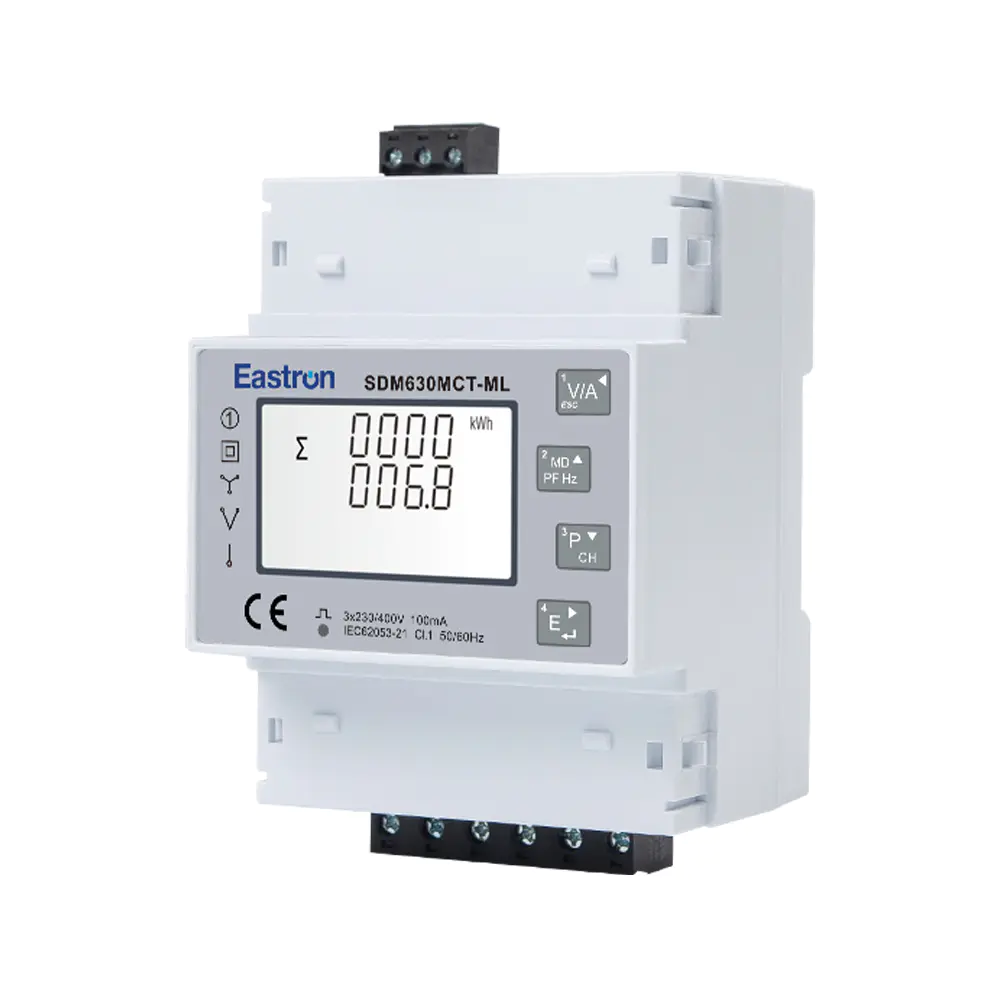
Multi-Circuit Three Phase Ethernet Modbus TCP Energy Meter for Data Center Metering
Aug 03,2022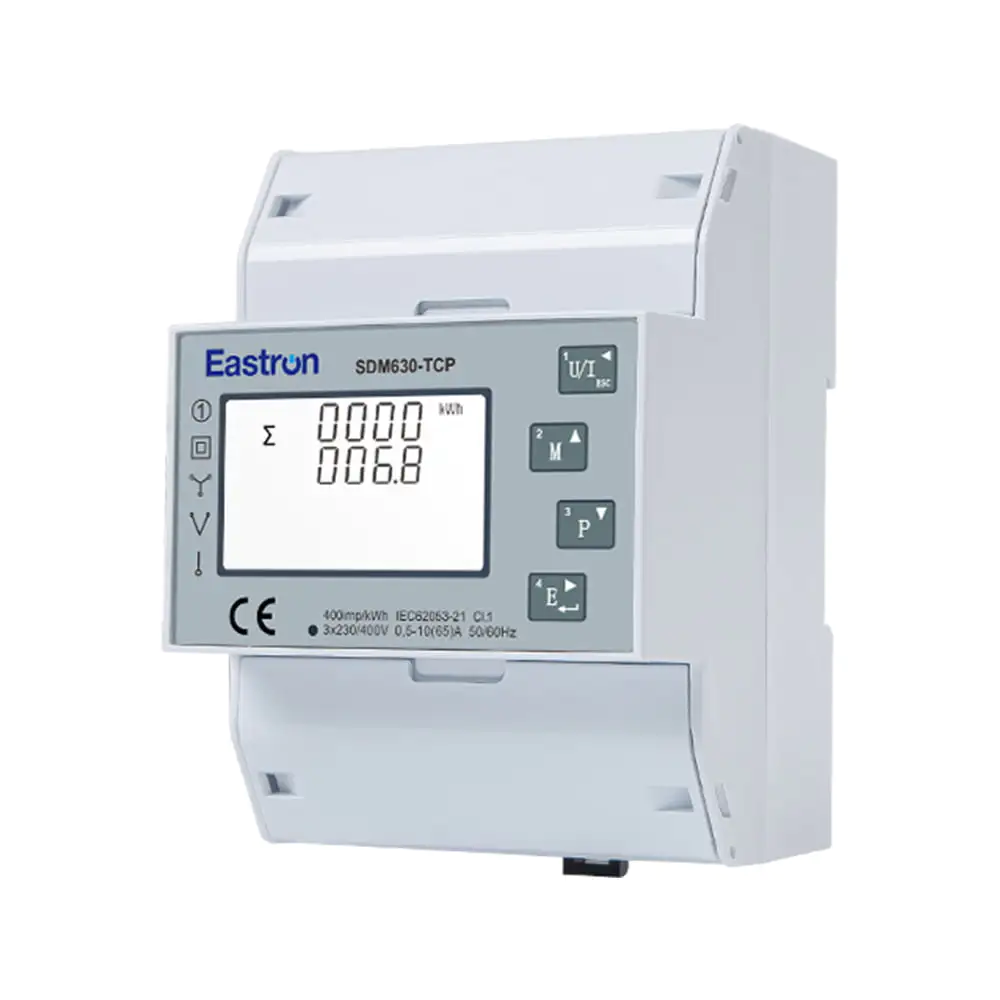
Direct Type Three Phase Ethernet Modbus TCP Energy Meter for Data Center Metering
Nov 24,2022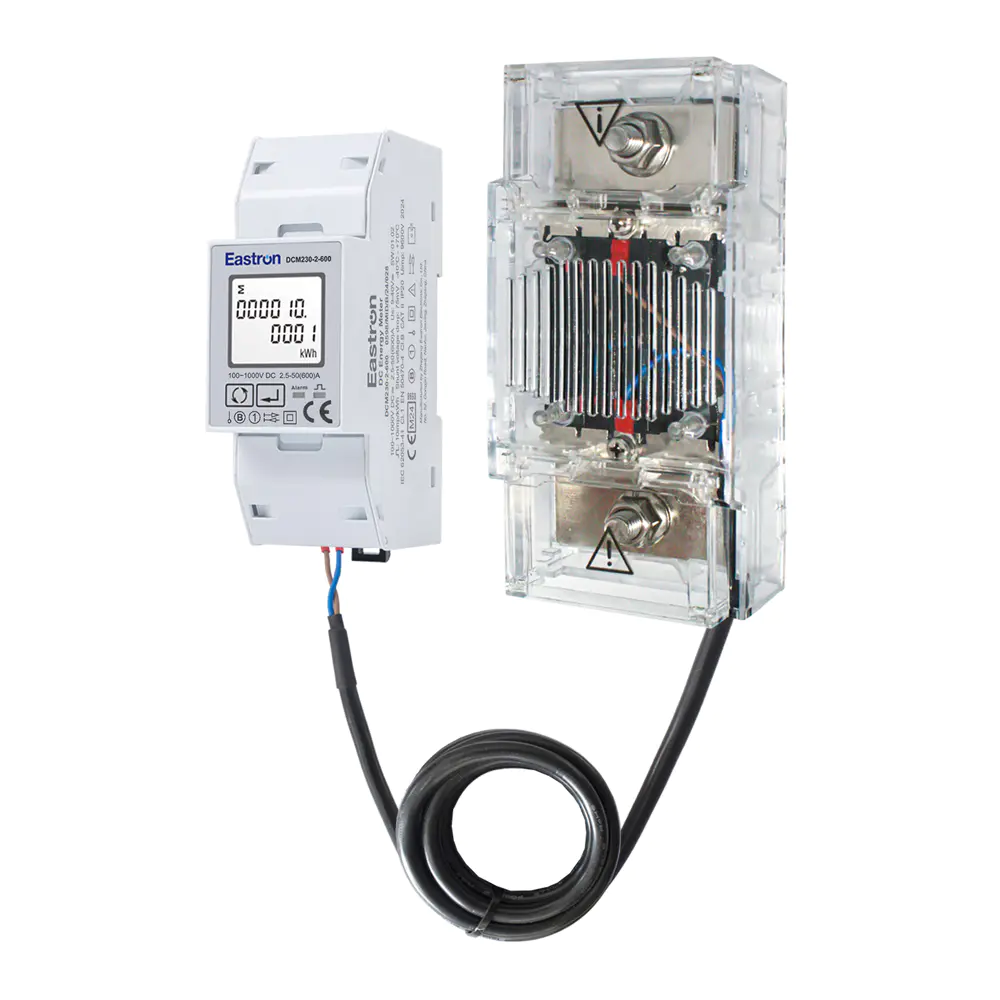
Max. Current 600A Modbus Multi-function DC Energy Meter for EV Charging Metering
Aug 02,2022
Din Rail DC Energy Monitoring Meter for EV Charging Metering
Aug 02,2022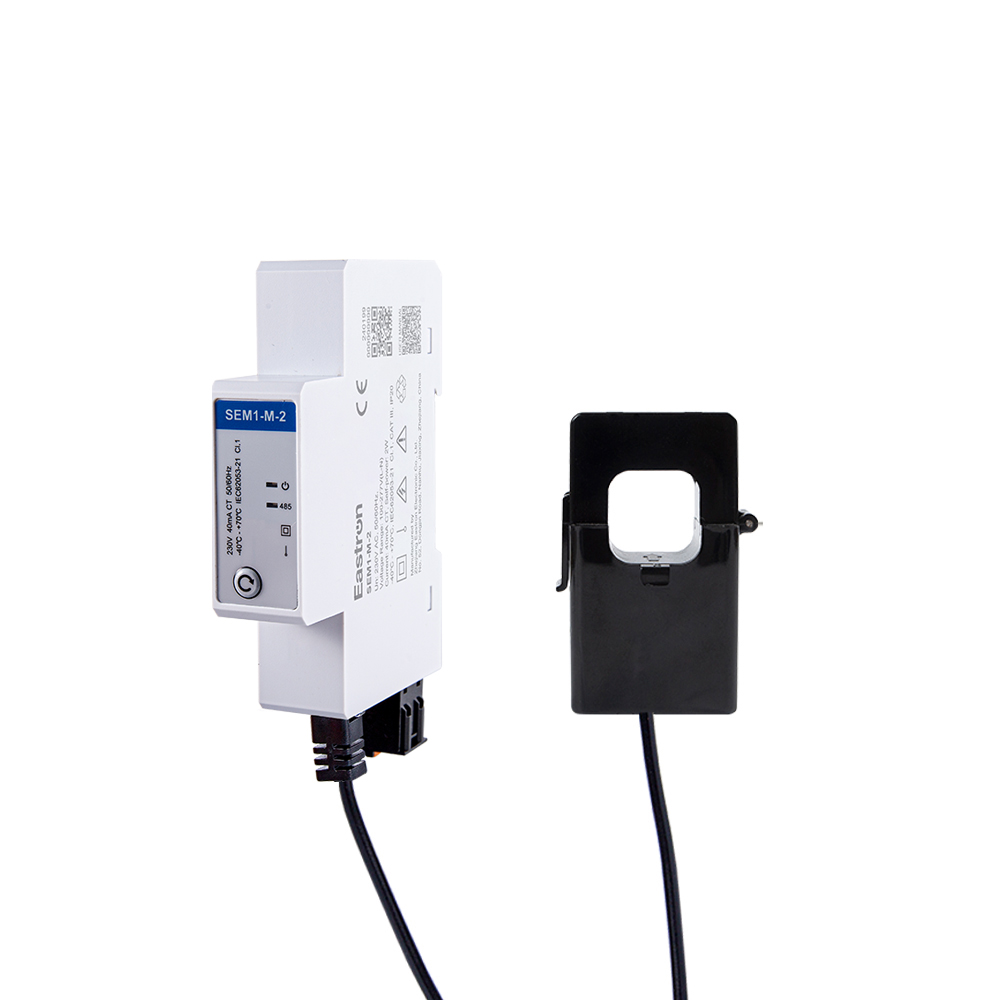
CT Type RS485 Modbus Single Phase Din Rail Energy Meter for PV Metering
May 30,2025
Din Rail Dual Channels DC Energy Monitoring Meter for EV Charging Metering
Aug 02,2022Content
Modern energy management depends on the ability to collect, exchange, and interpret data from many different devices. Electricity meters, power analyzers, sensors, controllers, protection equipment, and automation systems may use different communication interfaces and different network architectures. In many installations, existing field devices communicate through serial Modbus RTU, while supervisory systems, industrial computers, and cloud-connected platforms rely on Ethernet and Modbus TCP/IP. Connecting these two environments efficiently requires a dependable protocol gateway and serial device server.
The ESP-2100 is designed for this purpose. It provides a practical bridge between Modbus RTU serial networks and Modbus TCP/IP Ethernet networks, allowing established serial devices to participate in modern industrial communication systems. It can also make Modbus TCP devices accessible to serial masters, giving system integrators flexibility when expanding or upgrading an installation.
As an industrial communication product, the ESP-2100 is intended for demanding environments where stable data transmission, straightforward configuration, electromagnetic resilience, and compatibility with existing infrastructure are important. Its design combines an Ethernet port with RS232, RS422, and RS485 communication options, supports up to 256 nodes on each RS485 port, and includes network functions such as DHCP, DNS, and HTTP.
This article examines the product’s role, architecture, application value, integration advantages, and the manufacturing strengths behind it. It also explains how a gateway of this type can help organizations modernize energy measurement systems without replacing every installed field device.
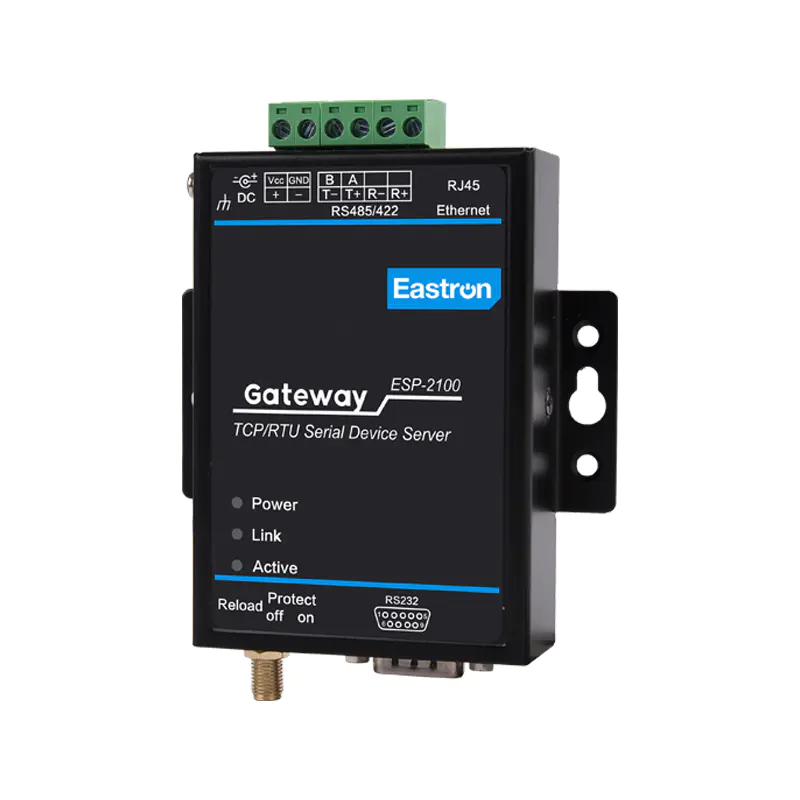
RS485 Modbus RTU to Ethernet TCP/IP Serial Server for IOT Solutions
Energy measurement systems are becoming more connected. A single project may include multifunction energy meters, MID-compliant meters, power analyzers, current transformers, gateways, relays, switches, and supervisory software. These devices may be installed in distribution boards, factories, commercial buildings, renewable energy facilities, data centers, or infrastructure projects.
Many meters and industrial instruments use serial communication because it is proven, economical, and well suited to field installations. Modbus RTU over RS485 is particularly common. It allows multiple slave devices to share a bus and communicate with a master controller, data concentrator, PLC, or building management system.
Ethernet, however, has become the preferred backbone for many modern facilities. Ethernet infrastructure is widely available, and it supports communication across longer organizational networks, industrial switches, control rooms, remote servers, and information technology systems. Modbus TCP/IP is therefore frequently used when plant-level or enterprise-level systems need access to field information.
The difference between these communication environments creates an integration gap. A serial meter cannot directly communicate with an Ethernet-based monitoring platform unless an appropriate conversion device is installed. Replacing all legacy meters may be expensive, disruptive, and unnecessary. A protocol gateway offers a more efficient alternative by translating communication between the two networks.
The gateway must do more than change electrical signals. It must manage communication rules, address mapping, network sessions, serial timing, and the relationship between masters and slaves. It should also operate reliably in environments affected by electrical noise, voltage disturbances, temperature changes, and complex wiring arrangements. These requirements make the selection of a gateway an important engineering decision rather than a simple accessory purchase.
The ESP-2100 is a Modbus RTU to TCP/IP gateway and high-performance serial device server. Its central function is to connect serial Modbus devices with Ethernet-based Modbus systems. In one direction, it enables Modbus RTU slave devices to be incorporated into an existing Modbus TCP network. In the other direction, it allows Modbus TCP slave devices to be accessed by serial masters.
This bidirectional capability is valuable because industrial systems are rarely built from one communication standard alone. A project may have a legacy PLC using RS485, newer meters connected to Ethernet, and a central energy management platform operating through Modbus TCP. The ESP-2100 can help these different sections communicate without forcing the entire installation to use one interface.
The product is positioned for Internet of Things and industrial connectivity solutions. By bringing serial data onto an Ethernet network, it creates a path for energy information to reach local dashboards, supervisory systems, databases, remote monitoring platforms, and broader digital management applications.
The principal product features include:
These features allow the ESP-2100 to serve as both a protocol converter and a network-accessible serial server. This combination gives it a broader role than a basic interface adapter. It can become an important communication point in a distributed electricity measurement and automation system.
Modbus RTU is a serial communication protocol commonly used with RS485, RS422, or RS232 interfaces. In a typical Modbus RTU network, a master sends a request containing a device address, function code, register information, and error-checking data. The designated slave responds with the requested information or an exception message.
RS485 is especially suitable for multidrop networks because several devices can share the same communication bus. This reduces cabling requirements and allows multiple meters or instruments to be connected to a single serial channel. The ESP-2100 supports up to 256 nodes on each RS485 port, offering substantial capacity for large device groups when the overall network design, addressing, wiring, and communication conditions are properly managed.
Modbus TCP/IP uses Ethernet and the TCP/IP protocol suite. Instead of serial frames, information is transported in network packets. A Modbus TCP client sends requests to a server through an IP network. The server may be a meter, controller, gateway, or other compatible device.
The ESP-2100 performs the necessary communication conversion between these formats. When an Ethernet-based Modbus TCP system requests information from a serial meter, the gateway receives the TCP request, converts it into an appropriate Modbus RTU request, sends it across the serial network, receives the response, and returns the data to the Ethernet system. The reverse process is used when a serial master needs to reach a Modbus TCP device.
This conversion helps preserve the value of existing field equipment. A facility can continue using installed meters and analyzers while introducing Ethernet-based monitoring and management. The gateway becomes an interoperability layer between proven field communication and modern network infrastructure.
The most important advantage of the ESP-2100 is its ability to connect Modbus RTU and Modbus TCP systems. Many industrial communication products are designed for only one direction or one limited application. A gateway capable of supporting communication between both network types provides greater design freedom.
For system integrators, interoperability reduces the need to redesign a complete project around a single vendor or interface. Existing serial meters can remain in service, while Ethernet-based software and communication infrastructure can be added. This can reduce equipment replacement, engineering work, and installation downtime.
Interoperability also supports gradual modernization. An organization can begin by connecting a small group of meters to a local Ethernet network and later expand the system. The gateway supports a transition from isolated serial communication to connected energy management without requiring an immediate, all-at-once upgrade.
The availability of RS232, RS422, and RS485 interfaces makes the ESP-2100 adaptable to different communication requirements. RS232 is frequently used for point-to-point communication and legacy equipment. RS422 can support balanced serial transmission in applications where its electrical characteristics are appropriate. RS485 is widely selected for multidrop industrial networks and meter installations.
Having several interface options in the product family simplifies equipment selection. Engineers can choose a compatible serial connection based on the installed device, network topology, cable arrangement, and project requirements. This flexibility is especially useful when the same gateway platform must be applied across different sites.
It also helps reduce the number of separate interface products that an organization must evaluate, stock, configure, and support. A versatile gateway platform can make engineering standards and maintenance procedures more consistent.
Each RS485 port supports up to 256 nodes. This capacity is useful for energy monitoring projects that include many meters distributed across a building, production line, campus, or utility-related installation. Instead of using an individual Ethernet connection for every meter, a group of serial devices can share a structured RS485 network and communicate through a gateway.
A high node count can reduce cabling complexity and network port usage. It may also simplify the arrangement of communication cabinets by allowing multiple meters to be organized into logical serial segments. Engineers must still consider device addressing, polling schedules, cable quality, termination, baud rate, electrical loading, and the response time required by the application. The gateway’s node capacity provides the foundation, while correct network design ensures practical performance.
By providing an Ethernet port, the ESP-2100 can connect serial equipment to existing local area networks and industrial Ethernet structures. This makes it suitable for installations where monitoring software, control systems, and data servers are located away from the meters themselves.
Ethernet integration can provide several operational benefits. Data can be collected centrally, access can be coordinated across departments, and energy information can be made available to authorized applications. Maintenance personnel may also be able to examine communication status from a network-connected workstation, depending on the overall system configuration.
Because Ethernet is commonly used across commercial and industrial facilities, the gateway can often be incorporated into an established infrastructure rather than requiring a completely separate communication network.
The ESP-2100 supports DHCP, DNS, and HTTP protocols. These functions help make network deployment and management more practical.
DHCP can assist with assigning network configuration in environments where centralized address management is used. DNS supports name-based network identification where appropriate. HTTP provides a familiar method for configuration or device access through a web-based interface, depending on the installed software and system setup.
These protocols are important because ease of use affects the total cost of installation. A gateway that is difficult to configure can consume significant engineering time, especially when many sites or devices must be commissioned. Familiar network functions can make the setup process more accessible to technicians who already work with Ethernet infrastructure.
The ESP-2100 is designed with attention to lightning resistance, electromagnetic interference, and adverse environmental conditions. Energy and automation equipment is often installed near switching devices, motors, transformers, power distribution equipment, and long cable routes. These conditions can expose communication equipment to electrical disturbances and noise.
Electromagnetic interference can cause data corruption, communication retries, or intermittent loss of connection. Lightning-related surges can create even more severe risks, particularly where cables extend between buildings or connect to outdoor equipment. A gateway intended for such environments must be designed with appropriate protection and a suitable hardware architecture.
Robustness does not eliminate the need for correct installation. System designers should still consider grounding, surge protection, isolation, cable routing, shielding, termination, enclosure selection, and local electrical regulations. Nevertheless, a gateway designed with environmental resilience in mind offers a stronger foundation than a device intended only for benign office conditions.
The ESP-2100 emphasizes easy hardware setup. This is valuable in projects where installers must connect multiple communication interfaces within limited panel space or where commissioning time must be controlled.
A straightforward setup can reduce wiring errors and make replacement easier. Clear interface allocation, practical terminal arrangements, and accessible configuration procedures can help technicians bring equipment online more efficiently. In a distributed energy management project, small improvements at each installation point can result in substantial savings across the entire project.
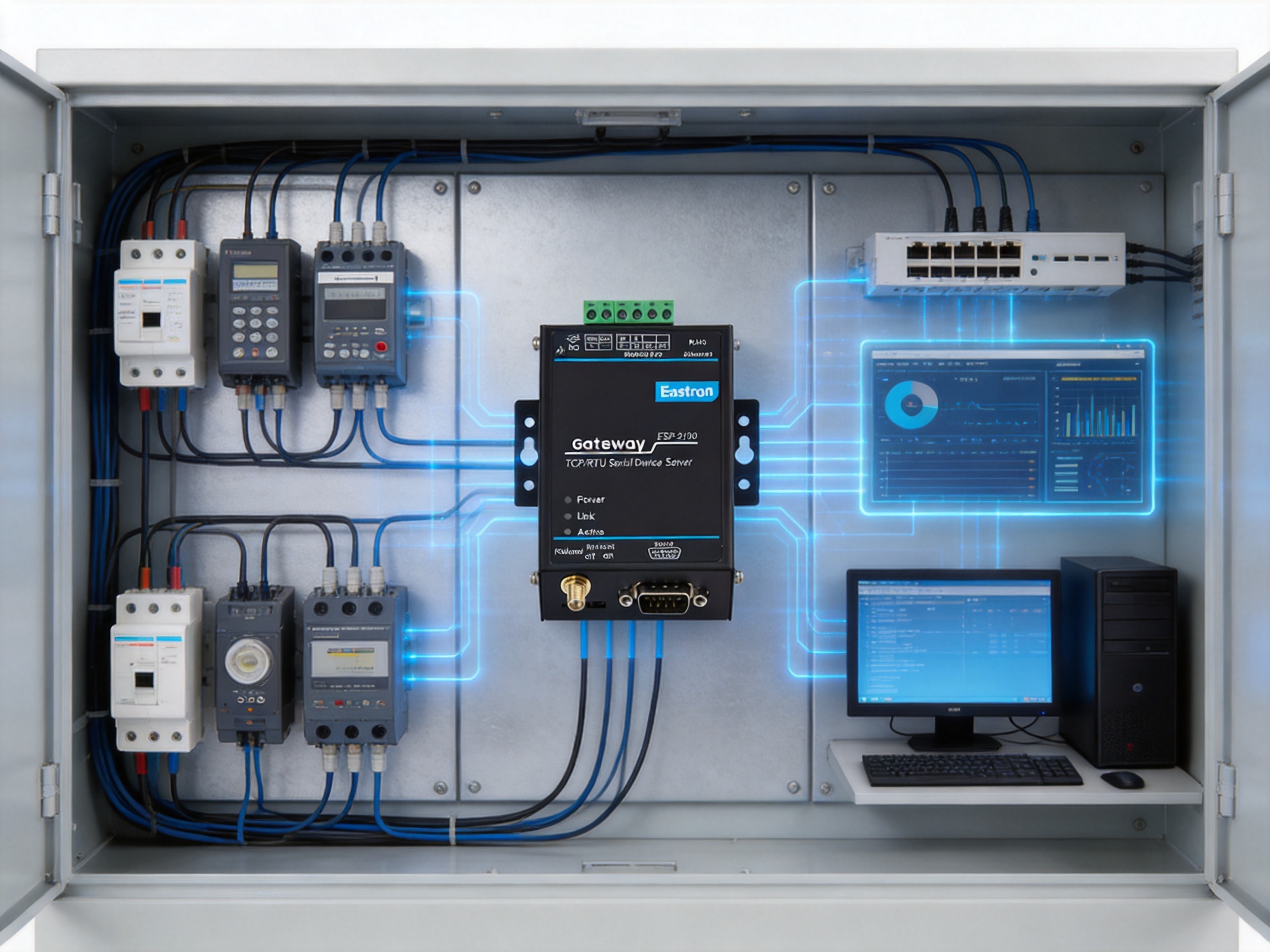
Commercial buildings often contain many energy meters serving tenant areas, lighting systems, air-conditioning equipment, elevators, mechanical systems, and common facilities. These meters may be installed at different times and may not all use the same communication interface.
The ESP-2100 can connect groups of serial meters to an Ethernet-based building management or energy monitoring system. This allows consumption data to be collected centrally and organized by floor, tenant, department, or equipment category.
Centralized communication can support more accurate energy allocation, operating cost analysis, equipment evaluation, and efficiency planning. When data from several meters is available through one network structure, facility managers can compare demand patterns and identify unusual changes more effectively.
Factories often contain a mixture of production equipment, distribution panels, motor control systems, power analyzers, and process monitoring devices. Energy consumption may need to be reviewed by production line, workshop, machine group, or shift.
Serial communication remains common in industrial environments because it is economical and well understood by automation engineers. At the same time, plant-wide systems increasingly rely on Ethernet. The ESP-2100 can connect these layers and help deliver energy information to supervisory software without replacing every existing instrument.
Its focus on electromagnetic resilience is particularly relevant in industrial sites. Motors, variable-speed drives, contactors, and switching equipment can create challenging electrical conditions. A communication gateway with a design oriented toward interference resistance can contribute to more dependable data exchange when installed according to good engineering practice.
Data centers require detailed visibility into power distribution, equipment loading, and energy performance. Meters and power analyzers may be deployed throughout electrical rooms, rack areas, cooling systems, backup power systems, and distribution paths.
A gateway can help bring serial measurement devices into an Ethernet-based monitoring architecture. This supports centralized collection and may simplify the integration of meter data into facility management, electrical monitoring, and reporting platforms.
In critical facilities, communication reliability is as important as measurement accuracy because incomplete data can make it harder to identify operating conditions. A robust gateway provides a practical communication link, while redundant system design, backup power, network segmentation, and appropriate maintenance procedures should be considered at the project level.
Solar power installations, energy storage facilities, and other distributed energy systems may contain meters, inverters, controllers, and monitoring equipment that communicate through different interfaces. Data from these devices may need to reach a local control cabinet, an operations center, or a remote management system.
The ESP-2100 can assist where serial Modbus RTU devices must communicate over an Ethernet network. Its ability to operate as a bridge between communication types makes it suitable for mixed-interface systems that evolve over time.
When equipment is installed outdoors or in electrically demanding locations, environmental considerations become especially important. Network planning should include proper protection against weather, surge events, temperature extremes, and grounding differences.
Automation systems frequently include legacy serial devices alongside newer Ethernet controllers. A protocol gateway enables these components to exchange information without forcing the replacement of functional equipment.
For example, a serial energy meter may provide voltage, current, power, energy, and demand information to a Modbus TCP supervisory application. A serial master may also use the gateway to access a TCP-based device. This creates a more adaptable architecture for facilities that combine automation, energy measurement, and equipment monitoring.
The ESP-2100 offers several practical advantages when compared with simpler or more narrowly focused communication products. A basic serial-to-Ethernet converter may transport serial data but may not provide the same level of Modbus RTU and Modbus TCP interoperability. A single-interface adapter may be limited to one serial standard, reducing its usefulness across mixed installations. A low-capacity device may require many gateways when a project includes a large number of RS485 nodes.
By combining Modbus protocol conversion, Ethernet connectivity, multiple serial interface options, and high RS485 node support, the ESP-2100 can reduce the number of separate communication components required in a system. Fewer components may simplify procurement, panel design, commissioning, spare-part management, and technical support.
Another advantage is its suitability for gradual modernization. A replacement-only strategy may require the removal of functioning meters and the installation of new communication-capable products. That approach can involve engineering redesign, shutdowns, rewiring, software changes, and additional commissioning. A gateway-based strategy can preserve existing devices while adding a modern network layer.
Environmental resilience is also an important differentiator. Products designed only for low-interference indoor environments may not be appropriate for power distribution rooms, industrial panels, or outdoor communication routes. The ESP-2100’s stated attention to lightning resistance, electromagnetic interference, and difficult environmental conditions makes it more suitable for demanding applications, subject to correct system-level protection and installation.
Ease of hardware setup and support for familiar network protocols can further reduce the practical difference between a technically possible installation and a smoothly commissioned one. For integrators, a product’s value is determined not only by its communication function but also by how efficiently it can be deployed and maintained.
Before installation, the communication topology should be documented. Engineers should identify the location of the gateway, serial devices, Ethernet switches, supervisory computers, and any remote network segments. A clear topology helps determine cable lengths, cabinet locations, network addressing, and maintenance access.
RS485 devices are normally arranged as a bus rather than an uncontrolled star. The number of devices, cable routing, termination, and communication speed should be evaluated together. The stated support of up to 256 nodes per RS485 port provides high capacity, but the practical design must also account for the characteristics of the connected devices and the operating environment.
Every Modbus RTU slave on a shared network must be assigned an appropriate address. Duplicate addresses can cause communication conflicts. The register structure of each connected meter or analyzer should also be recorded, including data type, scaling, units, read-only values, and writable parameters where applicable.
On the Ethernet side, the gateway must be assigned an appropriate network identity within the project’s addressing plan. Documentation should identify which TCP clients will access the gateway and which serial devices are associated with each address.
Accurate documentation is essential for long-term maintenance. A system may operate correctly after commissioning, but without a device list and register map, future troubleshooting can become unnecessarily difficult.
Communication cables should be routed away from high-power conductors where possible. If crossing is necessary, an appropriate crossing arrangement can help reduce interference. Shielding, grounding, cable selection, and separation distances should follow the requirements of the installation and applicable standards.
The gateway’s design for electromagnetic resilience is an important benefit, but no communication product can compensate for every installation problem. Surge protection, equipotential bonding, correct grounding, and suitable enclosures remain essential parts of a reliable system.
Commissioning should begin with a physical inspection. Technicians should verify power connections, serial wiring, network connections, device addresses, and configuration settings. Testing should then proceed in stages: first the gateway itself, then the Ethernet connection, then the serial network, and finally end-to-end data exchange.
Testing should include normal requests, multiple devices, communication under expected load, and recovery after a temporary interruption. Where the system is important to facility operations, alarm handling and data continuity should also be evaluated.
Clear commissioning records should include the gateway configuration, network parameters, serial settings, connected device list, and test results. These records support future expansion and reduce recovery time when maintenance is required.
The quality of a communication gateway depends on more than its external interface list. It reflects the manufacturer’s engineering capabilities, testing procedures, production controls, and ability to support products over their service life. Eastron Electronic Co., Ltd. has developed a broader technical foundation in electricity products and energy measurement solutions, including electricity meters, power analyzers, current sensors, communication modules, and management systems.
This product background is relevant to the ESP-2100 because gateways used in energy applications must communicate with measurement equipment reliably and support the operating requirements of electrical installations. A manufacturer that understands meters and energy systems can better appreciate the importance of data integrity, stable communication, measurement workflows, and system interoperability.
The company invests in research and development of new technologies and products for electricity metering. Its development teams in China and the United Kingdom contribute to product innovation and help maintain technical competitiveness.
Research and development strength supports continuous improvement in embedded software, communication functions, hardware design, and product usability. For a gateway, these areas are closely connected. The hardware must provide dependable electrical interfaces, the firmware must manage protocol conversion, and the user-facing configuration process must be practical for installers and system engineers.
Cooperation with universities and research institutions can also contribute to the advancement of product technologies. Such cooperation helps manufacturers maintain awareness of evolving technical methods and application requirements.
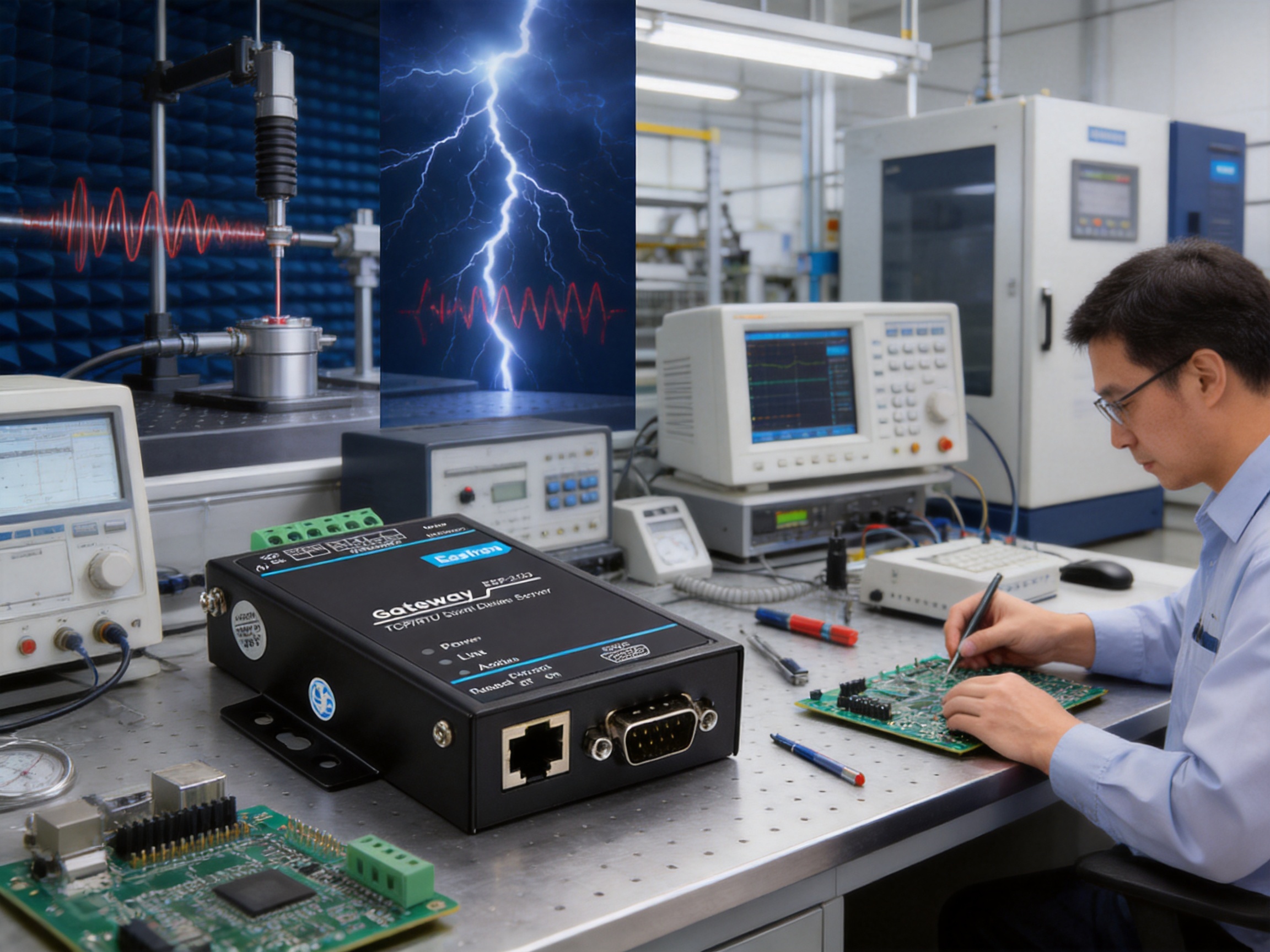
Eastron has established a professional laboratory capable of performing EMC, LVD, accuracy, and environmental tests according to IEC, EN, GB, and UL standards. These testing capabilities are important indicators of a structured product development and verification process.
EMC testing helps evaluate whether equipment can operate in the presence of electromagnetic disturbances and whether it produces unacceptable emissions. LVD testing addresses electrical safety requirements associated with low-voltage equipment. Environmental testing helps examine how products perform under specified environmental stresses. Accuracy testing is especially relevant to the company’s meter and measurement product portfolio.
For communication products used near electrical equipment, EMC and environmental evaluation are particularly meaningful. A gateway may be exposed to interference, temperature variation, electrical transients, and demanding installation conditions. Laboratory testing supports the goal of producing equipment that performs consistently within its intended application range.
The company follows the ISO 9001 quality management system. A quality management framework helps organize procedures for design, purchasing, production, inspection, documentation, corrective action, and customer support.
Production approval by SGS according to MID standards is another part of the company’s stated quality and compliance background. Although the ESP-2100 is a communication gateway rather than a measurement instrument itself, experience with regulated electricity products demonstrates the manufacturer’s familiarity with controlled production and product verification requirements.
Standards-based processes can also improve consistency between production batches. This matters for system integrators that deploy the same product across many projects and need predictable behavior, documentation, and support.
The company holds patented technologies in software, embedded software, and hardware. This combination is significant because modern energy products depend on the interaction of electronics, firmware, communication protocols, and application logic.
Embedded expertise can contribute to stable protocol handling, efficient data processing, reliable startup behavior, and practical configuration functions. Hardware expertise supports robust interfaces and appropriate protection. Software and hardware development performed within a coordinated engineering environment can make it easier to optimize the complete product rather than treating each subsystem separately.
Eastron products and services have been supplied to more than 50 countries across Europe, Asia-Pacific, America, the Middle East, and Africa. International experience exposes a manufacturer to different electrical systems, installation practices, standards, communication architectures, and customer expectations.
This international application experience can strengthen product documentation, technical support, compliance awareness, and design adaptability. It also gives the company practical feedback from a wide range of operating environments.

For an industrial gateway, reliability is a combination of design quality, component selection, manufacturing discipline, inspection, testing, installation, and maintenance. The ESP-2100’s stated design objectives address several important aspects: lightning resistance, electromagnetic interference resistance, and operation in difficult environments.
Manufacturing quality begins with controlled design requirements. The product must be developed around defined electrical, mechanical, communication, and environmental conditions. These requirements should then be translated into production specifications and inspection procedures.
During manufacturing, process control helps ensure that assemblies, connections, protective elements, and interface components are installed consistently. Inspection and testing can identify defects before products reach the field. Laboratory verification provides additional confidence that the design responds appropriately to applicable technical requirements.
Reliability is also supported by the company’s broader experience in electricity products. Metering equipment must operate accurately and consistently over long periods, often in electrical distribution environments. Knowledge gained through the development and production of such equipment can contribute to the design philosophy of communication products used alongside meters.
Customers should evaluate the product according to the requirements of each application. Important factors include power supply conditions, enclosure protection, temperature, humidity, network security, surge protection, grounding, serial cable length, and the compatibility of connected devices. A well-manufactured gateway is an important part of the solution, but dependable performance is achieved through coordinated product and system engineering.
Connecting serial meters to an Ethernet network can create benefits beyond basic communication. Once energy information is available to centralized software, organizations can use it for reporting, cost allocation, operational analysis, maintenance planning, and efficiency improvement.
Data from multiple meters can be compared across time and location. A facility manager may examine consumption by building area, production line, process, tenant, or equipment group. Abnormal changes can be investigated more quickly when information is collected in a consistent and accessible format.
Gateway-based connectivity can also support the integration of energy data with broader management systems. Depending on the software architecture, data may be used by building management platforms, industrial supervisory systems, energy dashboards, reporting tools, or databases. The gateway does not replace these systems; it provides the communication path that allows them to access field-level information.
In existing facilities, the ability to reuse installed meters is particularly valuable. Measurement devices often represent a significant investment, and replacement may interrupt operations. A communication gateway can extend the usefulness of those devices by connecting them to newer digital infrastructure.
A gateway with multiple serial interface options can reduce the need for additional adapters. This may simplify panel layout and reduce the number of points that must be powered and maintained. The Ethernet port provides a direct connection to the network side of the installation, while the serial ports connect to field equipment.
The support of DHCP, DNS, and HTTP can make the product more accessible to network technicians and automation personnel. Familiar network services reduce the learning curve during deployment, especially when the gateway is integrated into an existing Ethernet environment.
Maintenance can also be simplified through clear documentation. A service team can identify the gateway, its connected serial segment, its network address, and the devices associated with each Modbus address. If a meter is replaced, the communication plan can be updated without redesigning the complete system.
For larger projects, standardizing on a gateway platform may improve spare-part planning. Technicians can receive consistent training and use similar procedures across multiple buildings or production sites. This can reduce the operational burden associated with supporting a mixed collection of unrelated converters.
The ESP-2100 should be selected as part of a complete communication architecture. Engineers should first identify the role of each device. A serial master may need to access Modbus TCP slaves, or an Ethernet-based client may need to communicate with Modbus RTU meters. Defining the direction of communication helps determine the appropriate configuration.
The number and type of serial devices should then be reviewed. Projects with many RS485 meters may benefit from grouping devices into logical segments. Devices using RS232 or RS422 may require a different physical arrangement. The availability of these interface options allows the system designer to select a suitable connection method.
The Ethernet network should be evaluated for addressing, routing, switch capacity, segmentation, and access control. Where the gateway is connected to a larger business or enterprise network, security policies should be established. Network administrators should determine which systems can communicate with the gateway and how configuration access will be controlled.
Finally, the installation environment should be assessed. Areas with high electrical noise, outdoor cable routes, or exposure to lightning-related events require suitable protection and grounding arrangements. The gateway’s environmental design supports demanding applications, but the complete installation must be engineered as a coordinated system.
The first step is to list all meters, analyzers, controllers, and other devices that need to exchange data. The survey should record communication interface, protocol, device address, register map, location, and electrical environment.
The project team should determine whether the goal is to expose Modbus RTU devices to a Modbus TCP client, provide access to Modbus TCP devices from a serial master, or support both communication directions. This objective will guide the gateway configuration and software integration.
Installers should define cable routes, panel locations, Ethernet connections, serial bus structures, grounding arrangements, and protection measures. The plan should allow access for commissioning and future maintenance.
The gateway should be configured with the required network and serial parameters. Each connected device should be tested individually before the full system is placed under normal operating load. Test records should confirm successful reading of representative registers and stable communication over an appropriate period.
Final documentation should include network information, serial settings, device addresses, register maps, wiring diagrams, configuration records, and maintenance instructions. Good documentation protects the value of the installation long after the original project team has completed its work.
The ESP-2100 converts communication between Modbus RTU serial networks and Modbus TCP/IP Ethernet networks. It can connect serial Modbus slave devices to a Modbus TCP network and can also make Modbus TCP slave devices accessible to serial masters.
The product provides RS232, RS422, and RS485 port options. The appropriate interface should be selected according to the connected device and the planned network topology.
Each RS485 port supports up to 256 nodes. The actual installation should still be designed with attention to device addressing, cable quality, termination, baud rate, network loading, and environmental conditions.
Yes. Its Modbus RTU to Modbus TCP/IP conversion function is intended to allow serial Modbus devices, including compatible energy meters and analyzers, to communicate with Ethernet-based Modbus systems.
Yes. The ESP-2100 is designed to support conversion between Modbus TCP and Modbus RTU. This enables Ethernet-based systems to access serial devices and allows serial masters to access Modbus TCP slaves, subject to the configuration and compatibility of the connected equipment.
The product supports DHCP, DNS, and HTTP in addition to its Modbus TCP/IP gateway functions. These protocols assist with network configuration, device identification, and web-based access or setup functions supported by the product.
It is designed for demanding environments, with stated attention to lightning resistance, electromagnetic interference, and adverse operating conditions. Correct installation remains essential, including appropriate grounding, surge protection, cable routing, and enclosure selection.
Yes. A gateway can connect installed Modbus RTU meters to a newer Ethernet and Modbus TCP infrastructure. This may allow organizations to expand data access without immediately replacing functional field devices.
Before installation, confirm the communication protocol, interface type, serial settings, device addresses, register maps, power requirements, network plan, cable routes, environmental conditions, grounding, and protection arrangements.
Testing helps verify electrical safety, electromagnetic compatibility, environmental performance, and production consistency. A manufacturer with professional laboratory capabilities and a structured quality management system can provide a stronger foundation for reliable industrial products.
No. Although it is well suited to energy measurement systems, it can also support compatible industrial devices such as power analyzers, controllers, sensors, and automation equipment that use Modbus RTU or Modbus TCP communication.
A simple adapter may only transport serial data over a network. A Modbus gateway is designed to manage communication between Modbus RTU and Modbus TCP environments. The ESP-2100 combines protocol conversion with Ethernet connectivity, multiple serial interface options, network protocol support, and high RS485 node capacity.
The ESP-2100 addresses a common challenge in energy and industrial automation: connecting established serial devices to modern Ethernet networks. Its Modbus RTU and Modbus TCP conversion capability provides a practical interoperability layer, while its RS232, RS422, and RS485 options support different field communication requirements.
The product’s support for up to 256 nodes on each RS485 port makes it suitable for larger meter groups and distributed equipment networks. DHCP, DNS, and HTTP support contributes to easier network integration, while the focus on lightning resistance, electromagnetic resilience, and difficult environmental conditions supports applications beyond ordinary office networking.
Its value is strengthened by the manufacturer’s broader expertise in electricity meters, power analyzers, current sensors, communication modules, and energy management systems. Research and development teams, patented software and hardware technologies, laboratory testing capabilities, ISO 9001 quality management, and international market experience all contribute to the company’s ability to produce and support energy-related communication equipment.
For organizations seeking to modernize energy data collection without discarding existing serial infrastructure, the ESP-2100 offers a flexible and scalable approach. When combined with careful network planning, sound electrical installation, appropriate protection, and complete documentation, it can help create a reliable communication foundation for energy monitoring, building management, industrial automation, and IoT-oriented solutions.
Reliable energy management begins with reliable access to energy data. As facilities combine legacy meters, modern analyzers, industrial controllers, Ethernet systems, and digital management platforms, communication interoperability becomes essential. The ESP-2100 provides a direct solution by connecting Modbus RTU serial networks with Modbus TCP/IP Ethernet systems.
Its combination of protocol conversion, multiple serial interface options, high RS485 node capacity, network protocol support, practical setup, and environmental resilience makes it suitable for a broad range of energy and automation applications. The product can support new installations as well as phased upgrades of existing systems.
Behind the gateway is a manufacturer with experience in electricity products and energy measurement solutions, supported by research and development teams, professional laboratory facilities, standards-based testing, quality management procedures, embedded technology expertise, and an international customer base.
For system integrators, facility managers, electrical contractors, and industrial users, the ESP-2100 represents more than a connection between two interfaces. It is an enabling component for bringing field-level energy information into connected, scalable, and better-managed operational systems.
1. Modbus Organization, Modbus Application Protocol Specification.
2. Modbus Organization, Modbus over Serial Line Specification and Implementation Guide.
3. International Electrotechnical Commission, IEC standards relating to electromagnetic compatibility and low-voltage equipment.
4. EN standards relating to electrical equipment safety and electromagnetic compatibility.
5. ISO 9001, Quality Management Systems — Requirements.
6. IEC and related industrial guidance concerning RS485 network installation, grounding, shielding, and communication reliability.
7. Manufacturer-provided product information for the ESP-2100 Modbus RTU to TCP/IP gateway and serial device server.
Your email address will not be published. Required fields are marked *

We develop and produce high performance electricity meters, power analyzers, current sensors, communication modules and management systems.
Address:NO. 52, Dongjin Road, Nanhu, Jiaxing, Zhejiang, China
Copyright @ Eastron Electronic Co., Ltd. All rights reserved
