

 English
 Español
 Deutsch
 中文简体
中文简体

Product Consultation
Your email address will not be published. Required fields are marked *
Europe's Solar and Energy Storage Transition: Transforming the Power System Infrastructure for a Renewable Future
Jul 10,2026
Power Systems Are Becoming “Real-Time Systems”: Why Data Is More Critical Than Electricity
Jul 06,2026
New EPBD Regulations Drive HVAC Energy Transparency and Boost Demand for Smart Meters
Jul 07,2026Content
Modern solar photovoltaic installations, commercial electrical panels, industrial distribution boards, and energy management systems all depend on accurate, stable, and communicative metering. A three phase energy meter is no longer just a billing accessory; it is a control point, a diagnostic instrument, and a foundation for digital power management. The Din Rail CT Type Three Phase Multi-function Solar PV and Zero Export Meter, model SDM72CT-M, is designed for this role. It combines three phase four wire measurement, current transformer operation, bi-directional energy monitoring, pulse output, and RS485 Modbus RTU communication in a compact four-module Din rail format.
This product is especially suitable for applications where imported and exported energy must be measured with clarity, including solar PV systems, zero export control systems, building energy monitoring, small industrial automation, commercial load analysis, and distributed energy projects. With CT operation, configurable CT ratios, Modbus connectivity, and measurement of voltage, current, power, frequency, power factor, active energy, and reactive energy, the meter gives system integrators and electrical professionals a practical balance of flexibility, accuracy, and installation convenience.
Unlike basic kWh meters that only accumulate consumed energy, this multi-function meter is designed to present a broader picture of power behavior. It helps users understand how energy flows, whether generation exceeds consumption, how much active and reactive energy is involved, and how three phase loads are performing. In solar PV and zero export projects, these capabilities are essential because the control system must know not only how much energy is used, but also the direction of power flow and the real-time conditions of the electrical network.
Din Rail CT Type Three Phase Multi-function Solar PV/ Zero Export Meter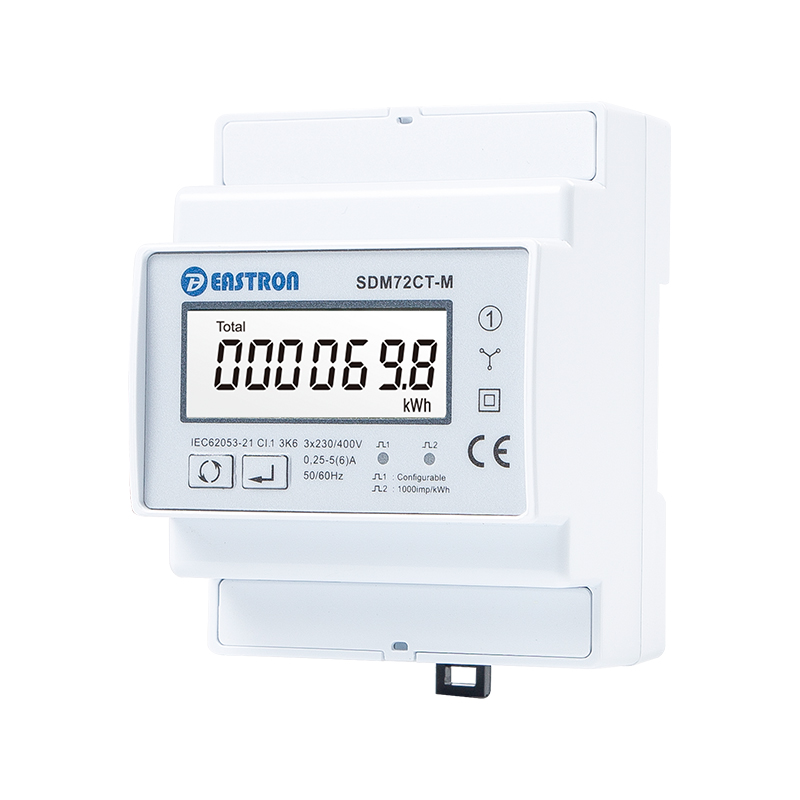
The SDM72CT-M is a Din rail mounted, CT-operated, three phase four wire energy meter for AC systems rated at 3 x 230/400 V. It is designed for 5 A CT secondary input and can be configured for a wide range of CT primary currents from 1 A to 9999 A. This makes it suitable for electrical systems where direct-connected metering is impractical or where the measured current exceeds the range of a compact meter.
The product measures active energy in kWh and power in W, while also supporting additional electrical parameter measurement such as voltage, current, frequency, power factor, reactive energy, and energy direction. It supports bi-directional measurement, enabling it to monitor both imported and exported energy. This function is particularly important for photovoltaic systems, battery energy systems, and sites where generation and consumption occur at the same connection point.
The meter includes RS485 Modbus RTU communication and pulse outputs. RS485 Modbus RTU enables integration with inverters, data loggers, programmable controllers, building management systems, energy management platforms, and zero export controllers. Pulse output provides a simple and reliable interface for energy counting or external monitoring devices. Together, these outputs make the device adaptable to both advanced digital control architectures and traditional monitoring setups.
With a compact width of four modules and standard 35 mm Din rail mounting, the meter is engineered for easy installation inside distribution boards. The LCD display provides local visibility, while remote communication allows system-level supervision. This combination is valuable in field environments because commissioning engineers can verify readings at the panel, while operators can monitor data from a central platform.
Three phase electrical systems are common in commercial buildings, factories, agricultural facilities, EV charging infrastructure, solar PV installations, and many utility-connected distribution systems. Compared with single phase systems, three phase networks require more detailed measurement because each phase may carry different loads, and unbalance can affect system efficiency, equipment lifetime, and operational safety.
A CT-operated meter offers a major advantage in these environments. Instead of passing the full load current through the meter, current transformers scale the current down to a safe and standardized secondary value, commonly 1 A or 5 A. The meter then calculates energy and power based on the CT ratio. This architecture allows one compact device to support a wide range of installation sizes, from smaller commercial loads to larger industrial feeders.
For installers and system designers, CT metering reduces complexity. The same meter type can often be used across many projects simply by selecting suitable CTs and configuring the correct ratio. This reduces inventory pressure, simplifies training, and makes future upgrades easier. If a site grows and the current rating changes, the metering architecture can be adapted with different CTs rather than replacing the entire measurement concept.
In solar PV and zero export systems, CT metering also offers installation flexibility. The meter can be installed at the grid connection point, distribution point, or another strategic location where power flow must be monitored. Because the measured energy may flow in both directions, the meter’s bi-directional capability is essential for accurate import and export recognition.
Solar photovoltaic systems create a dynamic electrical environment. During periods of strong sunlight, the PV system may generate more power than the building consumes. During low sunlight or high load conditions, the building may draw energy from the grid. In some markets or project conditions, exporting power to the grid is restricted or prohibited. A zero export system prevents unwanted power export by monitoring the point of common coupling and controlling inverter output accordingly.
For zero export control, the meter must provide fast, dependable, and correctly directed measurement data. It must distinguish import from export and communicate data to the controller or inverter. The SDM72CT-M is built for this environment by offering bi-directional measurement and RS485 Modbus RTU communication. It can help the control system decide whether PV generation should be increased, reduced, or maintained to keep export within the allowed limit.
This functionality makes the meter useful not only in grid-restricted solar projects but also in self-consumption optimization. Facility managers can compare generation, consumption, imported energy, and exported energy to improve load scheduling. For example, high-energy processes may be shifted to daylight hours to consume more PV energy onsite. Over time, the metering data can support better energy planning and more efficient system operation.
Basic energy meters may show total consumption, but they often do not provide the directional, real-time, and communicative features needed for solar PV integration. A multi-function zero export meter gives the system a more intelligent measurement layer. It does not merely record the past; it supports active control in the present.
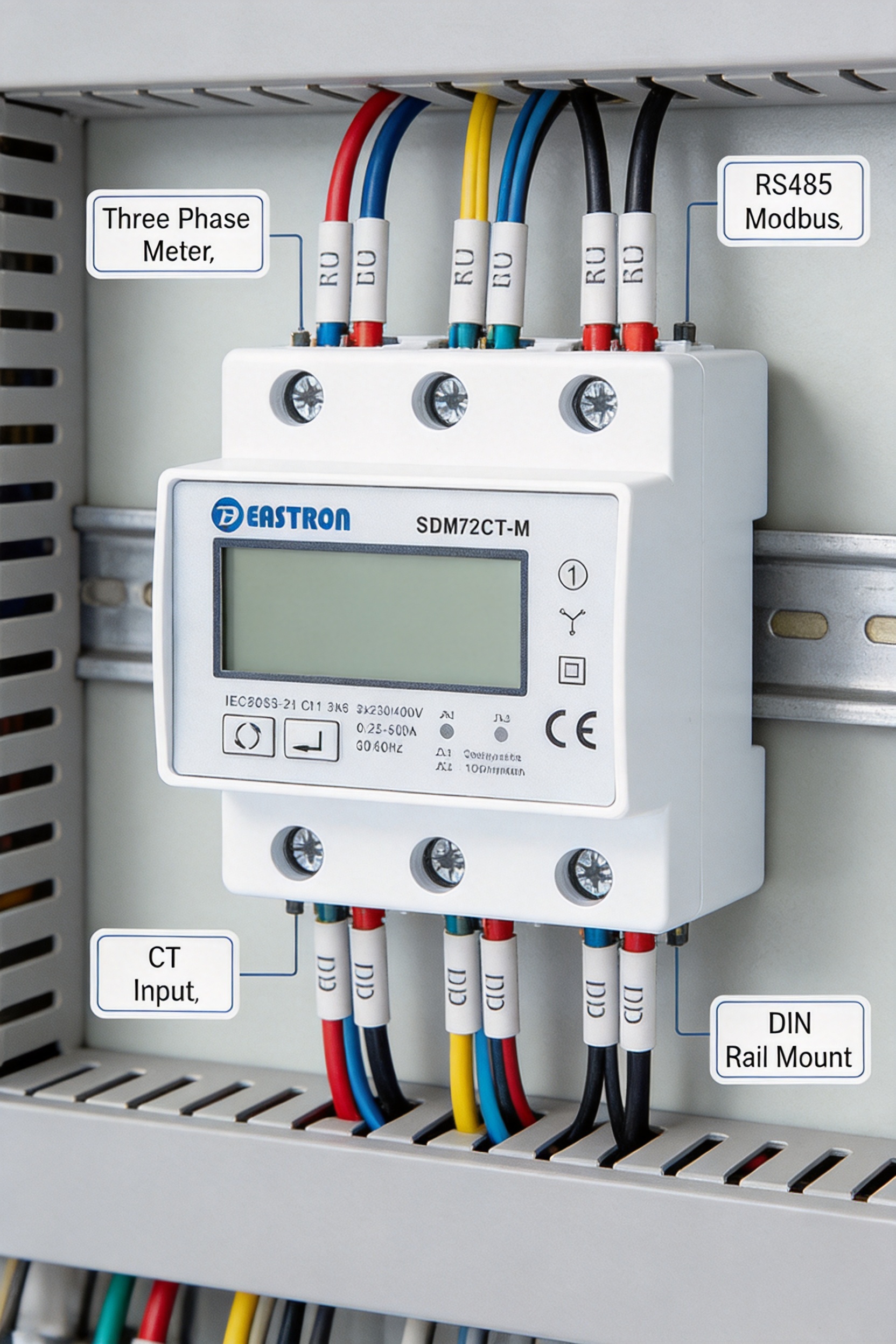
The meter is designed for RMS measurement on a three phase AC system with three phase four wire wiring. This is a common configuration for low-voltage distribution where phase-to-neutral and phase-to-phase voltages must be monitored. The rated system voltage is 3 x 230/400 V AC, aligning with many commercial and industrial installations.
Accuracy is a key requirement for energy monitoring. The meter provides active energy accuracy according to IEC 62053-21 Class 1.0 and EN 50470-1/3 Class B, while reactive energy is specified according to IEC 62053-23 Class 2. Current and voltage accuracy are specified at 0.5% of range maximum, frequency at 0.2% of mid-frequency, and power factor at 1% of unity, equal to 0.01. These specifications support dependable monitoring in energy management and solar control applications.
The meter supports CT primary configuration from 1 A to 9999 A and CT secondary options of 1 A or 5 A, with the stated product configuration using 5 A CT operation. The minimum CT current is 0.25 A and starting current is 10 mA, supporting measurement sensitivity for low-load conditions. This is helpful when monitoring systems with variable demand, such as buildings that shift between operating and standby modes.
Communication is handled through RS485 using Modbus RTU. The communication address range is 1 to 247, enabling multiple meters to operate on the same bus. Transmission distance can reach up to 1000 m under suitable installation conditions. Transmission speed ranges from 1200 bps to 9600 bps, with parity settings including none, odd, and even, and stop bits selectable as 1 or 2. These settings allow the meter to integrate with a wide range of host devices and control systems.
Item |
Specification |
Practical Value |
System Type |
Three phase four wire, 3P4W |
Suitable for common commercial and industrial low-voltage distribution |
Voltage |
3 x 230/400 V AC |
Matches standard three phase networks in many installations |
Current Input |
CT operated, 1 A or 5 A secondary |
Supports safe measurement of high-current circuits through CTs |
CT Primary Range |
1 A to 9999 A |
Allows one meter type to cover many project sizes |
Energy Measurement |
Active and reactive energy, import and export |
Supports solar PV, zero export, and energy analysis |
Communication |
RS485 Modbus RTU |
Integrates with controllers, inverters, gateways, and monitoring systems |
Pulse Output |
Two pulse outputs |
Provides simple energy counting interface for external devices |
Mounting |
35 mm Din rail, four modules wide |
Easy installation in distribution boards and control panels |
Active Energy Accuracy |
IEC 62053-21 Class 1.0, EN 50470-1/3 Class B |
Reliable energy data for monitoring and management |
Communication Distance |
Up to 1000 m |
Useful for larger facilities and distributed metering networks |
One of the most important advantages of this meter is its combination of compact size and multi-function capability. Some competing meters offer basic kWh measurement in a similar Din rail format, but they may not include bi-directional energy measurement, CT operation, Modbus RTU, pulse output, and a broad CT configuration range in one product. The SDM72CT-M brings these features together, reducing the need for separate devices.
Another advantage is its suitability for solar PV and zero export scenarios. In these applications, direction of energy flow is critical. A conventional import-only meter may show consumption but fail to provide the control data required to prevent export. A meter with bi-directional measurement can identify whether power is being imported from the grid or exported toward it, which is the central information required for inverter control and compliance with zero export rules.
CT operation also gives it an edge over direct-connected meters in higher-current systems. Direct-connected meters are limited by their rated current capacity and installation method. When loads exceed that range, CT meters become the more practical solution. The CT primary range of 1 A to 9999 A gives system designers broad flexibility. This reduces the need to source different meter families for different current ratings.
Communication capability is another competitive strength. RS485 Modbus RTU remains widely used in electrical automation because it is stable, economical, and supported by many devices. A meter that communicates through standard Modbus registers can be integrated into many systems without proprietary restrictions. This openness is valuable for integrators who need reliable interoperability with inverters, data acquisition units, SCADA systems, and energy management platforms.
The presence of pulse output further improves compatibility. Some legacy systems and simple monitoring devices depend on pulse counting rather than serial communication. By providing both pulse and Modbus outputs, the meter can support modern and traditional architectures. This dual-interface approach helps reduce replacement difficulties when upgrading older installations.
The compact four-module width also matters. Electrical panels are often crowded, especially in retrofit projects. A meter that fits neatly on a 35 mm Din rail without occupying excessive space can reduce installation cost and avoid panel redesign. Competitors with larger housings may require bigger enclosures or more complicated wiring layouts.
The value of a multi-function energy meter is not limited to energy totals. By measuring voltage, current, frequency, power, power factor, active energy, reactive energy, imported energy, and exported energy, the meter helps create a complete picture of electrical operation. This data can support troubleshooting, preventive maintenance, energy optimization, and system control.
Voltage monitoring helps identify supply problems such as undervoltage, overvoltage, or phase imbalance. Current measurement helps detect abnormal loading, unbalanced phase distribution, and possible overload conditions. Frequency measurement can help confirm grid stability or generator operation. Power factor measurement supports analysis of reactive power behavior and may guide power factor correction decisions.
Active energy measurement provides the familiar kWh data used for consumption tracking, cost allocation, and efficiency programs. Reactive energy measurement in kVArh offers insight into inductive or capacitive behavior. In facilities with motors, drives, transformers, and other inductive loads, reactive energy can affect utility charges and network efficiency. Monitoring it gives operators the information needed to address the issue.
Bi-directional measurement is especially valuable where distributed generation is present. Imported active energy shows what the site draws from the grid, while exported active energy shows what is sent back. In solar PV systems, this distinction allows operators to evaluate self-consumption rate and export behavior. In zero export systems, it helps confirm that export limitation is functioning as intended.
RS485 Modbus RTU is a practical communication choice for energy metering because it supports multi-drop wiring, long cable distances, and simple integration. In a typical system, several meters can be connected on the same RS485 bus, each with a unique communication address from 1 to 247. A controller or data logger polls each meter and collects values for display, control, storage, or analysis.
The meter supports transmission speeds from 1200 bps to 9600 bps. This range allows installers to choose a communication speed appropriate for cable length, noise conditions, and host device compatibility. Parity can be set to none, odd, or even, and stop bits can be set to 1 or 2. These parameters help match the meter to existing Modbus networks.
For solar PV zero export control, Modbus communication enables the inverter or control device to receive measured power data from the grid connection point. If exported power is detected, the controller can reduce inverter output. If the load increases, the controller can allow more generation. The meter therefore becomes a sensing element in a closed-loop control process.
In building energy management, Modbus data can be sent to gateways and monitoring platforms. Facility managers can view consumption trends, identify peak demand periods, compare phase loads, and verify energy-saving measures. In industrial automation, the meter can support process energy analysis by linking energy data with production activity.
Pulse outputs are useful where a simple energy pulse signal is required. They can be connected to counters, PLC inputs, or data acquisition systems. Pulse output is also valuable as a redundant or simplified method of energy recording when full serial communication is not necessary.
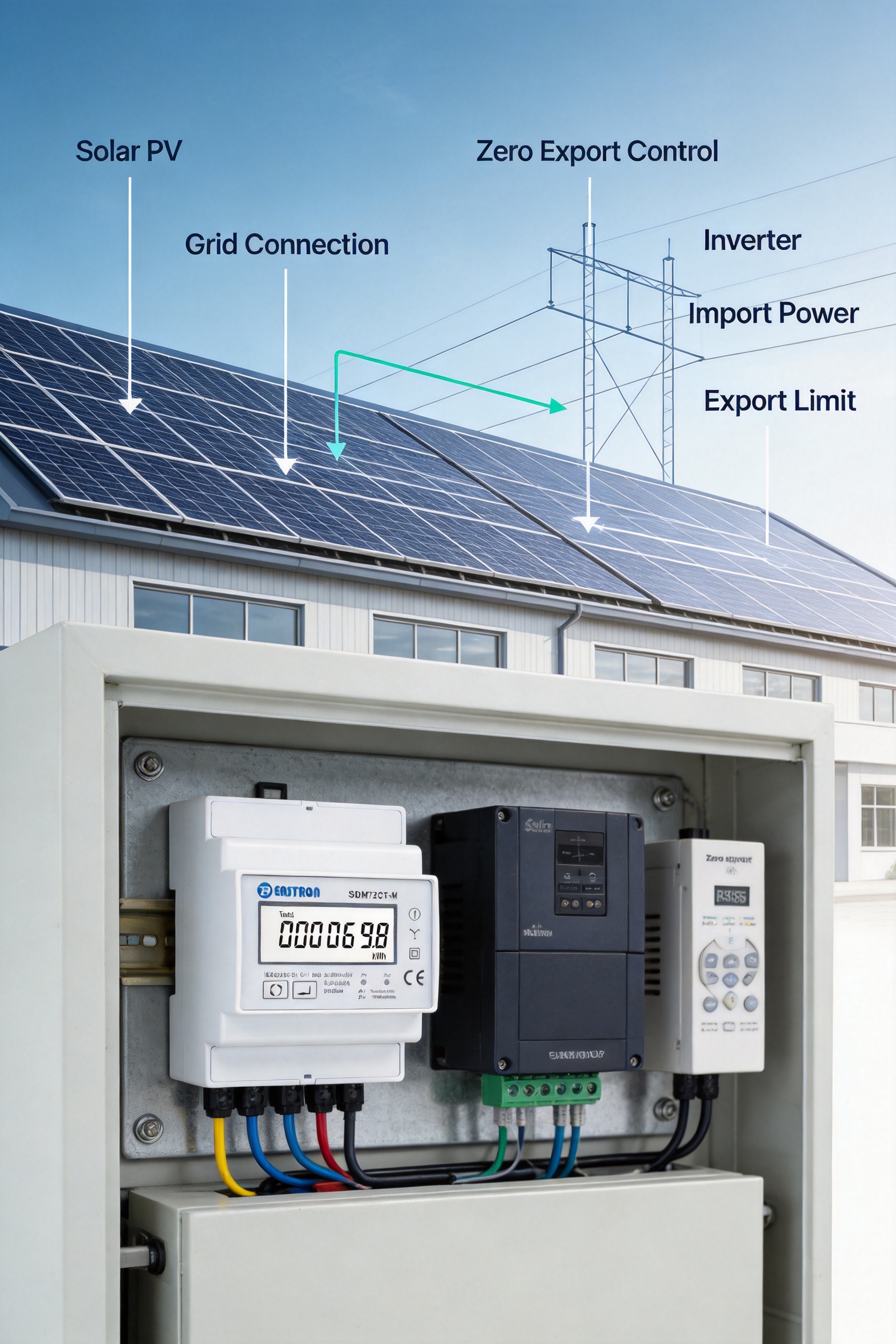
The product is designed for 35 mm Din rail mounting, which is a standard installation method in modern electrical panels. This makes mounting straightforward for electricians and panel builders. The four-module width is compact enough for many distribution boards while still offering a clear LCD display and wiring access.
CT-operated installation reduces the need to route high load current through the meter. Instead, CTs are installed around the conductors, and their secondary signals are wired to the meter. This can improve safety and practicality in higher-current systems. It also allows the meter to be used in retrofit projects where interrupting or rerouting large conductors would be difficult.
Correct installation remains essential. CT polarity must be observed to ensure accurate import and export direction. Voltage phase connections must correspond correctly with CT inputs so that power and energy calculations are accurate. Communication wiring should follow RS485 best practices, including suitable cable, correct polarity, termination where needed, and proper addressing when multiple devices share a bus.
The meter’s local LCD display helps during commissioning. Installers can check voltage, current, power, and other readings at the panel before connecting the device to a larger monitoring system. This shortens troubleshooting time and helps confirm that CT ratios and wiring are correctly configured.
Solar PV plants and rooftop installations are among the strongest application areas. The meter can be installed at the grid connection point to monitor imported and exported energy. Its Modbus output can provide data to zero export controllers or compatible inverters. This supports compliance with grid requirements while helping maximize onsite energy use.
Commercial buildings can use the meter for main incoming supply monitoring, tenant energy allocation, department-level monitoring, or equipment load tracking. Because the meter supports CTs, it can be applied to feeders of varying current ratings. The data can help identify waste, compare operating periods, and support sustainability reporting.
Industrial workshops and manufacturing facilities can use the meter to monitor production lines, motors, air compressors, HVAC equipment, and auxiliary systems. Energy data can be combined with production output to calculate energy intensity. This helps managers understand whether energy is being used efficiently and where improvement projects should begin.
Battery energy storage systems may also benefit from bi-directional energy measurement. Since energy can flow into or out of the battery system depending on charge and discharge mode, a directional meter helps verify operation and track energy exchange. While system design requirements vary, the measurement principles align well with storage applications.
EV charging facilities, microgrids, agricultural operations, and campus energy networks can also use CT-based three phase meters as part of their monitoring infrastructure. Any system requiring flexible current range, three phase measurement, Modbus communication, and import/export data can benefit from this type of meter.
The performance of an energy meter depends not only on its design but also on the manufacturing system behind it. Eastron Electronic Co., Ltd. is a high-tech manufacturer and supplier focused on electricity metering products, power analyzers, current sensors, communication modules, and energy management systems. Its product development is supported by teams in China and the United Kingdom, creating a strong foundation for both engineering innovation and market-oriented design.
The company’s manufacturing strength begins with research and development. Electricity metering requires knowledge of analog measurement, digital signal processing, embedded software, communication protocols, safety design, EMC performance, and long-term reliability. By continuously investing in new technologies and products, the company can keep pace with changing application requirements such as smart metering, renewable energy integration, and digital energy management.
Advanced manufacturing also depends on testing capability. The company has established a professional laboratory capable of performing EMC, LVD, accuracy, and environmental tests according to IEC, EN, GB, and UL standards. This is important because meters must operate in electrically noisy environments, withstand real-world temperature and humidity conditions, and maintain measurement accuracy over time. Internal laboratory capability helps shorten development cycles and improve product reliability before products reach customers.
Quality management is another core strength. Production follows ISO 9001 quality management principles, and manufacturing is approved by SGS according to MID-related standards. Such quality systems help ensure consistency from component sourcing through assembly, calibration, inspection, and delivery. For customers, this means products are not only well designed but also produced under controlled processes.
The company also holds patented technologies in software, embedded software, and hardware. In modern meters, software is as important as the physical measurement circuit. Communication stability, display logic, parameter configuration, energy calculation, and data handling all require reliable embedded programming. Proprietary technical capability allows the manufacturer to optimize product performance and respond to application-specific needs.
Energy meters are expected to operate continuously for many years. They are installed in electrical panels where temperature, electromagnetic interference, voltage fluctuation, and load variation are normal. A robust quality assurance process must therefore verify not only initial accuracy but also operational resilience.
Accuracy testing ensures that measured energy, current, voltage, power, and related parameters remain within specified tolerances. For this product, active energy accuracy is aligned with IEC 62053-21 Class 1.0 and EN 50470-1/3 Class B, while reactive energy follows IEC 62053-23 Class 2. These standards provide a recognized framework for evaluating metering performance.
EMC testing is essential because electrical panels often contain contactors, drives, inverters, relays, and communication devices. These components can generate electrical noise. A meter with good EMC performance is better able to provide stable readings and communication in challenging environments.
LVD and safety-related testing help verify that the meter is suitable for low-voltage electrical installations. Insulation, creepage, clearance, and enclosure design all contribute to electrical safety. Environmental testing helps ensure the product can withstand temperature and humidity conditions that may occur during storage, transport, and operation.
This testing philosophy gives customers confidence. When a meter is used for solar PV zero export control or energy management, inaccurate or unstable data can affect compliance, efficiency, and operational decisions. Strong quality assurance reduces these risks and supports dependable long-term use.
Energy management begins with measurement. Without reliable data, users cannot identify waste, verify savings, allocate costs, or manage distributed generation effectively. The SDM72CT-M supports energy management by making three phase electrical behavior visible and communicable.
In a commercial building, the meter can help identify peak demand periods. If demand charges are part of the utility bill, reducing peak demand can produce meaningful savings. By monitoring real-time power, facility managers can schedule high-load equipment more intelligently or identify unexpected simultaneous operation.
In an industrial facility, the meter can be used to compare energy consumption by process or production line. If one line consumes more energy than another for similar output, the data may reveal maintenance issues, inefficient operation, or process imbalance. Over time, this supports continuous improvement.
In solar PV systems, the meter supports self-consumption analysis. Operators can compare how much solar energy is used onsite and how much is exported. If export is restricted or economically less favorable, the data can guide load shifting, battery sizing, or control strategy changes.
Reactive energy monitoring can support power quality improvement. If reactive energy is high, the site may benefit from power factor correction or equipment review. Improving power factor can reduce losses and may reduce utility penalties in some regions.
System integrators need products that are flexible, reliable, and easy to support across multiple projects. The SDM72CT-M offers several practical advantages in this context. Its CT primary range from 1 A to 9999 A allows the same meter model to be applied across diverse installations. This simplifies project design and reduces training requirements.
The Modbus RTU interface is another integrator-friendly feature. Many controllers, gateways, inverters, and software platforms can communicate with Modbus devices. This reduces the risk of integration barriers and allows the meter to fit into open system architectures.
The compact Din rail design helps panel builders. A four-module meter is easy to allocate in standard enclosures, and the 35 mm mounting system is familiar to electrical professionals. Local display and configurable settings support commissioning and troubleshooting.
For solar PV integrators, the meter’s bi-directional measurement and zero export relevance reduce the need for separate measurement equipment. It can serve as the key measurement point for import/export control while also providing useful energy monitoring data.
For maintenance teams, the ability to view local data and collect remote data improves service efficiency. If a communication issue occurs, readings can still be checked at the LCD. If a load problem occurs, remote data can help diagnose it before sending personnel to site.
Direct-connected meters have their place in smaller circuits. They are simple and cost-effective when current levels are within the meter’s rating. However, they become less practical as load current rises. The installation may require routing large conductors through the meter, which can increase panel complexity and space requirements.
A CT-operated meter avoids many of these limitations. It measures scaled secondary current from CTs rather than carrying the full circuit current. This makes it more suitable for higher-current feeders and for installations where conductors are too large for direct metering. It also improves adaptability because changing CT ratios can extend the meter’s application range.
The SDM72CT-M also offers configuration flexibility that direct meters often lack. With CT primary settings from 1 A to 9999 A, it can be matched to many current transformer sizes. This is especially important in commercial and industrial projects where load capacities vary widely from one panel to another.
In solar PV and zero export installations, CT placement can be selected based on control needs. The CTs can monitor the grid connection point, main feeder, or another defined measurement point. This flexibility is a major design benefit.
Electrical panel space is valuable. Each additional device occupies rail length, increases wiring density, and may require larger enclosures. The four-module width of this meter provides a useful balance between compactness and usability. It is small enough for many distribution boards but still large enough to provide an LCD display and terminal layout suitable for professional installation.
The compact design is particularly useful in retrofit projects. Existing panels may not have much spare space, and replacing the enclosure may be expensive or impractical. A compact Din rail meter helps add modern monitoring capability without major structural changes.
Despite its size, the meter includes multiple functions that might otherwise require separate devices. It measures multiple electrical parameters, supports import/export measurement, communicates by Modbus RTU, and provides pulse outputs. This integration can reduce wiring, simplify commissioning, and improve system neatness.
For panel manufacturers, compact multi-function devices can reduce bill of material complexity. Instead of installing a basic meter plus an additional communication module or separate energy pulse device, a single integrated meter can perform the required tasks.
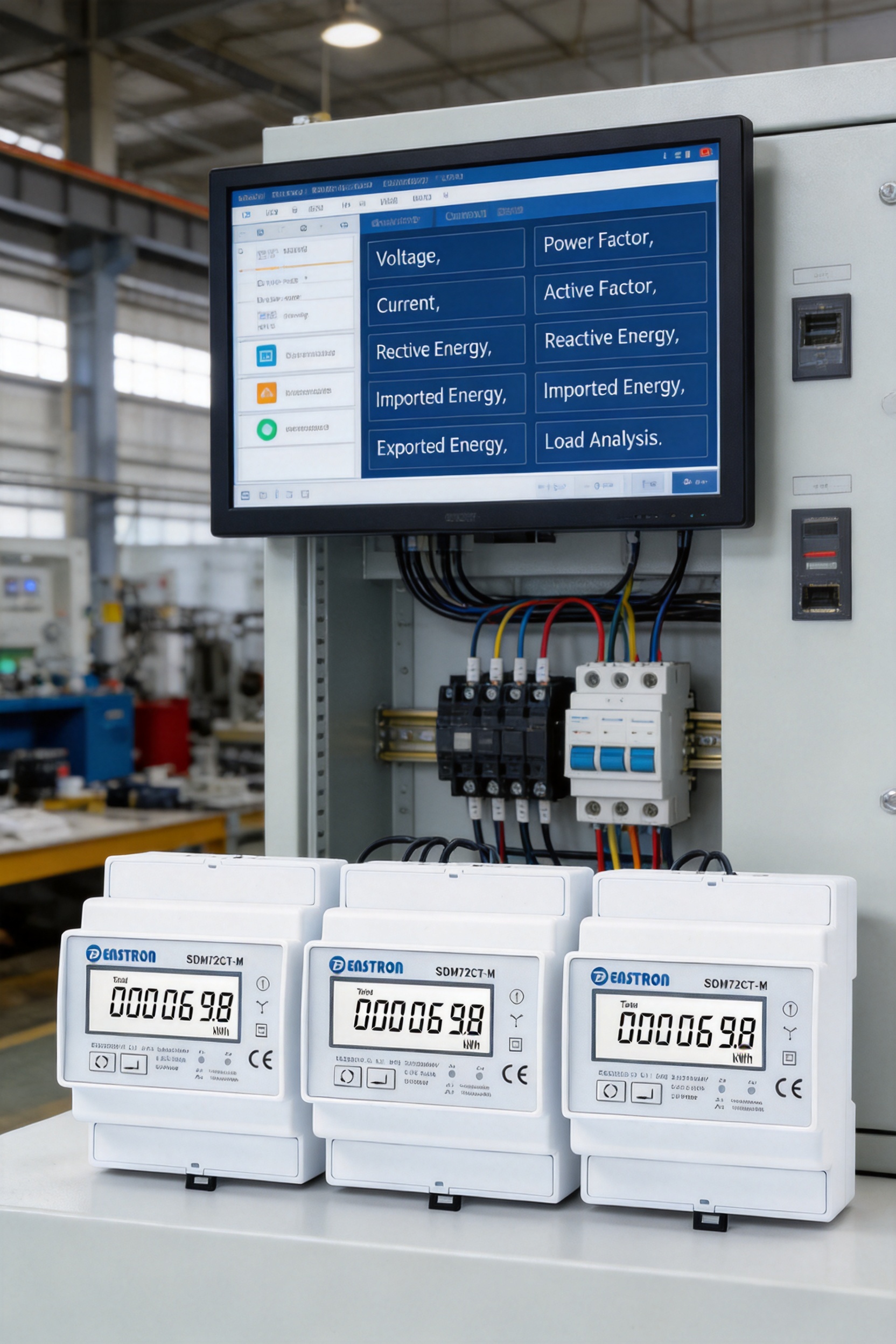
Energy measurement products are used in a wide range of climates, installation practices, grid conditions, and regulatory environments. A manufacturer with international experience must design products that can adapt to these variations. The company behind this meter supplies products and services to more than 50 countries across Europe, Asia-Pacific, America, the Middle East, and Africa. This broad market presence supports a practical understanding of diverse customer needs.
International use also requires attention to standards. The product’s references to IEC, EN, and related accuracy frameworks reflect the importance of recognized measurement criteria. For customers, standards alignment supports confidence in product performance and simplifies specification in professional projects.
The company’s location in Jiaxing, near Shanghai, Hangzhou, and Jiangsu, provides access to a strong manufacturing and logistics environment. This regional advantage supports supply chain coordination, technical collaboration, and efficient delivery. Combined with internal R&D and laboratory capability, it strengthens the company’s ability to produce and support reliable energy measurement products.
Service capability is also important. Metering projects often require technical guidance during product selection, wiring, configuration, and system integration. The company emphasizes technical support and after-sales service, helping customers apply products correctly and solve project issues efficiently.
The global energy sector is moving toward digitalization. Buildings, factories, and infrastructure systems increasingly rely on real-time data to improve efficiency, reduce emissions, and integrate renewable generation. Smart meters and multi-function measurement devices are fundamental to this transformation.
The SDM72CT-M contributes to digital energy transformation by converting electrical behavior into accessible data. Through Modbus RTU, the meter can share information with gateways, monitoring platforms, and control systems. This enables visualization, automation, reporting, and optimization.
In renewable energy systems, data is essential for balancing generation and consumption. In commercial buildings, data supports sustainability targets and energy-saving programs. In industrial operations, data supports cost control and production efficiency. In all of these cases, the meter acts as a trusted measurement node.
Zero export control is a good example of digital energy in action. Instead of passively allowing energy to flow, the system measures, decides, and adjusts. The meter provides the measurement layer, while the controller and inverter execute the control strategy. This coordinated process allows renewable energy systems to operate within grid requirements while maximizing onsite benefit.
When selecting this meter, users should confirm that the electrical system is three phase four wire and that the voltage rating matches the installation. They should choose current transformers with suitable primary current ratings and compatible secondary output. Proper CT class and burden should be considered to maintain measurement performance.
During installation, CT direction and phase matching must be checked carefully. If CT polarity is reversed, the meter may interpret import as export or produce incorrect power values. If voltage and current phases are mismatched, power factor and energy readings may be inaccurate. Commissioning should include verification under known load conditions.
Communication settings should be planned before connecting the meter to a Modbus network. Each device must have a unique address, and baud rate, parity, and stop bits must match the host system. RS485 wiring should be arranged with attention to cable quality, shielding where appropriate, and termination on longer runs.
For zero export systems, it is important to confirm compatibility between the meter, inverter, and controller. The control device must be able to read the required data registers and respond quickly enough for the application. Site conditions, inverter behavior, and grid rules should all be considered during system design.
The main purpose is to measure and communicate three phase electrical parameters, including active energy, reactive energy, power, voltage, current, frequency, power factor, imported energy, and exported energy. It is particularly useful for solar PV systems, zero export control, commercial energy monitoring, and industrial power management.
CT operation allows the meter to measure high-current circuits safely and flexibly through current transformers. Instead of passing the full load current through the meter, CTs reduce the current to a standard secondary value such as 1 A or 5 A. This makes the meter suitable for many different installation sizes.
Yes. The meter supports bi-directional measurement and RS485 Modbus RTU communication, both of which are important for zero export control. It can help a controller or inverter determine whether the site is importing or exporting power and adjust generation accordingly.
The meter uses RS485 Modbus RTU. It supports communication addresses from 1 to 247, transmission speeds from 1200 bps to 9600 bps, parity options of none, odd, or even, and selectable stop bits of 1 or 2.
A basic kWh meter usually records only consumed energy. This meter provides multi-function measurement, bi-directional import and export monitoring, CT ratio flexibility, pulse outputs, and Modbus communication. These features make it more suitable for energy management and solar PV control.
Yes, when used with suitable current transformers. The CT primary setting range from 1 A to 9999 A allows the meter to be applied to a wide range of feeder sizes and load currents.
The meter is four modules wide and mounts on a standard 35 mm Din rail. This compact size makes it suitable for many distribution boards and control panels.
Active energy accuracy is specified according to IEC 62053-21 Class 1.0 and EN 50470-1/3 Class B. Reactive energy is specified according to IEC 62053-23 Class 2.
Yes. Because it supports Modbus RTU, it can be integrated with many building management systems, gateways, data loggers, and energy monitoring platforms, provided the host system supports the required communication settings and data mapping.
Installers should verify CT polarity, CT ratio settings, voltage phase sequence, current phase matching, communication address, baud rate, and Modbus parameters. A commissioning test under a known load is recommended to confirm accurate import and export readings.
The Din Rail CT Type Three Phase Multi-function Solar PV and Zero Export Meter represented by model SDM72CT-M is a practical and capable solution for modern energy measurement. It combines CT-based flexibility, three phase four wire measurement, bi-directional import/export recognition, active and reactive energy monitoring, pulse output, and RS485 Modbus RTU communication in a compact Din rail package.
Its greatest value lies in the way it bridges measurement and control. In solar PV systems, it supports zero export strategies by providing directional power data. In commercial and industrial facilities, it supports energy management by revealing consumption, load behavior, power quality indicators, and system trends. In integration projects, it offers open communication and adaptable CT configuration, reducing design complexity and improving compatibility.
Compared with conventional meters, it delivers broader functionality, better suitability for renewable energy applications, and greater installation flexibility. Compared with many competing products, its combination of compact design, CT range, Modbus communication, pulse output, and bi-directional measurement gives it a strong practical advantage.
The product is also supported by a manufacturer with strong R&D capability, professional laboratory testing, quality management systems, patented technologies, and international market experience. These strengths help ensure that the meter is not only technically capable but also reliable, manufacturable, and suitable for demanding global applications.
For installers, integrators, facility managers, and renewable energy professionals, this type of meter is more than an electrical accessory. It is a data gateway into the electrical system, a control reference for solar PV operation, and a foundation for smarter energy decisions.
International Electrotechnical Commission. IEC 62053-21: Electricity Metering Equipment, Particular Requirements for Static Meters for Active Energy.
International Electrotechnical Commission. IEC 62053-23: Electricity Metering Equipment, Particular Requirements for Static Meters for Reactive Energy.
European Committee for Electrotechnical Standardization. EN 50470-1: Electricity Metering Equipment, General Requirements, Tests and Test Conditions.
European Committee for Electrotechnical Standardization. EN 50470-3: Electricity Metering Equipment, Particular Requirements for Static Meters for Active Energy.
Modbus Organization. Modbus Application Protocol Specification.
International Organization for Standardization. ISO 9001: Quality Management Systems, Requirements.
Industry technical literature on three phase power measurement, current transformer metering, and solar photovoltaic zero export control systems.
Your email address will not be published. Required fields are marked *

We develop and produce high performance electricity meters, power analyzers, current sensors, communication modules and management systems. China Custom Smart Meters Manufacturers and Factory
Address:NO 52, Dongjin Road, Nanhu, Jiaxing, Zhejiang, China
Copyright @ Eastron Electronic Co., Ltd. All rights reserved Electricity Meters Manufacturers
