

 English
 Español
 Deutsch
 中文简体
中文简体

Product Consultation
Your email address will not be published. Required fields are marked *
Europe's Solar and Energy Storage Transition: Transforming the Power System Infrastructure for a Renewable Future
Jul 10,2026
Power Systems Are Becoming “Real-Time Systems”: Why Data Is More Critical Than Electricity
Jul 06,2026
New EPBD Regulations Drive HVAC Energy Transparency and Boost Demand for Smart Meters
Jul 07,2026Content
Modern power distribution requires more than simple electricity metering. Industrial facilities, commercial buildings, data centers, renewable energy installations, and intelligent low-voltage or medium-voltage networks all need detailed electrical visibility, reliable communication, high measurement accuracy, event records, harmonics analysis, and flexible integration with energy management systems. The DI/DO Ethernet Modbus TCP 96x96 panel mounted multi-function power analyzer is designed for these requirements, combining multi-parameter measurement, high-accuracy energy monitoring, harmonic analysis up to the 63rd order, digital input and output functions, RS485 Modbus RTU, and Ethernet Modbus TCP/IP in a compact 96 mm by 96 mm panel-mounted format.
This product is positioned as a smart power analyzer for single-phase and three-phase systems, including 1P2W, 3P3W, and 3P4W applications. It measures and displays voltage, current, frequency, active power, reactive power, apparent power, power factor, active energy, reactive energy, imported energy, exported energy, demand values, harmonics, total harmonic distortion, and individual harmonic distortion. With Class 0.5S active energy accuracy and 5A CT input, it is suitable for demanding electrical monitoring applications where stable data, remote reading, and system-level integration are essential.
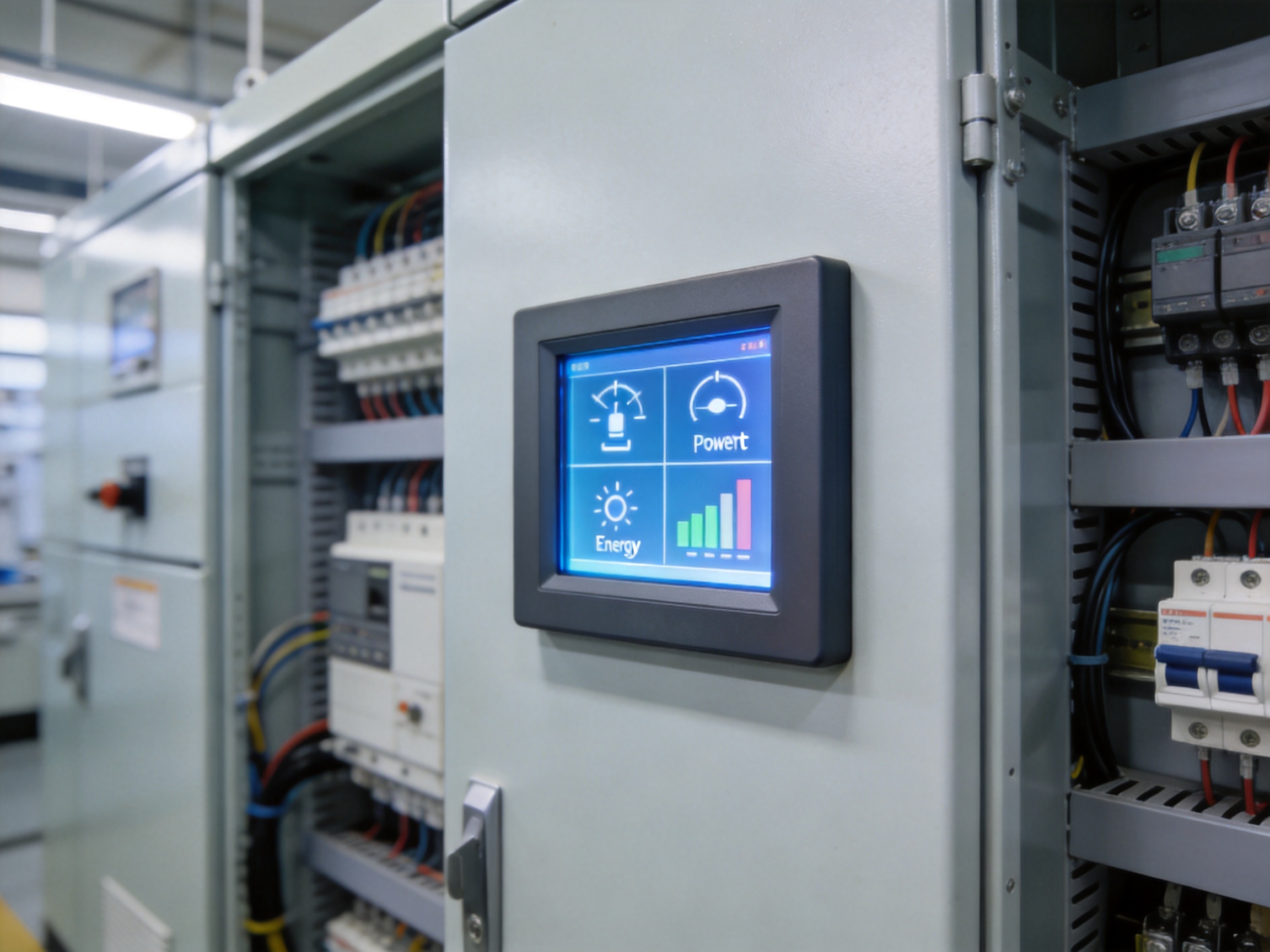
The analyzer is a panel-mounted multi-function power monitoring instrument with a 96x96 mm front size and a depth of approximately 92 mm. It is intended for installation in electrical panels, distribution cabinets, power control centers, machine control panels, energy monitoring boards, and building electrical rooms. Its backlit LCD display provides clear visibility from wide viewing angles, while the bar graph function gives intuitive power indication for operators who need quick visual assessment at the panel.
The device supports three-phase three-wire and three-phase four-wire systems and uses external current transformers with a rated secondary input of 5A. By configuring CT and PT ratios, the analyzer can be adapted to different electrical networks and load capacities. This flexibility makes it suitable for installations ranging from small commercial distribution boards to large industrial power feeders.
One of the strongest advantages of the analyzer is its combination of local measurement and communication capability. RS485 Modbus RTU allows connection to traditional industrial monitoring networks, programmable logic controllers, gateways, and supervisory control systems. Ethernet Modbus TCP/IP enables direct integration into modern IP-based energy management platforms. This dual communication architecture helps users bridge legacy systems and newer digital infrastructure without replacing existing hardware.
The instrument also includes digital input and digital output functions. Digital inputs may be used for external signal counting, status monitoring, or system event acquisition. Digital outputs may be used for alarm output, external device control, or integration with automation logic. Together with sequence of events recording and configurable alarm parameters, the analyzer becomes not only a measurement device but also a practical monitoring and control node.
The analyzer offers a balanced feature set for facilities that need accurate electrical data, communication flexibility, and advanced power quality insight. Its key advantages include multi-parameter measurement, harmonic analysis up to the 63rd order, RS485 and Ethernet communication, digital input and output, high accuracy, multi-tariff support through real-time clock functionality, SOE recording, and a panel-friendly installation design.
Many conventional meters provide only energy accumulation and basic electrical readings. In contrast, this analyzer provides an expanded view of electrical performance. It measures RMS values including harmonics on three-phase AC systems, which is critical because distorted waveforms are common in modern facilities using variable frequency drives, switching power supplies, LED lighting, UPS systems, electric vehicle charging equipment, and renewable inverters.
The harmonic analysis capability up to the 63rd order is a major benefit over many competing panel meters that only provide basic THD or limited harmonic order measurement. High-order harmonic visibility helps maintenance engineers detect abnormal distortion sources, evaluate power quality risks, prevent overheating in conductors and transformers, and support compliance-oriented power quality investigations.
Its Class 0.5S active energy performance, according to IEC 62053-22, provides dependable energy measurement for sub-metering and facility energy analysis. The analyzer is also designed to provide active power, reactive power, apparent power, voltage, current, frequency, power factor, and THD accuracy suitable for energy management and operational monitoring.
Item |
Specification |
Practical Benefit |
System compatibility |
1P2W, 3P3W, 3P4W |
Suitable for single-phase and three-phase electrical networks |
Current input |
5A CT secondary input |
Works with external CTs for a wide range of load currents |
Measured voltage |
50V to 600V for 3P4W; 50V to 480V for 3P3W |
Covers common low-voltage distribution applications |
Active energy accuracy |
IEC 62053-22 Class 0.5S; IEC 62053-21 Class 1.0 |
Reliable data for sub-metering and energy analysis |
Harmonic analysis |
THD and IHD up to the 63rd harmonic |
Supports advanced power quality monitoring |
Communication |
RS485 Modbus RTU and Ethernet Modbus TCP/IP |
Compatible with industrial and IP-based management systems |
Digital functions |
Digital input and digital output |
Enables signal acquisition, alarm output, and device control |
Display |
Backlit LCD with bar graph indication |
Improves local visibility and operator convenience |
Dimensions |
96x96x92 mm |
Standard panel format for electrical cabinets |
Operating temperature |
-25°C to 55°C |
Suitable for demanding indoor electrical environments |
The analyzer measures multiple electrical parameters required for daily operation, energy management, load balancing, maintenance, and troubleshooting. Voltage and current readings help operators verify supply conditions and load behavior. Frequency measurement supports power system stability monitoring. Active, reactive, and apparent power values provide insight into real power consumption, reactive burden, and total electrical capacity usage.
Power factor measurement is particularly important in industrial and commercial facilities. Low power factor can increase losses, reduce network efficiency, and lead to penalties from utility providers in some regions. By displaying power factor and related power parameters, the analyzer helps facility managers identify when capacitor banks, power factor correction equipment, or load optimization measures may be necessary.
Energy measurement is available for active and reactive energy, including imported and exported energy. This is useful for buildings and industrial sites that consume electricity from the grid and may also export power through solar photovoltaic systems, energy storage systems, or other distributed energy resources. Imported and exported energy data gives users a clearer understanding of two-way energy flow.
Maximum demand monitoring is another practical function. Demand data supports contract capacity analysis, peak load identification, load scheduling, and energy cost optimization. In facilities where demand charges are significant, detailed demand monitoring can help managers control peak consumption and make informed decisions about equipment operation schedules.
Electrical networks are increasingly affected by nonlinear loads. Variable speed drives, inverters, rectifiers, UPS systems, welding equipment, charging systems, and electronic power supplies can introduce harmonic distortion into current and voltage waveforms. Excessive harmonics can cause transformer overheating, nuisance breaker tripping, motor vibration, capacitor failure, neutral conductor overheating, and communication interference.
The analyzer’s ability to measure total harmonic distortion and individual harmonic distortion up to the 63rd harmonic gives maintenance teams a deeper diagnostic tool than standard meters. Many competing instruments stop at basic THD readings or measure only lower-order harmonics. By extending harmonic visibility to the 63rd order, the analyzer helps engineers better locate distortion patterns and evaluate whether mitigation devices such as harmonic filters or reactors are needed.
This capability is also valuable for predictive maintenance. A sudden increase in harmonic content can indicate abnormal equipment operation, deteriorating drives, unbalanced loading, or new nonlinear loads added to the system. When combined with communication and alarm settings, harmonic monitoring can become part of a proactive maintenance strategy.
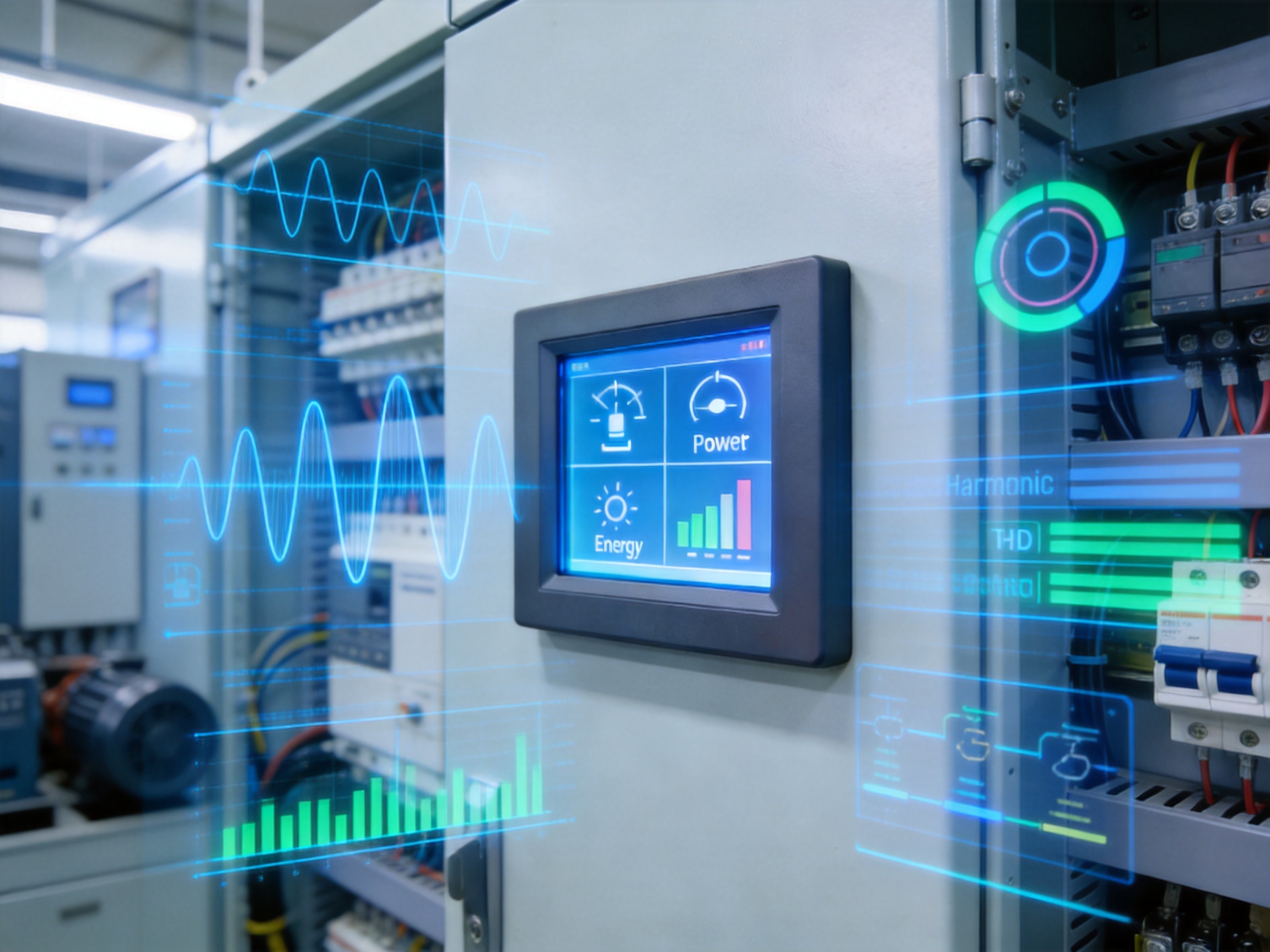
Communication is one of the product’s most important strengths. RS485 Modbus RTU remains widely used in industrial automation because it is stable, cost-effective, and suitable for multi-drop networks. The analyzer supports Modbus RTU through a two-wire half-duplex RS485 port, with baud rates of 2400, 4800, 9600, 19200, and 38400 bps. It supports addresses from 1 to 247, with parity options including none, even, and odd, and stop bit configuration of one or two bits.
Ethernet Modbus TCP/IP adds another layer of connectivity. Many modern building management systems, energy monitoring platforms, industrial computers, and cloud-connected gateways rely on IP-based communication. By supporting Ethernet communication, the analyzer can be integrated into modern networked environments more directly than products limited to serial communication.
This dual communication design is a practical advantage over competitors that provide only RS485 or require optional modules for Ethernet. Users can deploy the analyzer in existing RS485 networks today and migrate to Ethernet-based monitoring later. For system integrators, this reduces design complexity and increases compatibility across different projects.
Remote reading and setting are supported, allowing engineers to collect data, configure parameters, and monitor device status without repeated physical access to electrical panels. This improves operational efficiency, especially in sites with many distribution boards, difficult-to-access installations, or multiple buildings.
The inclusion of digital input and digital output functions increases the analyzer’s value beyond electrical measurement. Digital inputs can receive external signals such as breaker status, switch status, pulse input from other meters, or equipment running signals. This allows the analyzer to serve as part of a wider monitoring system where electrical values and status information are combined.
Digital outputs can be used for alarm signaling or external control. For example, if current exceeds a set threshold, voltage drops below an acceptable level, power factor becomes too low, or harmonic distortion exceeds a defined limit, the analyzer can trigger an output signal to alert personnel or initiate a control action. With 30 types of configurable alarm parameters, users can build meaningful local and remote alarm strategies.
Compared with meters that only measure and transmit data, the analyzer provides a more interactive role in electrical management. It can contribute to event response, status collection, and device coordination, making it suitable for smart panels, intelligent distribution systems, and automation environments.
The analyzer supports multi-tariff functions with real-time clock availability. Multi-tariff energy monitoring is useful where electricity pricing varies by time of day, season, peak period, off-peak period, or contractual tariff structure. By separating energy consumption across tariff periods, users can better understand cost distribution and identify opportunities to move flexible loads to lower-cost periods.
For commercial buildings, this may support energy cost allocation by operating schedule. For industrial facilities, it may help evaluate whether certain processes can be shifted away from peak tariff windows. For energy service companies and system integrators, multi-tariff data provides a stronger basis for energy-saving proposals and performance verification.
Sequence of events recording helps users understand not only what happened, but when it happened. Electrical disturbances, alarm triggers, status changes, and operational events can be difficult to analyze without time-based records. SOE recording supports troubleshooting by preserving event order and helping technicians correlate electrical data with equipment behavior.
In power distribution systems, event records can help identify recurring problems such as undervoltage events during motor startup, overload conditions during production peaks, or power quality changes after new equipment is connected. This function is especially useful in facilities where uptime, process stability, and maintenance traceability are important.
The panel-mounted analyzer includes a backlit LCD display designed for full viewing angles. A clear local display is still important even in systems with remote monitoring because technicians and electricians often need to inspect values directly at the cabinet. During commissioning, troubleshooting, or routine inspection, local visibility speeds up work and reduces dependence on separate test instruments.
The bar graph power indication provides a quick visual reference for load level. Operators can instantly see whether a feeder is lightly loaded, approaching high load, or operating near a defined range. This helps support rapid decisions during maintenance, switching operations, and load balancing.
The push-in installation and plug-in connection design also improves the user experience. Panel devices must be easy to install, replace, and wire, especially in projects with many metering points. A convenient mounting and connection structure reduces installation time, improves consistency, and helps minimize wiring errors.
The analyzer uses a standard 96x96 mm panel format, a common size for industrial and commercial panel instruments. This makes it suitable for new panel designs and retrofit applications where existing panel openings may already match standard dimensions. With a depth of 92 mm and a weight of approximately 420 g, it fits well into typical electrical cabinet layouts.
The front display protection level is IP51 according to IEC 60529, supporting use in indoor panel environments where protection against dust and limited moisture exposure is needed at the front interface. The meter case uses self-extinguishing UL 94 V-0 material, which contributes to electrical safety and flame resistance. Shrouded screw-clamp terminals provide secure wiring connections.
The analyzer is designed for operation from -25°C to 55°C, with storage from -40°C to 70°C and humidity tolerance below 95% RH at 50°C, non-condensing. These environmental characteristics allow use in demanding electrical rooms and industrial control cabinets, provided installation conditions are appropriate.
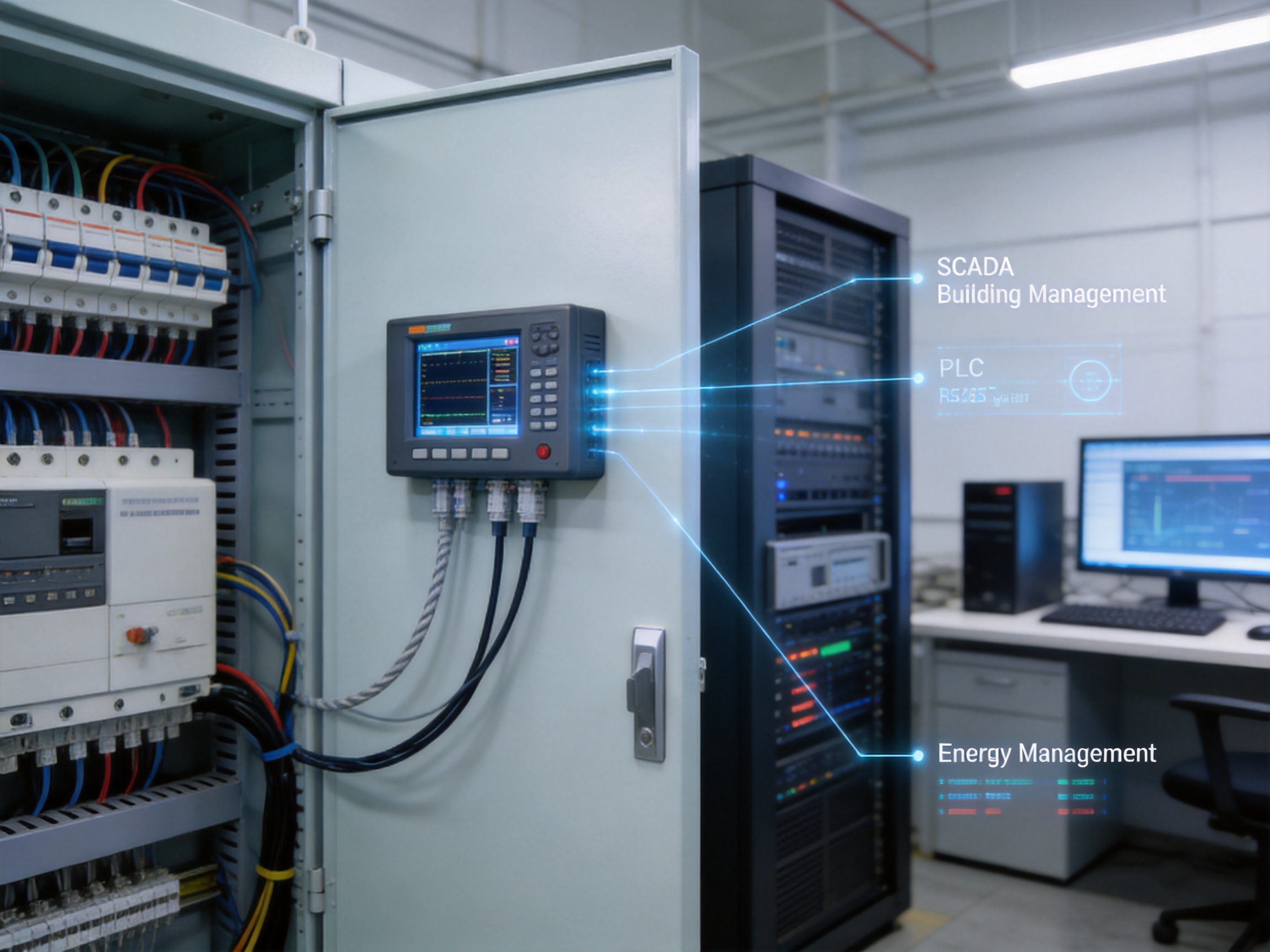
The analyzer stands out from conventional panel meters in several important areas. First, it combines multi-function electrical measurement and power quality analysis in one compact device. Many basic meters show voltage, current, power, and energy, but do not provide harmonic analysis to the 63rd order or detailed individual harmonic data.
Second, it supports both RS485 Modbus RTU and Ethernet Modbus TCP/IP. A competing meter may provide serial communication only, requiring additional gateways for Ethernet integration. Other products may provide Ethernet only, limiting compatibility with existing RS485 field networks. By offering both communication methods, the analyzer provides project flexibility and long-term system adaptability.
Third, its digital input and output functions create additional system value. A basic meter often acts only as a passive measuring instrument. This analyzer can receive external status signals, support alarm output, and participate in monitoring logic. This makes it more suitable for smart panels and energy management solutions.
Fourth, Class 0.5S active energy accuracy gives it a strong position for sub-metering applications where accuracy matters. Reliable energy data is necessary for internal billing, tenant energy allocation, equipment efficiency analysis, and measurement-based energy saving verification.
Fifth, the analyzer’s real-time clock, multi-tariff capability, SOE recording, alarm setting flexibility, and backlit display give users a more complete operating experience. It is not merely a display instrument; it is a practical field-level intelligence device for power monitoring.
The analyzer is suitable for electricity transmission and power distribution systems, as well as power consumption measurement and analysis in low-voltage and medium-voltage intelligent power grids. In a main distribution board, it can monitor incoming supply quality, feeder loading, demand trends, and energy consumption. In sub-distribution boards, it can support department-level or process-level energy analysis.
In industrial plants, the analyzer can monitor production lines, motor control centers, compressor systems, HVAC equipment, pumping stations, lighting systems, and high-consumption machinery. By collecting detailed electrical data, plant managers can detect inefficiencies, identify abnormal operating conditions, and plan energy-saving actions.
In commercial buildings, it supports tenant metering, floor-level energy monitoring, HVAC energy analysis, and facility operation optimization. In data centers, it can be used for panel-level monitoring, power usage visibility, and load balancing. In renewable energy and storage systems, imported and exported energy readings help track bidirectional energy flow.
For system integrators, the analyzer offers a flexible platform for smart energy systems. Its Modbus protocols, digital functions, alarm settings, and harmonic data allow integration into building management systems, SCADA systems, industrial automation platforms, and energy dashboards.
The product is supported by a manufacturer specializing in electricity products and energy measurement solutions, with experience in electricity meters, power analyzers, current sensors, communication modules, and management systems. This background is important because a reliable power analyzer requires expertise in metering accuracy, embedded software, communication protocols, electromagnetic compatibility, safety design, mechanical structure, and production quality control.
The company maintains development teams in China and the United Kingdom, combining energetic product development with international technical perspective. Continuous investment in research and development helps the company introduce new technologies, improve product functions, and respond to changing market requirements. Cooperation with universities and technical institutions further strengthens innovation and supports advanced product engineering.
The manufacturer has established a professional laboratory capable of performing electromagnetic compatibility, low-voltage directive, accuracy, and environmental tests according to IEC, EN, GB, and UL-related standards. In the power metering industry, this laboratory capability is a major strength. It allows engineers to validate products during development, identify design weaknesses, improve reliability, and maintain consistent quality before mass production.
Advanced manufacturing is not only about assembling components. It includes design verification, component selection, firmware validation, calibration, communication testing, environmental testing, safety checks, and quality management. The company follows ISO 9001 quality management practices, and production is approved by SGS according to MID-related standards. These systems help ensure that each product is manufactured under controlled procedures.
The company also holds patented technologies in software, embedded software, and hardware. Patents demonstrate original technical development and support product differentiation. In a device such as this analyzer, embedded software is critical because it handles measurement algorithms, communication protocols, event records, display logic, alarm settings, and parameter configuration. Strong embedded software capability helps ensure stable operation and accurate data processing.
Power analyzers are installed in demanding electrical environments where reliability is essential. They must continue operating despite voltage fluctuations, electromagnetic interference, temperature variation, communication activity, and long service periods. The manufacturer’s laboratory and quality system support a comprehensive testing philosophy that covers accuracy, environmental adaptability, EMC performance, safety, and production consistency.
Accuracy testing verifies that measured values remain within specified limits for current, voltage, energy, power, frequency, and related parameters. EMC testing helps confirm that the product can resist interference and avoid causing unacceptable interference to other equipment. Environmental testing evaluates operation and storage under temperature and humidity conditions. Safety-related testing supports insulation, material, and protection design.
During production, calibration and functional inspection help ensure that shipped units meet expected performance. Communication testing verifies Modbus RTU and Modbus TCP/IP behavior. Display and keypad checks confirm local operation. Input and output checks validate the DI/DO functions. Mechanical inspection helps ensure that the housing, terminals, and panel installation features meet quality requirements.
This structured approach gives the analyzer an advantage over low-cost, minimally tested alternatives. In energy monitoring, poor measurement accuracy or unstable communication can lead to wrong decisions, billing disputes, maintenance delays, and integration problems. Strong manufacturing and testing reduce these risks.
System integrators need products that are technically capable, easy to configure, reliable in communication, and adaptable to different site requirements. This analyzer supports those needs through configurable CT and PT ratios, multiple wiring modes, Modbus RTU, Modbus TCP/IP, alarm parameters, digital input and output, and a compact panel form factor.
The availability of both serial and Ethernet communication makes integration easier across mixed systems. A project may include older PLCs using RS485, newer gateways using Ethernet, and cloud energy platforms collecting data through IP networks. With this analyzer, integrators can create a consistent metering architecture without selecting different meter models for each communication environment.
Modbus is a widely accepted protocol, which reduces integration complexity. Engineers can map registers into SCADA software, building management platforms, data acquisition systems, and energy analysis software. The analyzer’s rich parameter set provides more useful data for dashboards and reports than basic energy-only meters.
The DI/DO functions also reduce the need for separate I/O devices in some applications. If a panel requires electrical measurement plus basic status or alarm signaling, the analyzer may simplify wiring and device count. This can reduce panel space, installation labor, and project cost.
For end users, the analyzer supports lower energy costs, better maintenance awareness, improved electrical safety, and more transparent facility operation. Accurate energy data helps managers understand where electricity is used. Demand data helps identify peak consumption. Power factor and reactive power data support efficiency improvement. Harmonic data helps protect equipment and improve power quality.
Remote communication reduces manual meter reading and allows centralized monitoring. Instead of sending technicians to record values at each panel, data can be collected automatically. This saves time, reduces human error, and provides continuous records for analysis. Alarm functions help users respond more quickly to abnormal conditions.
For maintenance teams, the analyzer becomes a diagnostic instrument installed directly in the electrical network. When equipment trips, overheats, or behaves abnormally, technicians can review voltage, current, power, power factor, harmonics, demand, and event data. This can shorten troubleshooting time and support more informed maintenance decisions.
For energy managers, the analyzer provides data needed for benchmarking, reporting, and energy-saving verification. It can support ISO 50001-style energy management practices by providing measured evidence of consumption trends and improvement results.

The DI/DO Ethernet Modbus TCP 96x96 panel mounted multi-function power analyzer is a strong choice because it combines advanced measurement, communication flexibility, power quality insight, and industrial installation practicality. It is suitable for users who need more than a basic meter but still want a compact, panel-mounted instrument that can be integrated into real-world electrical systems.
Its most important strengths are Class 0.5S active energy accuracy, harmonic analysis up to the 63rd order, RS485 Modbus RTU, Ethernet Modbus TCP/IP, digital input and output, SOE recording, multi-tariff availability, alarm parameter flexibility, and a clear backlit LCD display. These features directly address the needs of smart distribution, energy monitoring, and facility operation.
The product is further strengthened by the manufacturer’s capabilities in research and development, patented technology, laboratory testing, quality management, international market experience, and professional technical support. A power analyzer is not only a hardware product; it depends on accurate measurement algorithms, stable firmware, reliable communication, safe mechanical design, and consistent production. The manufacturer’s strengths support these requirements.
It can be used in single-phase and three-phase systems, including 1P2W, 3P3W, and 3P4W configurations. This makes it suitable for a wide range of low-voltage and medium-voltage monitoring applications when used with appropriate CT and PT settings.
Harmonic analysis up to the 63rd order provides deeper visibility into waveform distortion than basic THD-only meters. It helps engineers identify nonlinear load problems, evaluate power quality, protect equipment, and plan harmonic mitigation.
RS485 Modbus RTU is widely used in industrial field networks, while Ethernet Modbus TCP/IP is suitable for modern IP-based systems. Having both allows the analyzer to work with legacy and modern monitoring platforms, improving integration flexibility.
Class 0.5S active energy accuracy means the analyzer can provide reliable energy data for sub-metering, energy analysis, internal cost allocation, and performance verification. It is more suitable for serious energy management than low-accuracy indicators.
Digital inputs can collect external status or pulse signals, while digital outputs can support alarm signaling or control actions. These functions help the analyzer participate in a wider monitoring and automation system rather than acting only as a display meter.
Yes. It measures energy, demand, power factor, and other parameters, and supports multi-tariff applications with real-time clock availability. These functions help users understand consumption patterns and identify opportunities to reduce energy costs.
Yes. It uses a standard 96x96 mm panel-mounted design with a 92 mm depth, backlit LCD display, push-in installation, and plug-in connection features. It is designed for installation in electrical cabinets and distribution panels.
The manufacturer has professional research and development teams, patented software and hardware technologies, a dedicated laboratory for EMC, safety, accuracy, and environmental testing, ISO 9001 quality management practices, and production approval according to MID-related standards.
The DI/DO Ethernet Modbus TCP 96x96 panel mounted multi-function power analyzer is a comprehensive solution for modern electrical measurement and energy management. It delivers accurate energy data, broad electrical parameter monitoring, advanced harmonic analysis, communication flexibility, digital I/O integration, event recording, alarm functions, and convenient panel installation.
Compared with conventional power meters, it provides stronger diagnostic capability, better communication options, more automation value, and greater suitability for intelligent power distribution systems. Its support for both RS485 and Ethernet communication makes it especially useful for facilities transitioning from traditional monitoring to connected energy management platforms.
Behind the product is a manufacturer with strong technical development, testing, quality management, and global service capabilities. These strengths help ensure that the analyzer is not only feature-rich but also dependable in practical applications. For industrial plants, commercial buildings, data centers, renewable energy systems, and smart distribution projects, this analyzer offers a powerful balance of accuracy, intelligence, and integration flexibility.
International Electrotechnical Commission. IEC 62053-22: Electricity Metering Equipment, Static Meters for Active Energy, Classes 0.2S and 0.5S.
International Electrotechnical Commission. IEC 62053-21: Electricity Metering Equipment, Static Meters for Active Energy, Classes 1 and 2.
International Electrotechnical Commission. IEC 62053-24: Electricity Metering Equipment, Static Meters for Reactive Energy.
International Electrotechnical Commission. IEC 60529: Degrees of Protection Provided by Enclosures.
Modbus Organization. Modbus Application Protocol Specification.
International Organization for Standardization. ISO 9001 Quality Management Systems Requirements.
UL Standards. UL 94 Standard for Tests for Flammability of Plastic Materials for Parts in Devices and Appliances.
Your email address will not be published. Required fields are marked *

We develop and produce high performance electricity meters, power analyzers, current sensors, communication modules and management systems. China Custom Smart Meters Manufacturers and Factory
Address:NO 52, Dongjin Road, Nanhu, Jiaxing, Zhejiang, China
Copyright @ Eastron Electronic Co., Ltd. All rights reserved Electricity Meters Manufacturers
