

 English
 Español
 Deutsch
 中文简体


Product Consultation
Your email address will not be published. Required fields are marked *
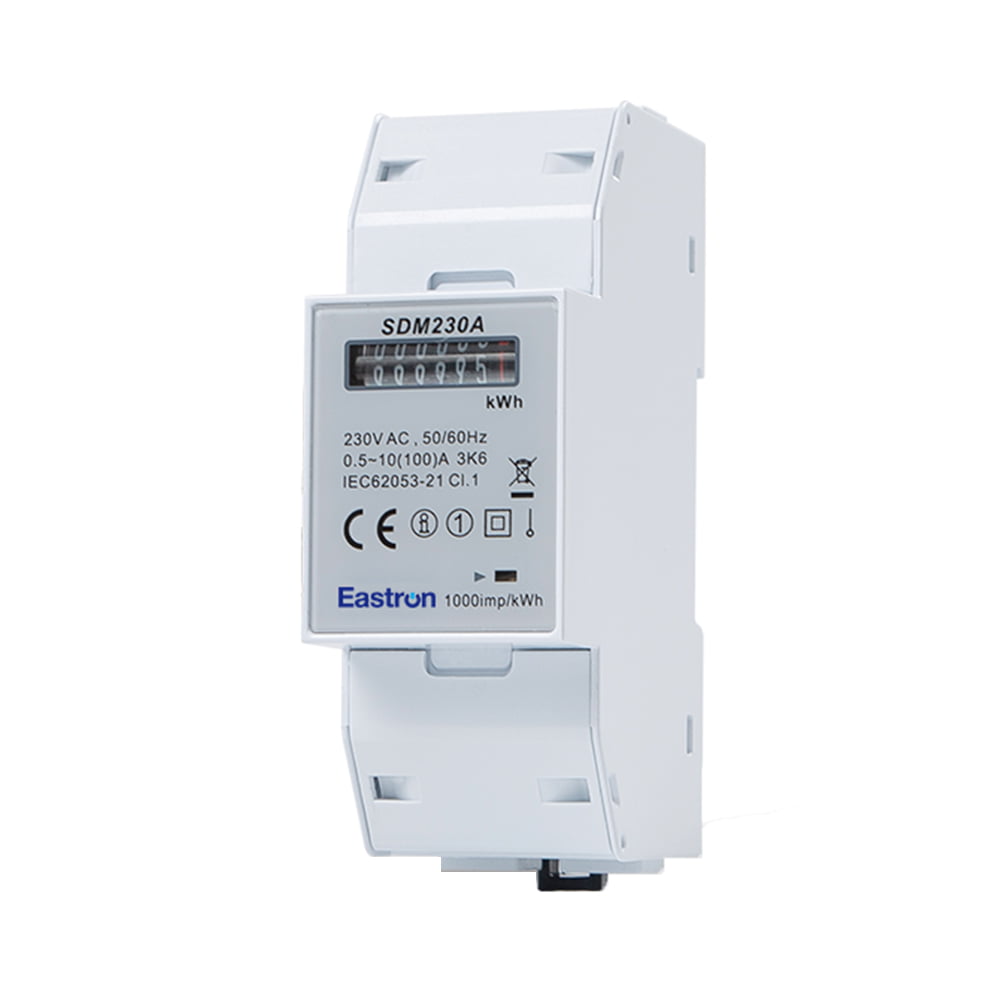
Analog Display 100A Din Rail Single Phase Electronic kWh meter with Pulse Output
Aug 11,2022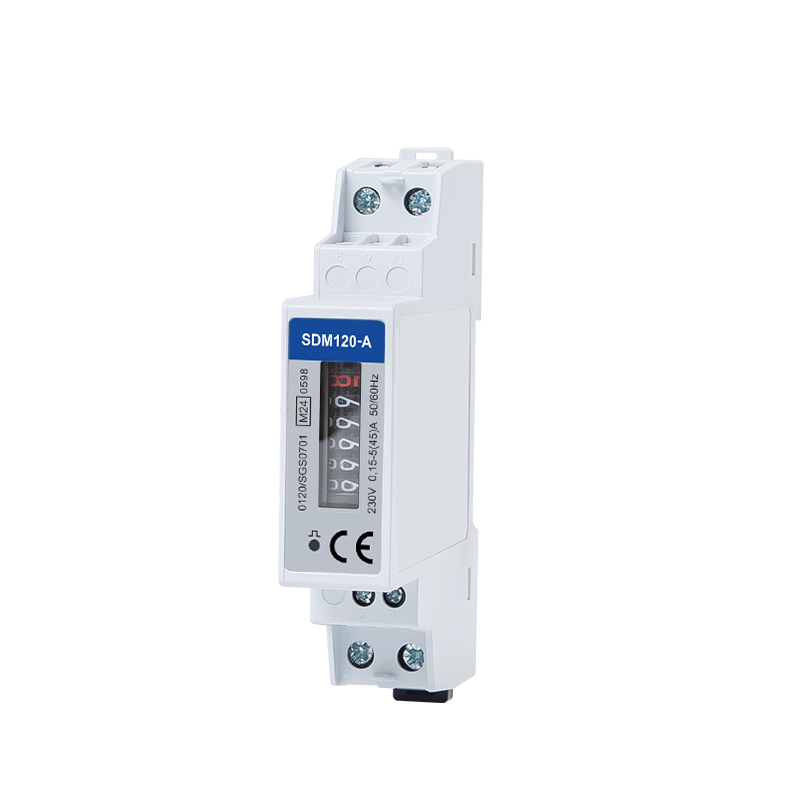
Analog Display Din Rail Single Phase Electronic kWh meter with Pulse Output
Aug 11,2022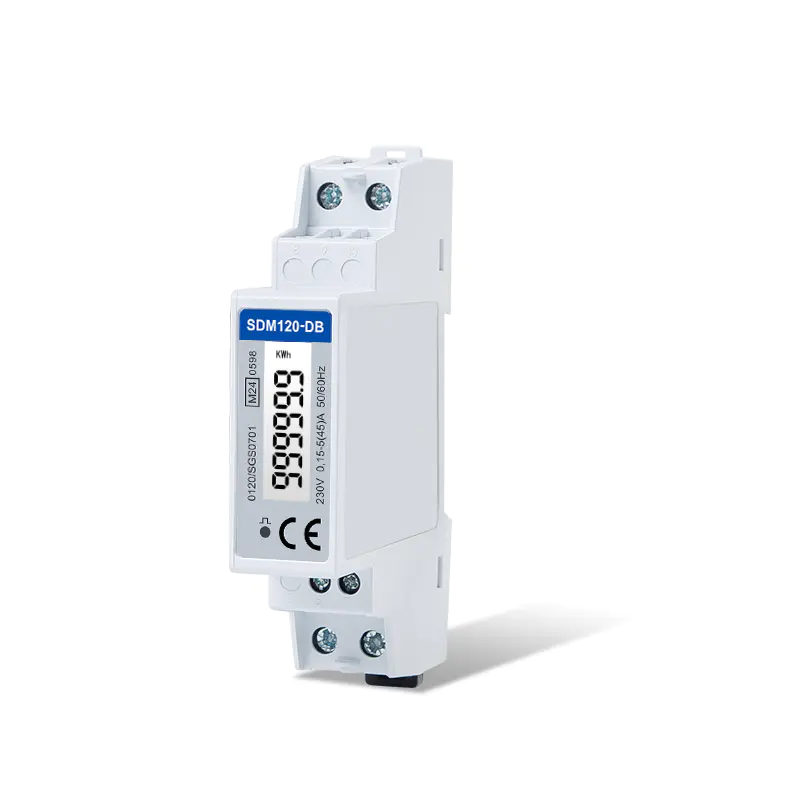
Backlit LCD Display Din Rail Single Phase Electronic kWh meter with Pulse Output
Aug 11,2022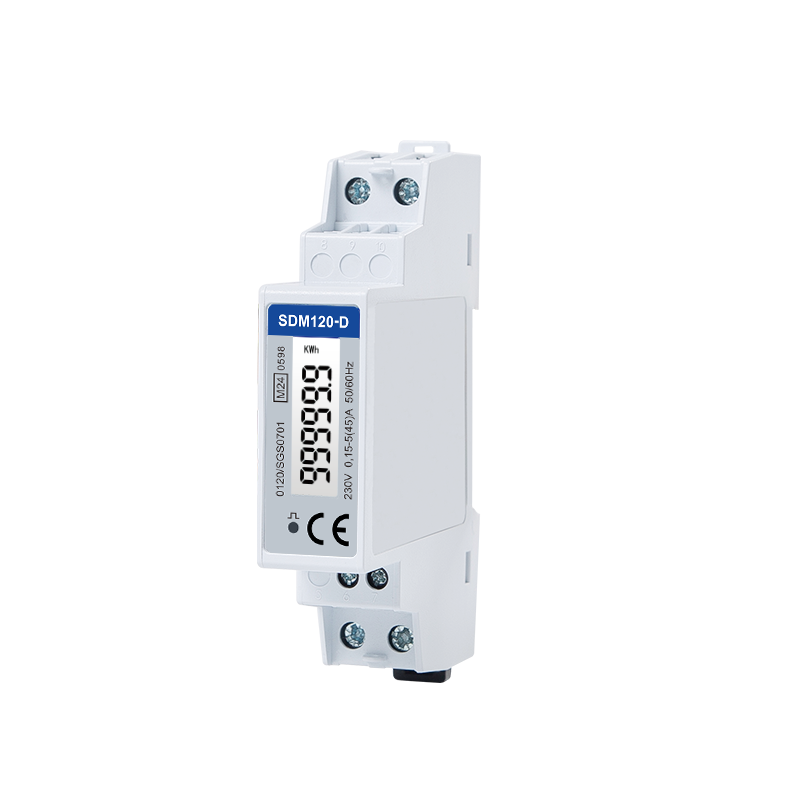
LCD Display Din Rail Single Phase Electronic kWh meter with Pulse Output
Aug 11,2022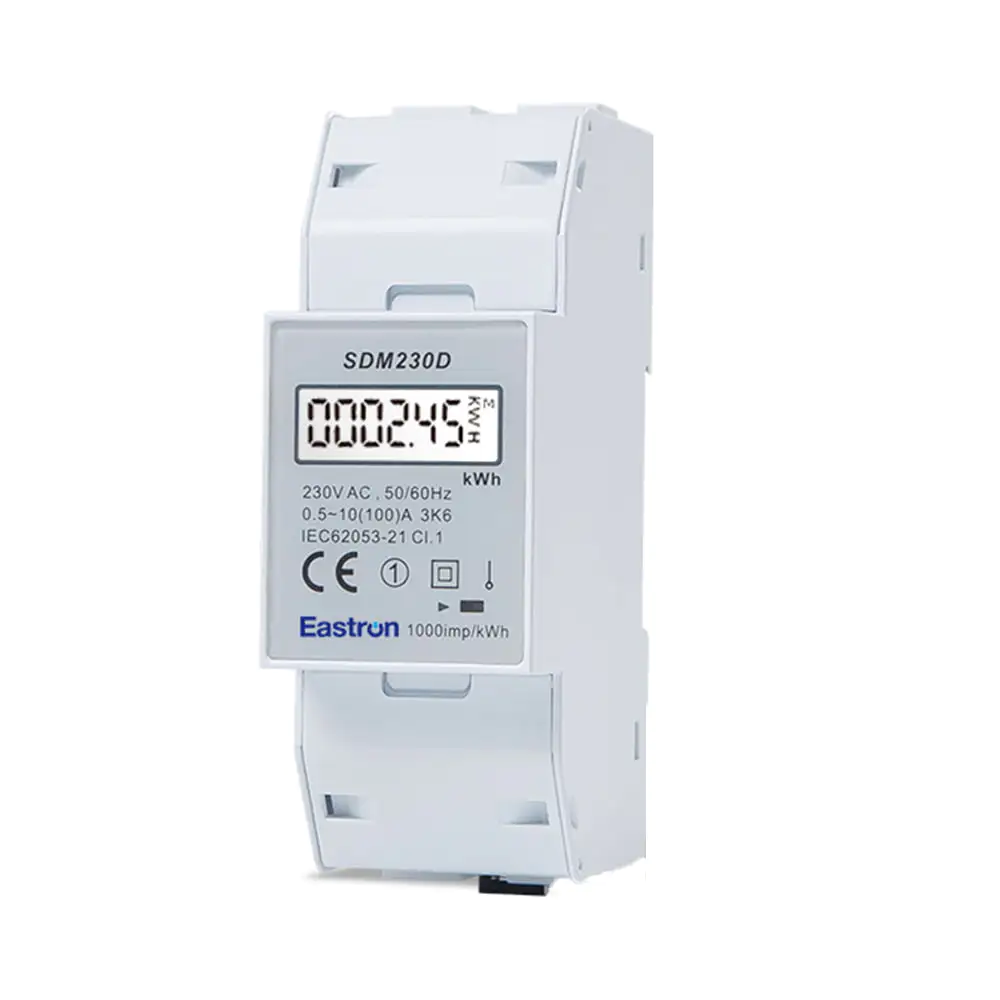
LCD Display 100A Din Rail Single Phase Electronic kWh meter with Pulse Output
Aug 11,2022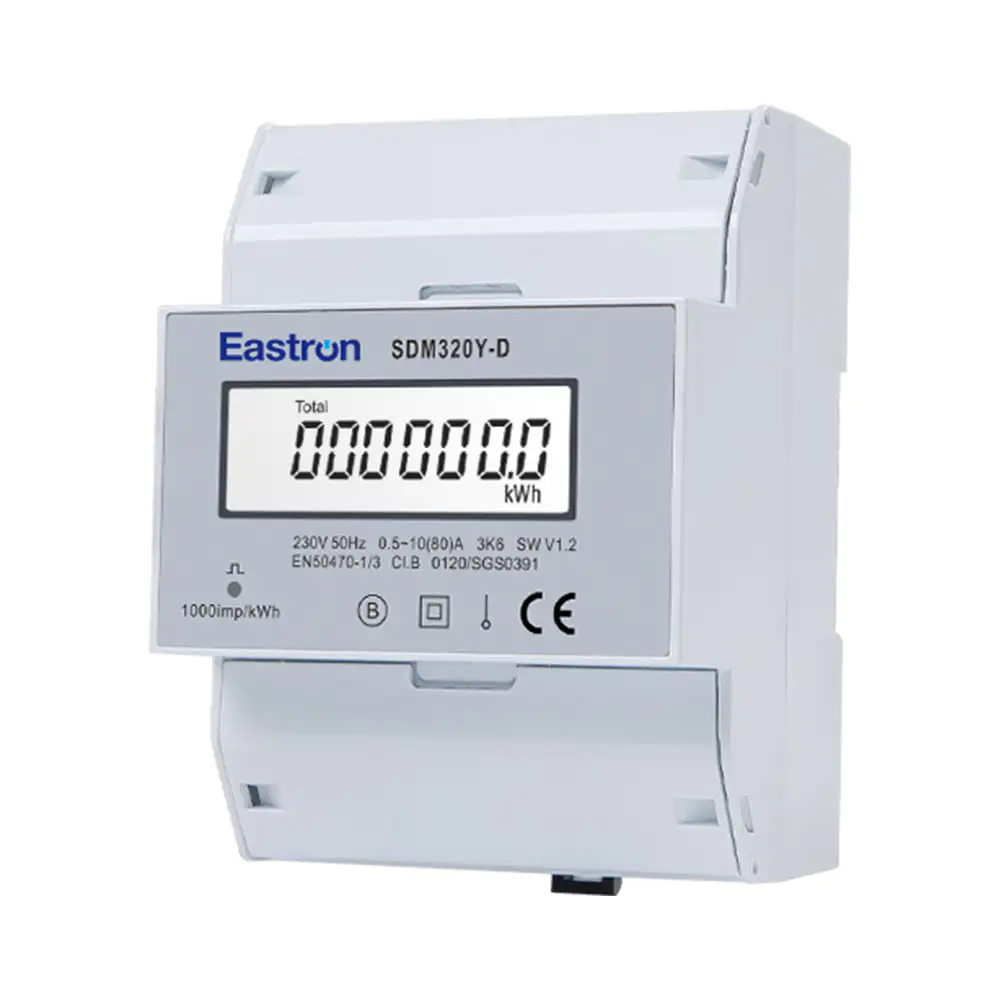
Single Phase Electronic kWh meter with Pulse Output
Nov 24,2022Content
Accurate energy measurement is essential in residential distribution boards, small commercial installations, solar-generation monitoring, equipment panels, and many other low-voltage applications. A practical meter must do more than display a number. It should fit easily inside a compact enclosure, withstand normal electrical operating conditions, provide dependable measurement, support straightforward installation, and deliver useful output signals for monitoring or control systems. The SDM120-A analog display DIN rail single-phase electronic kWh meter is designed around these requirements.
This compact meter measures active energy on a single-phase, two-wire AC system and accepts a direct load of up to 45 A. Its one-module, 18 mm DIN rail format helps preserve valuable panel space, while its analog display gives users an immediate visual indication of accumulated energy consumption. A pulse output is also available for connection to remote counters, data acquisition equipment, building management systems, or simple energy-monitoring arrangements.
Although the device has a compact form factor, it combines several features that are often separated across different meter types: direct current measurement, active-energy registration, visible mechanical-style indication, pulse communication, and DIN rail mounting. This combination makes it a useful option for installations that need dependable kWh measurement without the cost, complexity, or physical size of a full multifunction power analyzer.
The SDM120-A is a single-phase, two-wire electronic kWh meter for use on a 230 V AC system. It is intended for direct connection to loads up to 45 A and measures active energy consumed by the connected circuit. The meter is identified as an analog display model, meaning that its front indication is designed for direct reading rather than relying on a digital menu, communication screen, or external software platform.
The meter is supplied in a compact DIN rail housing measuring one module, or approximately 18 mm in width. This narrow profile is particularly valuable where a distribution board contains multiple protective devices, contactors, residual-current devices, control relays, and measurement components. A narrow meter can be installed without requiring a larger enclosure or sacrificing space needed for other equipment.
The product is also available within the SDM120-A/D/DB family, which includes models or configurations associated with pulse output and related measurement functions. The SDM120-A is the analog display version described in this article. Its core application is the measurement of active energy in a single-phase circuit, with a pulse output for external energy counting.
Unlike a basic electromechanical meter, the device uses electronic measurement technology. Electronic metering allows the manufacturer to achieve a compact structure, stable performance, and a practical combination of direct current input and pulse output. The design also supports modern panel-building practices in which instruments are expected to occupy minimal rail space while remaining compatible with digital monitoring systems.
Analog Display Din Rail Single Phase Electronic kWh meter with Pulse Output
| Characteristic | Specification |
|---|---|
| Measurement system | RMS measurement on a single-phase AC system, 1P+N |
| Wiring type | Single-phase, two-wire |
| Rated voltage | 230 V |
| Operating voltage | 80% to 120% of rated voltage |
| Rated current, Ib | 5 A |
| Maximum current, Imax | 45 A |
| Minimum current, Imin | 0.15 A |
| Starting current | 20 mA |
| Energy measured | Active energy |
| Accuracy classification | IEC 62053-21 Class 1; EN 50470-3:2022 Class B/C as specified |
| Display | Analog display |
| Output | Pulse output for active energy |
| Mounting format | DIN rail, one module, approximately 18 mm wide |
The specifications show that the SDM120-A is intended for direct-load metering rather than transformer-operated high-current measurement. Its 45 A maximum current rating covers many residential circuits, small commercial loads, auxiliary circuits, renewable-energy branches, and equipment-level monitoring applications.
The 230 V rated voltage is suitable for common single-phase distribution systems. The stated operating range of 80% to 120% of rated voltage provides a broad voltage window for normal system variation. As with all electrical equipment, the actual installation should be checked against local voltage conditions, wiring rules, protective-device requirements, and the applicable version of the product documentation.
Active energy is the quantity most commonly associated with electricity consumption and billing. It represents the energy converted into useful work, heat, light, motion, or other forms of consumption by an electrical load. In a single-phase installation, the meter evaluates the electrical quantities in the circuit and accumulates the resulting active energy over time.
For many applications, active-energy measurement is more relevant than a large set of instantaneous electrical parameters. A small shop, apartment sub-circuit, workshop machine, pump, advertising sign, electric heater, or solar-generation branch may primarily require an indication of how many kilowatt-hours have been used or produced. Installing a full power analyzer in such a circuit could add unnecessary cost and complexity. The SDM120-A provides a focused solution for the central measurement requirement.
The meter’s measurement method is specified as RMS measurement on a single-phase AC system. RMS measurement is important because AC voltage and current vary continuously with time. A measurement device must process these changing quantities rather than simply read a fixed instantaneous value. Correct RMS-based measurement helps the instrument operate appropriately in real-world AC distribution environments.
The product information identifies energy accuracy according to IEC 62053-21 Class 1 and EN 50470-3:2022 Class B/C as specified for the relevant configuration. These classifications position the meter for dependable general-purpose energy measurement. The exact applicable class should be confirmed from the model marking and certification documents before a project specifies the meter for regulated billing or revenue-metering use.
The meter also specifies a minimum current of 0.15 A and a starting current of 20 mA. These values indicate the sensitivity of the measurement system to low-load operation. In practical terms, a circuit may remain energized while drawing only a small amount of current, and the meter is designed to begin registering at a low current level. The actual reading behavior will depend on the circuit conditions, power factor, voltage quality, and installation environment.
One of the clearest advantages of the SDM120-A is its compact physical design. At approximately 18 mm wide, it occupies only one standard DIN rail module. This is significantly more space-efficient than many multifunction meters, panel meters, or older electromechanical designs that require wider housings.
Space inside electrical cabinets has a direct effect on project cost. A wider enclosure may require more material, a larger mounting plate, additional wiring space, and more time during assembly. In retrofit work, available space may be fixed and difficult to increase. A one-module meter can often be added to an existing distribution board with minimal rearrangement of other components.
The narrow housing is also useful in modular residential distribution boards. A contractor may need to measure a dedicated circuit while keeping the main protective devices, surge protection, contactors, and terminal equipment in the same enclosure. The SDM120-A allows measurement to be added without consuming the space of a large instrument.
Compact construction does not eliminate the need for safe installation. The device must be wired according to the supplied wiring diagram and applicable electrical regulations. The circuit should be isolated before installation, suitable overcurrent protection should be provided, conductors should be correctly sized, and terminals should be tightened according to the manufacturer’s instructions. The meter is a measurement component, not a substitute for circuit protection.
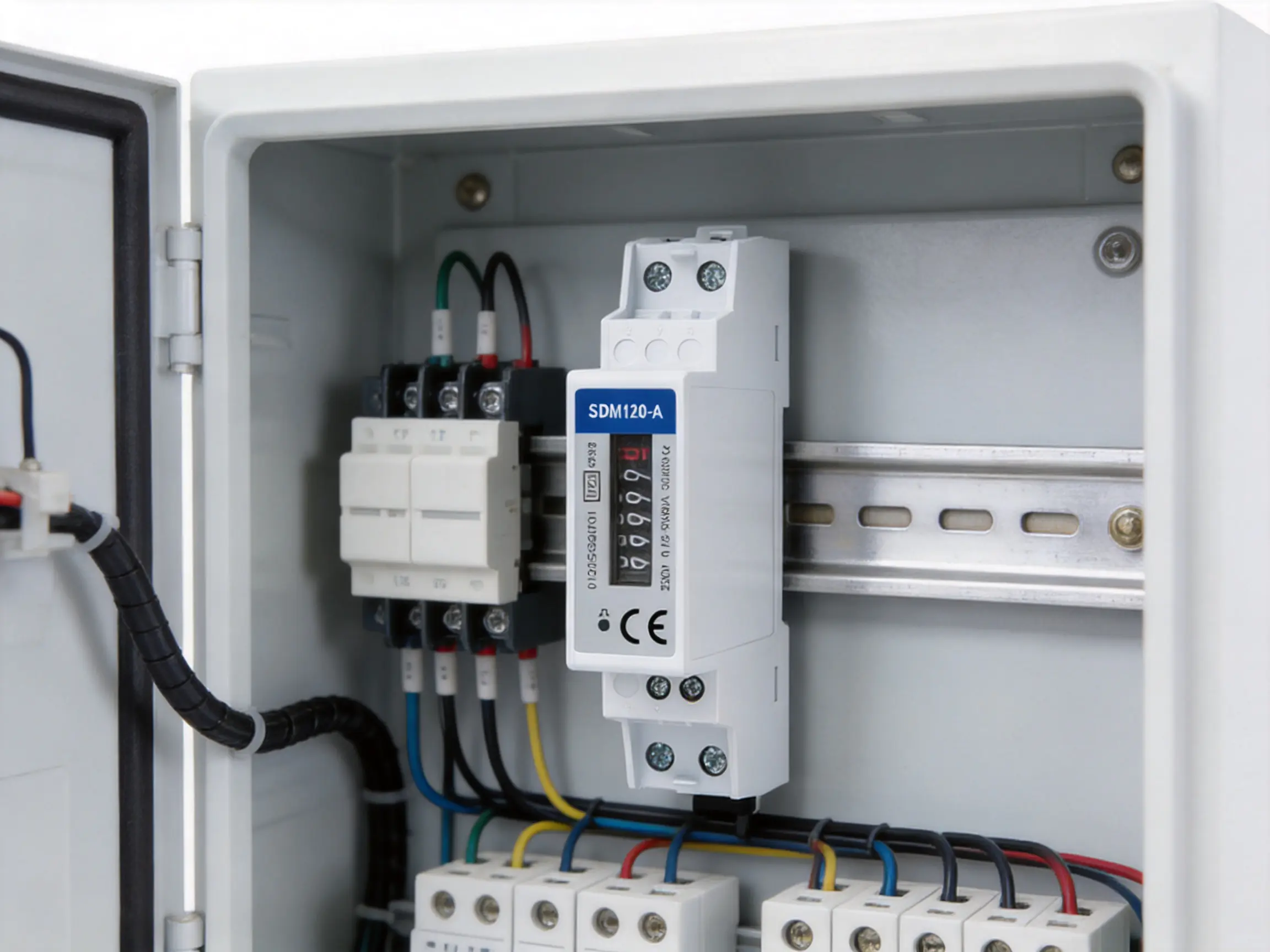
The analog display provides a simple and direct user experience. A person standing in front of the distribution board can inspect the accumulated energy indication without opening a software application, connecting a communication converter, or navigating a digital menu. This is useful during commissioning, maintenance, inspections, and routine energy checks.
Simple visual access can be especially valuable in environments where the user does not need a detailed data history. For example, a technician may want to compare the energy used by two circuits, check whether a newly installed load is operating, or observe the output of a small solar-generation circuit. A front-facing analog indication can provide this information immediately.
The display also reduces dependence on auxiliary equipment. A networked meter may require a gateway, communication wiring, a powered data logger, software configuration, and user permissions before a reading can be obtained. The SDM120-A can provide a local energy indication independently, while the pulse output remains available for installations that require remote counting.
Analog indication can also be useful in locations with limited connectivity. Construction sites, small workshops, agricultural buildings, utility rooms, and service enclosures may not have reliable network access. A local display remains useful even when no communication infrastructure is installed.
At the same time, the display should not be viewed as a replacement for a complete energy-management platform when advanced functions are required. The SDM120-A is focused on active-energy measurement. It is not presented as a device for harmonic analysis, demand profiling, power-quality assessment, multi-tariff management, or extensive two-way communication. Its strength is its simplicity and compactness.
The pulse output extends the usefulness of the meter beyond local display. Each pulse represents a defined quantity of active energy according to the meter’s pulse constant and configuration. An external counter, programmable controller, data logger, gateway, or building management system can count these pulses and calculate energy accumulation over time.
This approach is suitable for basic remote monitoring. A facility manager may collect energy data from several small circuits without installing a multifunction meter on every branch. A controller can use the pulse signal to record consumption, compare operating periods, generate reports, or trigger an alert when a predetermined energy threshold is reached.
Pulse output is also useful when a project needs a straightforward interface rather than a complete digital communications protocol. Simple pulse counting can reduce system integration effort and may be supported by equipment already present in a building. It can also be used as a cost-conscious way to connect individual meters to a central monitoring panel.
When designing a pulse-counting system, the integrator should confirm the pulse type, electrical characteristics, pulse constant, isolation arrangement, input compatibility, cable length, and required counting frequency. The external receiving device must be suitable for the meter’s output. Wiring should be separated from circuits that could introduce excessive electromagnetic interference, especially in industrial installations.
A pulse output is cumulative by nature. If the project requires time-stamped records, interval data, reverse-energy identification, demand values, or event logs, the external monitoring system must provide those functions. The meter supplies the energy pulse; the connected controller or gateway determines how that information is stored and presented.
The maximum direct current rating of 45 A allows the meter to measure many circuits without an external current transformer. This is a significant practical advantage for small and medium single-phase loads. A direct-connected meter reduces the number of components required and avoids the installation considerations associated with selecting, mounting, and wiring a separate current transformer.
Current-transformer-based metering can be highly effective for large currents, but it introduces additional design requirements. The transformer ratio must be selected correctly, the secondary circuit must be wired properly, and the meter must be compatible with the transformer output. Physical space is also required around the conductor and transformer body. For a circuit below the direct-input limit, a direct meter is often simpler and more economical.
The 5 A rated current, 45 A maximum current, 0.15 A minimum current, and 20 mA starting current define the operating range stated for the product. Engineers should select the meter based on the expected continuous current, possible overload conditions, conductor capacity, protective-device rating, and local installation standards. The 45 A value should not be treated as permission to exceed the capacity of the associated wiring or protection equipment.
Direct connection can improve installation clarity because the current path is easy to understand. The supply and load conductors pass through the meter according to the wiring diagram, and no separate transformer ratio needs to be programmed. This can reduce commissioning mistakes, especially in small installations where the main objective is reliable energy accumulation rather than advanced electrical analysis.
The product description identifies an available unidirectional, anti-reverse measurement version that can be used for solar-generation energy measurement. This type of application requires careful consideration of the intended direction of energy flow. A generation circuit may need to register energy delivered from an inverter or renewable-energy source to a local distribution system.
In a solar installation, the meter can be placed on a suitable single-phase generation branch, subject to current, voltage, wiring, protection, and certification requirements. The local display allows a technician or owner to inspect accumulated generation, while the pulse output can feed a monitoring device for remote collection.
Not every solar system has the same electrical arrangement. Some systems are single-phase, while others are three-phase. Some installations measure inverter output, some measure grid import and export, and others measure a dedicated load. Therefore, the project designer must verify that the meter’s single-phase, two-wire configuration and energy direction are appropriate for the intended point of measurement.
The anti-reverse version may be valuable where reverse-direction registration would produce an undesirable result. However, the exact behavior, approval status, and application limits should be verified in the relevant technical documentation. If the installation is connected to a regulated utility network, local interconnection rules and metering requirements take priority.
Traditional electromechanical meters have a long history of service, but they are generally larger and less convenient to integrate with modern monitoring systems. They may require more panel space and typically do not provide a native pulse output in the same compact way as a modern electronic DIN rail meter.
The SDM120-A offers electronic measurement, a narrow modular housing, and a pulse interface. These features make it better suited to new modular distribution boards and retrofit projects that need both local indication and remote counting. Its electronic architecture also supports a low starting current and a defined accuracy classification.
A digital multifunction meter may display voltage, current, frequency, power factor, active power, reactive power, apparent power, demand, harmonics, and other values. Such a device is appropriate when the user needs a detailed view of electrical system behavior. However, it generally costs more, occupies more space, requires additional configuration, and can be excessive for a circuit that only needs active-energy measurement.
The SDM120-A focuses on the essential kWh function. Its advantage is not the number of parameters displayed but the efficiency with which it performs the required task. For a simple energy-submetering point, a smaller specialized product can offer a better balance between capability, installation effort, and cost.
Current-transformer meters are useful for high-current circuits or installations where the measured conductor cannot pass directly through the meter. They are not always the best choice for a circuit below 45 A. A direct-input meter removes the need for an external transformer, simplifies wiring, and reduces the number of components that must be installed and checked.
The SDM120-A is therefore particularly attractive when the load falls within its direct measurement range. For larger loads, multi-phase systems, or applications requiring flexible conductor installation, a current-transformer-based instrument may be more appropriate.
Networked smart meters can provide advanced communication, remote configuration, interval data, and integration with cloud platforms. These functions are valuable for large energy-management projects. However, they may require communication infrastructure and more extensive commissioning.
The SDM120-A can serve as a practical entry-level measurement point. Its pulse output allows it to participate in a wider monitoring solution without requiring every meter to contain a complex communications interface. In a mixed system, compact pulse-output meters can monitor basic circuits while advanced networked analyzers are reserved for main incomers or critical loads.
The performance of any energy meter depends not only on its published specifications but also on the consistency of its production process. Eastron Electronic Co., Ltd. develops and manufactures electricity meters, power analyzers, current sensors, communication modules, and energy-management products. Its product portfolio and engineering background support the development of compact metering products such as the SDM120-A.
The company is headquartered in Jiaxing, China, in a manufacturing region with access to major industrial, logistics, research, and electronics networks. Its location near Shanghai, Hangzhou, and Jiangsu supports cooperation with suppliers, engineering organizations, testing resources, and international customers.
A significant strength is the company’s focus on research and development. Eastron maintains development teams in China and the United Kingdom and works with universities and institutions on new technologies and products. This combination of in-house engineering and external technical cooperation can help connect practical manufacturing requirements with advances in measurement, embedded systems, and electrical applications.
The company has developed patented technologies in software, embedded software, and hardware. For a modern electronic meter, these areas are closely related to measurement processing, display operation, pulse generation, circuit protection, firmware behavior, and product integration. Proprietary development can help a manufacturer refine products for specific installation requirements rather than relying entirely on generic designs.
Quality control is supported by a professional laboratory capable of performing electromagnetic compatibility, low-voltage, accuracy, and environmental tests. These test categories are important for energy meters. Accuracy testing checks measurement performance; EMC testing evaluates resistance to and emissions of electromagnetic disturbance; low-voltage testing supports electrical safety evaluation; and environmental testing examines behavior under relevant temperature, humidity, or other conditions.
The availability of internal laboratory capabilities can shorten development feedback cycles. Engineers can identify issues during design verification, make adjustments, and repeat tests before production is released. It also helps the manufacturer maintain greater control over validation activities and product consistency.
Eastron follows an ISO 9001 quality management system. A quality management system provides a structured framework for design control, purchasing, production, inspection, corrective action, documentation, and continual improvement. Certification alone does not guarantee that every installation will be successful, but a disciplined management system is an important foundation for repeatable manufacturing.
The company’s production is approved by SGS according to MID standards, as stated in the supplied company information. Where a product is intended for legally controlled measurement, customers should identify the exact model, certificate, conformity documentation, marking, and market requirements. Product approval is always specific to the applicable model and use case.
Electronic energy meters contain measurement circuits, terminals, display components, output interfaces, protective elements, and a housing that must work together in a limited space. Manufacturing quality therefore depends on more than assembling a circuit board. Component selection, soldering quality, calibration, mechanical assembly, terminal integrity, firmware control, and final inspection all contribute to the finished product.
During electronics production, controlled assembly processes help ensure that components are positioned correctly and solder joints meet defined requirements. Inspection systems can identify placement or soldering defects, while functional testing can confirm that the completed board responds properly to voltage, current, display, and pulse-output conditions.
Calibration and accuracy verification are especially important for energy meters. A meter must be tested against known electrical conditions so that its measurement behavior can be compared with the specified accuracy class. Testing may include different current levels, voltage conditions, power factors, starting-current behavior, and energy accumulation. The precise production test sequence depends on the manufacturer’s internal procedures and the relevant standards.
Mechanical quality is equally important. DIN rail equipment must install securely, maintain appropriate terminal spacing, and provide reliable conductor connections. The housing must protect internal parts during normal handling and operation. A compact design leaves little room for assembly variation, so dimensional control and inspection are essential.
Environmental testing helps assess the product under conditions that may occur during transportation, storage, installation, and service. Temperature changes, humidity, vibration, and electrical disturbance can influence electronic equipment. A manufacturer with dedicated environmental and EMC testing capability is better positioned to identify weaknesses before products reach the market.
These manufacturing strengths are relevant to the SDM120-A because the product is intended for widespread installation in distribution boards and equipment panels. A meter may be installed by different contractors in different countries and exposed to a range of load conditions. Consistent production and documented testing help provide a more predictable installation experience.
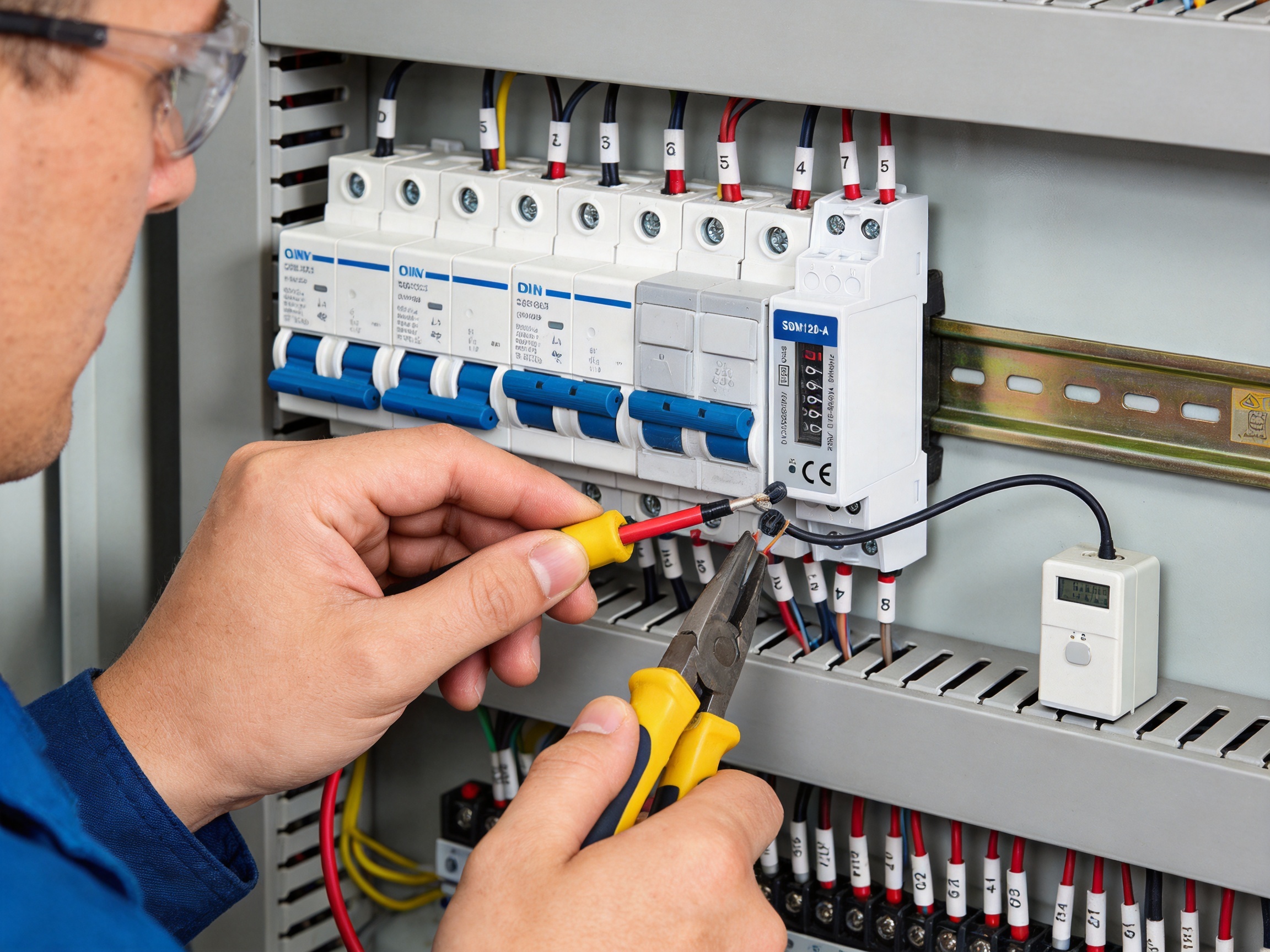
The SDM120-A is designed for DIN rail installation. Before installation, the engineer or electrician should confirm the system type, rated voltage, current range, conductor arrangement, enclosure suitability, and required protective equipment. The device is specified for a single-phase, two-wire system with neutral, commonly described as 1P+N.
The wiring diagram supplied with the product should be followed exactly. The supply side and load side must be identified, and the input and output terminals must not be confused. The circuit should be isolated and verified dead before conductors are connected. Only qualified personnel familiar with local electrical regulations should perform the installation.
Because the product is a direct-load meter, the measured current passes through the meter terminals. The designer should check that the expected load, prospective overload, conductor size, terminal capacity, and protective device are compatible. A meter should not be installed in a circuit whose current may exceed the specified maximum.
The pulse output should be wired to a compatible receiving device. The system designer should document the pulse constant and conversion method so that the external system can translate pulse counts into kilowatt-hours. Cable routing should minimize exposure to high-current conductors, variable-frequency drives, contactor coils, and other possible sources of interference.
After installation, commissioning should include a visual inspection, terminal verification, voltage check, load test, display observation, and pulse-output confirmation. A known or independently measured load can be used to compare the meter’s behavior with expectations. The commissioning record should identify the meter, installation point, date, initial reading, and any connected monitoring equipment.
The meter can be used to monitor a dedicated apartment circuit, electric heating branch, workshop supply, water-heating circuit, or other single-phase load within the direct-current range. Its compact size is useful in residential consumer units where space is limited. The local indication allows the occupant or maintenance provider to view accumulated consumption, while a pulse counter can support remote reporting.
Retail stores, offices, restaurants, and small service facilities often need to separate energy use by tenant, department, or equipment group. A compact kWh meter can help identify the consumption of lighting, refrigeration, signage, office equipment, or auxiliary systems. It can also support internal cost allocation when combined with suitable procedures and local legal requirements.
In a workshop, the meter can monitor an individual machine or a group of machines. The display provides a quick indication during maintenance, and pulse output can be connected to a production or energy database. Measuring equipment-level consumption may help identify inefficient operating schedules, standby losses, or changes in machine performance.
For an appropriate single-phase solar branch, an available unidirectional configuration can measure generation energy. The meter may be installed near the inverter output or another defined measurement point. The project must confirm that the current and voltage remain within the product limits and that the chosen direction of measurement matches the project objective.
Compact energy meters can be useful in temporary buildings, event facilities, construction offices, rental equipment, and portable distribution assemblies. The one-module profile supports compact enclosure design. However, temporary installations can experience demanding conditions, so the enclosure, environmental protection, mechanical security, and cable management must be selected appropriately.
Panel builders benefit from the device’s narrow footprint and direct connection. A one-module meter can be incorporated into standardized board layouts without redesigning the entire enclosure. This helps simplify material planning and may reduce the number of enclosure sizes required for different projects.
Contractors can also benefit from the focused function set. There is no need to configure a large number of measurement parameters when the project only requires accumulated active energy. A clearly defined application can reduce training time and make handover easier for the end user.
For systems that need remote counting, the pulse output offers a familiar integration method. The meter can be paired with an existing pulse input module or gateway rather than requiring a dedicated communications network for every measurement point. This may be advantageous in projects with many small subcircuits.
Stocking and replacement can also be simpler when a compact meter covers common single-phase applications. A distributor or contractor can maintain a practical inventory of direct-connected energy meters for residential, commercial, and light industrial requirements. Final selection should still be based on the exact electrical and regulatory requirements of each project.
End users generally want energy information that is understandable, dependable, and easy to access. The analog display addresses the need for local visibility, while the electronic measurement system supports stable energy registration. The pulse output provides a path toward more advanced monitoring without forcing the user to purchase a complex analyzer at the beginning.
The compact form factor can reduce the need for cabinet expansion. In retrofit projects, avoiding a larger enclosure can reduce disruption and installation labor. The direct 45 A measurement range may also remove the need for additional current transformers on suitable circuits.
Another advantage is scalability. A facility may begin with one local meter and later connect its pulse output to a central counter or energy-management system. Additional meters can be installed on other branches as the monitoring requirement grows. This creates a staged approach to energy management.
Users should recognize the limits of a focused meter. If they need power-quality analysis, real-time demand control, voltage-event recording, two-way import and export measurement, or extensive communications, they should select an instrument designed for those functions. Choosing the right level of capability is an advantage in itself because it avoids both under-specification and unnecessary complexity.
Before ordering the SDM120-A, the application should be reviewed against several questions. Is the circuit single-phase and two-wire? Is the nominal voltage approximately 230 V? Is the maximum expected current no greater than 45 A? Is active-energy measurement the main requirement? Is an analog local display preferred? Will the pulse output be connected to another device?
The designer should also determine whether energy needs to be measured in one direction only or whether the application involves import, export, or bidirectional flow. For solar and distributed-energy systems, the direction of measurement is particularly important.
Accuracy requirements should be examined carefully. A Class 1 or Class B/C product may be appropriate for general measurement, submetering, and monitoring, but legal metrology requirements differ by market and application. If the meter will be used for billing or regulated settlement, the purchaser should verify the applicable certification and approval documentation for the exact model.
Environmental conditions should also be considered. The surrounding temperature, humidity, dust, vibration, enclosure rating, altitude, and electrical noise may affect the choice of equipment. The installation must follow the product’s environmental limits and the requirements of the complete panel assembly.
Routine maintenance for a compact electronic kWh meter is generally straightforward. The enclosure and display should be kept clean and visible, terminals should be inspected as part of a safe maintenance program, and the connected monitoring system should be checked for correct pulse counting. Any inspection must be performed under appropriate isolation and safety procedures.
Unexpected changes in energy readings should be investigated systematically. Possible causes include a change in load, wiring errors, loose connections, incorrect pulse scaling, a fault in the external counter, or a difference between the meter’s measurement point and the location assumed by the monitoring system.
Where the pulse output is used for long-term data collection, the system integrator should maintain a record of the pulse constant, meter serial number, installation date, initial reading, and software scaling factor. This information supports troubleshooting and ensures that replacement meters can be configured correctly.
The analog display remains useful during maintenance because it provides a local reference independent of the external monitoring system. If the remote database shows an unexpected value, a technician can compare it with the meter’s front indication and determine whether the issue is at the measurement point or in the communication chain.
The SDM120-A is not designed to compete with every type of electrical instrument. Its value comes from providing the functions that many installations actually need in a small and accessible package. It measures active energy, supports direct loads up to 45 A, fits one DIN rail module, displays the result locally, and provides a pulse output for external counting.
Compared with a basic display-only meter, it offers an additional integration path through the pulse output. Compared with a large multifunction analyzer, it is narrower, simpler, and more focused. Compared with a current-transformer solution for a suitable low-current circuit, it can reduce installation components and wiring complexity.
These advantages are strengthened by the manufacturer’s development, laboratory, certification, and quality-management capabilities. Research teams in China and the United Kingdom, cooperation with universities and institutions, internal EMC and accuracy testing, ISO 9001 quality management, and international product experience all support the company’s ability to develop and produce energy-measurement equipment.
For users seeking a practical single-phase kWh meter rather than a highly complex analyzer, this balance can be more valuable than an extended list of unused functions. The product is especially well matched to compact distribution boards, small commercial energy monitoring, equipment-level measurement, and appropriately designed solar-generation applications.
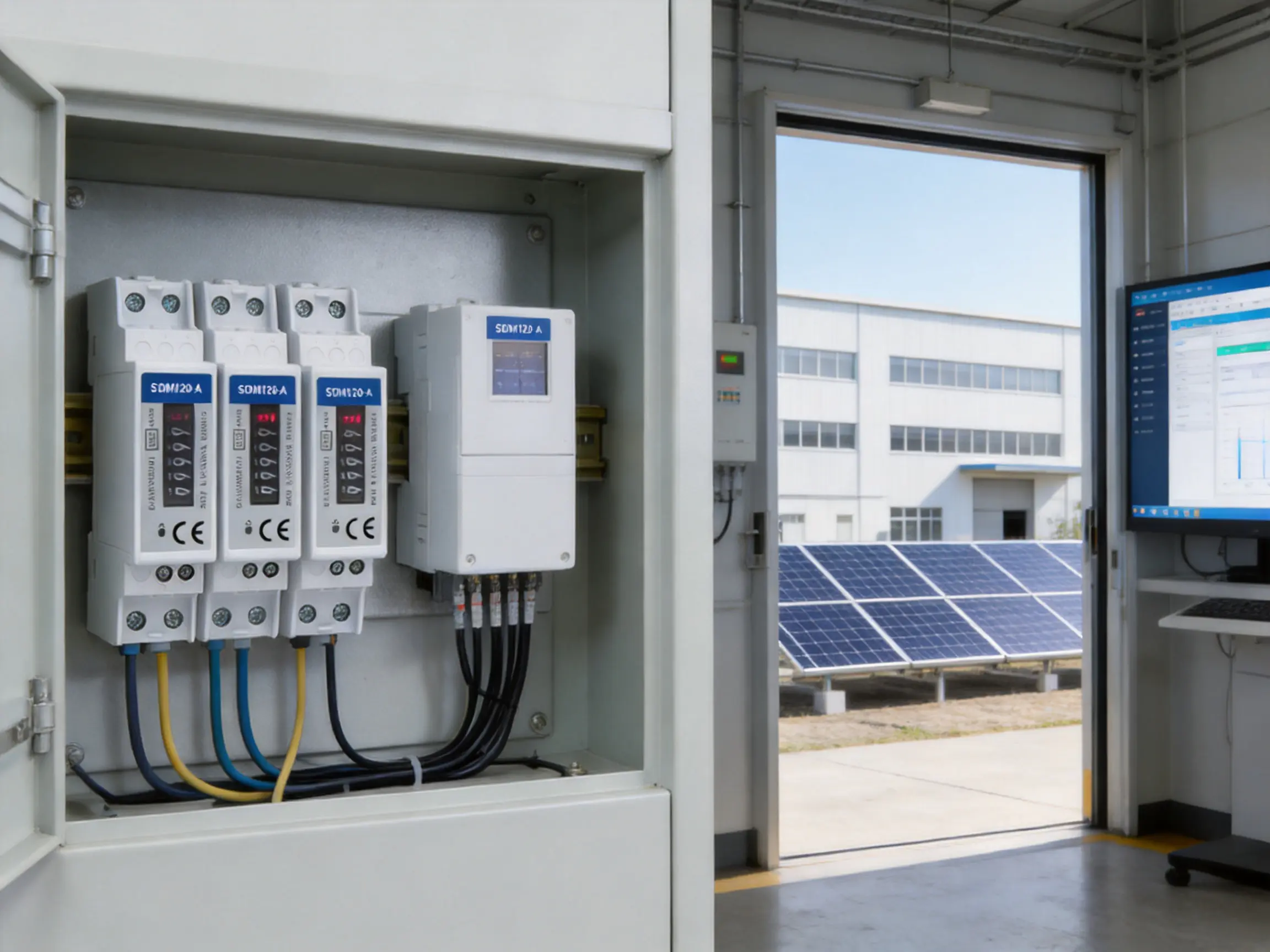
The meter is specified for RMS measurement on a single-phase AC system with one phase and neutral, commonly identified as a 1P+N or single-phase, two-wire system.
It measures and accumulates active energy, normally expressed in kilowatt-hours. It is intended for energy registration rather than a complete analysis of all electrical parameters.
The specified maximum direct current is 45 A. The expected load, conductors, protective devices, and installation conditions must all be suitable for the selected circuit.
The rated voltage is 230 V, with an operating range specified as 80% to 120% of the rated voltage.
No current transformer is required for a suitable direct-connected circuit within the meter’s specified current range. A different metering solution should be considered for higher-current or incompatible applications.
The analog display provides a local indication of accumulated energy. It allows users and technicians to inspect the reading directly at the distribution board without relying on software or a communication network.
The pulse output provides an external signal associated with active-energy measurement. It can be connected to a pulse counter, controller, gateway, logger, or building management system for remote energy counting.
An available unidirectional, anti-reverse measurement version is identified for solar-generation energy measurement. The installer must verify the exact model, energy direction, system phase arrangement, current, voltage, and applicable grid or regulatory requirements.
The meter occupies approximately 18 mm of DIN rail width, equivalent to one standard modular position. This helps save space inside distribution boards and control panels.
The supplied product information identifies IEC 62053-21 Class 1 and EN 50470-3:2022 Class B/C accuracy classifications as specified. The exact applicable classification and certification should be confirmed for the model and intended market.
No. The product is a focused active-energy meter. It should not be selected when the application requires extensive power-quality analysis, harmonic measurement, demand functions, or a broad range of instantaneous electrical parameters.
Installation should be performed by qualified electrical personnel who understand the applicable wiring regulations, isolation procedures, protection requirements, and the supplied wiring diagram.
The buyer should check phase arrangement, rated voltage, maximum current, measurement direction, accuracy requirements, display preference, pulse-output compatibility, enclosure conditions, and any local certification or legal-metrology requirements.
The pulse output can be connected to a compatible external receiving device. The system designer must confirm the output characteristics, pulse constant, input compatibility, cable arrangement, and scaling method used by the receiving system.
A focused meter can be more economical, easier to install, and more space-efficient when the application only requires active-energy measurement and basic remote counting. A larger analyzer remains preferable when detailed electrical data is needed.
The SDM120-A analog display DIN rail single-phase electronic kWh meter is designed for installations that need practical, compact, and accessible active-energy measurement. Its 230 V single-phase, two-wire configuration, direct 45 A current capacity, one-module DIN rail housing, analog display, and pulse output create a useful combination for residential, commercial, equipment, and selected renewable-energy applications.
Its principal advantages over larger or more complex alternatives are simplicity, space efficiency, direct connection, and clear local indication. At the same time, the pulse output gives the product a path into remote energy-monitoring systems. This balance makes it suitable for projects that require more than a basic local reading but do not need the cost and complexity of a full multifunction power analyzer.
The product is supported by a manufacturer with experience in electricity meters, power analyzers, current sensors, communication modules, and energy-management solutions. Research and development resources, internal laboratory testing, patented technologies, ISO 9001 quality management, and international market experience provide a strong foundation for product development and manufacturing consistency.
Correct selection and installation remain essential. Engineers must confirm system compatibility, current limits, voltage conditions, energy direction, accuracy requirements, pulse-interface details, and local regulations. When these requirements are satisfied, the SDM120-A can serve as an effective building block for clear, scalable, and space-conscious energy measurement.
1. International Electrotechnical Commission, IEC 62053-21, Electricity Metering Equipment: Particular Requirements for Static Meters for Active Energy.
2. European Committee for Electrotechnical Standardization, EN 50470-3:2022, Electricity Metering Equipment: Particular Requirements for Static Meters for Active Energy.
3. Eastron Electronic Co., Ltd., SDM120-A Product Technical Information and Electrical Characteristics.
4. Eastron Electronic Co., Ltd., SDM120-A/D/DB Wiring and Dimension Information.
5. International Organization for Standardization, ISO 9001, Quality Management Systems: Requirements.
6. Eastron Electronic Co., Ltd., Corporate Profile and Energy Measurement Solutions Information.
Your email address will not be published. Required fields are marked *

We develop and produce high performance electricity meters, power analyzers, current sensors, communication modules and management systems.
Address:NO. 52, Dongjin Road, Nanhu, Jiaxing, Zhejiang, China
Copyright @ Eastron Electronic Co., Ltd. All rights reserved
