

 English
 Español
 Deutsch
 中文简体
中文简体

Product Consultation
Your email address will not be published. Required fields are marked *
Europe's Solar and Energy Storage Transition: Transforming the Power System Infrastructure for a Renewable Future
Jul 10,2026
Power Systems Are Becoming “Real-Time Systems”: Why Data Is More Critical Than Electricity
Jul 06,2026
New EPBD Regulations Drive HVAC Energy Transparency and Boost Demand for Smart Meters
Jul 07,2026Content
Modern DC energy systems are growing rapidly in electric vehicle charging, battery storage, solar power, industrial DC distribution, telecom power, data centers, and advanced automation. As these applications expand, accurate and reliable DC measurement becomes essential for billing, monitoring, efficiency optimization, and system protection. The Max. Current 300A Multi-function Din Rail DC MID Energy Meter with DC Shunt, model DCM230-2-300, is designed to meet these requirements with a practical combination of certified accuracy, high-voltage DC capability, bi-directional measurement, RS485 Modbus communication, and DIN rail installation.
This DC MID energy meter is built for DC systems up to 1000V DC and a maximum current of 300A when used with the included 75mV DC shunt. It measures key electrical parameters such as energy, power, voltage, and current, while supporting import and export energy measurement for applications where power may flow in both directions. Its MID approval, Class 1.0 / B accuracy, pulse output, and Modbus RTU communication make it suitable for professional environments that demand traceable, transparent, and stable energy data.
For customers comparing DC meters in the market, this product offers a strong balance of practical engineering and application readiness. Many DC meters are either limited in voltage range, lack recognized certification, provide only basic display functions, or require additional accessories before installation. By contrast, the DCM230-2-300 combines up to 1000V DC voltage input, 300A current capability through a 75mV shunt, DIN rail mounting, RS485 communication, pulse output, and an included shunt package. These features reduce system integration complexity and help installers deploy a complete metering solution more efficiently.
The product is especially relevant to EV charger manufacturers, charging station operators, energy storage integrators, renewable energy system designers, industrial control panel builders, and energy management platform developers. It allows measured DC energy data to be used not only on the meter itself, but also in wider digital monitoring systems through Modbus RTU. This makes it a valuable component for connected energy infrastructure where accuracy, communication, and certification all matter.
Max. Current 300A Multi-function Din Rail DC MID Energy Meter with DC Shunt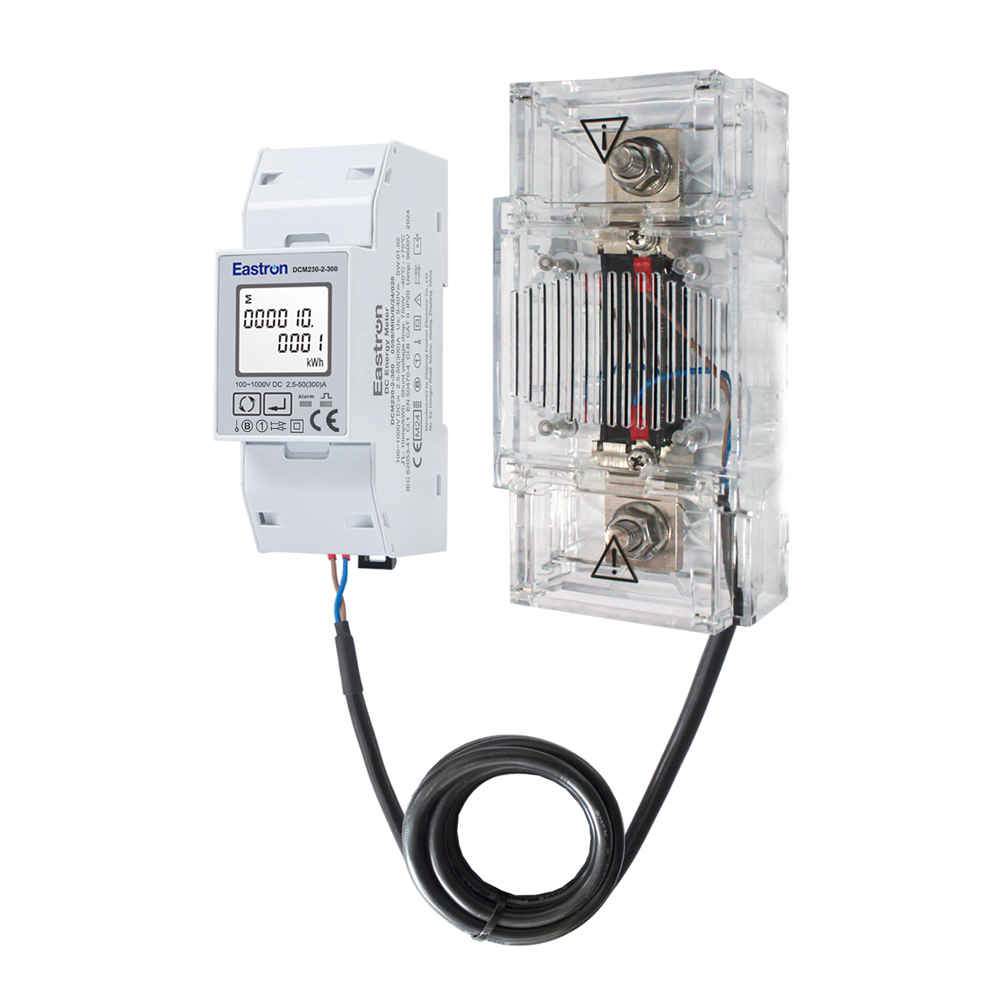
The DCM230-2-300 is a multifunction DIN rail DC MID energy meter designed for measuring and monitoring DC electrical systems. Its measurement scope includes active energy, power, voltage, current, and related DC parameters. It supports bi-directional measurement, meaning it can record both imported and exported energy. This is important in applications such as battery charging and discharging, vehicle-to-grid development, DC microgrids, photovoltaic storage systems, and test benches where current flow may reverse depending on operating conditions.
The meter uses a DC shunt connection for current measurement. In the 300A configuration, the supplied shunt outputs 75mV at rated current, allowing the meter to calculate current and energy accurately. This approach is widely used in high-current DC measurement because it provides a stable and cost-effective way to sense current while keeping the measuring instrument compact. With the shunt included in the package, installers receive a matched solution rather than needing to source a compatible shunt separately.
The voltage input range of 100-1000V DC makes the meter suitable for high-voltage DC environments. This range is particularly valuable for EV charging systems, where DC fast charging architecture often operates at elevated voltage levels. It also supports other advanced DC applications that require measurement beyond low-voltage battery circuits. The ability to operate across such a wide voltage range gives system designers more flexibility and reduces the need to use multiple meter models for different voltage classes.
DIN rail installation enables simple integration inside electrical cabinets, charger control panels, distribution enclosures, and monitoring boxes. DIN rail mounting is familiar to electrical installers and is compatible with modular control cabinet design. The compact installation style helps save panel space and supports neat wiring, especially in systems where multiple meters, relays, breakers, communication gateways, and control modules must be arranged together.
Communication is handled through RS485 Modbus RTU, a widely used industrial protocol. Modbus support enables the meter to transmit measurement data to energy management systems, charger controllers, supervisory control platforms, building management systems, and industrial automation networks. With an address range of 1 to 247, adjustable transmission speeds from 1200bps to 19200bps, parity options, and 1 or 2 stop bits, the meter can be adapted to a variety of field communication conditions.
Parameter |
Specification |
Application Benefit |
Product Type |
DIN rail DC MID energy meter with DC shunt |
Suitable for professional DC metering and cabinet installation |
Model |
DCM230-2-300 |
300A configuration for high-current DC systems |
Voltage Input |
100-1000V DC |
Supports high-voltage DC applications such as EV chargers |
Maximum Current |
300A |
Handles demanding charging, storage, and industrial loads |
Shunt |
75mV default DC shunt included |
Reduces accessory selection work and supports stable current measurement |
Accuracy |
Class 1.0 / B |
Provides reliable energy measurement for monitored DC systems |
Measured Values |
kWh, W, V, A, and related DC parameters |
Offers multi-parameter visibility for operation and analysis |
Energy Direction |
Bi-directional import and export measurement |
Useful for charging, discharging, storage, and reversible DC power flow |
Communication |
RS485 Modbus RTU and pulse output |
Enables integration with control systems and energy platforms |
Certification |
MID approved; compliant with EN50470-4 and IEC62053-41 |
Supports regulated and professional metering applications |
One of the most important advantages of this meter is its 100-1000V DC input range. Many traditional meters are designed for AC systems, while many simple DC meters are intended for low-voltage battery circuits. High-voltage DC systems require different design priorities, including insulation coordination, measurement stability, safety awareness, and compatibility with fast-changing power electronics environments. The DCM230-2-300 is built specifically for DC measurement, making it far more suitable than adapting an AC-oriented device or a low-voltage DC indicator.
In electric vehicle charging infrastructure, accurate DC energy measurement is becoming increasingly important. DC chargers transfer energy directly to the vehicle battery, and operators need dependable energy data for cost calculation, operational analysis, station efficiency evaluation, and customer transparency. A meter with MID approval and Class 1.0 / B accuracy gives charger designers a stronger foundation for building charging systems that meet professional and regional compliance expectations.
Battery energy storage systems are another natural application. Energy storage is inherently bi-directional: the system charges from a power source and discharges to a load or grid-connected inverter. A meter that can distinguish import and export energy allows operators to evaluate charge and discharge performance separately. This helps with cycle analysis, efficiency calculation, battery asset management, and preventive maintenance planning.
Industrial DC distribution is also expanding. Factories and automation environments increasingly use DC buses for drives, robotics, data equipment, and power conversion systems. Accurate DC metering helps facility managers identify load trends, detect abnormal consumption, allocate energy costs, and improve system efficiency. Because the meter communicates through Modbus RTU, it can be connected to PLCs, SCADA systems, and energy dashboards without requiring a complex custom interface.
The 300A current rating makes this meter suitable for high-current DC circuits where smaller metering products cannot be used. High-current DC measurement must be handled carefully because wiring, heat, voltage drop, mechanical mounting, and signal stability all affect performance. The supplied 75mV shunt provides a defined sensing element for the meter. At rated current, the shunt produces a small voltage signal proportional to current, enabling the meter to calculate current, power, and accumulated energy.
Including the shunt is a practical advantage over competitors that sell the meter and shunt separately. Separate sourcing can create uncertainty about compatibility, shunt ratio, signal level, mechanical installation, and calibration expectations. A complete package simplifies procurement and helps prevent mismatched components. For OEMs and panel builders, this can shorten engineering time and reduce installation errors.
The shunt-based design also supports flexible cabinet layouts. The high-current conductor path can be arranged through the shunt while the meter itself remains mounted on the DIN rail in a convenient reading and wiring position. This is useful in EV charger cabinets where high-current cables and control electronics are often separated for safety and thermal management. The signal wiring from the shunt to the meter can be planned cleanly, allowing better organization inside the enclosure.
For applications that operate near high current for long periods, measurement stability and installation quality are critical. The use of a properly rated shunt helps maintain predictable current sensing. When combined with correct conductor sizing, secure fastening, suitable ventilation, and appropriate cabinet design, the meter and shunt configuration can deliver reliable data in demanding duty cycles.
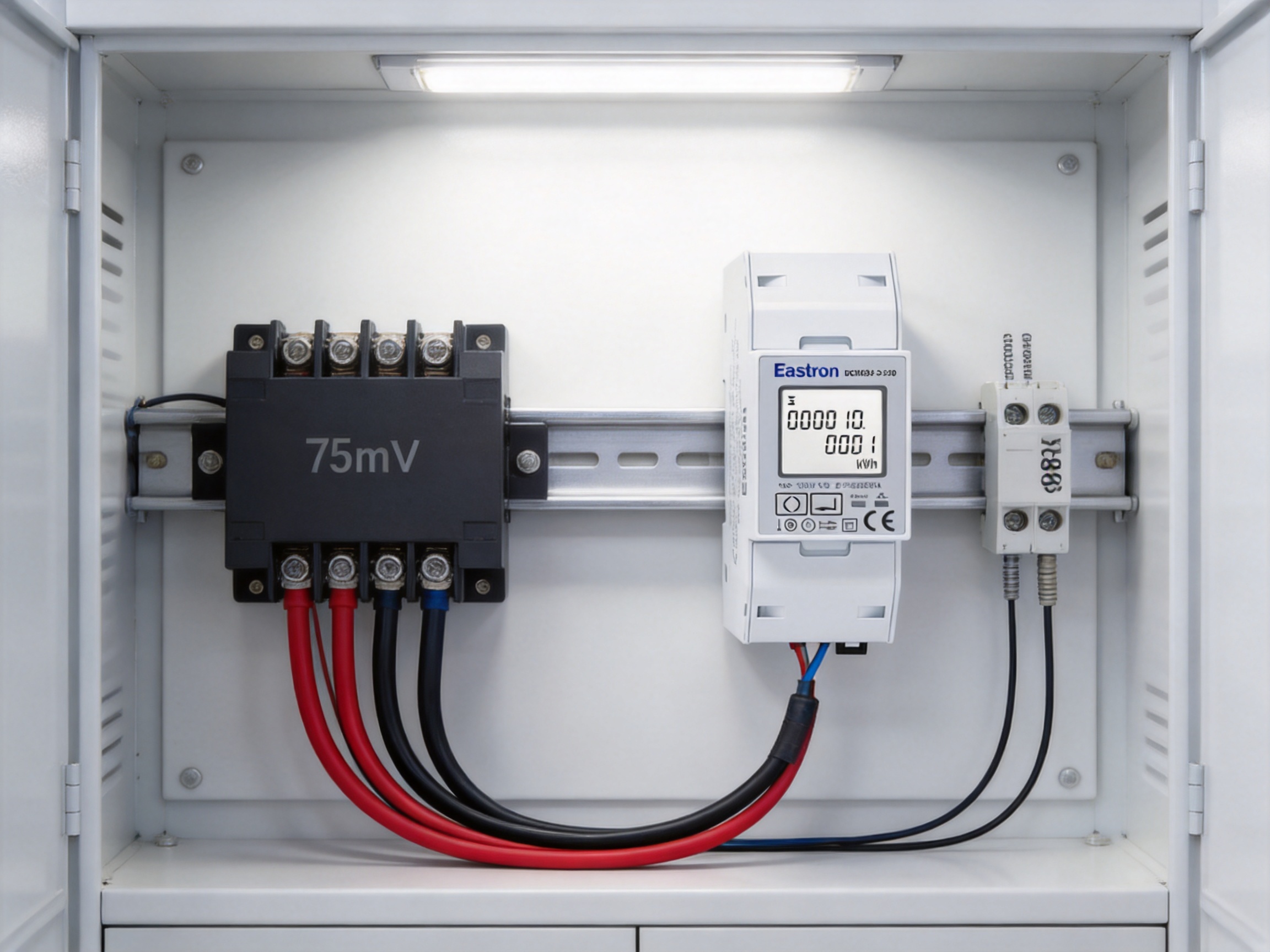
MID approval is a major differentiator for this DC energy meter. The Measuring Instruments Directive is a recognized European framework for measuring devices used in regulated applications. For customers, MID approval signals that the product has been assessed according to defined requirements rather than being only a general-purpose indicator. In fields such as EV charging, energy resale, shared infrastructure, and accountable energy management, recognized approval can be a decisive requirement.
The DCM230-2 series has been assessed and certified as meeting the requirements of EU Directive 2014/32/EU. It complies with EN50470-4 and IEC62053-41, standards that are relevant for DC electricity metering. This is important because DC metering standards are more specialized than conventional AC metering expectations. A product designed around these standards provides stronger technical assurance for integrators and end users.
The meter provides Class 1.0 / B accuracy. Its listed measurement accuracy includes active energy and power at 1% of range maximum, with current and voltage at 0.5% of range maximum. This level of accuracy is suitable for many professional monitoring and billing-adjacent environments, especially where traceable DC energy data is required. Compared with uncertified low-cost DC counters, a certified meter reduces uncertainty and supports better long-term confidence.
Accuracy is not only about the meter specification on paper. It also depends on design discipline, manufacturing consistency, calibration processes, quality control, and environmental testing. This is where the company’s broader capabilities become important. The manufacturer operates professional testing facilities for EMC, LVD, accuracy, and environmental tests according to IEC, EN, GB, and UL standards. These capabilities help ensure that products are not only designed correctly but also validated under relevant technical conditions.
Bi-directional measurement is increasingly important in modern DC systems. Traditional metering often assumes energy flows in one direction: from source to load. In contemporary systems, however, power flow can be dynamic. Batteries charge and discharge. EV chargers may be designed for future vehicle-to-grid or vehicle-to-building applications. Renewable energy systems may store surplus power and later release it. Test systems may alternate between supply and regeneration.
The DCM230-2-300 records both import and export energy, often described as IMP and EXP. This allows system operators to understand energy movement in both directions rather than viewing the circuit as a simple one-way load. For example, in a battery storage application, import energy may represent charging energy, while export energy may represent discharged energy. Comparing these values can help estimate system efficiency, identify abnormal loss, and support operational planning.
For EV charging manufacturers, bi-directional readiness can support product evolution. Even if a charger is currently used only for one-way DC charging, future market demand may require energy export capability. Selecting a meter with bi-directional measurement from the beginning can make the platform more adaptable. This reduces the likelihood of redesign when advanced energy interaction becomes necessary.
Compared with single-direction DC meters, a bi-directional meter offers better data completeness. It avoids the risk of negative readings being ignored, misinterpreted, or not recorded. In intelligent energy management, complete data is valuable because software platforms need accurate direction, magnitude, and accumulated totals to produce meaningful reports.
Energy measurement is no longer limited to local display. Most professional energy systems now require digital data transmission. The DCM230-2-300 includes RS485 Modbus RTU communication, allowing it to connect with controllers, gateways, monitoring platforms, and industrial automation systems. RS485 is valued for its robustness, multi-drop capability, and long-distance performance in industrial environments.
The meter supports communication addresses from 1 to 247, making it possible to place multiple devices on the same network. This is valuable in charging stations with multiple charging outputs, storage systems with multiple branches, or industrial panels with several monitored circuits. Each meter can be assigned a unique address and read by a master device or gateway.
Transmission distance can reach up to 1000m under appropriate installation conditions, which supports large facilities and distributed monitoring layouts. Transmission speeds from 1200bps to 19200bps provide flexibility for different network designs. Parity settings include none as default, odd, and even, while stop bits may be set to 1 or 2. These options help the meter match existing Modbus networks rather than forcing system designers to change their communication architecture.
Pulse output is also included, offering an additional method for energy signal acquisition. Some systems use pulse counting for simple energy accumulation, while Modbus is used for richer parameter reading. Having both communication modes gives integrators more choices and improves compatibility with legacy systems as well as modern digital platforms.
When compared with many conventional DC meters, the DCM230-2-300 offers several practical advantages. The first is its combination of high-voltage and high-current capability. Some meters can measure high voltage but not high current, while others are limited to lower DC voltage environments. The ability to support up to 1000V DC and 300A in a DIN rail format makes this product well matched to EV chargers and other demanding DC systems.
The second advantage is certification. In the market, many DC meters are sold as monitoring devices without MID approval. They may be acceptable for informal indication, but they may not satisfy projects requiring recognized metering assessment. MID approval gives the DCM230-2-300 stronger credibility for applications where measured energy has financial, contractual, or regulatory significance.
The third advantage is multi-function measurement. Instead of only counting energy, the meter measures kWh, W, V, A, and related parameters. This helps users evaluate real-time performance and not just accumulated consumption. Voltage and current readings can reveal operating conditions, while power readings show instantaneous demand. Energy readings support billing, cost allocation, and long-term analysis.
The fourth advantage is communication readiness. A meter without Modbus may require external converters or manual reading, which is inefficient in connected systems. RS485 Modbus RTU allows easy data integration, while pulse output offers an additional acquisition channel. This dual output structure gives the product broader compatibility than simpler standalone devices.
The fifth advantage is the included shunt. In high-current DC metering, the shunt is not a minor accessory; it is a key part of the measurement chain. Including a 75mV shunt in the package helps ensure the current sensing element matches the intended configuration. This can reduce procurement complexity, installation uncertainty, and commissioning time.
The sixth advantage is the manufacturer’s quality infrastructure. Products supported by in-house testing, experienced R&D teams, ISO 9001 quality management, and MID-related production approval are better positioned for consistent performance than products from suppliers with limited verification capability. For OEMs and project developers, supplier reliability can be just as important as the meter specification itself.
The DCM230-2-300 is particularly well suited for DC EV charger applications. DC charging systems require precise measurement of energy delivered to the vehicle battery. Accurate measurement supports user billing, charger efficiency analysis, power module monitoring, and station-level energy management. A meter designed for DC systems and certified to relevant standards gives charger manufacturers a more dependable building block.
In a typical DC charger, the meter can be installed inside the charger cabinet on a DIN rail, while the shunt is placed in the high-current DC path. The meter reads the shunt signal and voltage input, calculates current, power, and energy, and provides data to the charger controller through RS485 Modbus. The controller can then display energy values, transmit data to backend software, or use the information for operational control.
Because the voltage input reaches 1000V DC, the meter is compatible with high-voltage EV charging architectures. As vehicle battery voltages increase and fast charging systems evolve, this voltage range gives manufacturers room to design future-ready products. A lower-voltage meter may restrict charger platform development, but this model supports a broader range of DC charger designs.
Bi-directional measurement also matters for future charging ecosystems. While many current DC chargers are one-way, future charging may include vehicle-to-grid, vehicle-to-home, and vehicle-to-building functions. A meter capable of import and export measurement supports these development paths. For charger manufacturers, selecting components with this capability can reduce future redesign effort.
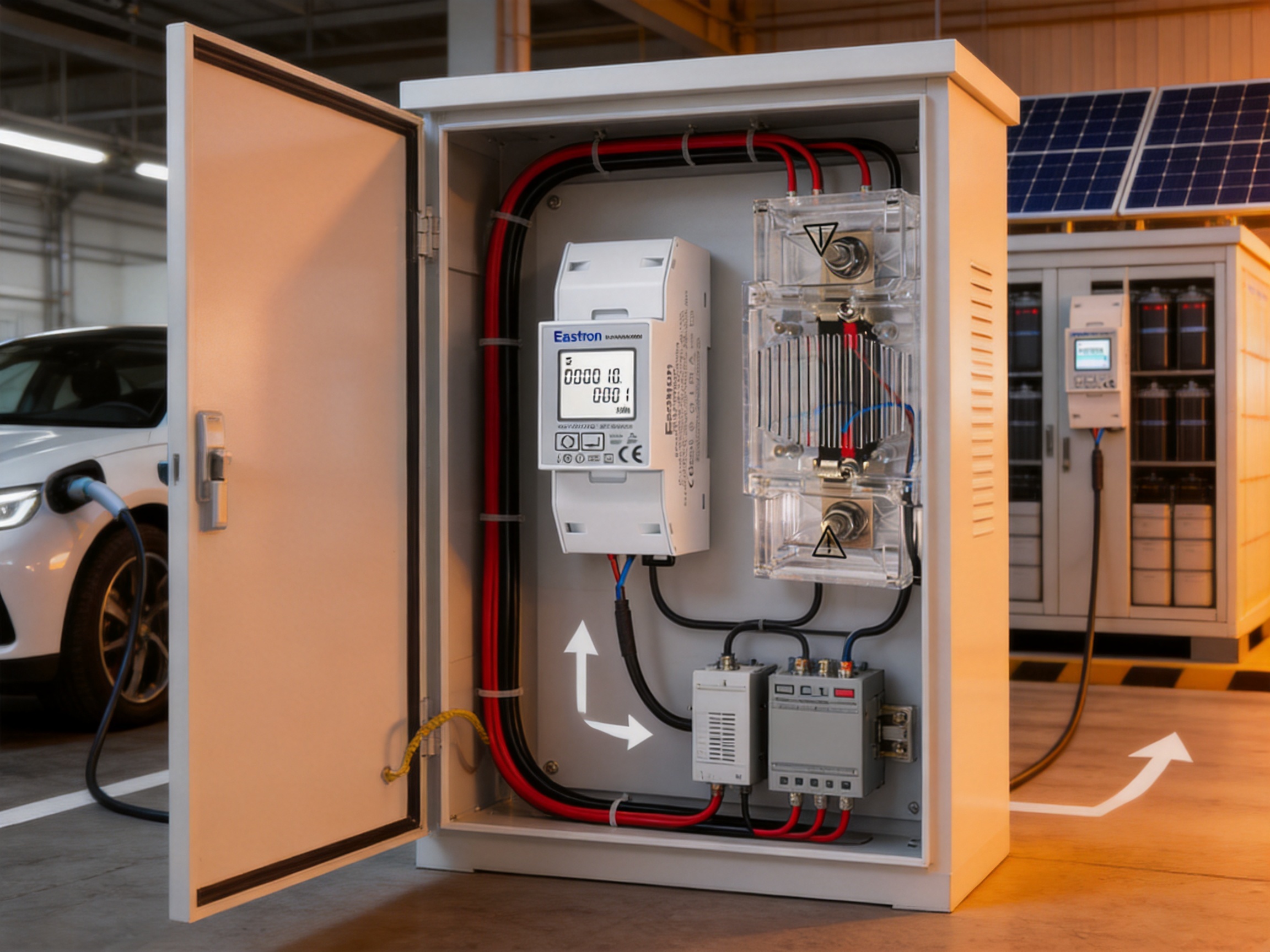
Energy storage systems require careful monitoring because their value depends on charge and discharge performance. The DCM230-2-300 can measure both energy directions, making it suitable for battery storage cabinets, DC bus monitoring, charge controllers, and test environments. Operators can record how much energy enters a battery system and how much energy is later delivered, helping them calculate practical system efficiency.
Renewable energy systems also benefit from accurate DC measurement. In photovoltaic installations, DC energy exists before inverter conversion. Measuring DC-side power and energy can help evaluate array output, storage charging, DC combiner performance, and conversion losses. When combined with AC-side meters, DC meters provide a fuller picture of total system behavior.
In DC microgrids, energy may flow among solar panels, batteries, loads, converters, and grid interfaces. Bi-directional metering helps track these flows and allows energy management software to make better decisions. The RS485 Modbus interface allows the meter to contribute data to microgrid controllers and supervisory platforms.
Compared with using only inverter data or controller estimates, an independent DC energy meter provides a dedicated measurement point. This can improve transparency and help detect discrepancies. For example, if the energy reported by a charger, inverter, or battery management system differs from the meter reading, maintenance teams can investigate sensor drift, wiring issues, software configuration, or equipment inefficiency.
Industrial DC systems are used in automation, transport equipment, manufacturing lines, power electronics testing, and specialized machinery. These environments often require robust monitoring because downtime is expensive and energy quality affects productivity. The DCM230-2-300 supports industrial monitoring with its DIN rail form, Modbus communication, and multi-parameter measurement.
Voltage and current values help maintenance teams identify whether equipment is operating within expected limits. Power readings show instantaneous load behavior. Energy readings allow production managers to allocate energy use to specific machines, lines, or processes. Over time, this data can support energy-saving programs and predictive maintenance.
RS485 Modbus is widely used in industrial control systems, which makes integration more straightforward. The meter can be connected to PLCs, human-machine interfaces, data loggers, or industrial gateways. Multiple meters can be placed on the same RS485 network, allowing centralized monitoring of several DC circuits.
The product’s professional certification and manufacturing background also benefit industrial users. In harsh or electrically noisy environments, measurement devices must be properly designed and validated. The manufacturer’s testing capability for EMC, LVD, accuracy, and environmental performance helps support reliability in real-world industrial applications.
The quality of an energy meter is shaped not only by its design specification but also by the manufacturing process behind it. Eastron Electronic Co., Ltd., headquartered in Jiaxing, China, is a high-tech manufacturer and supplier of electricity products and energy measurement solutions. The company develops and produces electricity meters, power analyzers, current sensors, communication modules, and management systems. This broad product background supports deep understanding of metering applications across residential, commercial, industrial, and energy infrastructure markets.
The company continues to invest in research and development, with innovative development teams in China and the United Kingdom. This international engineering structure helps the company respond to global market needs, technical standards, and application trends. Collaboration with universities and institutions further strengthens technology development and supports the integration of advanced solutions into new products.
For DC metering, engineering capability is particularly important. DC energy measurement involves different challenges from AC measurement, including shunt signal handling, DC voltage sensing, high-current thermal considerations, polarity and direction detection, and compliance with newer DC metering standards. A manufacturer with dedicated R&D teams and a broad measurement product portfolio is better prepared to solve these challenges systematically.
Production quality is supported by ISO 9001 quality management. ISO 9001 helps ensure that design, procurement, production, inspection, and continuous improvement are managed through controlled processes. For customers purchasing meters at scale, process control is essential because they need stable product performance across batches and long-term supply.
The company’s production is approved by SGS according to MID standards. This reinforces confidence in the ability to manufacture certified metering products under controlled conditions. Certification is not only a one-time design achievement; it also depends on maintaining production consistency. MID-related production approval helps ensure that certified products continue to be made according to applicable requirements.
Reliable meters require rigorous testing. The manufacturer has established its own professional laboratory capable of performing EMC, LVD, accuracy, and environmental tests according to IEC, EN, GB, and UL standards. This is a significant advantage because in-house testing allows faster validation, stronger design feedback, and better control over product quality.
EMC testing is essential because energy meters often operate near power electronics, switching converters, chargers, relays, contactors, and communication devices. These environments can generate electromagnetic interference. A meter must be designed to resist interference and continue providing stable data. In-house EMC capability helps engineers identify weaknesses early and improve product robustness.
LVD-related testing helps verify electrical safety under relevant low-voltage directive principles. In high-voltage DC systems, insulation, creepage, clearance, and component selection must be handled carefully. Testing supports safe design and reduces the risk of failures in real-world operation.
Accuracy testing is central to metering performance. A meter must measure consistently across voltage, current, and load conditions. Accuracy verification helps confirm that the product meets its stated Class 1.0 / B expectations and relevant standards. For customers, this means more trustworthy data for billing, monitoring, and energy analysis.
Environmental testing evaluates how products perform under temperature, humidity, and other operating stresses. DC meters installed in EV chargers or industrial cabinets may experience changing conditions, especially in outdoor or semi-outdoor equipment. Environmental validation helps ensure stable operation across practical operating scenarios.
Because the company performs many of these tests internally, product development can be more efficient. Engineers can test prototypes, adjust designs, verify improvements, and move toward production with greater confidence. This shortens development cycles while improving product reliability.
The DIN rail design simplifies installation in standard electrical enclosures. Installers can mount the meter alongside breakers, power supplies, relays, terminal blocks, surge protection devices, and communication gateways. This modular approach is widely used in electrical engineering and helps keep cabinets organized.
The shunt should be installed in the DC current path according to correct electrical practice. Since high current is involved, mechanical fastening, conductor selection, thermal spacing, and safety precautions are important. Signal wiring between the shunt and meter should be routed carefully to reduce interference and maintain measurement accuracy. Proper polarity and wiring verification should be completed before commissioning.
The voltage input range of 100-1000V DC requires appropriate attention to insulation and safety. Installers should follow applicable standards, equipment manuals, and local regulations. Protective devices, disconnects, fuses, and enclosure design should be selected according to the system voltage and fault current conditions.
Communication setup is straightforward for Modbus networks. The meter address can be assigned within the 1 to 247 range. Baud rate, parity, and stop bit settings can be adjusted to match the master device or existing RS485 network. For longer cable runs, correct cable selection, shielding, termination, and grounding practices should be used to maintain reliable communication.
Once connected, the meter can provide measurement data to energy management software, charger control systems, PLCs, or gateways. This enables remote monitoring, automatic reporting, alarm logic, energy cost analysis, and operational optimization. The combination of local measurement and digital communication makes the product suitable for both standalone and networked systems.
OEMs need components that are technically capable, certifiable, reliable, and easy to integrate. The DCM230-2-300 supports these needs by combining DC measurement, MID approval, high-voltage input, 300A shunt-based current measurement, and Modbus communication. For EV charger manufacturers, battery system builders, and DC equipment OEMs, this reduces the burden of developing a custom measurement solution from the ground up.
System integrators benefit from the product’s ready-to-use package. The included shunt simplifies procurement, while DIN rail mounting simplifies cabinet design. Modbus communication makes the meter compatible with widely used control and monitoring architectures. These factors help integrators complete projects faster and with fewer compatibility concerns.
Project developers and operators benefit from accurate energy visibility. In charging stations, energy storage sites, and industrial facilities, reliable energy data supports billing, maintenance, efficiency improvement, and asset management. A certified meter helps strengthen user confidence and can support compliance requirements depending on the project location and use case.
Compared with selecting a generic low-cost DC meter, choosing a certified multifunction model from an experienced manufacturer can reduce long-term risk. Lower-cost devices may appear attractive during procurement, but they can create problems if they lack proper communication, certification, stability, or support. In professional energy infrastructure, reliability and data trustworthiness often deliver greater value than initial purchase price alone.

Eastron Electronic Co., Ltd. has supplied products and services to more than 50 countries across Europe, Asia-Pacific, America, the Middle East, and Africa. This international presence demonstrates experience with diverse market requirements, electrical standards, customer expectations, and application environments. Global supply experience is important for customers who require dependable long-term cooperation rather than one-time component purchasing.
The company’s product range includes electronic kWh meters, multifunction energy meters, MID energy meters, ETL energy meters, DC energy meters, power analyzers, systems and solutions, current transformers, relays and switches, PTB / Eichrecht energy meters, UL/ETL energy meters, and gateways. This broad portfolio allows customers to source multiple energy measurement and management components from one supplier, improving compatibility and support efficiency.
The company holds patented technologies in software, embedded software, and hardware. Metering products increasingly depend on embedded intelligence, communication protocols, digital calibration, data storage, and system connectivity. A supplier with capabilities in both hardware and software can deliver more integrated and adaptable solutions.
Technical support and after-sales service are also part of the company’s value. Energy metering projects often require more than a product datasheet. Customers may need help with model selection, wiring interpretation, Modbus integration, certification questions, and troubleshooting. Professional support can reduce commissioning time and improve project outcomes.
The company’s stated mission is to create value for customers and grow together with partners. Its values include integrity, pragmatism, refinement, and innovation. These principles align well with the needs of energy infrastructure customers, who require accurate products, practical engineering, continuous improvement, and reliable cooperation.
DC power systems are becoming more important as electrification accelerates. EV charging, battery storage, renewable integration, data infrastructure, industrial automation, and DC microgrids all require better energy measurement. A meter used in these environments must be accurate, communicative, certified, and physically suitable for installation in real equipment.
The DCM230-2-300 addresses these needs with a clear feature set: 100-1000V DC input, 300A maximum current, 75mV shunt connection, MID approval, Class 1.0 / B accuracy, bi-directional measurement, RS485 Modbus RTU, pulse output, and DIN rail mounting. Each feature solves a practical application problem. Together, they form a complete DC metering solution for professional systems.
Its advantages over many competing meters are not based on a single specification, but on the total combination. High voltage without certification is not enough. Certification without communication is limiting. Communication without a proper high-current sensing package may complicate installation. The DCM230-2-300 brings these requirements together in one product, which is why it is especially suitable for OEMs and integrators seeking a dependable DC meter platform.
The manufacturer’s advanced process capability further strengthens the product. In-house laboratories, EMC and accuracy testing, ISO 9001 management, MID-related production approval, R&D investment, patented technologies, and global supply experience all contribute to product reliability. Customers are not only buying a meter; they are choosing a manufacturing system and engineering partner behind that meter.
The meter is designed to measure and monitor energy and electrical parameters in DC systems. It measures kWh, power, voltage, current, and related DC values. It is especially suitable for EV chargers, battery storage systems, renewable DC applications, industrial DC distribution, and DC monitoring panels.
The meter supports a DC voltage input range of 100-1000V DC. This wide range makes it suitable for high-voltage DC applications such as DC fast charging and advanced energy storage systems.
The DCM230-2-300 configuration supports a maximum current of 300A when used with the appropriate DC shunt. The package includes a 75mV DC shunt.
The shunt is the current sensing element. Including it in the package helps reduce compatibility concerns and simplifies procurement. It also helps installers deploy a matched meter and shunt solution instead of selecting a separate accessory.
Yes. The meter supports import and export energy measurement. This is important for battery systems, renewable energy systems, and future-ready EV charging applications where power may flow in both directions.
The meter uses RS485 Modbus RTU communication and also provides pulse output. Modbus enables integration with controllers, gateways, energy management platforms, PLCs, and monitoring systems.
Yes. The DCM230-2 series is MID approved and has been assessed according to the requirements of EU Directive 2014/32/EU. It complies with EN50470-4 and IEC62053-41.
The meter provides Class 1.0 / B accuracy. Listed measurement accuracy includes active energy and power at 1% of range maximum, and current and voltage at 0.5% of range maximum.
Compared with many generic DC meters, this product offers a stronger combination of high-voltage capability, 300A current measurement, MID approval, bi-directional measurement, RS485 Modbus communication, pulse output, DIN rail mounting, and an included shunt. These features make it more suitable for professional and regulated DC energy applications.
The manufacturer has professional R&D teams, ISO 9001 quality management, MID-related production approval, patented technologies, and its own laboratory for EMC, LVD, accuracy, and environmental testing according to IEC, EN, GB, and UL standards. These strengths help improve consistency, reliability, and long-term product quality.
The Max. Current 300A Multi-function Din Rail DC MID Energy Meter with DC Shunt is a strong solution for professional DC energy measurement. With 100-1000V DC input, 300A maximum current, a 75mV shunt, MID approval, Class 1.0 / B accuracy, bi-directional measurement, RS485 Modbus RTU, pulse output, and DIN rail mounting, it is well suited to EV chargers, energy storage systems, renewable DC systems, industrial DC distribution, and connected energy management platforms.
Its value lies in the combination of certification, measurement capability, communication, and installation practicality. For customers comparing available DC metering products, this model provides advantages that reduce integration complexity and improve measurement confidence. The included shunt, wide voltage range, import/export energy recording, and Modbus interface make it a practical and future-oriented choice.
Behind the product is a manufacturer with strong engineering, testing, production, and international supply capabilities. Eastron Electronic Co., Ltd. supports its metering products with advanced R&D, professional laboratories, ISO 9001 quality management, MID-related production approval, and experience across global energy measurement markets. This manufacturing foundation adds confidence for OEMs, integrators, and project operators who require dependable DC energy data.
European Union. Directive 2014/32/EU on Measuring Instruments.
EN50470-4. Electricity Metering Equipment for DC Active Energy.
IEC62053-41. Electricity Metering Equipment Particular Requirements for Static Meters for DC Energy.
IEC Standards for Electricity Metering, Electromagnetic Compatibility, and Environmental Testing.
ISO 9001 Quality Management Systems Requirements.
Technical product information for DCM230-2 series DC energy meters.
Your email address will not be published. Required fields are marked *

We develop and produce high performance electricity meters, power analyzers, current sensors, communication modules and management systems. China Custom Smart Meters Manufacturers and Factory
Address:NO 52, Dongjin Road, Nanhu, Jiaxing, Zhejiang, China
Copyright @ Eastron Electronic Co., Ltd. All rights reserved Electricity Meters Manufacturers
